Technique & Performance
Strumming
Strumming is playing a chord on a guitar, ukulele or similar instrument by brushing a pick or the fingers across several strings at once, in a rhythm called a strumming pattern.
When you strum, you sound the strings of a chord in one quick sweep instead of plucking them one at a time. Strumming is the heart of rhythm guitar and ukulele playing in folk, pop, rock and country music. One hand holds the chord shape; the other supplies the rhythm.
Down-strums and up-strums
A down-strum moves toward the floor, from the low strings to the high ones. An up-strum moves back up, usually catching mainly the higher strings. Patterns are often written with letters: D for down and U for up.
The secret of a steady pattern is that the strumming hand never stops. It moves down on every beat and up on every "and", like a pendulum, whether or not it touches the strings. A pattern is made by choosing which of those movements actually hit the strings, and the missed strums keep the hand in time.
A pattern to learn today
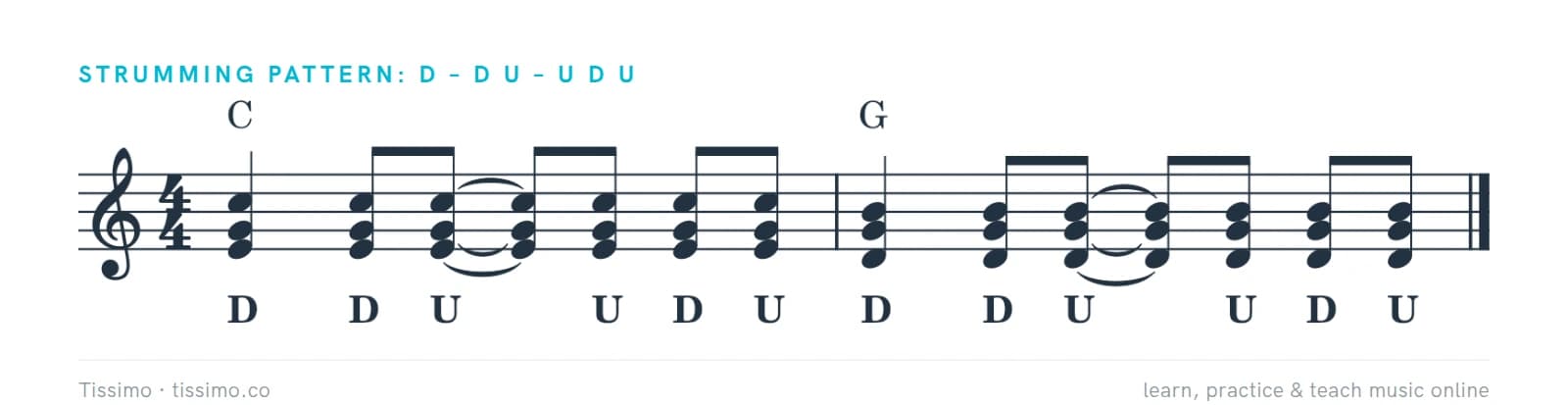
The pattern in the example, D – D U – U D U, is one of the most common in folk and pop. Count "1, 2 and, 3 and, 4 and":
- Strum down on 1 and on 2, then up on the "and" of 2.
- On 3, move your hand down but miss the strings.
- Strum up on the "and" of 3, down on 4 and up on the "and" of 4.
Start on one chord, very slowly, saying "down, down-up, miss-up, down-up" aloud. When it feels automatic, change chords on beat 1. Change on the Count: Open Guitar Chords practices that chord change.
Tips for a better strum
- Relax the wrist. The motion comes mostly from a loose wrist and forearm, not from the shoulder.
- Hold the pick loosely enough that it can give a little against the strings.
- Lean on beats 2 and 4 in pop and rock, the backbeat, for a stronger groove.
- Use dynamics. Strum lightly in a verse and harder in a chorus.
- Mute for rhythm. Resting the side of the strumming hand on the strings near the bridge (palm muting), or relaxing the chord fingers, gives a tight, percussive sound.
Once steady eighth notes feel easy, try sixteenth-note patterns, where the hand moves down and up twice per beat, and the swing or shuffle feel of the blues.
Common questions
What is the most common strumming pattern?
There is no single one, but D – D U – U D U (down, down-up, up-down-up) is among the most widely taught for beginners on guitar and ukulele.
Should I strum with a pick or my fingers?
Either works. A pick gives a brighter, louder strum; the fingers or thumb give a softer, warmer one. Many ukulele players strum with the index finger.