Technique & Performance
Fingerpicking
Fingerpicking is playing a guitar or similar instrument by plucking individual strings with the thumb and fingers, usually in a repeating pattern, so bass notes, chord tones and melody can sound together.
Instead of sweeping across the strings with a pick, a fingerpicker gives each finger its own strings. The thumb usually plays bass notes on the lower strings, while the fingers pluck the higher strings for chord tones and melody. The result can sound like several instruments at once: a bass line, an accompaniment and sometimes a tune on top. Folk, classical, country and blues guitarists all fingerpick, and fingerstyle is a common name for the whole approach.
The finger names: p, i, m, a
Guitar music names the plucking fingers with letters taken from Spanish:
- p (pulgar): the thumb, usually for the bass strings
- i (índice): the index finger
- m (medio): the middle finger
- a (anular): the ring finger
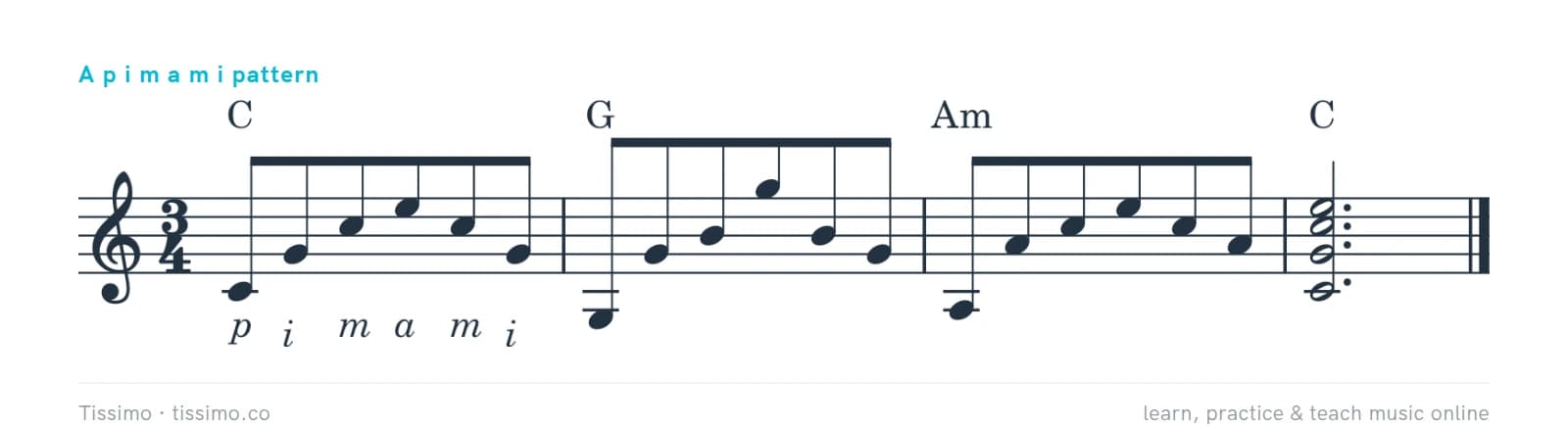
The little finger is rarely used. A beginner's pattern often puts p on the bass string of the chord, i on the third string, m on the second and a on the first: one finger per string.
Common patterns
- Arpeggio patterns such as p i m a m i, which roll up and back down through the chord, as in the example. In 3/4 it fills a bar with six eighth notes.
- Pinch: the thumb and a finger pluck at the same moment, often on beat 1, to mark the start of the bar.
- Alternating bass: the thumb moves between two bass strings on every beat while the fingers play syncopated notes above. The style is often called Travis picking, after the country guitarist Merle Travis.
How to practice
- Learn the plucking pattern on open strings first, without a chord, until it runs by itself.
- Say the letters aloud as you play: "p – i – m – a – m – i".
- Add the chord, then practice changing chords on beat 1 without stopping the pattern.
- Keep the thumb steady. In most patterns the thumb is the timekeeper; if it stays even, the rest follows.
- Keep the hand quiet. Rest your fingers near their strings, pluck with a small movement from the knuckle, and let each finger follow through toward your palm.
Alternate the Plucks, Not the Beats and Which Finger Plucks Next? give you right-hand exercises, and One Guitar Phrase, Two Notations shows how the same notes look in tablature.
Common questions
What do p, i, m and a mean in guitar music?
They name the plucking fingers, from Spanish: p is the thumb (pulgar), i the index finger (índice), m the middle finger (medio) and a the ring finger (anular).
Is fingerpicking harder than strumming?
It asks for more independence between the fingers, so it usually takes longer to feel natural. A slow, simple pattern on open strings makes a good start.
Practice it: free worksheets
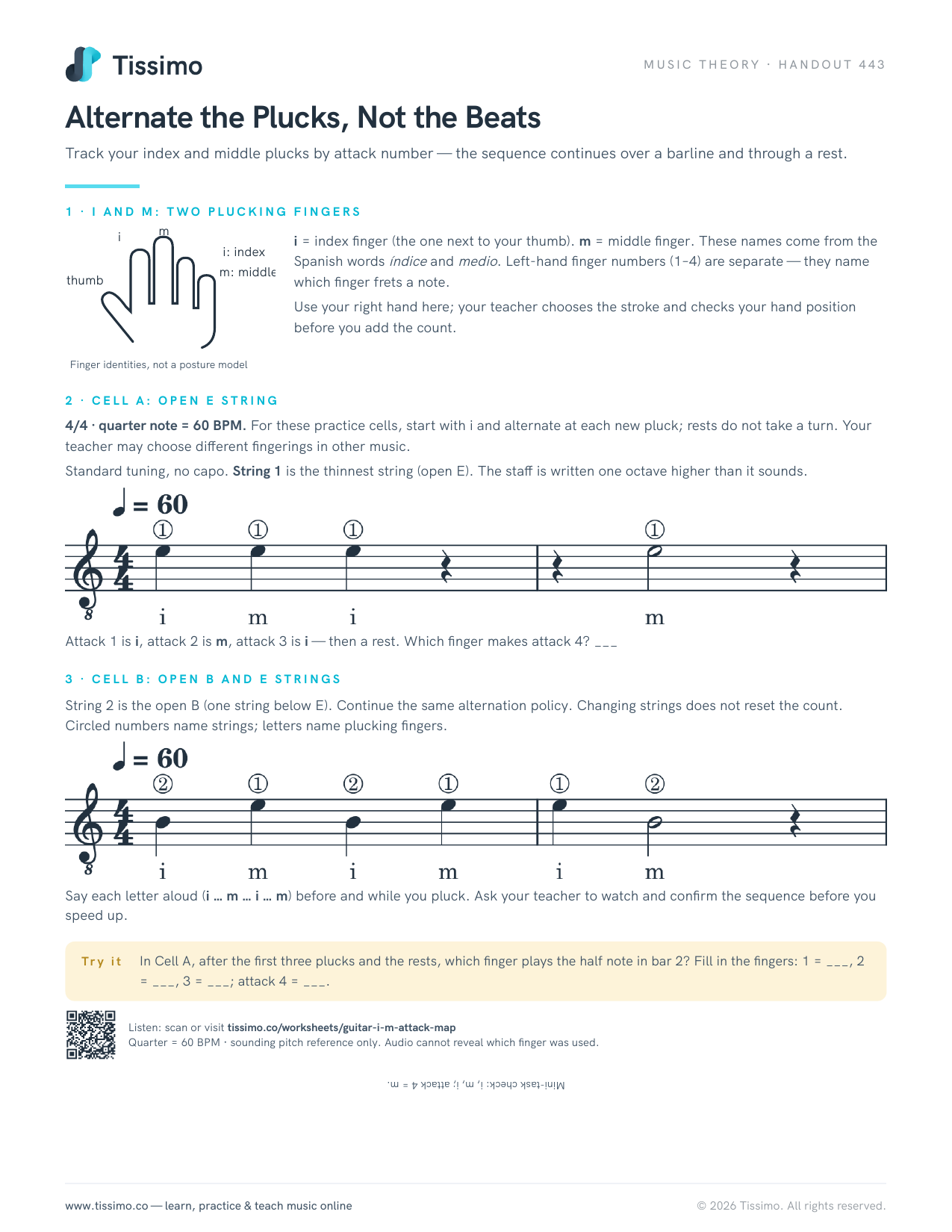 Alternate the Plucks, Not the BeatsTrack your index and middle plucks by attack number — the sequence continues over a barline and through a rest.
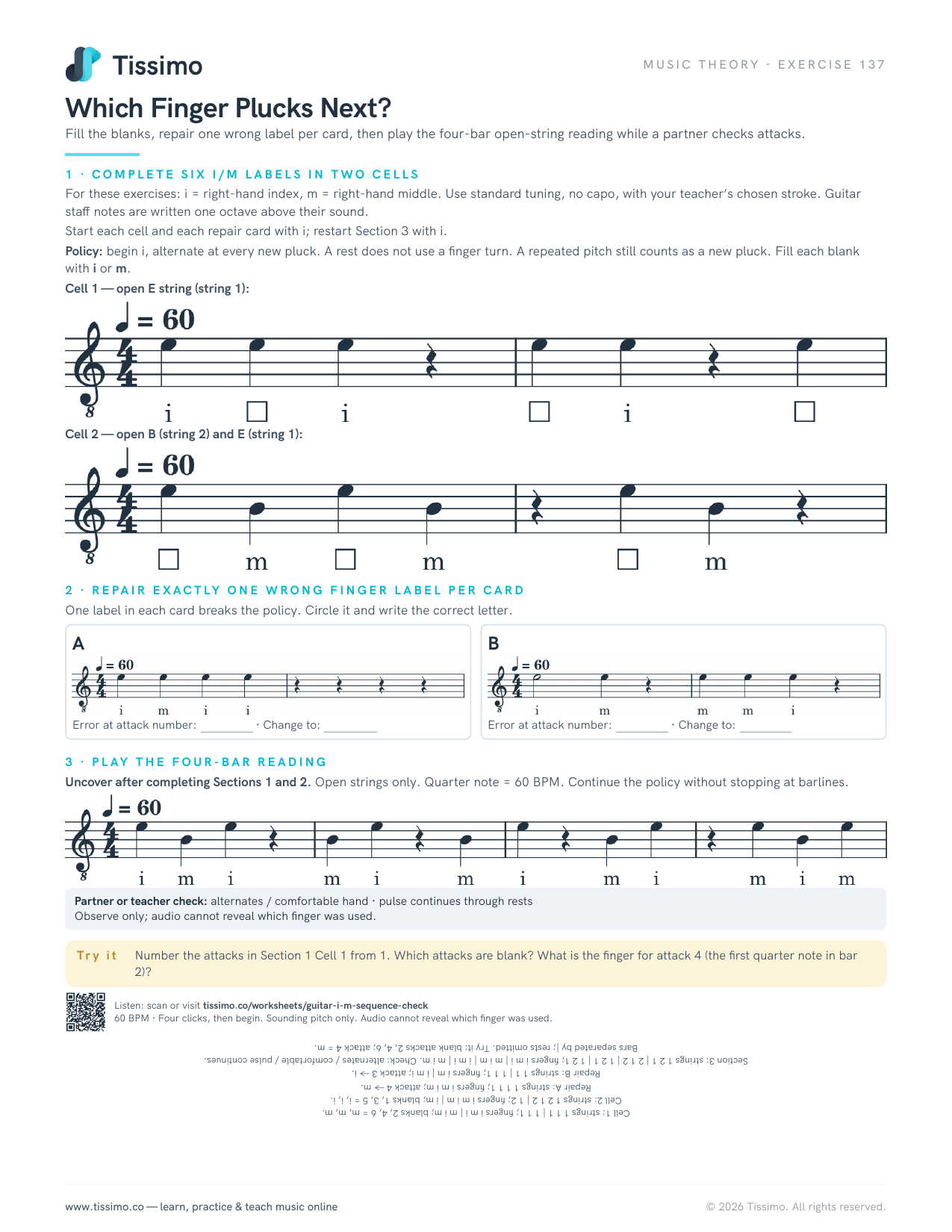 Which Finger Plucks Next?Fill the blanks, repair one wrong label per card, then play the four-bar open-string reading while a partner checks attacks.
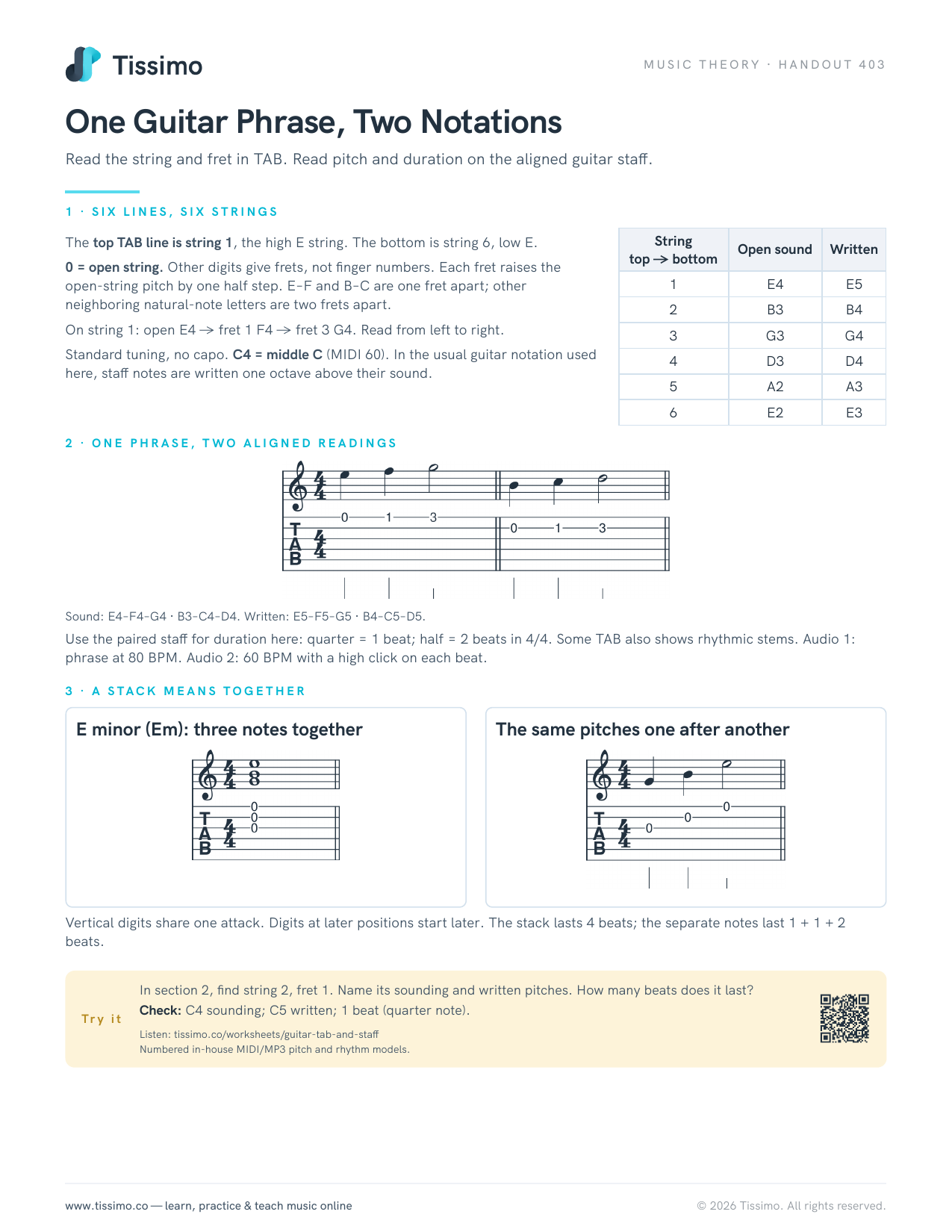 One Guitar Phrase, Two NotationsRead the string and fret in TAB. Read pitch and duration on the aligned guitar staff.