Instruments & Voices
Harpsichord
The harpsichord is a keyboard instrument whose strings are plucked when you press the keys. It was the main keyboard instrument of the Baroque era, and it cannot play louder or softer through touch alone.
The harpsichord looks like a small grand piano, but it works differently: when you press a key, a small plectrum plucks the string instead of a hammer striking it. The result is a bright, crisp, ringing sound. It was the main keyboard instrument of Europe from the Renaissance through the Baroque era, and composers such as Bach, Handel, Domenico Scarlatti and François Couperin wrote much of their keyboard music for it.
How a harpsichord makes its sound
At the far end of each key stands a thin wooden strip called a jack. A small plectrum sticks out sideways from it, traditionally cut from a bird's feather quill and today often made of plastic. Press the key and the jack rises, so the plectrum plucks the string. Release it and the jack falls back. The plectrum sits on a hinged tongue, so it slips past the string without plucking again, and a piece of felt on top of the jack (the damper) stops the sound.
A pluck is about the same strength however you press, so the harpsichord cannot make a crescendo or play one note louder than another by touch. Players create accents and shape with timing instead: articulation, tiny delays, rolled chords, ornaments and the number of notes they play at once.
Stops, choirs and two keyboards
Larger harpsichords have more than one set of strings, each called a choir. Stops (levers or knobs) choose which choirs sound. An 8-foot choir sounds at written pitch; a 4-foot choir sounds an octave higher. Many larger instruments have two keyboards (manuals) that control different choirs, and a coupler that lets one keyboard play both. A buff stop (sometimes called a harp stop) presses felt or leather pads against the strings for a muted, pizzicato-like sound. Choosing the stops for a piece is called registration.
Range
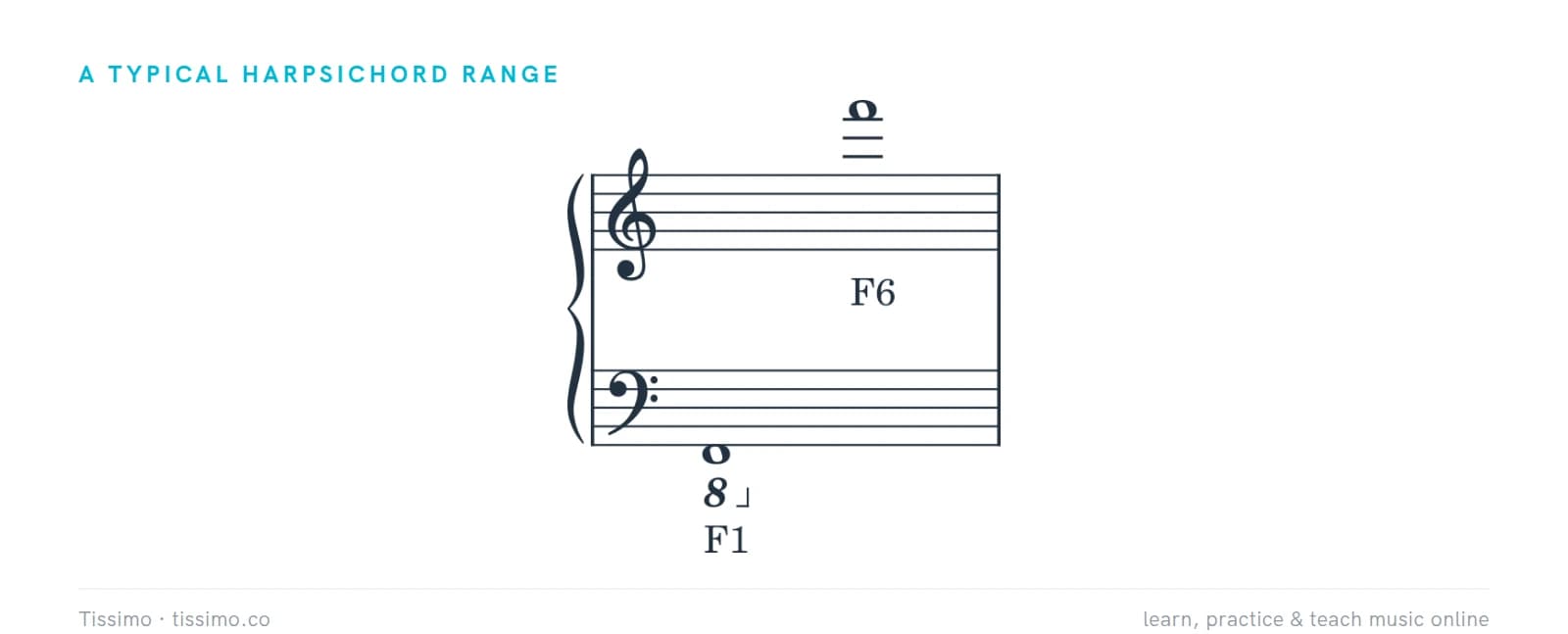
Harpsichords were made in many sizes, so the range varies. Many large eighteenth-century instruments, and modern copies of them, span about five octaves, roughly F1 to F6. Smaller and older instruments often have fewer keys.
How harpsichord music is written
Harpsichord music uses the same grand staff as piano music and does not transpose. In Baroque ensembles the harpsichord often played the basso continuo: the player read only a bass line with figured bass numbers and improvised the chords above it.
Harpsichord, piano and clavichord
The piano strikes its strings with hammers, so it responds to how hard you play. The clavichord, another early keyboard, presses small brass blades (tangents) against the strings: it is very quiet, but it does respond to touch. The harpsichord plucks, so it is louder than a clavichord but has no touch dynamics.
Tips for pianists trying the harpsichord
- Use a light touch and press only as far as you need to pluck. Pushing harder does not make it louder.
- Release keys precisely. Letting go stops the note, so the small silences between notes become a big part of your expression.
- There is no sustain pedal: legato has to come from your fingers.
Common questions
What is the difference between a harpsichord and a piano?
A harpsichord plucks its strings; a piano strikes them with felt hammers. Because of that, the piano plays louder when you press faster and the harpsichord does not. Harpsichords are also lighter in sound and construction, and most have a smaller range.
Can a harpsichord play loud and soft?
Not through touch. Harpsichordists change the volume and color by adding or removing sets of strings with the stops, by playing more or fewer notes at once, and by shaping the timing and length of notes.
Practice it: free worksheets
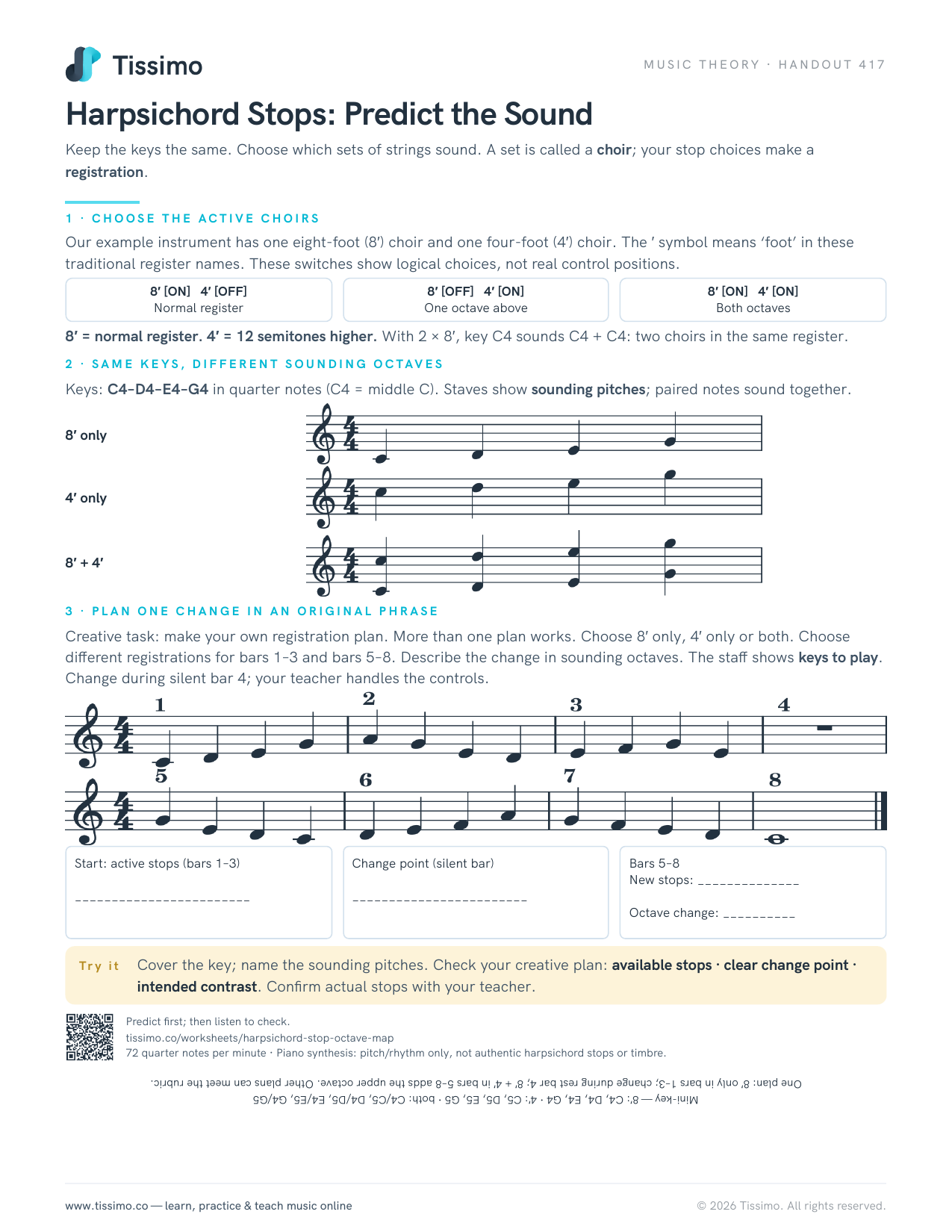 Harpsichord Stops: Predict the SoundKeep the keys the same. Choose which sets of strings sound. A set is called a choir; your stop choices make a registration.
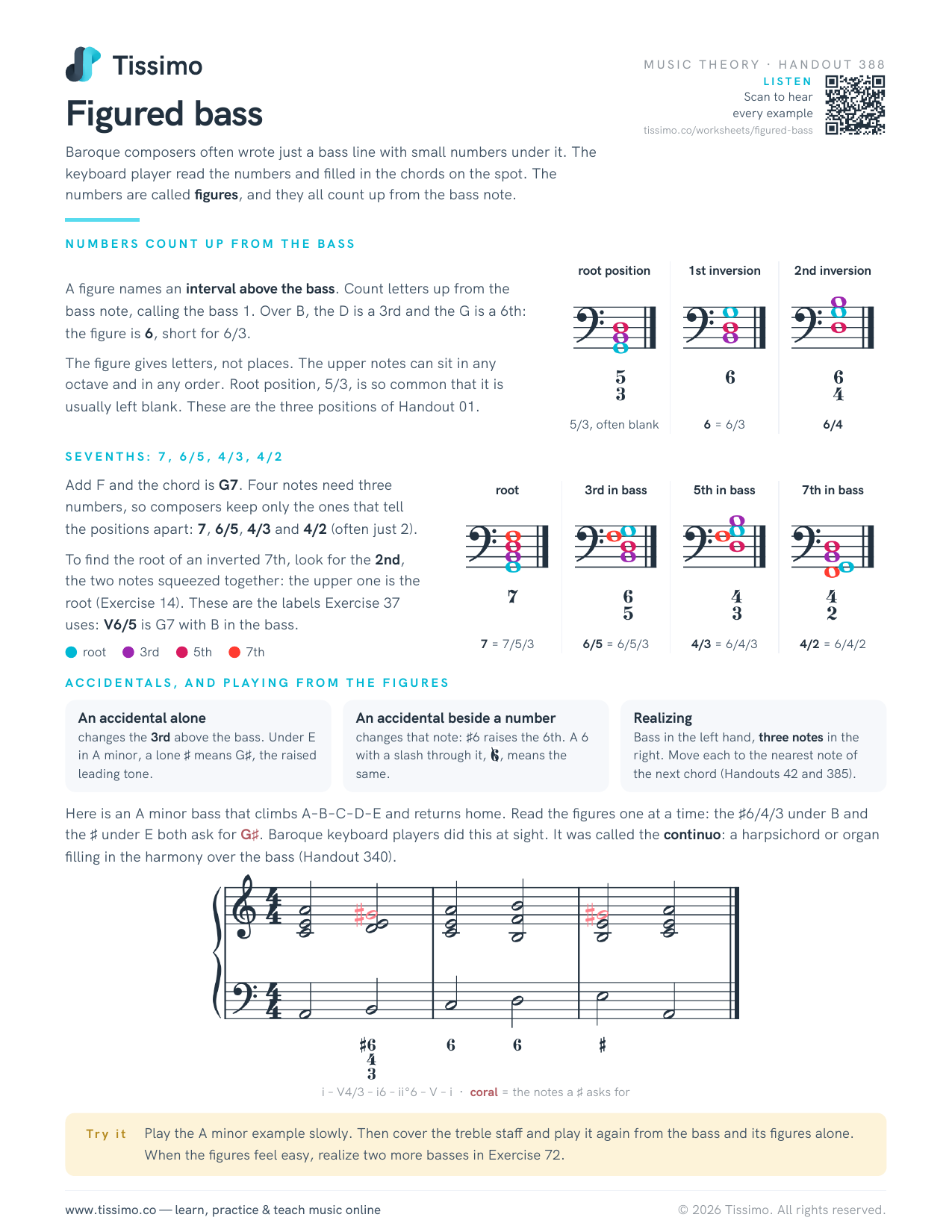 Figured bassBaroque composers often wrote just a bass line with small numbers under it. The keyboard player read the numbers and filled in the chords on the spot. The numbers are called figures, and they all count up from the bass note.
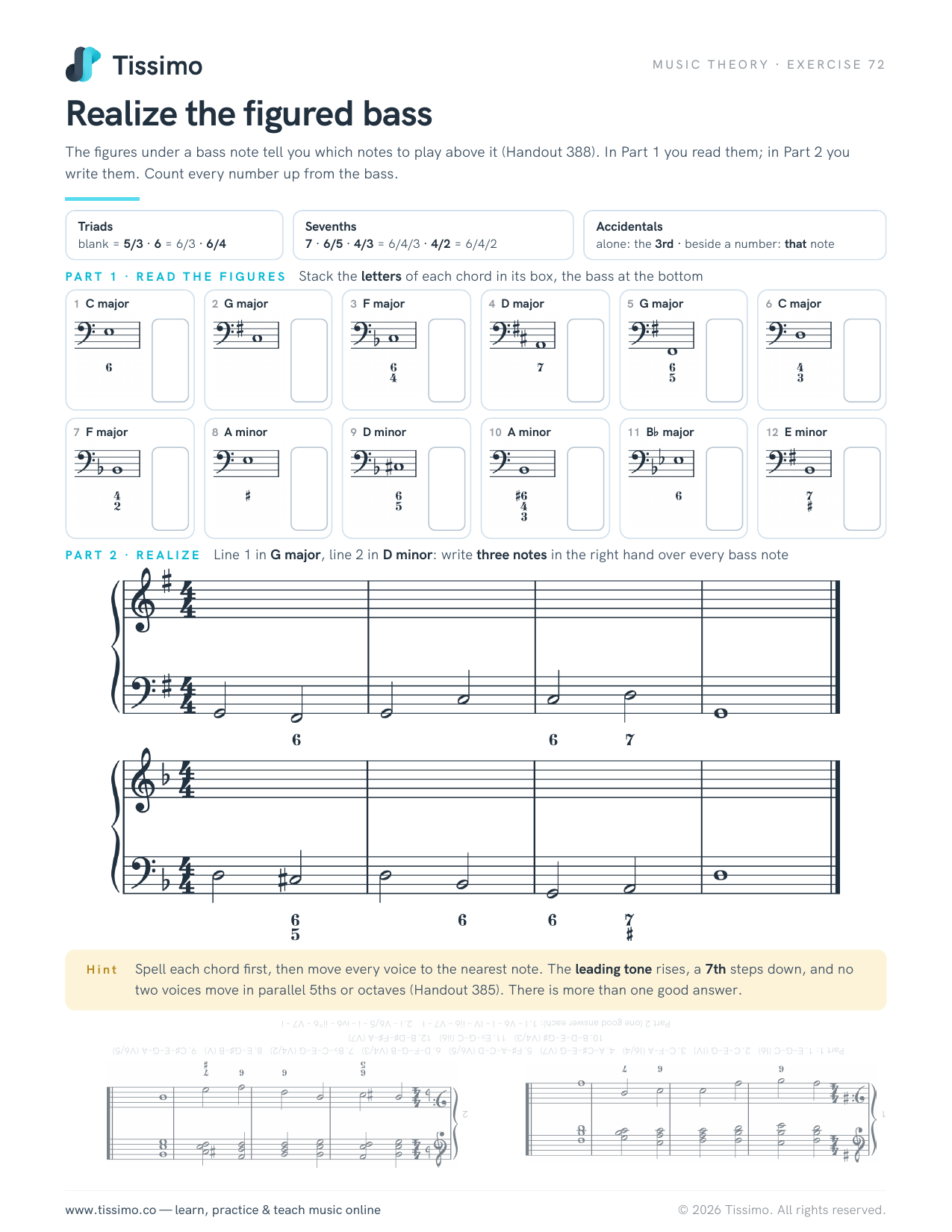 Realize the figured bassThe figures under a bass note tell you which notes to play above it (Handout 388). In Part 1 you read them; in Part 2 you write them. Count every number up from the bass.
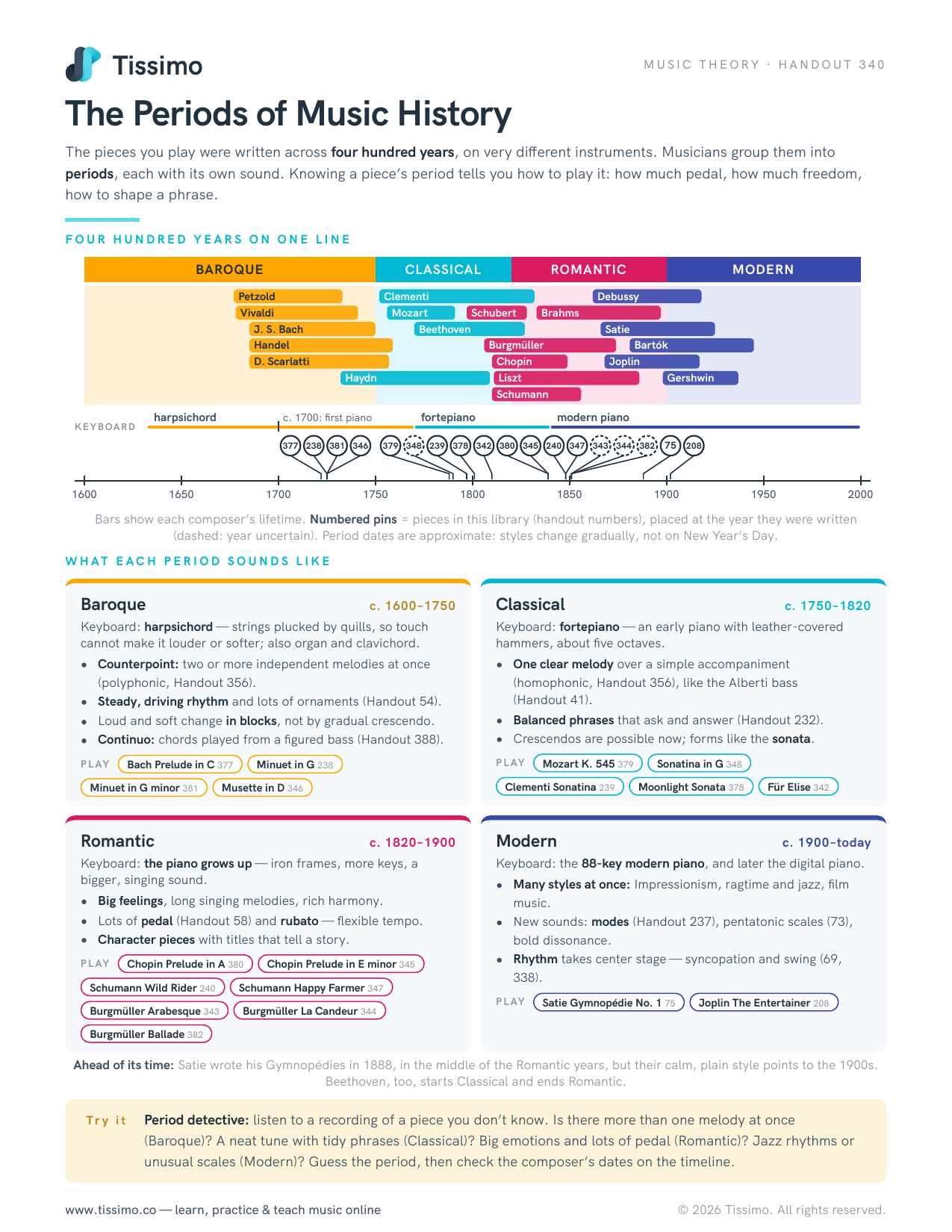 The Periods of Music HistoryThe pieces you play were written across four hundred years, on very different instruments. Musicians group them into periods, each with its own sound. Knowing a piece’s period tells you how to play it: how much pedal, how much freedom, how to shape a phrase.
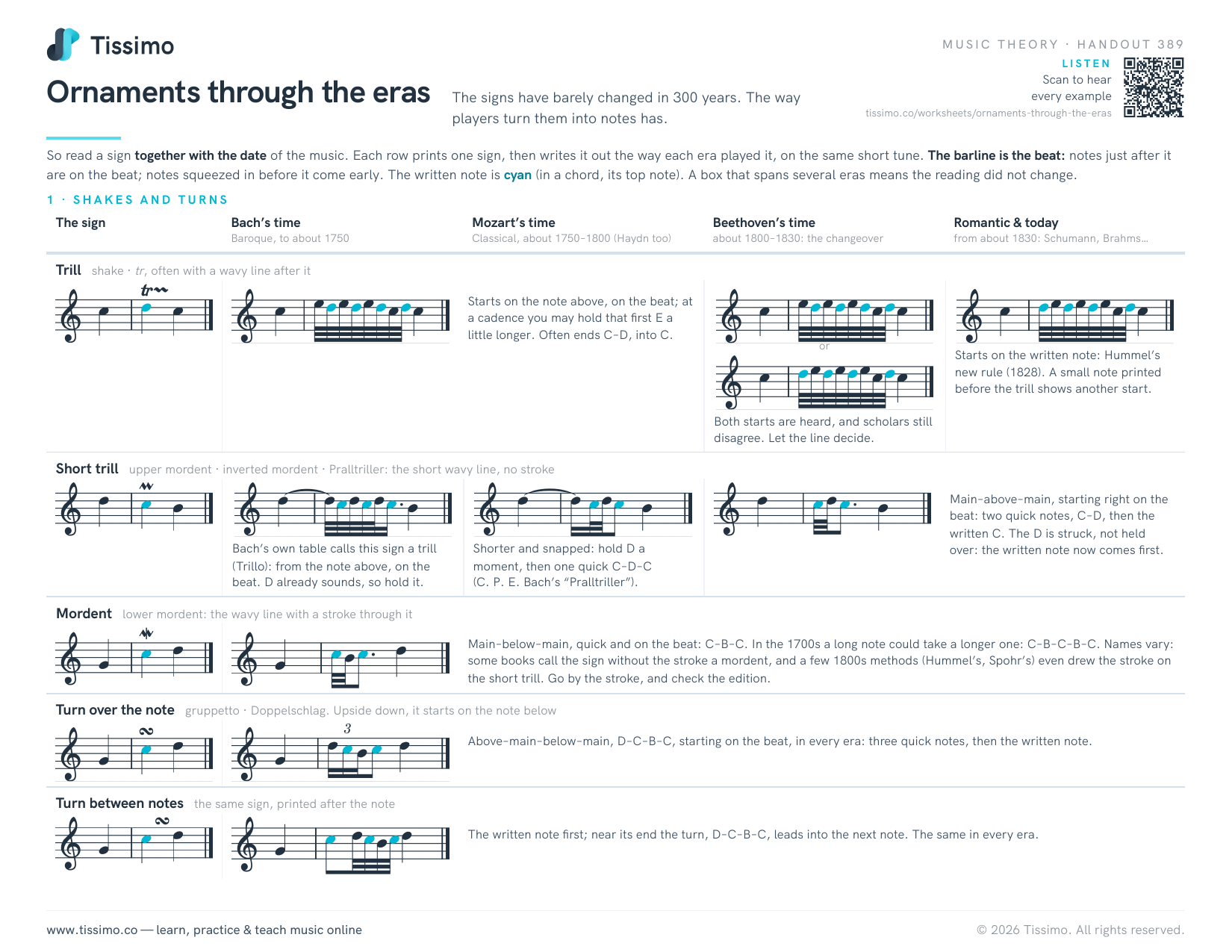 Ornaments through the erasThe signs have barely changed in 300 years. The way players turn them into notes has.