Notation & Symbols
Treble Clef
The treble clef, or G clef, is the curling symbol that marks the second staff line as the G above middle C. It is used for higher music: the right hand of the piano, violin, flute and high voices.
The treble clef is the clef most people meet first. It is a G clef: the symbol grew out of a decorated letter G, and its spiral wraps around the second line of the staff (counting from the bottom). That line becomes the G above middle C, G4, and every other line and space takes its name from there.
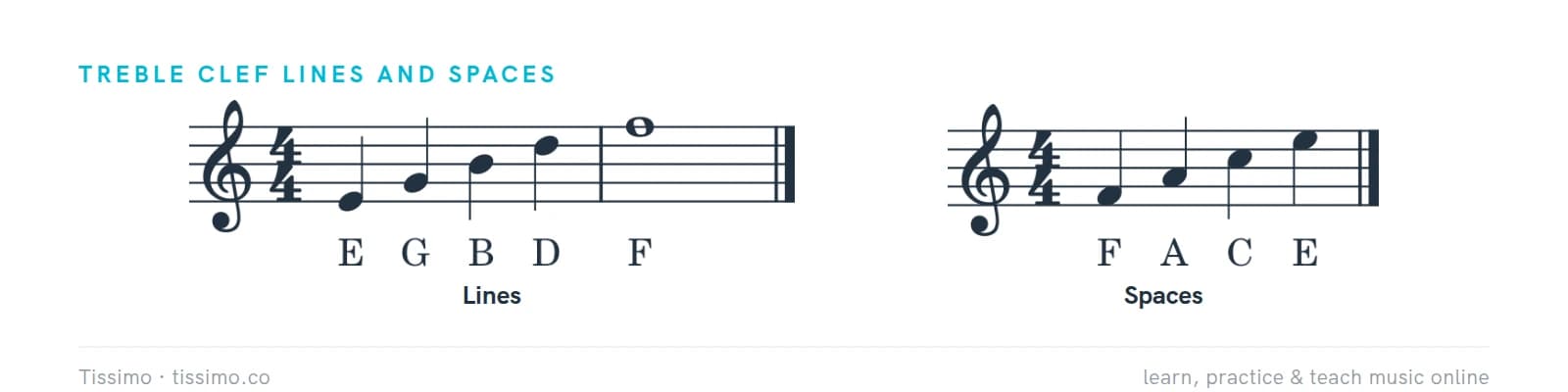
Lines and spaces of the treble staff
- Lines, bottom to top: E, G, B, D, F. Many students remember them as "Every Good Boy Does Fine".
- Spaces, bottom to top: F, A, C, E, which spell the word FACE.
The rhymes are a good start, but aim to recognize a few landmark notes by sight: the G line where the clef curls, the B on the middle line and the F on the top line. From a landmark, move one letter per line or space. Just below the staff, D hangs from the bottom line and middle C sits on the first ledger line. Just above it, G sits on top of the top line and A on the first ledger line.
Who reads treble clef?
Treble clef is used for higher instruments and voices: the right hand of the piano, the violin, flute, oboe, clarinet, saxophone and trumpet, and soprano and alto singers. Some of these, such as the clarinet and trumpet, are transposing instruments, so the written note is not the sounding pitch, but the clef still names the written note in the usual way.
Two common variants sound an octave lower than written. Tenor parts in choral music often use a treble clef with a small 8 below it, and guitar music is written in treble clef an octave higher than it sounds, which keeps it on the staff.
A common mix-up
If you also read bass clef, check the clef at the start of every line before reading. The same position names a different note in each clef: the bottom line is E in treble clef but G in bass clef.
Practice with The Staff & the Treble Clef, Name the notes: treble clef and the Note reading chart.
Common questions
Why is the treble clef called the G clef?
It developed from a letter G, and its curl marks the line where the G above middle C is written: the second line from the bottom.
What notes are on the treble clef lines and spaces?
The lines, from the bottom, are E, G, B, D and F. The spaces are F, A, C and E.
Practice it: free worksheets
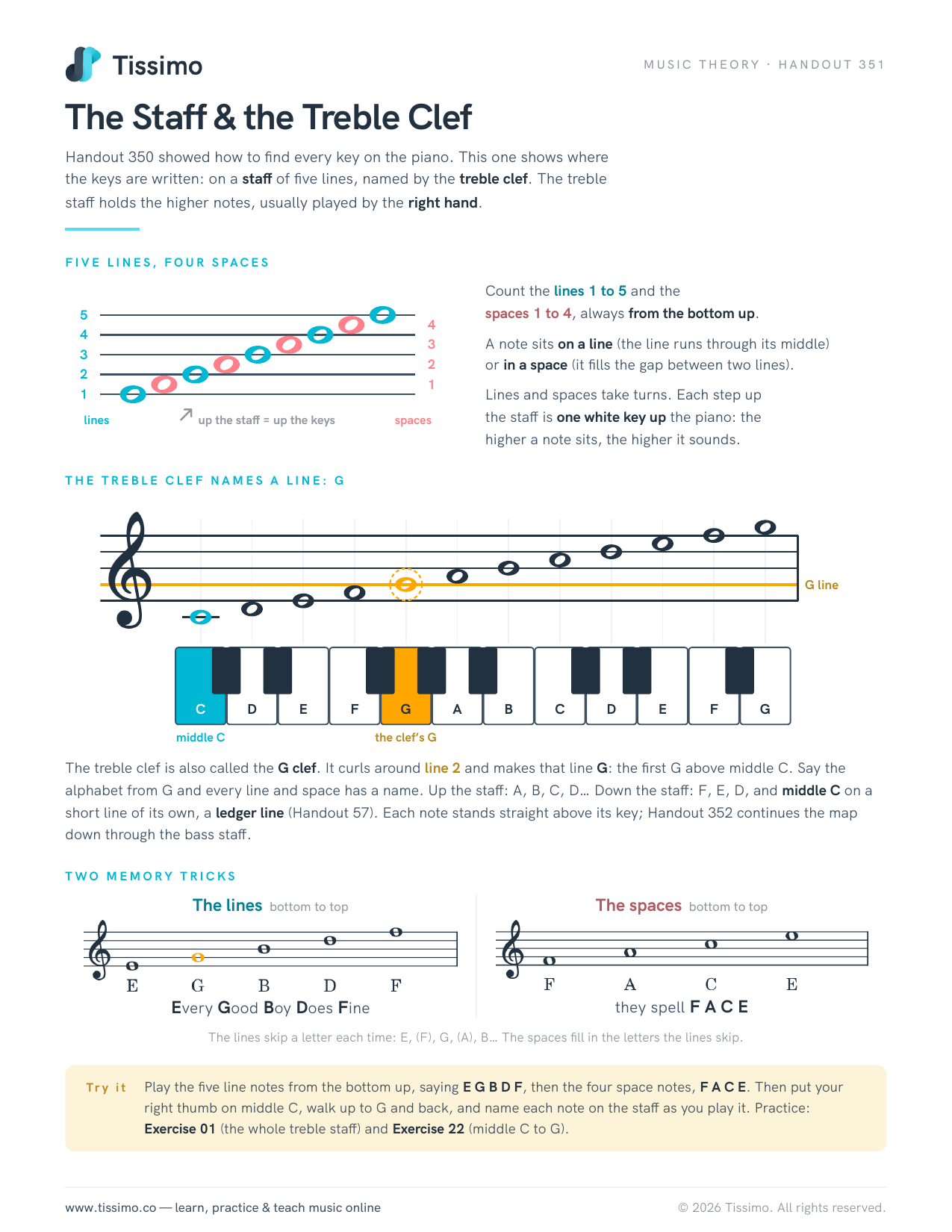 The Staff & the Treble ClefHandout 350 showed how to find every key on the piano. This one shows where the keys are written: on a staff of five lines, named by the treble clef. The treble staff holds the higher notes, usually played by the right hand.
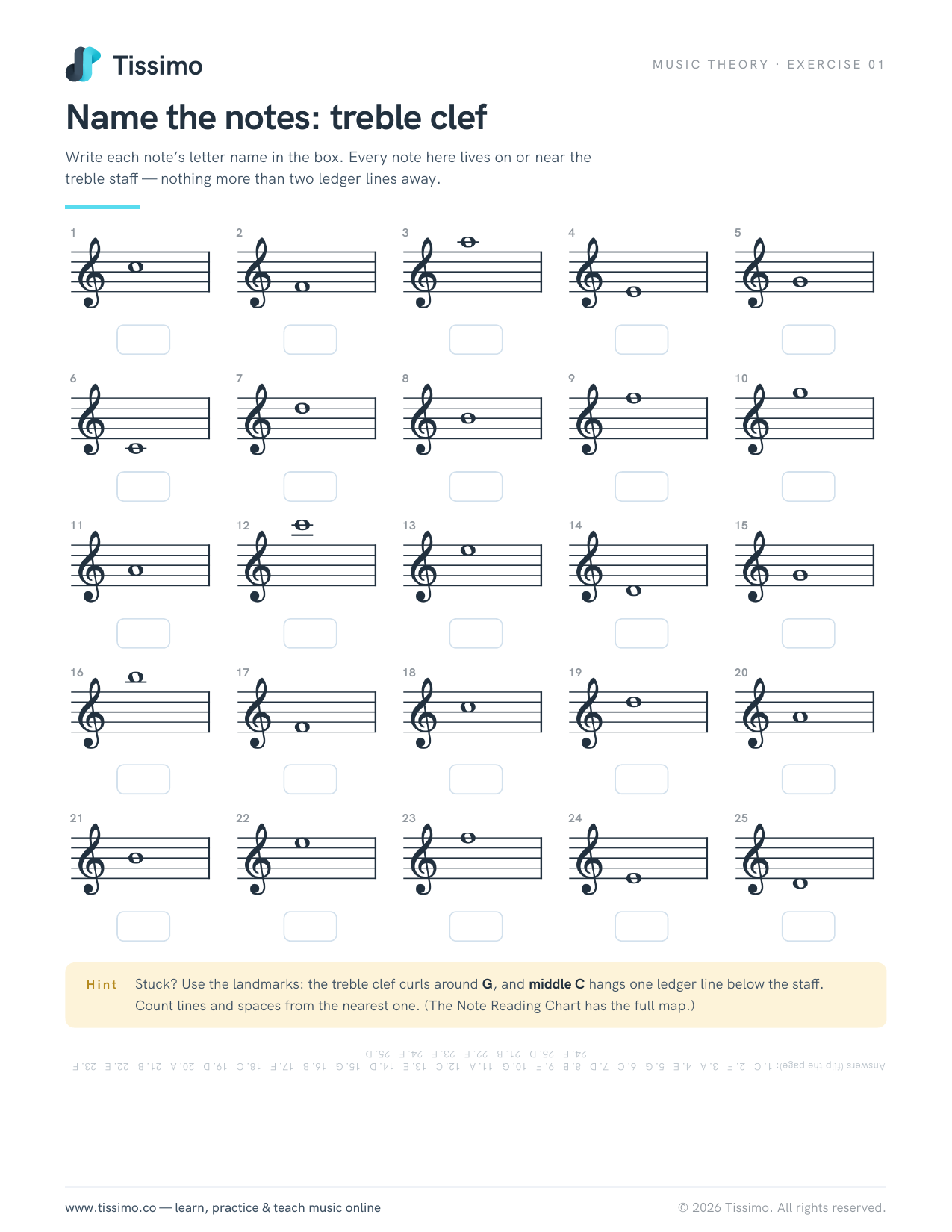 Name the notes: treble clefWrite each note’s letter name in the box. Every note here lives on or near the treble staff — nothing more than two ledger lines away.
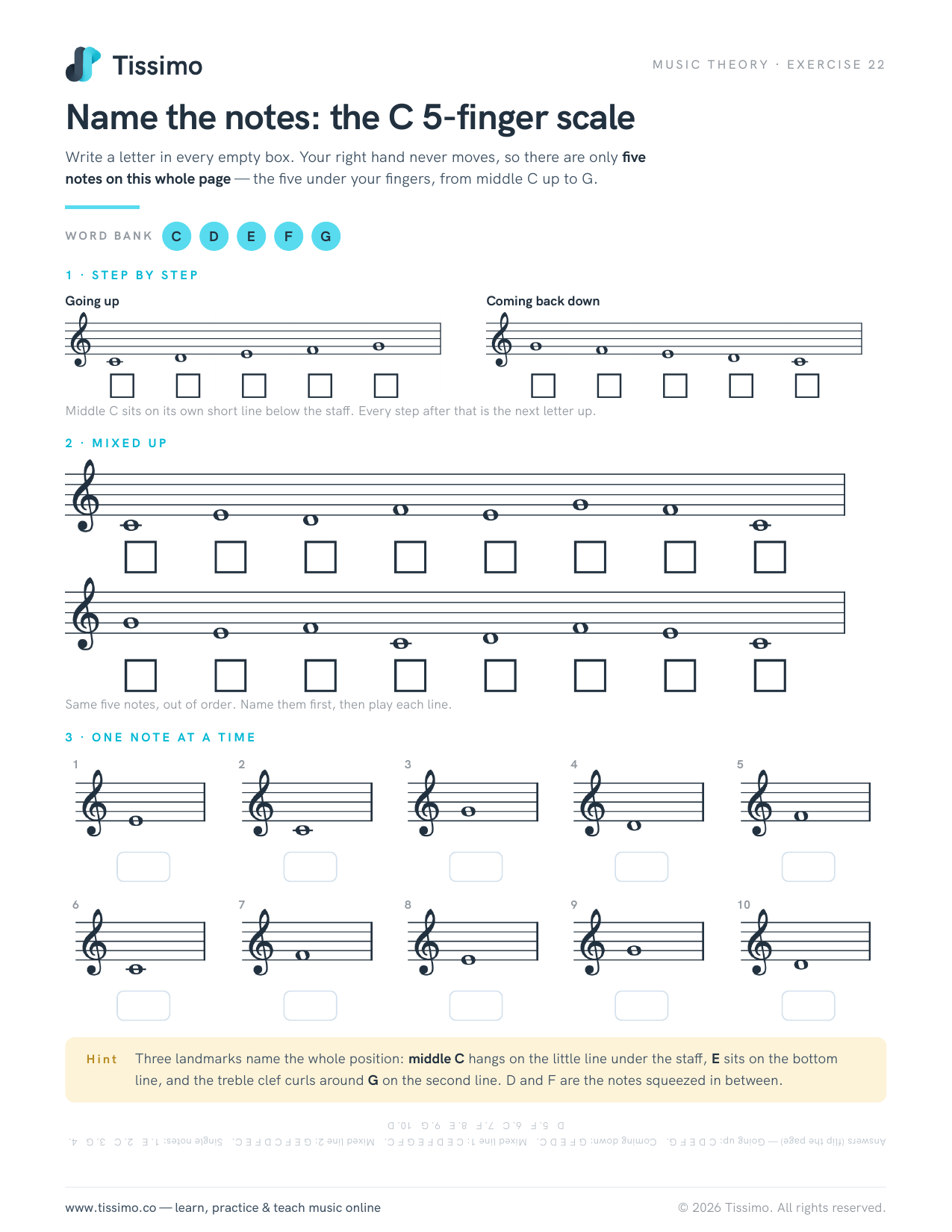 Name the notes: the C 5-finger scaleWrite a letter in every empty box. Your right hand never moves, so there are only five notes on this whole page — the five under your fingers, from middle C up to G.
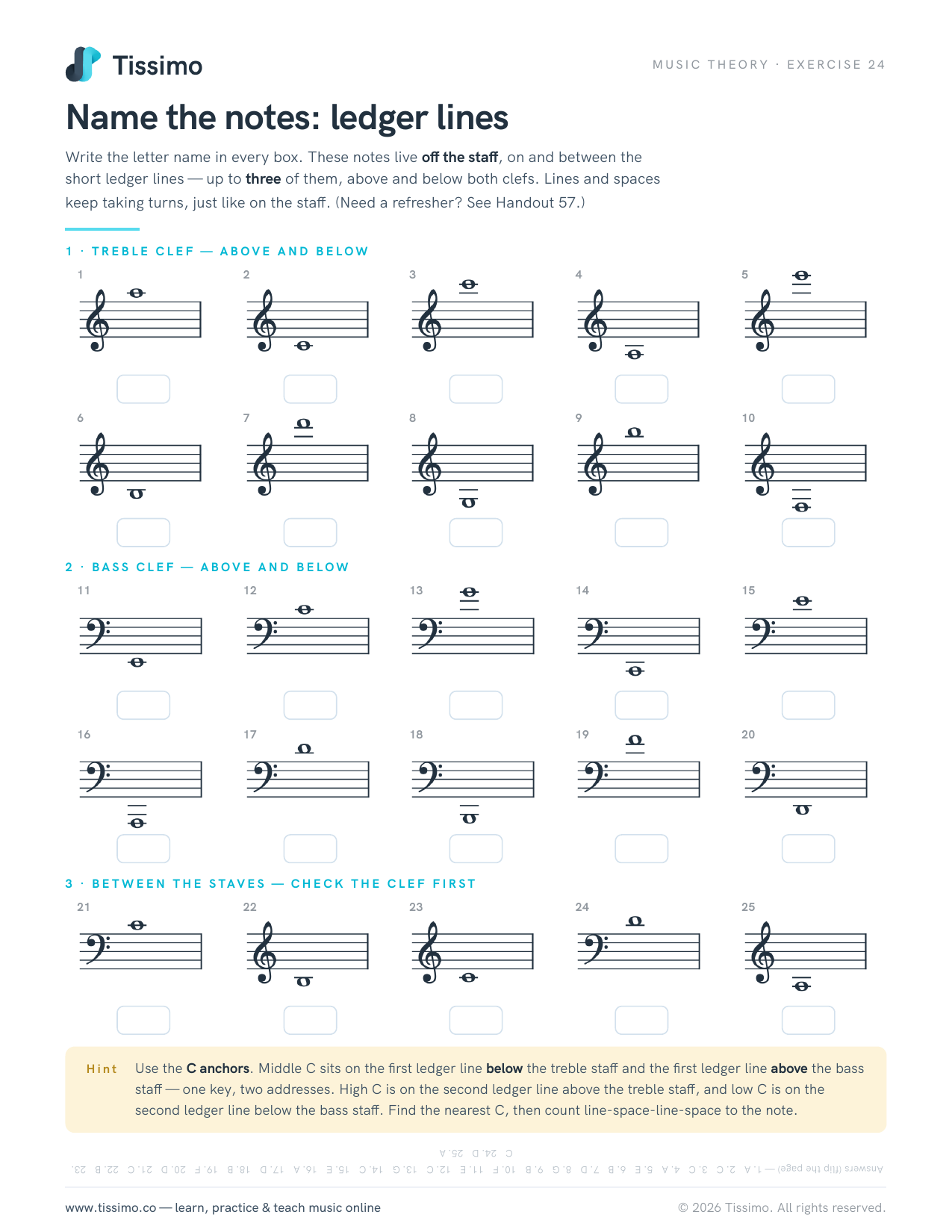 Name the notes: ledger linesWrite the letter name in every box. These notes live off the staff, on and between the short ledger lines — up to three of them, above and below both clefs. Lines and spaces keep taking turns, just like on the staff. (Need a refresher? See Handout 57.)
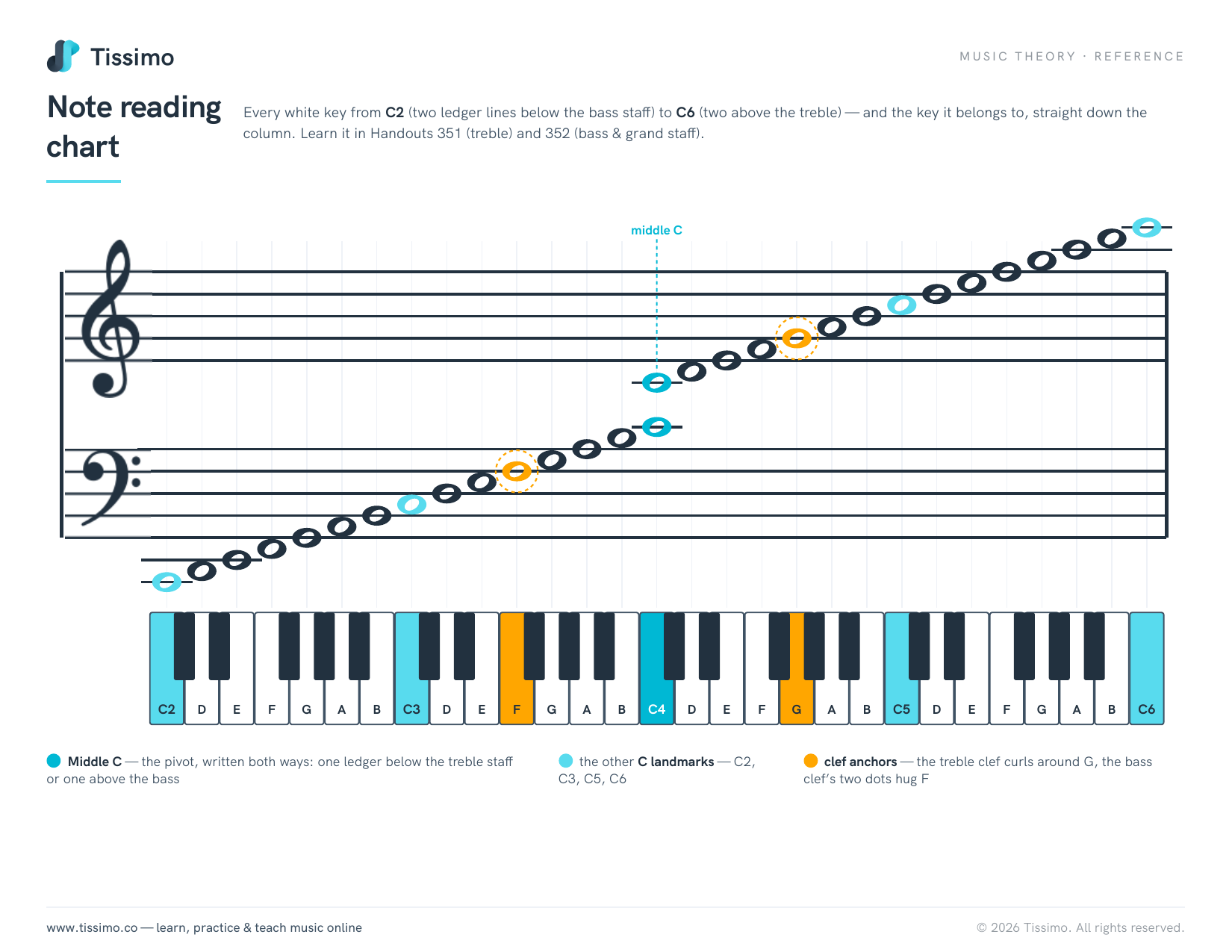 Note reading chartEvery white key from C2 (two ledger lines below the bass staff) to C6 (two above the treble) — and the key it belongs to, straight down the column. Learn it in Handouts 351 (treble) and 352 (bass & grand staff).
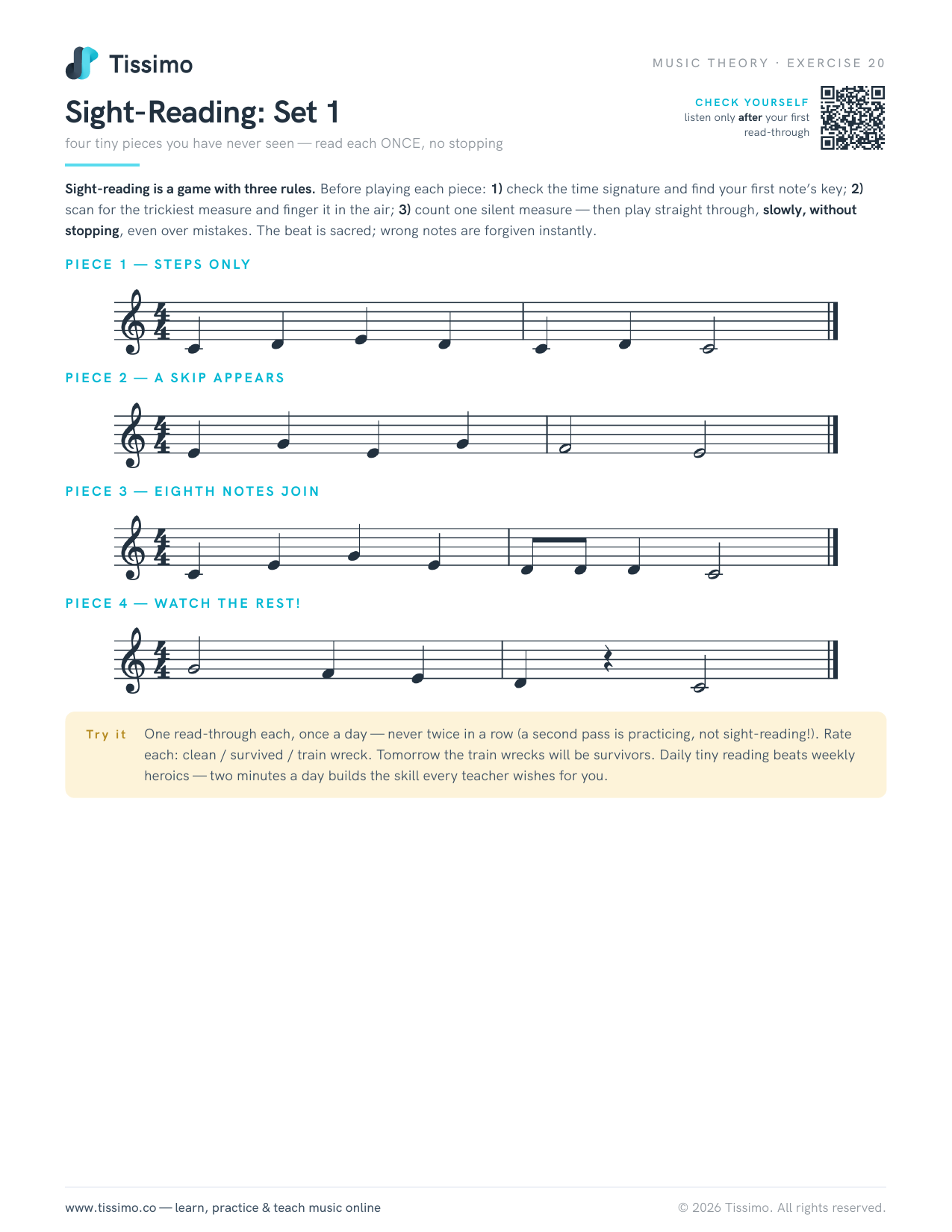 Sight-Reading: Set 1four tiny pieces you have never seen — read each ONCE, no stopping