Instruments & Voices
Flute
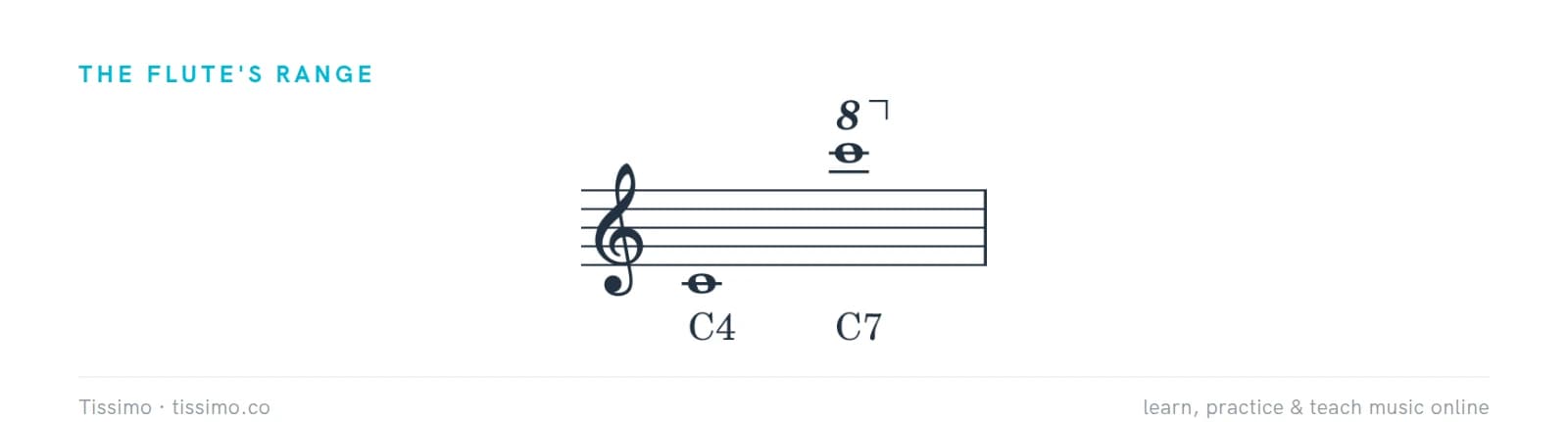
The flute is a woodwind instrument without a reed: you blow across a hole in its side, and the air stream splitting on the hole's edge makes the sound. The concert flute plays from C4 to about C7 and reads treble clef.
The flute is the highest regular member of the woodwind family after the piccolo, and one of the oldest kinds of instrument there is. You hold it sideways, to the right, and blow across a hole in the head joint, much as you might blow across the top of a bottle. It is made of metal today, usually silver-plated or solid silver, but it is still a woodwind, because the family is defined by how the sound starts, not by what the instrument is made of.
How a flute makes its sound
Your lips shape a narrow stream of air that strikes the far edge of the embouchure hole. The stream flips back and forth across the edge, and that sets the air inside the tube vibrating. There is no reed. Keys open and close tone holes along the tube, changing the length of the vibrating air column. To play higher, you send a faster, more focused air stream, which makes the same fingering jump up an octave (G4 and G5, for example, share the same keys). The modern key system is based on the design of Theobald Boehm in the mid-1800s.
Range and registers
The concert flute in C plays from C4, middle C, to about C7, and higher for advanced players. Many flutes have a longer foot joint that adds a low B3. The low register is soft and breathy, the middle register sweet and flexible, and the top register bright and penetrating.
How flute music is written
Flute music is written in treble clef at the pitch it sounds, so the flute is not a transposing instrument. High notes often sit on several ledger lines above the staff, and flutists get used to reading them. Its relatives do transpose: the piccolo sounds an octave higher than written, the alto flute a perfect fourth lower and the bass flute an octave lower.
Its role
In the orchestra the flutes often play the top line of the woodwinds and many famous solos. The flute is also a central instrument in concert bands, wind quintets, solo and chamber music, and it appears in jazz, Latin music and pop. Players use articulation such as single, double and triple tonguing for fast passages.
Tips for beginners
- Start with the head joint alone: aim for a clear, steady tone before adding the rest of the flute.
- Keep your lips relaxed and the opening small. Most early problems come from too much air, not too little.
- Rest the flute on the base of your left index finger and your right thumb, so your fingers are free to move.
- Breathe low and slow; long tones every day build a beautiful sound.
Common questions
Why is the flute a woodwind if it is made of metal?
Woodwinds are grouped by how the sound starts: with an air stream on an edge (flutes) or with a reed (clarinets, oboes, saxophones, bassoons). Brass instruments start the sound with the player's buzzing lips. Early flutes were wooden, and the name stuck.
Is the flute a transposing instrument?
No. The concert flute in C sounds as written. The piccolo sounds an octave higher than written, and the alto flute sounds a perfect fourth lower.
Practice it: free worksheets
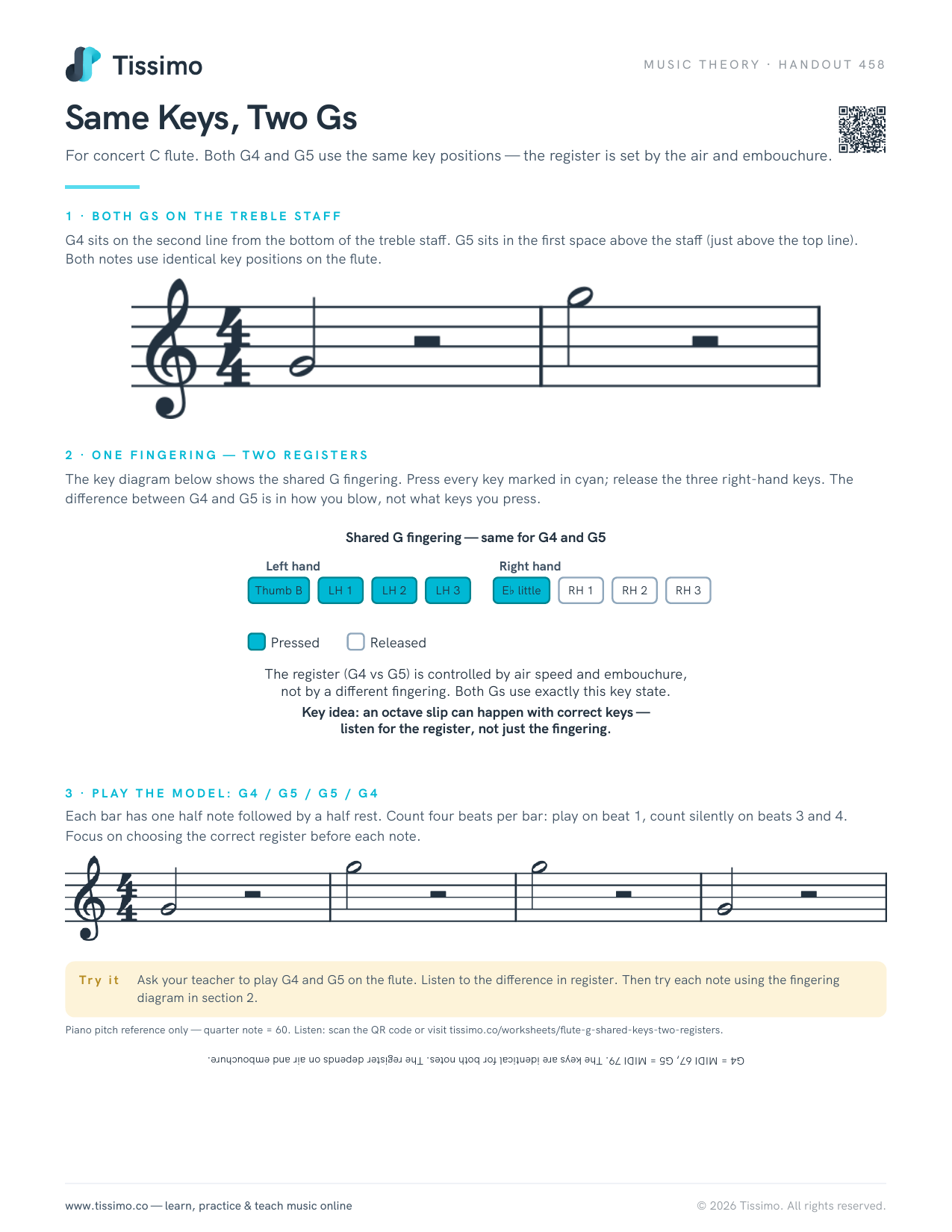 Same Keys, Two GsFor concert C flute. Both G4 and G5 use the same key positions — the register is set by the air and embouchure.
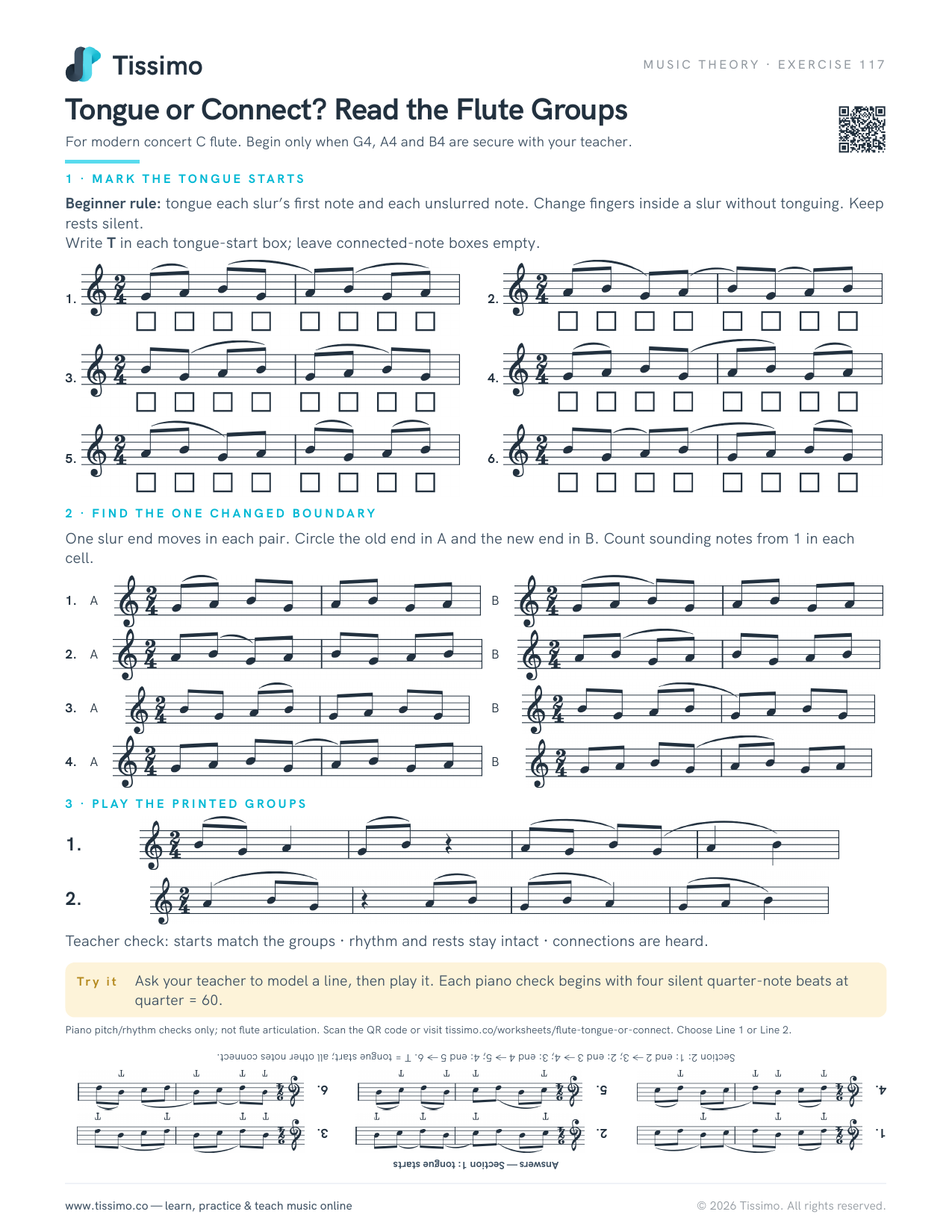 Tongue or Connect? Read the Flute GroupsFor modern concert C flute. Begin only when G4, A4 and B4 are secure with your teacher.
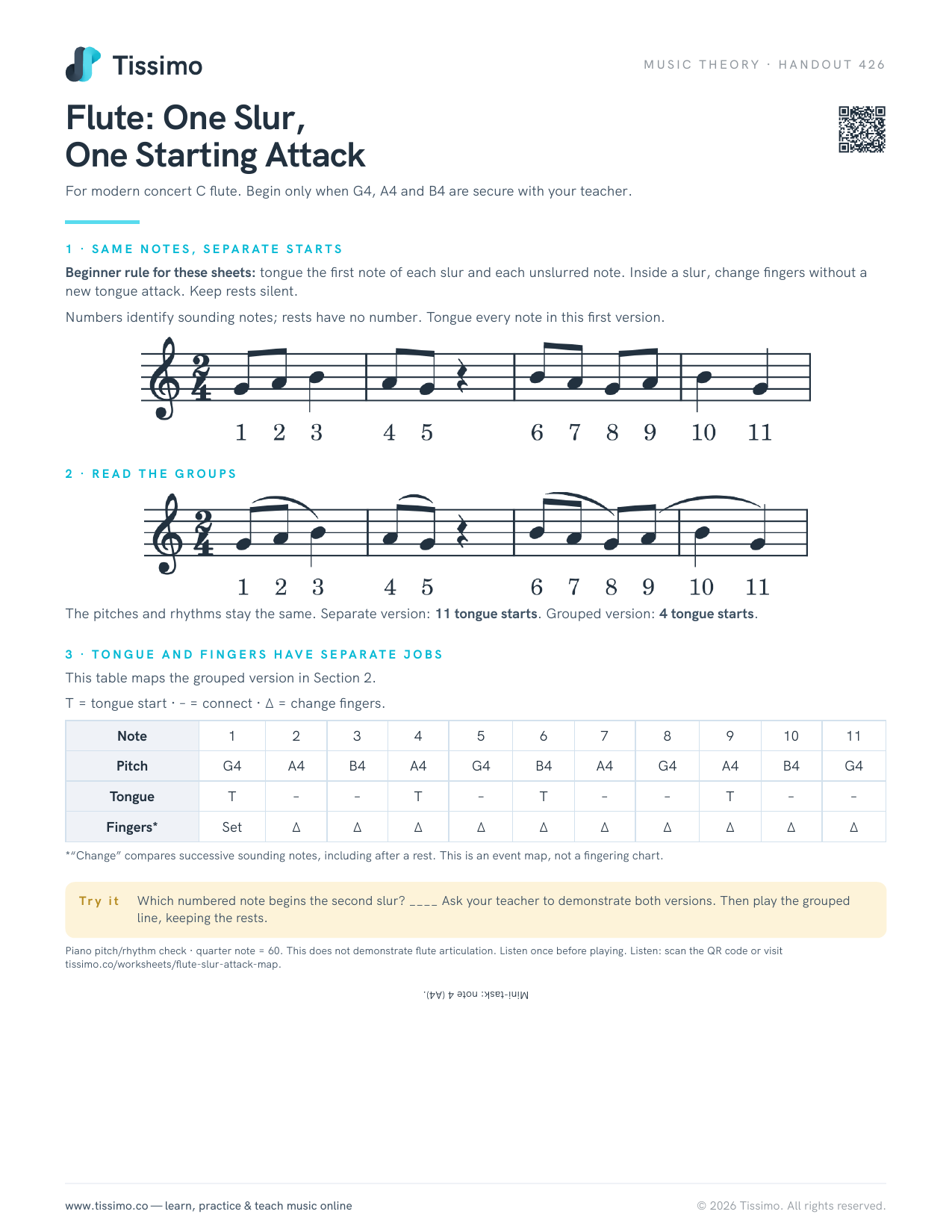 Flute: One Slur, One Starting AttackFor modern concert C flute. Begin only when G4, A4 and B4 are secure with your teacher.
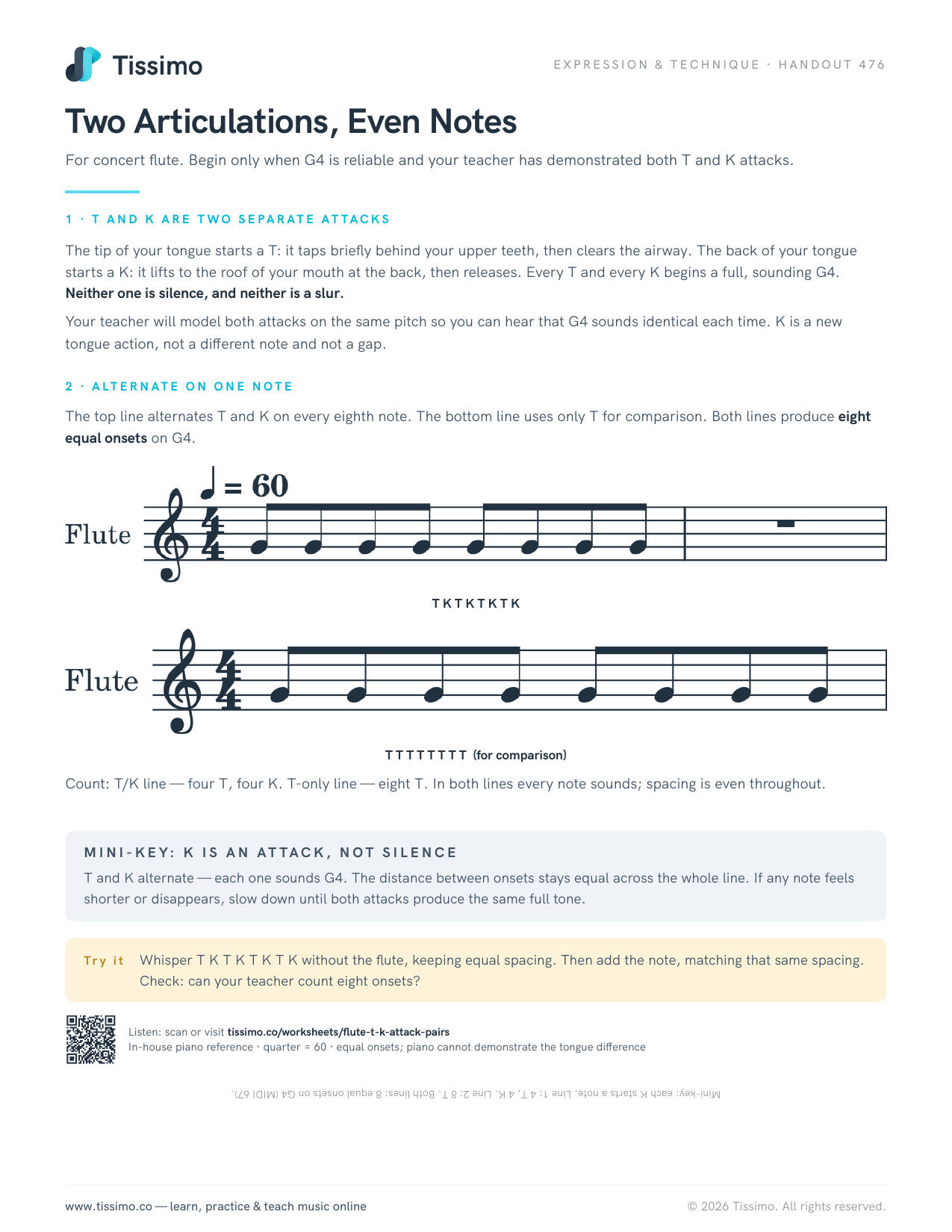 Two Articulations, Even NotesFor concert flute. Begin only when G4 is reliable and your teacher has demonstrated both T and K attacks.
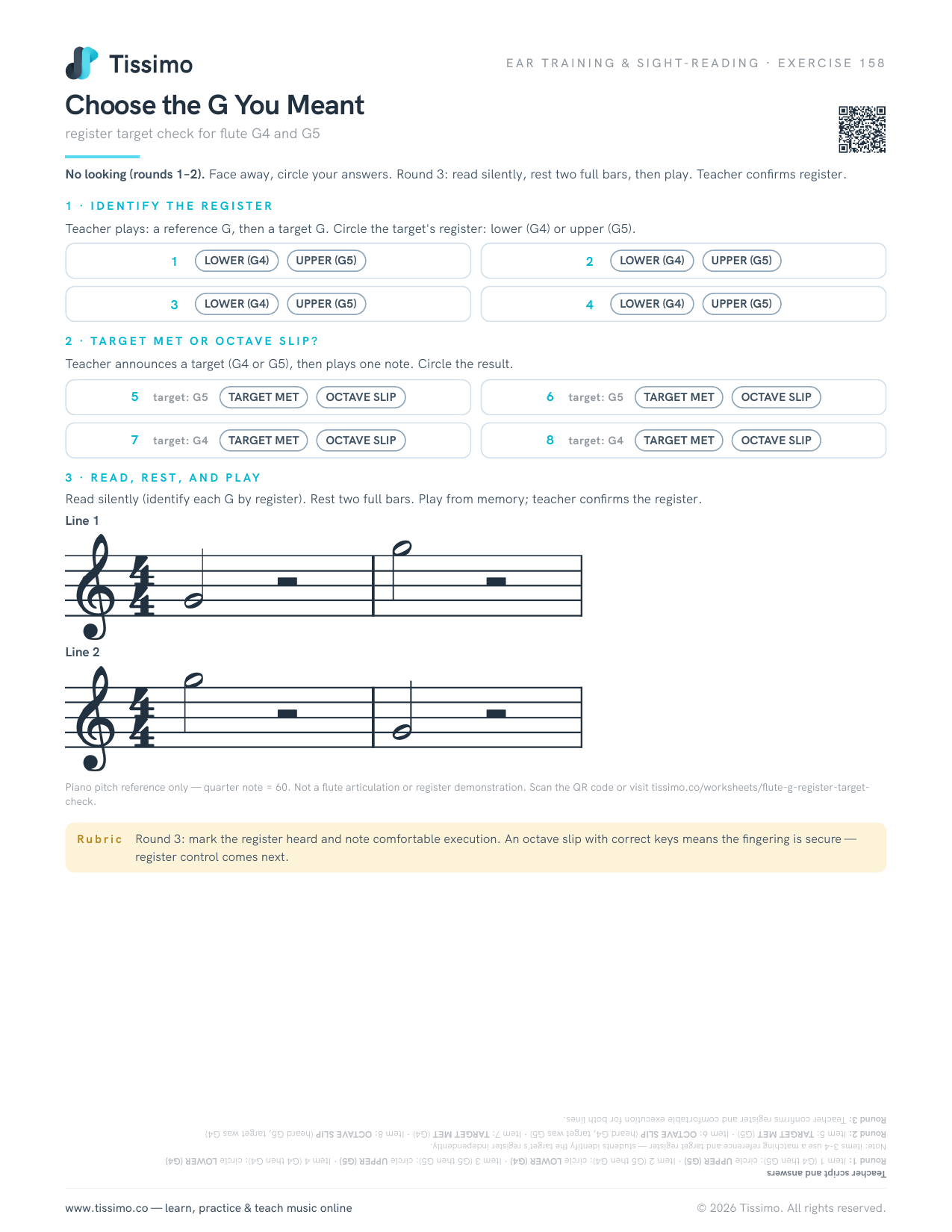 Choose the G You Meantregister target check for flute G4 and G5
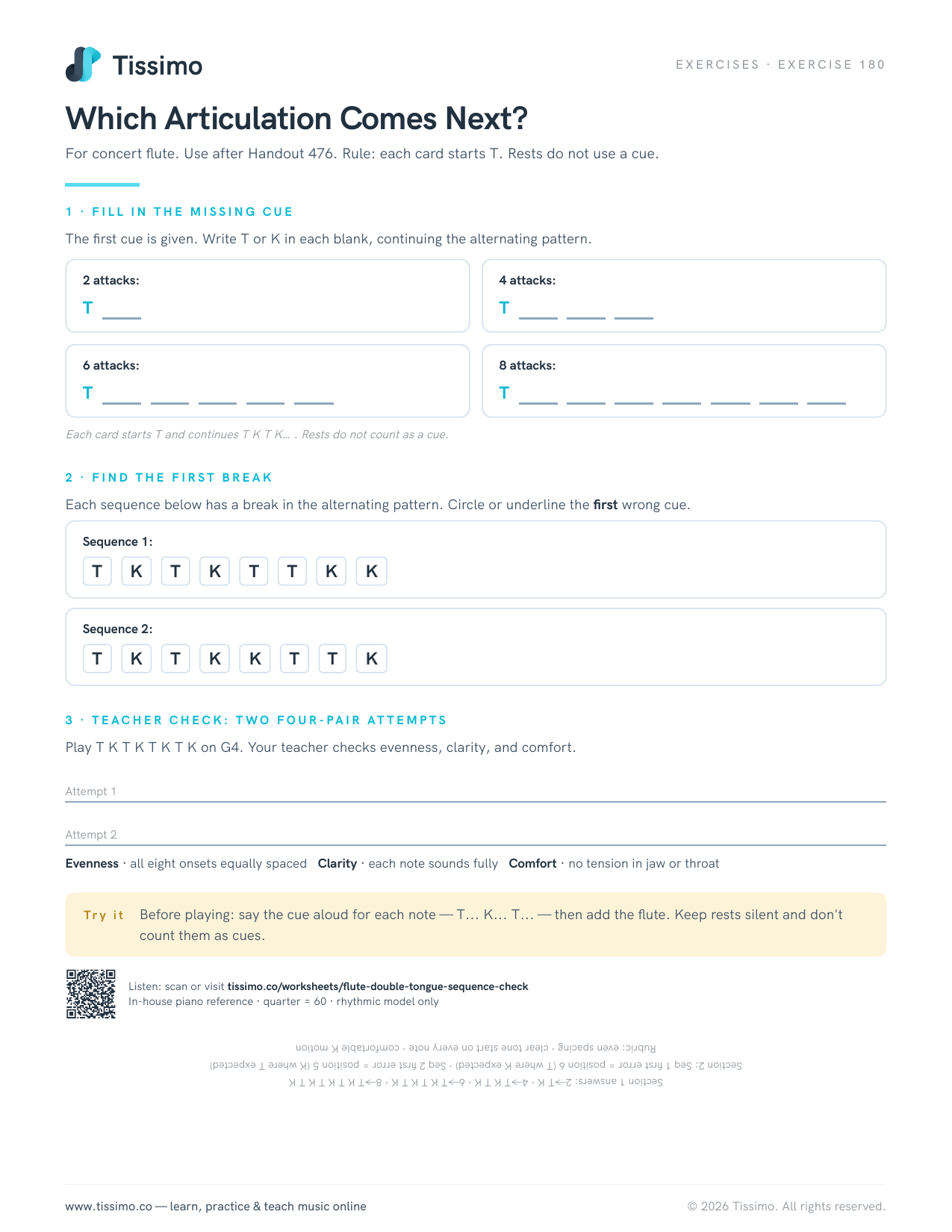 Which Articulation Comes Next?For concert flute. Use after Handout 476. Rule: each card starts T. Rests do not use a cue.