Instruments & Voices
Orchestra
Pronounced OR-kuh-struh
An orchestra is a large instrumental ensemble of strings, woodwinds, brass and percussion, usually led by a conductor. A full symphony orchestra can have around a hundred players; a chamber orchestra is smaller.
An orchestra is a large group of instrumentalists playing together, with several players on each string part. A full symphony orchestra for nineteenth- and twentieth-century music often has somewhere around 80 to 100 musicians; a chamber orchestra, suited to earlier music, may have a few dozen. "Philharmonic" and "symphony" in an orchestra's name usually mean the same kind of group.
The four sections
- Strings (string family): first and second violins, violas, cellos and double basses, usually the largest section and the core of the sound.
- Woodwinds (woodwind family): flutes, oboes, clarinets and bassoons, often with piccolo, English horn, bass clarinet or contrabassoon.
- Brass (brass family): French horns, trumpets, trombones and tuba.
- Percussion (percussion family): timpani, plus instruments such as bass drum, snare drum, cymbals, triangle, xylophone and glockenspiel.
Many pieces add a harp, a piano or celesta, or other instruments, and some add choir and solo singers.
The conductor
The conductor stands in front of the orchestra, beats time with a baton or the hands, cues entries and shapes the tempo, dynamics and balance. Most of a conductor's work happens in rehearsal, where they decide how the piece should go. The concertmaster, the leader of the first violins, acts as the players' leader and plays any violin solos.
Seating and score order
Seating varies, but a common plan puts the strings in a fan at the front, the woodwinds in the middle, and the brass and percussion at the back. The conductor's score lists the instruments in a standard order from top to bottom: woodwinds, then brass, then percussion, then harp and keyboards, then strings. Within each section the instruments run roughly from high to low, with one famous exception: the horns are printed above the trumpets.
Tuning
Before a concert the orchestra tunes to an A sounded by the principal oboe. Many orchestras tune to A = 440 Hz (A440), and some prefer a slightly higher pitch.
A short history
The orchestra grew out of the string ensembles of the Baroque era, which were held together by a harpsichord or organ playing the continuo. The Classical orchestra settled on strings plus pairs of flutes, oboes, bassoons, horns and trumpets, with timpani and, increasingly, clarinets. In the Romantic era composers added trombones, tuba, more horns, harp and a growing percussion section, reaching the large orchestra heard in symphonies and film music today.
Joining an orchestra
School, youth and community orchestras welcome players of string, wind, brass and percussion instruments. You will need to read music fluently in your clef, count rests reliably (see multimeasure rest) and watch the conductor while you play.
Common questions
What is the difference between a symphony orchestra and a philharmonic orchestra?
Usually nothing: both are full-size orchestras, and the name is a matter of history and tradition. Some cities have both, simply as two separate orchestras.
Why does the orchestra tune to the oboe?
It is a long tradition. The usual explanations are that the oboe's clear, penetrating tone is easy to hear across the stage and that its pitch is fairly stable, so it makes a good reference for everyone else.
How many musicians are in an orchestra?
It depends on the music. A chamber orchestra may have around 20 to 40 players; a full symphony orchestra for large Romantic or modern works often has 80 to 100 or more.
Practice it: free worksheets
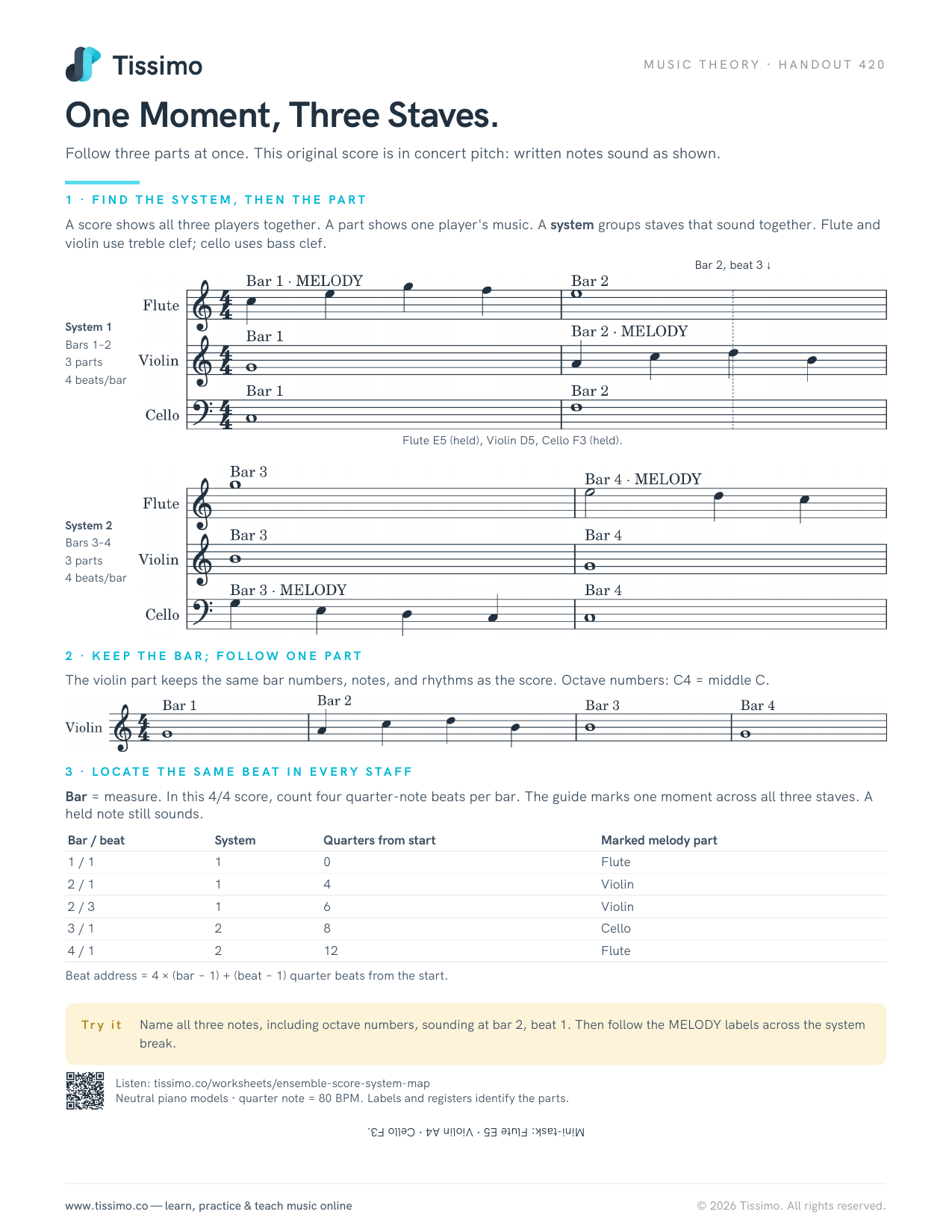 One Moment, Three Staves.Follow three parts at once. This original score is in concert pitch: written notes sound as shown.
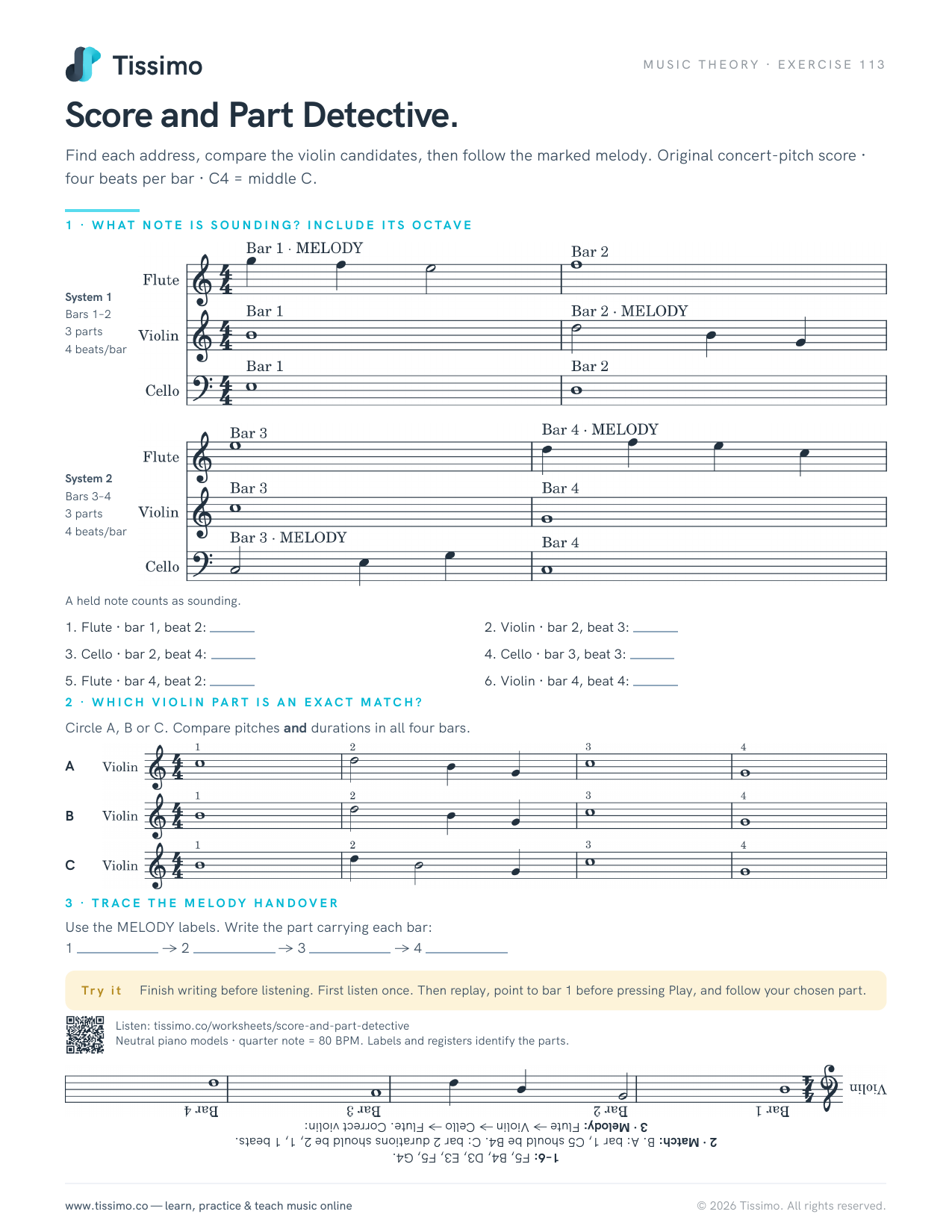 Score and Part Detective.Find each address, compare the violin candidates, then follow the marked melody. Original concert-pitch score · four beats per bar · C4 = middle C.
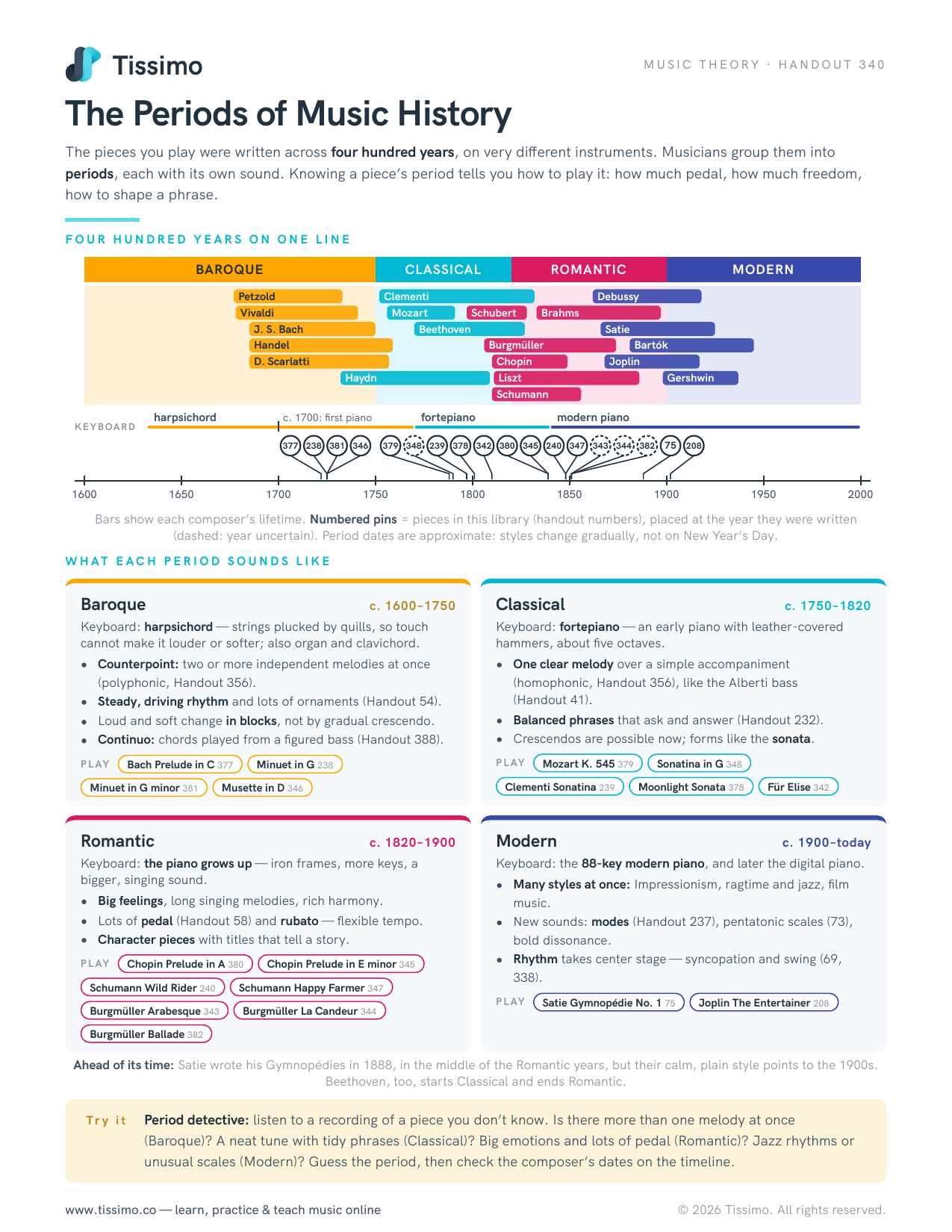 The Periods of Music HistoryThe pieces you play were written across four hundred years, on very different instruments. Musicians group them into periods, each with its own sound. Knowing a piece’s period tells you how to play it: how much pedal, how much freedom, how to shape a phrase.