Technique & Performance
Chamber Music
Chamber music is music for a small group of instrumentalists, usually with one player on each part and no conductor, such as a string quartet, a piano trio or a wind quintet.
The name comes from the Italian camera, a room or chamber: this was music associated with private rooms in homes and palaces rather than with churches or theaters. Today it is performed in concert halls too, but it keeps the character of a conversation among a few players.
Typical groups
- String quartet: two violins, viola and cello (see string quartet).
- Piano trio: piano, violin and cello.
- Piano quintet: piano with a string quartet.
- Wind quintet: flute, oboe, clarinet, bassoon and French horn.
- Brass quintet: usually two trumpets, French horn, trombone and tuba.
- Duos: for example a sonata for violin or cello with piano.
Somewhat larger groups, such as sextets and octets, are usually counted as chamber music too, as long as each part has its own player.
How it works without a conductor
The players lead and follow each other. They:
- Cue entrances with a breath, a nod or a movement of the instrument.
- Listen for balance, deciding at every moment whose line matters most: voicing on the scale of a group.
- Agree on interpretation: tempo, dynamics, phrasing and, for strings, bowing.
- Read from parts. Each player usually reads their own part, often with small cues showing what the others play; the pianist reads from a score with the other parts printed above the piano staves.
Why play chamber music
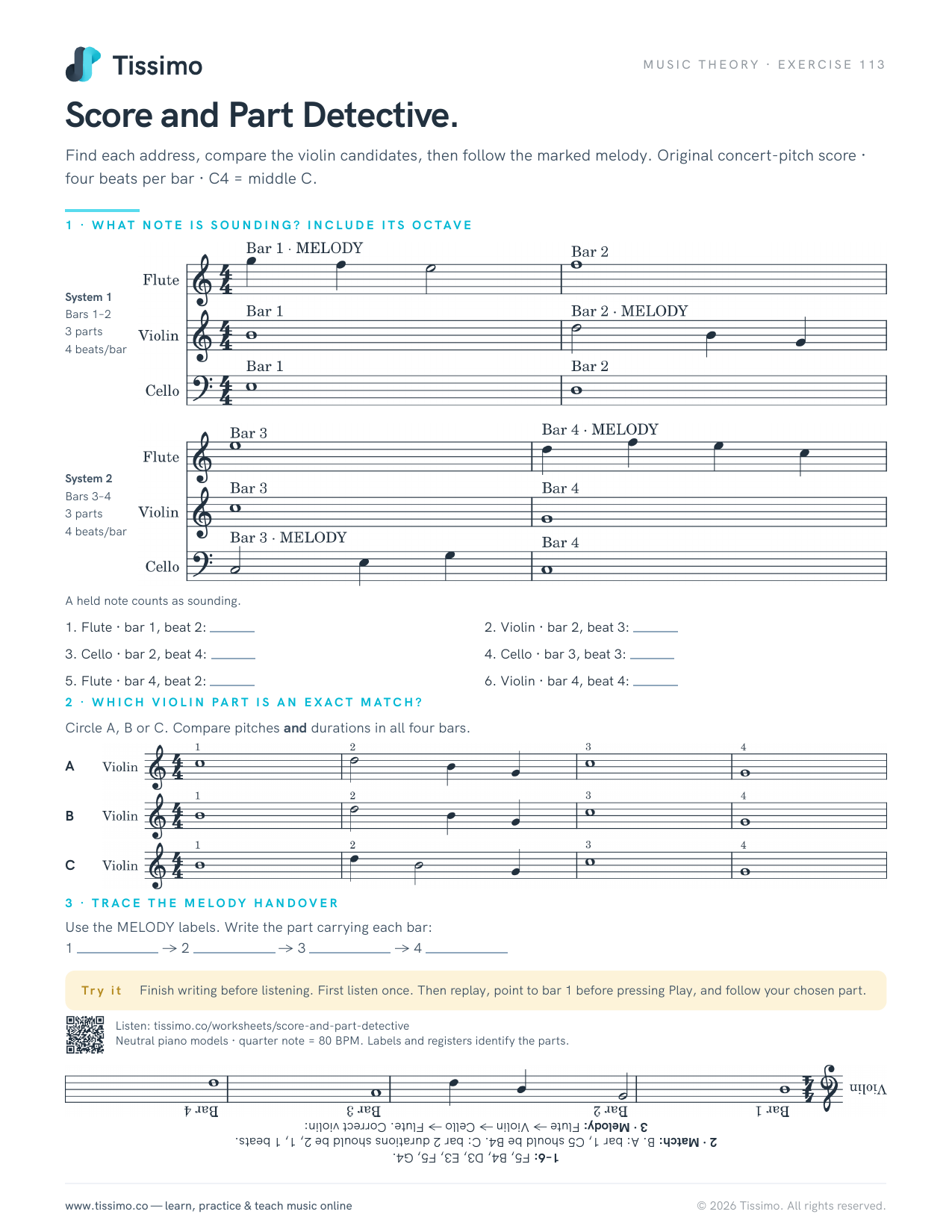
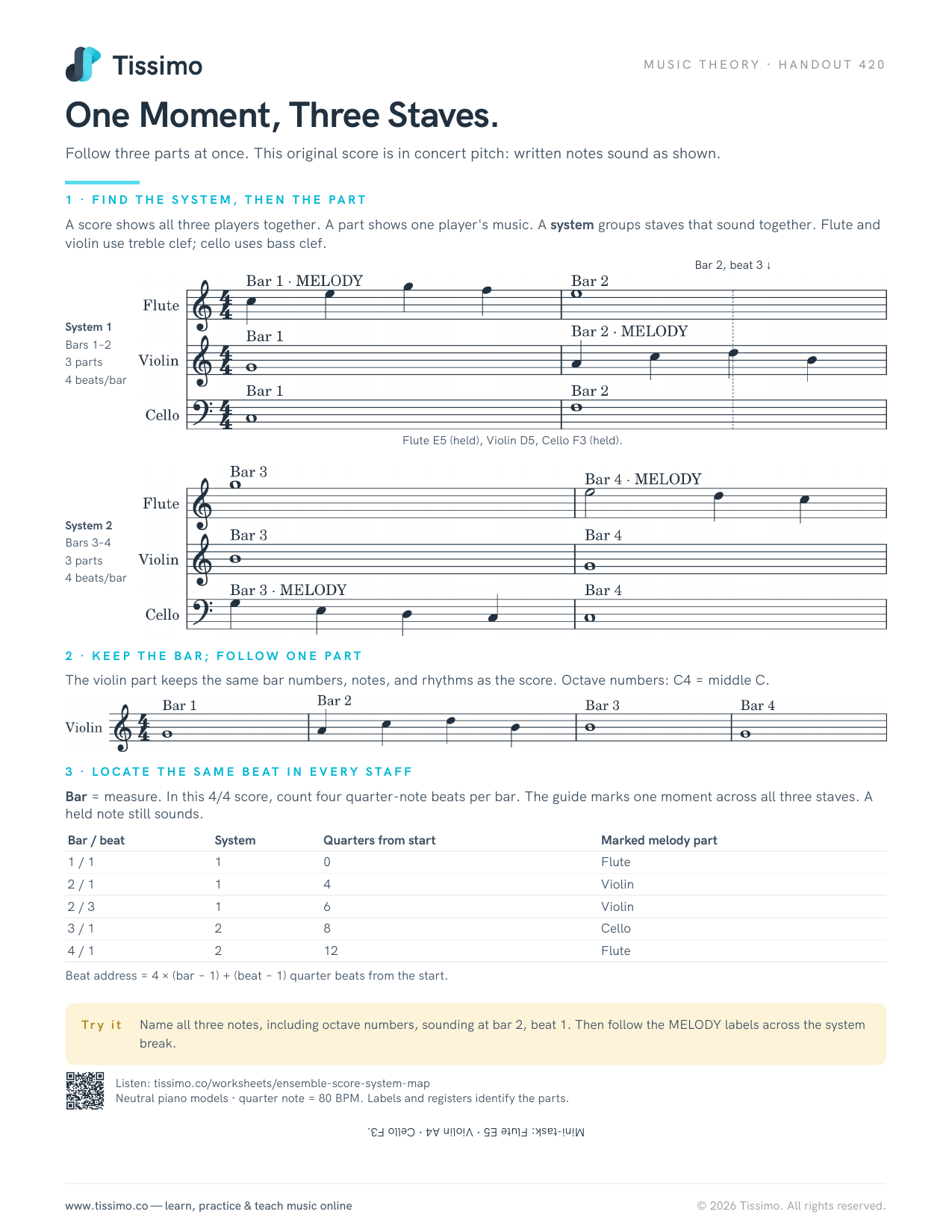
Chamber music is one of the best training grounds a student can have. You learn to count independently, listen across the group, adjust your intonation and take responsibility for your part, because nobody else is playing it. Many musicians find it the most rewarding music they make. Ask your teacher about joining or forming a group; even a duet with a friend is a start. Score and Part Detective and One Moment, Three Staves practice following several parts at once.
Common questions
What counts as chamber music?
Music for a small group, usually from two to about ten players, with one player on each part and normally no conductor. String quartets, piano trios and wind quintets are classic examples.
Why is it called chamber music?
Because it was associated with rooms, camera in Italian, in homes and palaces, rather than with churches or large theaters.