Technique & Performance
Intonation
Intonation is how accurately a musician plays or sings in tune, especially on instruments and voices where the performer controls the exact pitch of each note, such as strings, winds and the voice.
When a teacher says "watch your intonation", they mean some notes are slightly sharp (too high) or flat (too low). Singers, string players, and wind and brass players shape every pitch as they play, so playing in tune is part of their technique. On the piano, each key's pitch is fixed when the instrument is tuned, so pianists don't control intonation note by note, although they still need to hear it when they play with others.
Why notes go out of tune
- Strings: a finger a few millimeters from its spot changes the pitch. Shifts and stretches are the usual danger points.
- Winds and brass: breath support, embouchure, temperature and the instrument's own tendencies all move the pitch. Many instruments have notes that tend to be a little sharp or flat and need adjusting.
- Voice: tiredness, weak breath support and awkward leaps pull singers sharp or flat, and singing without accompaniment (A cappella) makes any drift easy to hear.
Playing in tune with others
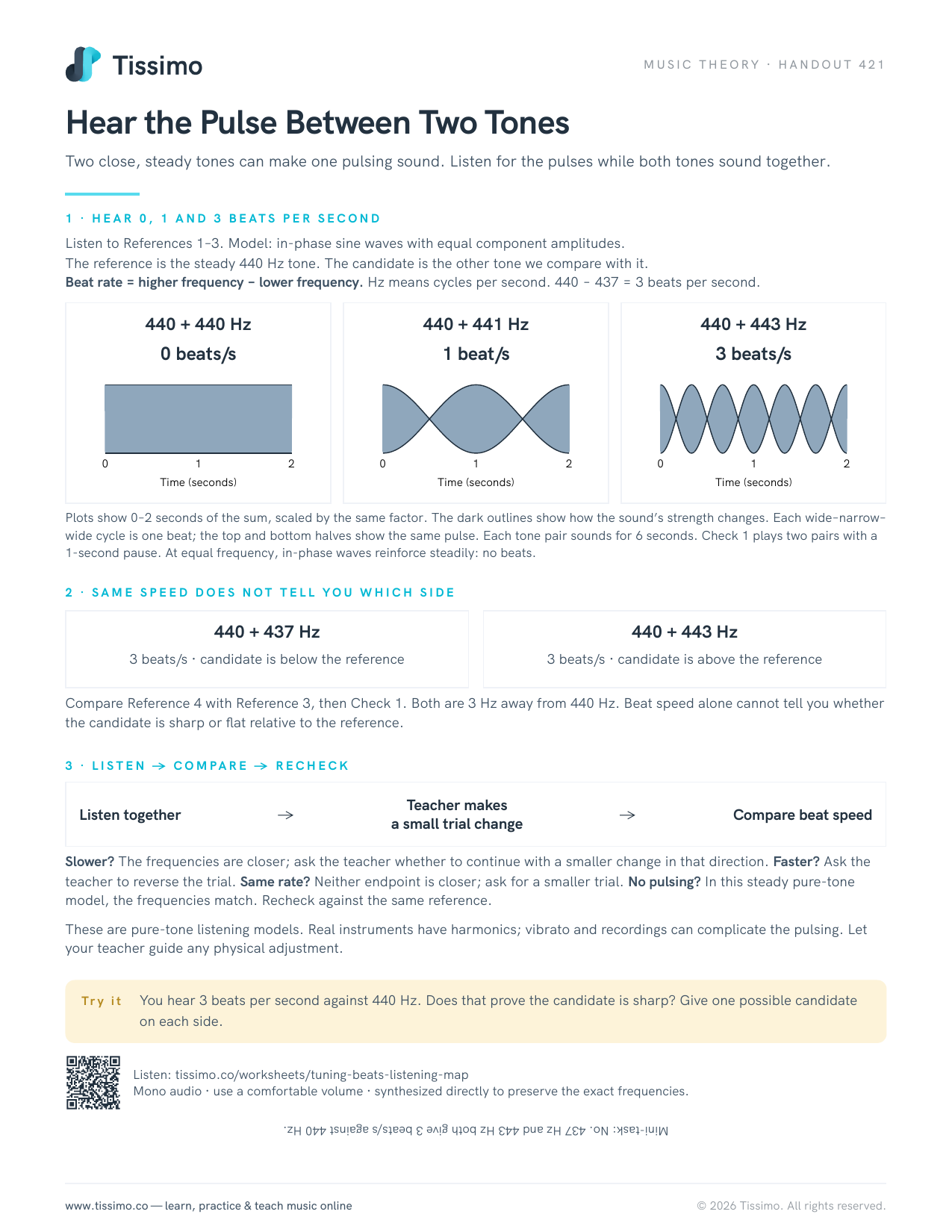
Good intonation is more than matching a tuner. In an ensemble, players listen and adjust to each other. When two notes are slightly apart, you hear a wobble called beating; as they come closer, the wobble slows down and disappears. Experienced ensembles also adjust some intervals for a purer sound, for example placing the third of a major chord a little lower than a piano would, closer to just intonation, while the piano itself is tuned in equal temperament.
How to improve your intonation
- Tune carefully first, to a reliable reference (see tuning).
- Play against a drone. Hold a steady tonic on a keyboard or app and play slow scales over it. Listen for beats and adjust until each note settles.
- Hear it before you play it. If you can sing the note in your head, your fingers or lips can find it.
- Use a tuner to check, not to steer. Play a note, listen, then look. Watching the needle while you play trains your eyes rather than your ears.
- Practice shifts and leaps slowly, stopping on each arrival note to check it.
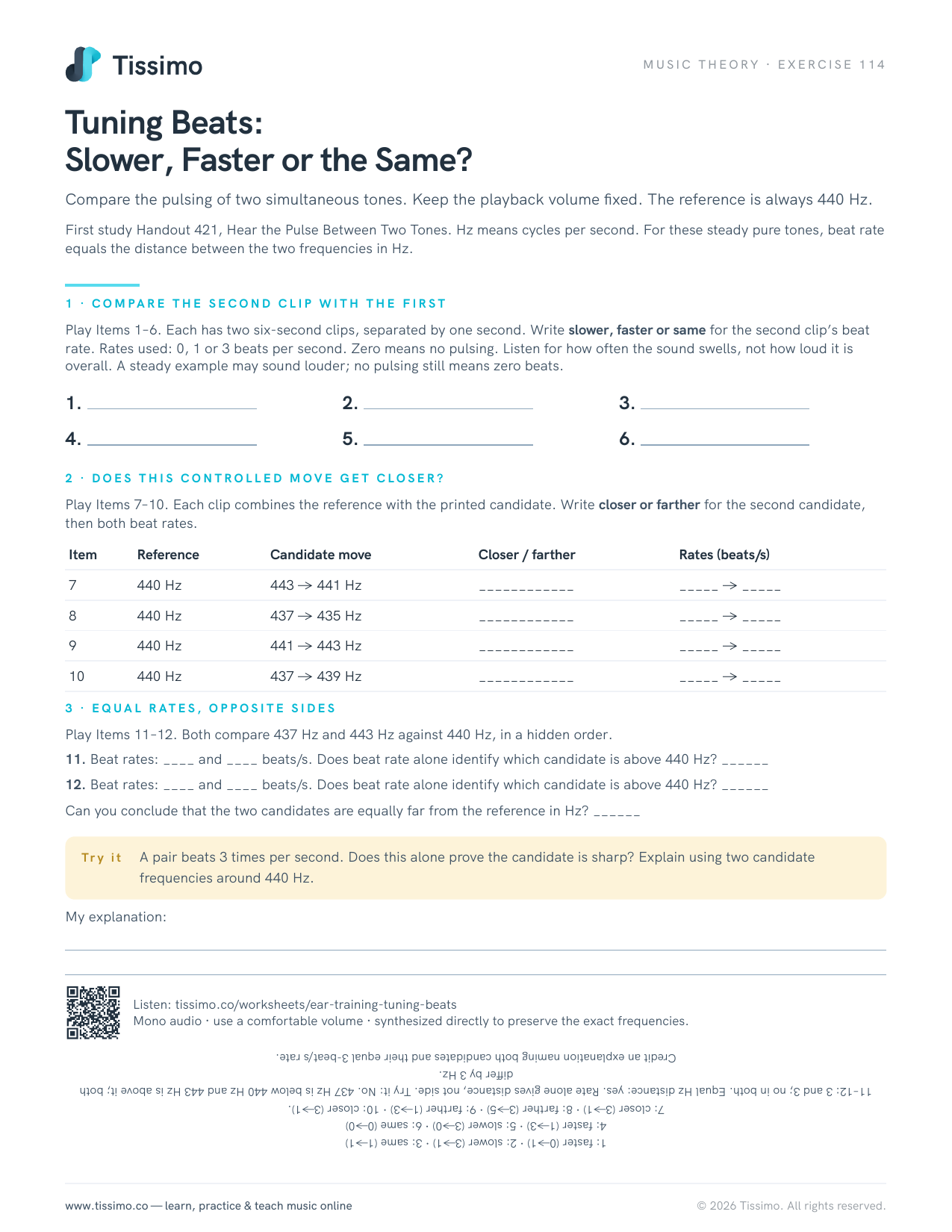
Tuning Beats: Slower, Faster or the Same? and Hear the Pulse Between Two Tones train exactly the listening behind steady intonation.
A second meaning
In Gregorian chant, the intonation is the opening phrase of a chant, sung by a soloist before the choir joins in.
Common questions
What do sharp and flat mean in intonation?
Sharp means slightly higher than the intended pitch; flat means slightly lower. In intonation these are small differences, usually much less than a half step, measured in cents.
Do pianists need to worry about intonation?
Not note by note, because a piano's pitches are set when it is tuned. Pianists still need a good ear for it when accompanying singers or other instruments, and a piano that has drifted out of tune needs a technician.