Sound & Acoustics
Beating (Acoustic Beats)
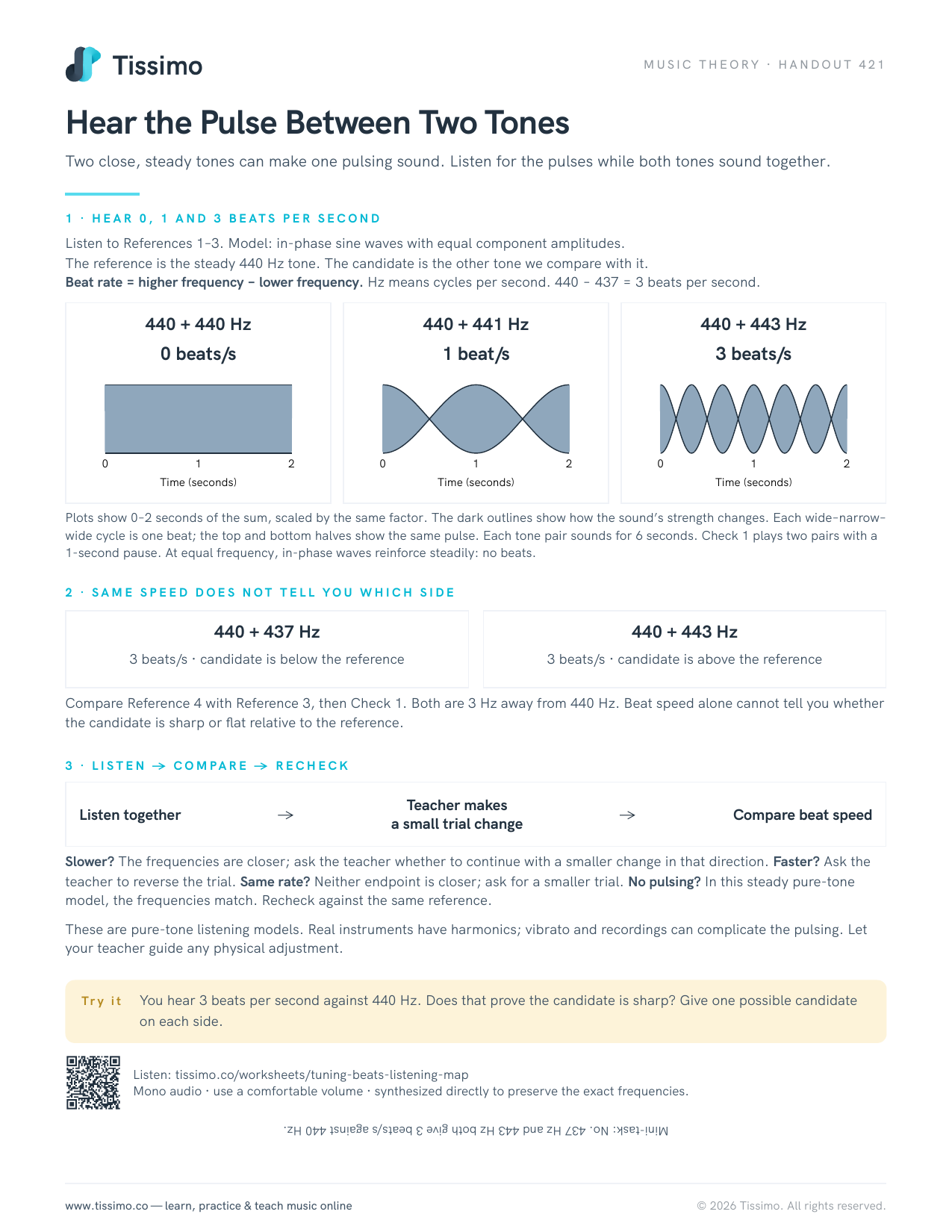
Beating is the regular pulsing you hear when two tones of slightly different frequency sound together. The beats per second equal the difference between the two frequencies, so musicians tune by making the beats slow down and stop.
Play two notes that are almost, but not quite, the same pitch, and the combined sound swells and fades in a steady pulse: wow-wow-wow. Those pulses are beats, and the effect is called beating. It has nothing to do with the rhythmic beat of the music; it is pure acoustics.
Why beats happen
Two sound waves of nearly the same frequency keep drifting in and out of step. When their peaks line up, they reinforce each other and the sound gets louder. A moment later one wave has slipped half a cycle ahead, its peaks meet the other's troughs, and the sound gets quieter. This happens as many times per second as the difference between the two frequencies:
- 440 Hz and 442 Hz: 2 beats per second
- 440 Hz and 444 Hz: 4 beats per second
- 440 Hz and 440 Hz: no beats at all
The closer the pitches, the slower the beats.
Tuning by ear with beats
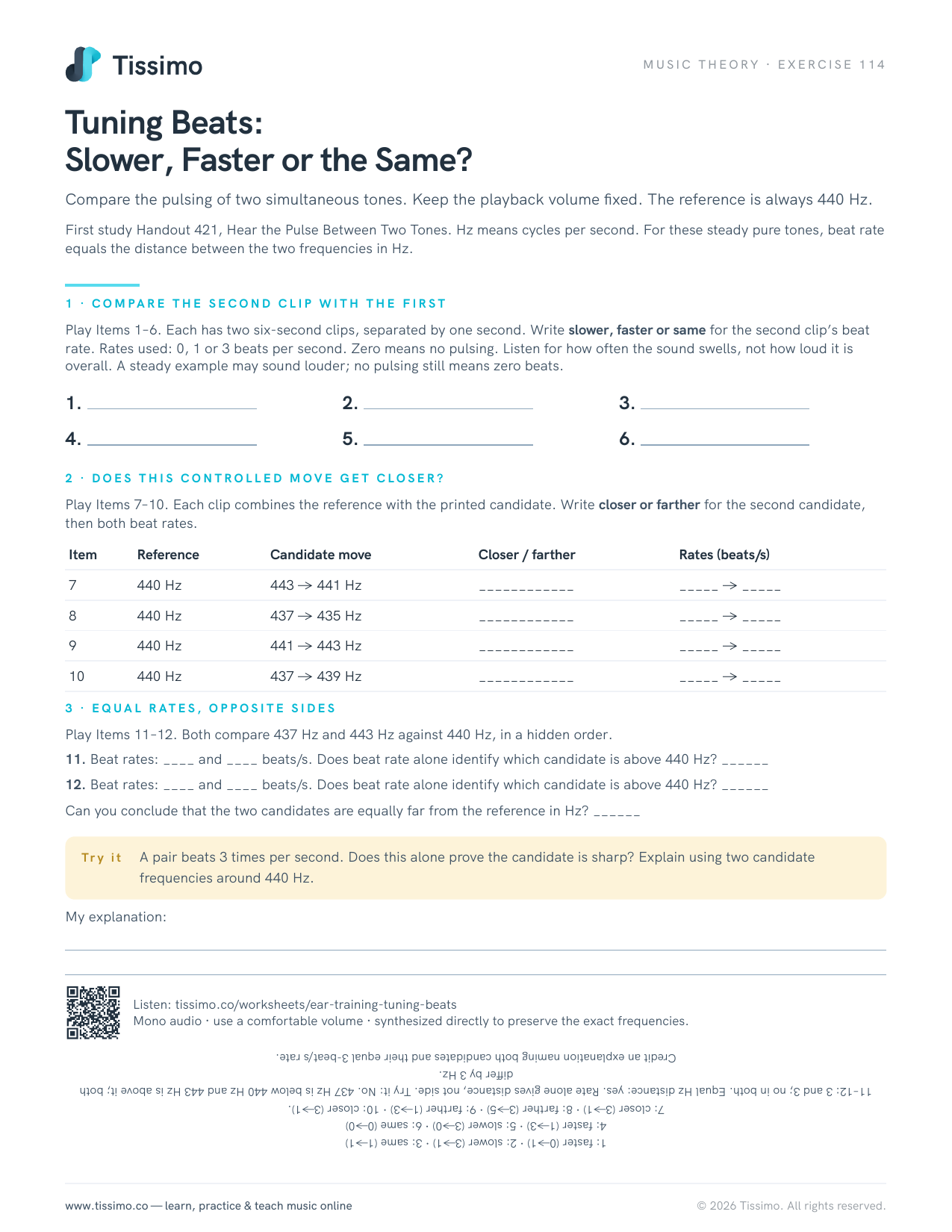
That makes beats the most precise tuning tool you have. Guitarists tune one string against another, violinists play two strings together, and wind players tune to a reference note, all listening for the beats to slow down and stop. Piano tuners go further: because equal temperament leaves most intervals slightly impure, they count the beats of fifths, fourths and thirds and set each one to a specific speed.
Beats also arise between overtones, not only between fundamentals, which is why a slightly mistuned octave or fifth wobbles too. The pure intervals of just intonation produce no beats at all, a large part of why they sound so smooth.
From beats to roughness
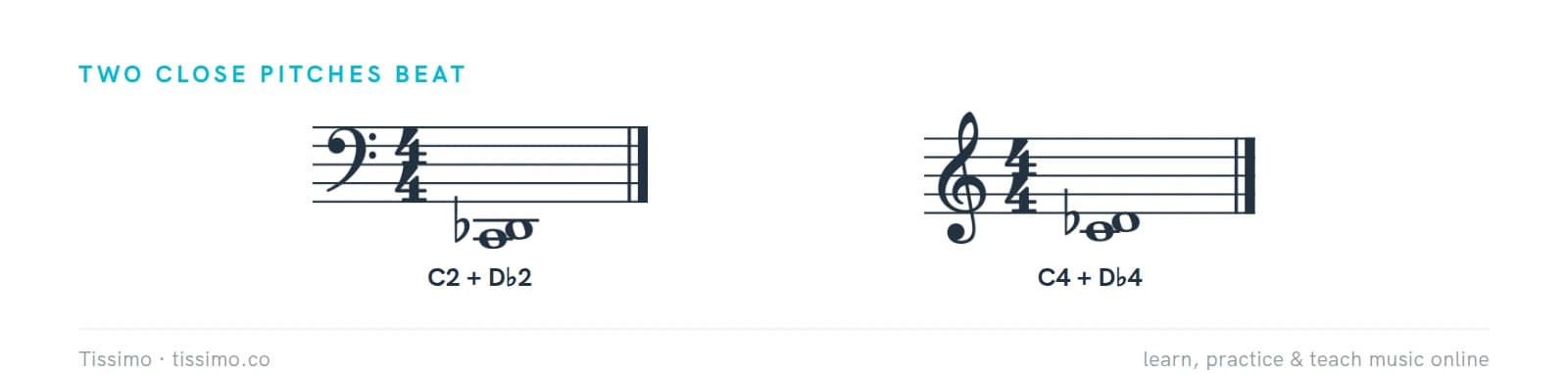
As the difference grows, the beats speed up. A few per second sound like a slow wobble; beyond roughly 15 per second they blur into a buzzy roughness; and once the two tones are far enough apart, you hear two separate notes. That roughness is a major ingredient of dissonance. Two notes a half step apart in the bass beat slowly, while the same half step two octaves higher beats so fast that it simply sounds harsh:
Beats on purpose
Musicians sometimes use beating as a color. The celeste stops of some pipe organs pair two ranks of pipes tuned slightly apart for a shimmering sound, accordion reeds tuned slightly apart give the classic musette tone, and synthesizer players detune two oscillators by a few cents for a fuller, chorus-like sound.
Hear beats speed up and slow down in Hear the Pulse Between Two Tones, and practice judging them in Tuning Beats: Slower, Faster or the Same?.
Common questions
How do you calculate beats per second?
Subtract the lower frequency from the higher one. Two tones at 440 Hz and 443 Hz beat 3 times per second; at 440 Hz and 440.5 Hz, once every two seconds.
Why do musicians listen for beats when tuning?
Beats show that two pitches don't quite match, and their speed shows by how much. As you adjust a string or a slide toward the reference, the beats slow down; when they stop, the two notes are in tune.