Sound & Acoustics
Cent
A cent is a unit for measuring small differences in pitch: one hundredth of an equal-tempered half step. An octave contains 1,200 cents, and tuners show how many cents sharp or flat a note is.
A cent is a tiny, precise unit of pitch distance. One equal-tempered half step is divided into 100 cents, so a whole step is 200 cents and an octave 1,200. The English scholar Alexander J. Ellis introduced the unit in the 1880s to compare the tuning of musical scales from around the world.
Why not just use hertz?
Your ear judges pitch by ratios, not by differences in hertz. From A4 (440 Hz) up a half step is about 26 Hz; from A2 (110 Hz) up a half step is only about 6.5 Hz. Both are the same musical distance, 100 cents. Cents measure intervals the way you hear them, so "10 cents sharp" means the same thing in any register.
For the curious, the interval between two frequencies f₁ and f₂ is 1,200 × log₂(f₂ ÷ f₁) cents. You will rarely need the formula, since tuners and software do the work.
Cents in practice
- Tuners show how far you are from the nearest equal-tempered note, usually in cents: "+8" means 8 cents sharp.
- Tuning systems are easiest to compare in cents. In equal temperament every interval is a whole multiple of 100.
- Microtones, intervals smaller than a half step, are usually described in cents: a quarter tone is 50 cents.
- Recording software lets you detune a synthesizer oscillator or shift a vocal by a set number of cents.
Pure intervals in cents
The pure ratios of just intonation fall between equal temperament's hundreds:
- Pure perfect fifth (3:2): 702.0 cents, 2.0 wider than equal temperament
- Pure perfect fourth (4:3): 498.0 cents, 2.0 narrower
- Pure major third (5:4): 386.3 cents, 13.7 narrower
- Pure minor third (6:5): 315.6 cents, 15.6 wider
- Pure major sixth (5:3): 884.4 cents, 15.6 narrower
- The 7th harmonic (7:4 above the octave below it): 968.8 cents, 31.2 lower than an equal-tempered minor seventh
How small is a cent?
Very small. Under good conditions, trained musicians can hear a difference of just a few cents, especially between two tones sounding together, where slow beating gives the mismatch away. That is why good intonation is a matter of listening for beats and blend, not only of watching a needle.
Train that kind of listening with Tuning Beats: Slower, Faster or the Same?.
Common questions
How many cents are in a half step?
100 in equal temperament, and 1,200 in an octave. Other tuning systems have half steps of other sizes; in just intonation, for example, the half step 16:15 is about 112 cents.
What does it mean when a tuner says a note is 10 cents sharp?
The note is a tenth of a half step higher than the equal-tempered pitch the tuner is aiming for. Lower it slightly until the reading is close to 0.
Practice it: free worksheets
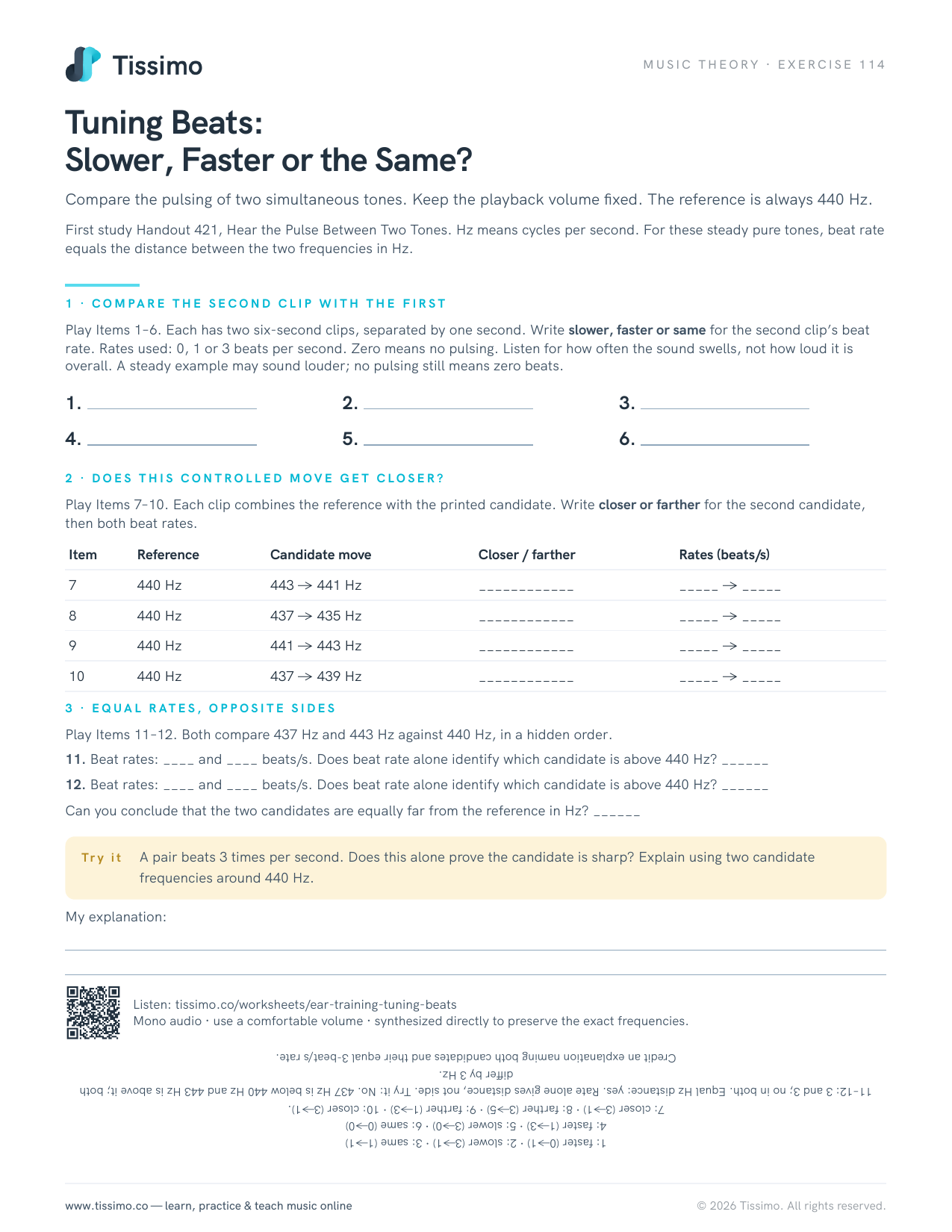 Tuning Beats: Slower, Faster or the Same?Compare the pulsing of two simultaneous tones. Keep the playback volume fixed. The reference is always 440 Hz.
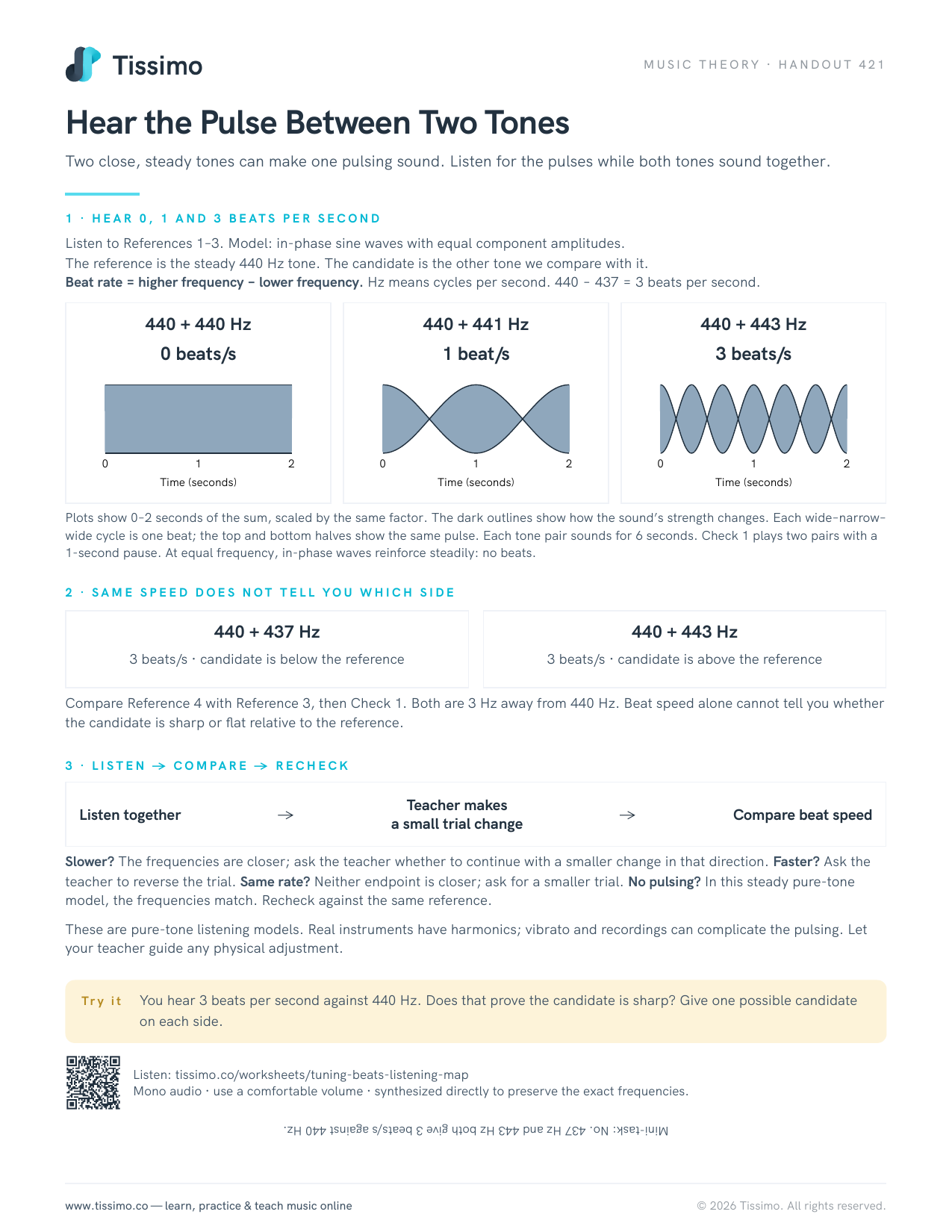 Hear the Pulse Between Two TonesTwo close, steady tones can make one pulsing sound. Listen for the pulses while both tones sound together.
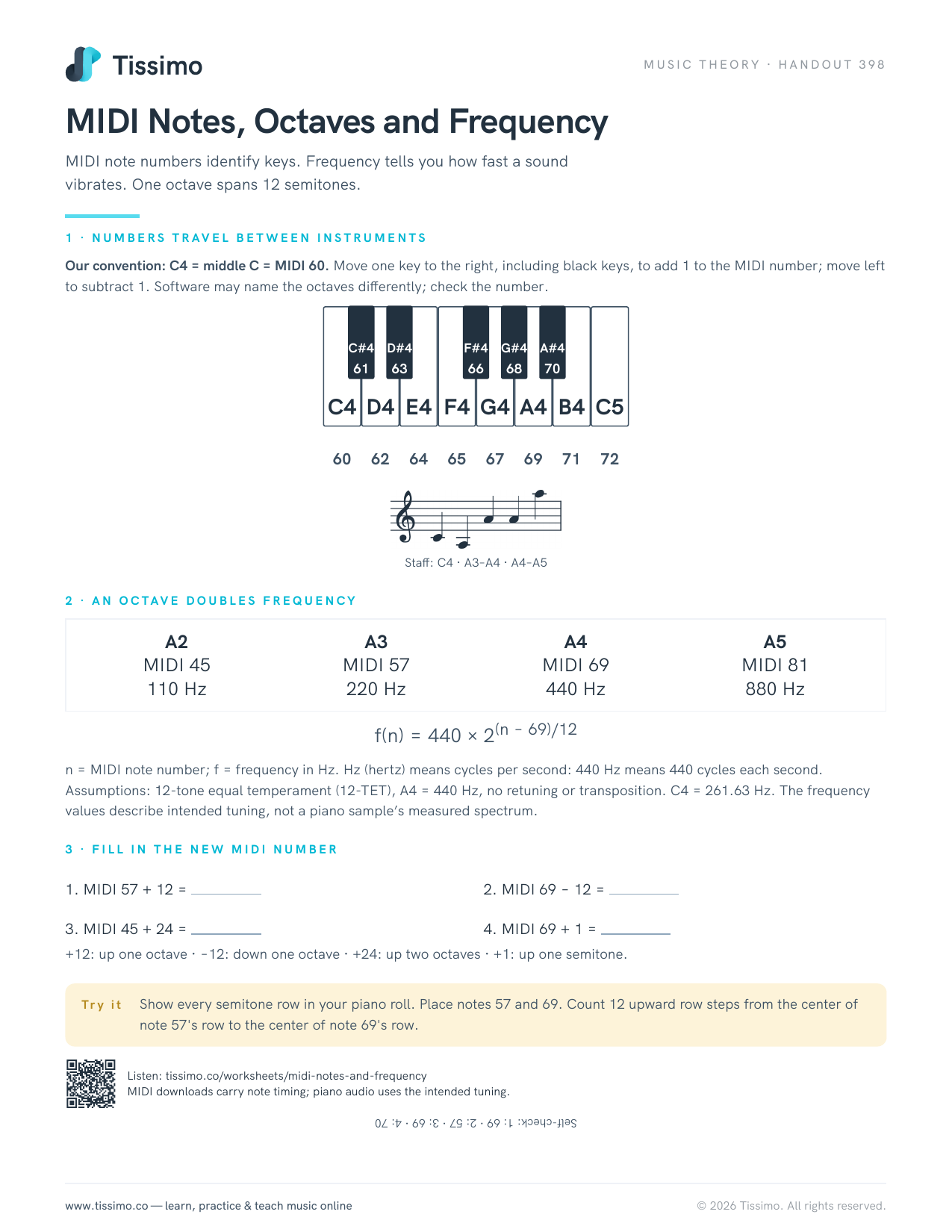 MIDI Notes, Octaves and FrequencyMIDI note numbers identify keys. Frequency tells you how fast a sound vibrates. One octave spans 12 semitones.