Sound & Acoustics
Equal Temperament
Twelve-tone equal temperament divides the octave into 12 equal half steps of 100 cents each. Every key sounds equally in tune, at the cost of making most intervals slightly impure.
Twelve-tone equal temperament is the standard starting point for modern pianos, fretted guitars and digital keyboards. Other equal temperaments divide the octave into different numbers of steps; this entry describes the familiar twelve-tone system. It divides the octave into 12 equal half steps. Each half step raises the frequency by the same ratio, the twelfth root of 2 (about 1.0595), and measures exactly 100 cents, so the octave is 1,200 cents.
Why make the steps equal?
Pure intervals don't fit together. Stack twelve pure fifths (3:2 each) and you overshoot seven octaves by about 23.5 cents, the Pythagorean comma. Stack three pure major thirds (5:4 each), C–E–G♯–B♯, and you fall about 41 cents short of the octave. Any keyboard tuning has to put those leftovers somewhere. Older temperaments pushed them into rarely used keys, which sounded rough. Equal temperament spreads them evenly, so every interval of a given size is identical, in every key.
What it costs
Compared with the pure ratios of just intonation:
- Octaves are pure: 1,200 cents.
- Fifths are 700 cents, about 2 cents narrower than a pure 3:2 fifth (702.0). Hardly anyone notices.
- Major thirds are 400 cents, about 14 cents wider than a pure 5:4 third (386.3). Trained ears hear a slight shimmer, the beating of the impure interval.
- Minor thirds are 300 cents, about 16 cents narrower than a pure 6:5 third (315.6).
That small roughness buys total freedom: you can modulate to any key, transpose anything anywhere, and play enharmonic equivalent notes such as C♯ and D♭ on the same key.
A little history
Mathematicians in China and in Europe worked out exact equal half steps around 1600, and fretted instruments such as the lute, whose frets run straight across all the strings, were already played with nearly equal half steps. On keyboards, equal temperament became the norm only gradually, mostly during the 19th century. Bach's Well-Tempered Clavier (Book 1 in 1722, Book 2 in the early 1740s) shows that all 24 major and minor keys could be played on one keyboard, but many scholars think Bach had a well temperament in mind: an unequal tuning in which every key is usable but each has a slightly different color.
Equal temperament and other players
Singers, string players and wind players are not locked into equal temperament. In a choir or a string quartet, held chords often drift toward purer thirds and fifths, and when a piano joins in, its tuning becomes the reference everyone has to meet.
Tuning Beats: Slower, Faster or the Same? trains you to hear the small differences that tuning depends on.
Common questions
Why is the piano tuned in equal temperament?
So that every key sounds equally good. Pure intervals cannot all fit on a keyboard with 12 keys per octave. Equal temperament makes every half step the same size, so music works in all 24 major and minor keys and can modulate freely, with every interval only slightly impure.
Is equal temperament out of tune?
Slightly, by design. Only the octave is pure. Fifths are about 2 cents narrow and major thirds about 14 cents wide compared with pure ratios. Most listeners hear this as normal, but it is audible in long, sustained chords.
Practice it: free worksheets
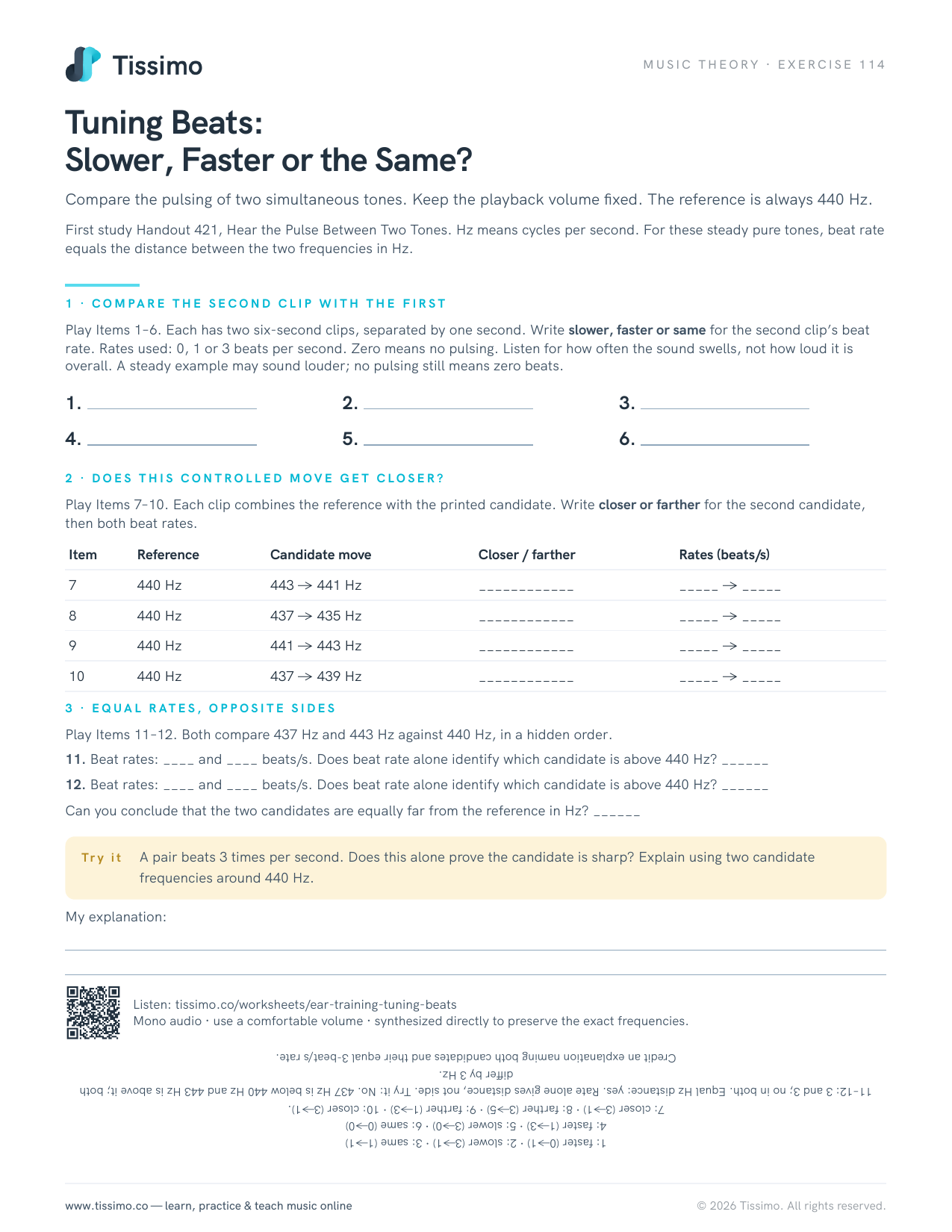 Tuning Beats: Slower, Faster or the Same?Compare the pulsing of two simultaneous tones. Keep the playback volume fixed. The reference is always 440 Hz.
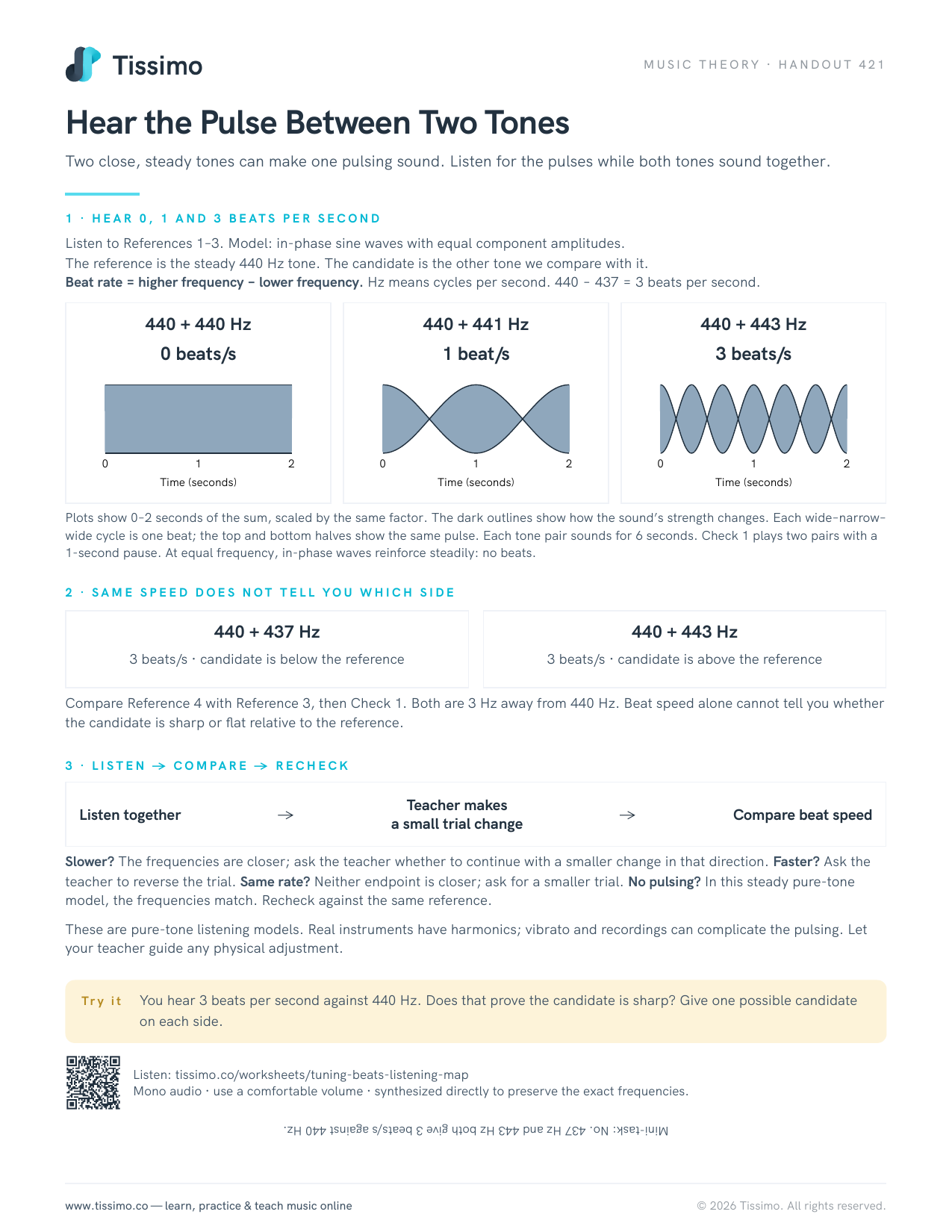 Hear the Pulse Between Two TonesTwo close, steady tones can make one pulsing sound. Listen for the pulses while both tones sound together.
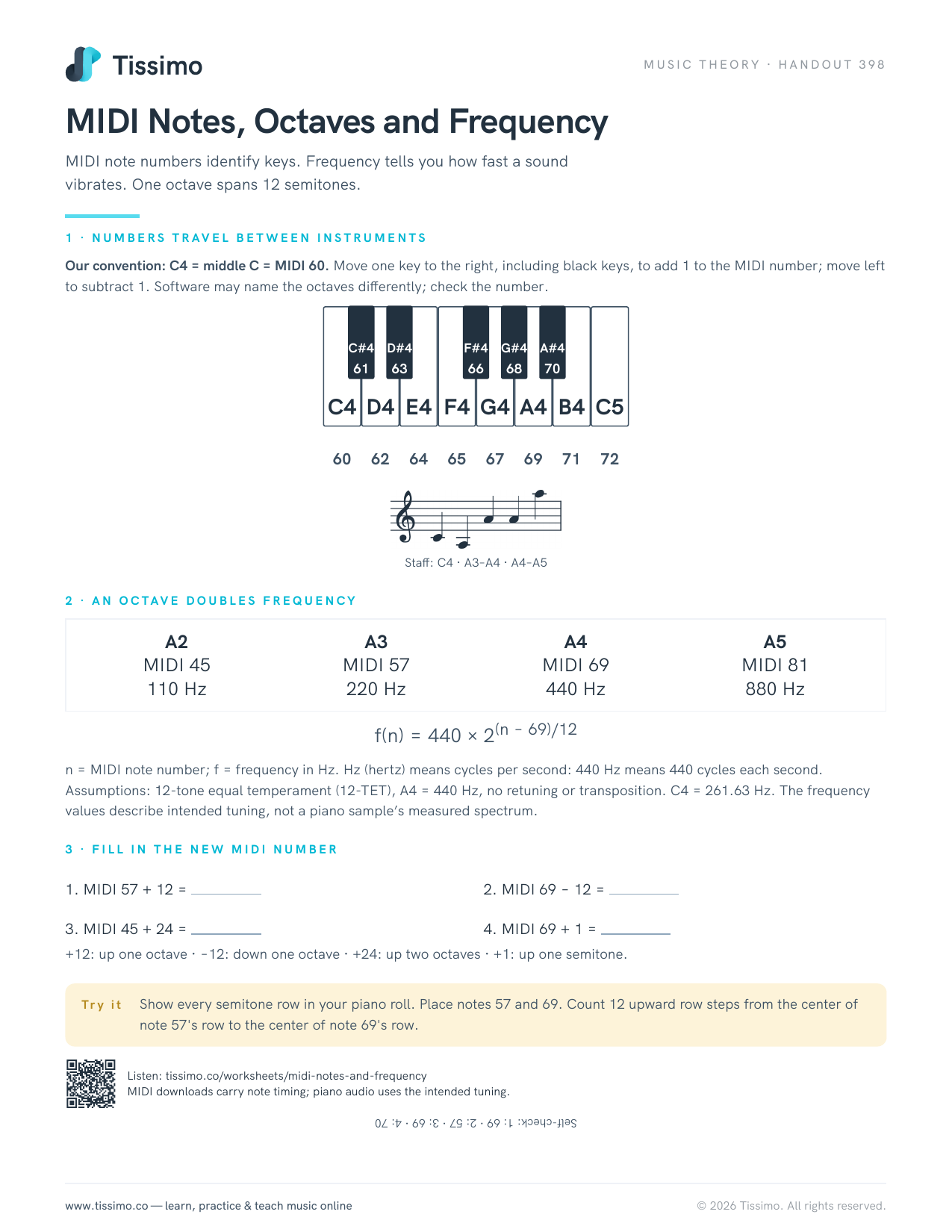 MIDI Notes, Octaves and FrequencyMIDI note numbers identify keys. Frequency tells you how fast a sound vibrates. One octave spans 12 semitones.