Pitch & Intervals
Perfect Fifth
Written as P5
A perfect fifth (P5) is an interval of seven half steps spanning five letter names, such as C–G, D–A or A–E. With its pure 3:2 frequency ratio, it is the most consonant interval after the octave.
A perfect fifth spans five letter names and seven half steps: C up to G, D up to A, A up to E, F up to C. Abbreviated P5, it measures 700 cents in equal temperament.
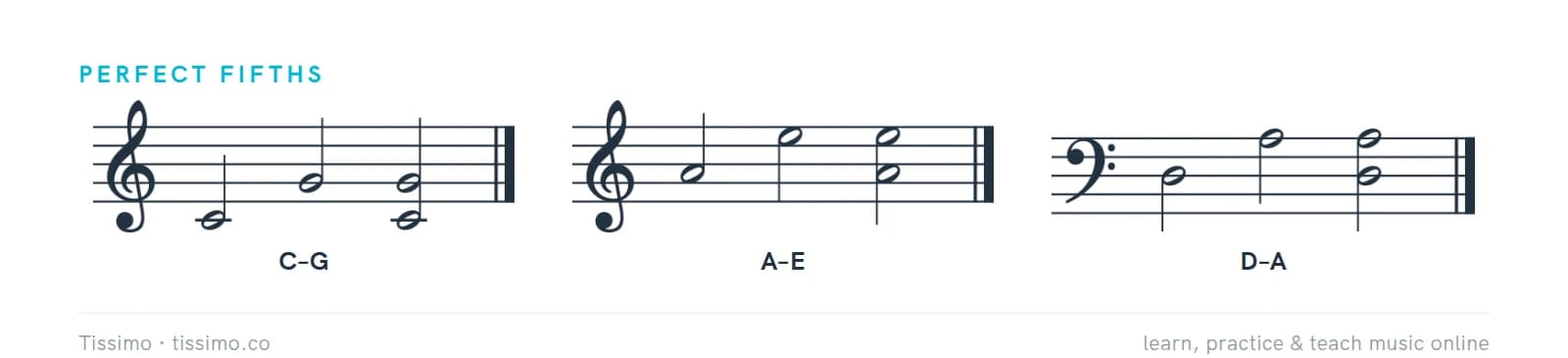
Counting it
C–D–E–F–G is five letters, so C–G is a 5th. Count seven half steps from C and you land on G. On the staff, a 5th skips exactly one line or space: from a line to the line two above it, or from a space to the space two above it.
Every white-key 5th is perfect except B–F, which spans only six half steps: a diminished fifth, the tritone. A perfect fifth above B is F♯; a perfect fifth below F is B♭.
The most stable interval after the octave
Two notes a perfect fifth apart vibrate in the simple ratio 3:2: for every two vibrations of the lower note, the upper one makes three. Many of their overtones coincide, so the fifth sounds open, hollow and very stable. It is the interval between the 2nd and 3rd harmonics of the harmonic series. The equal-tempered fifth on a piano is just under 2 cents narrower than a pure 3:2, too little for most listeners to notice.
Where fifths turn up
- Every major and minor triad has a perfect fifth between its root and its fifth (C–G in C–E–G).
- A rock power chord is just a root and its fifth, often with the octave added.
- The violin, viola and cello are tuned in fifths (violin: G–D–A–E).
- The circle of fifths arranges all 12 keys a fifth apart, and the dominant of a key lies a fifth above its tonic.
- "Twinkle, Twinkle, Little Star" leaps up a fifth from the first "twinkle" to the second.
Parallel fifths
In classical part-writing, two voices moving in parallel perfect fifths are avoided: the fifth blends so well that the two voices stop sounding independent. Medieval organum and rock guitar use parallel fifths freely.
Inversion
Inverted, a perfect fifth becomes a perfect fourth: C–G becomes G–C, and 7 + 5 = 12.
Learn it on the staff with Intervals: the 5th, and see how fifths connect every key in The Circle of Fifths.
Common questions
How many half steps are in a perfect fifth?
Seven. From C, counting every black and white key, the seventh key is G. In equal temperament that is 700 cents.
Why are parallel fifths not allowed?
They are avoided only in the classical part-writing style taught in harmony courses. A perfect fifth blends so smoothly that two voices moving in parallel fifths sound like one thickened voice, which works against the independent lines that style aims for. Rock, folk and medieval music use them freely.
Practice it: free worksheets
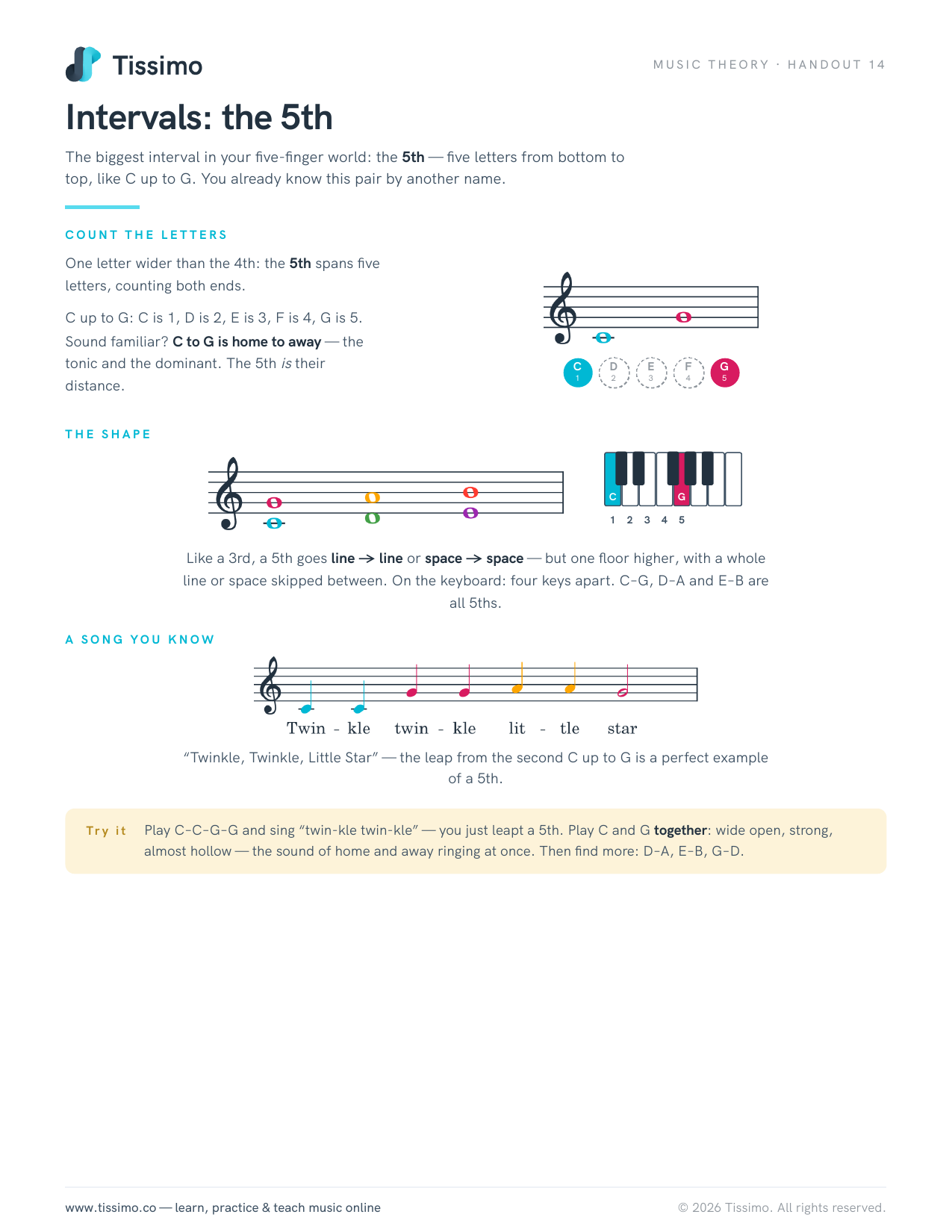 Intervals: the 5thThe biggest interval in your five-finger world: the 5th — five letters from bottom to top, like C up to G. You already know this pair by another name.
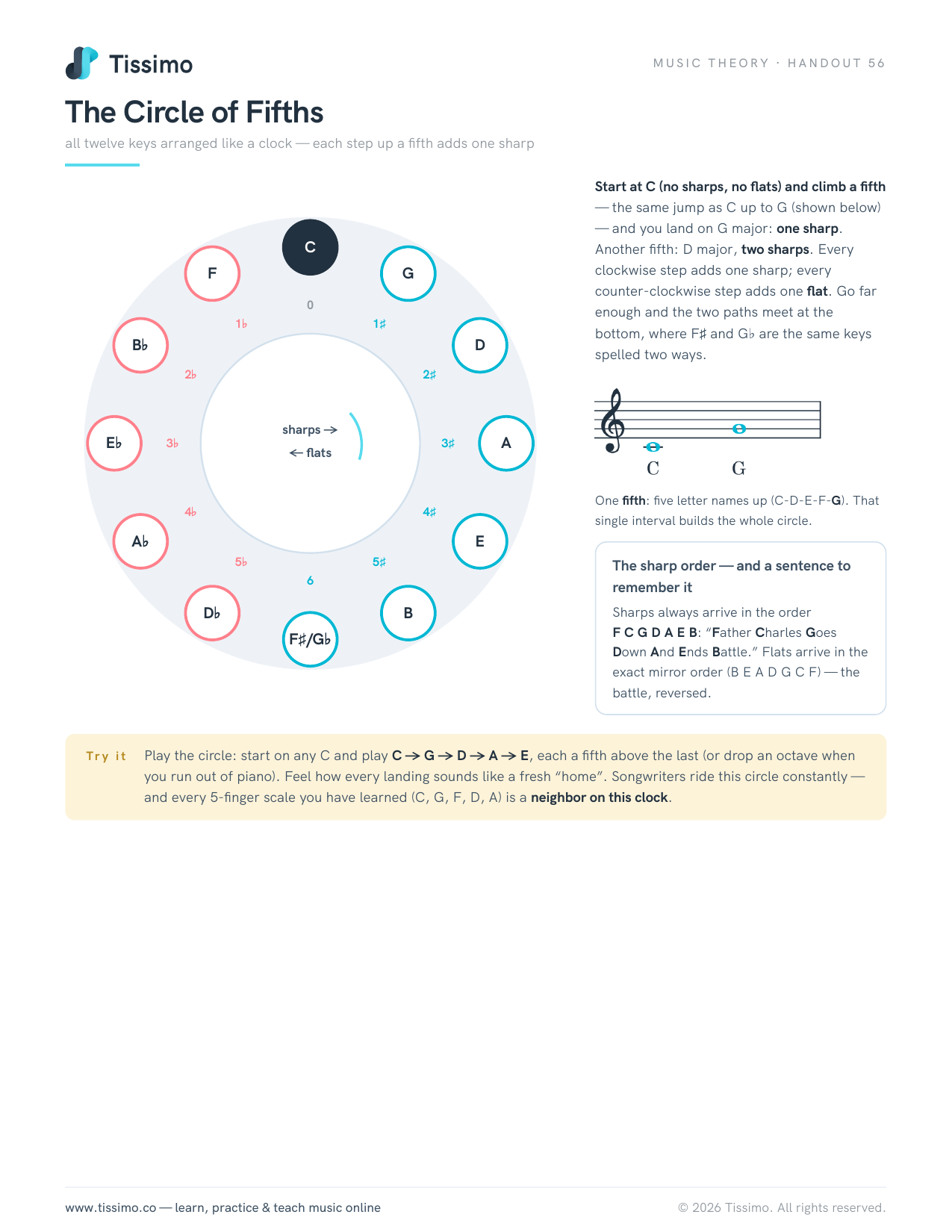 The Circle of Fifthsall twelve keys arranged like a clock — each step up a fifth adds one sharp
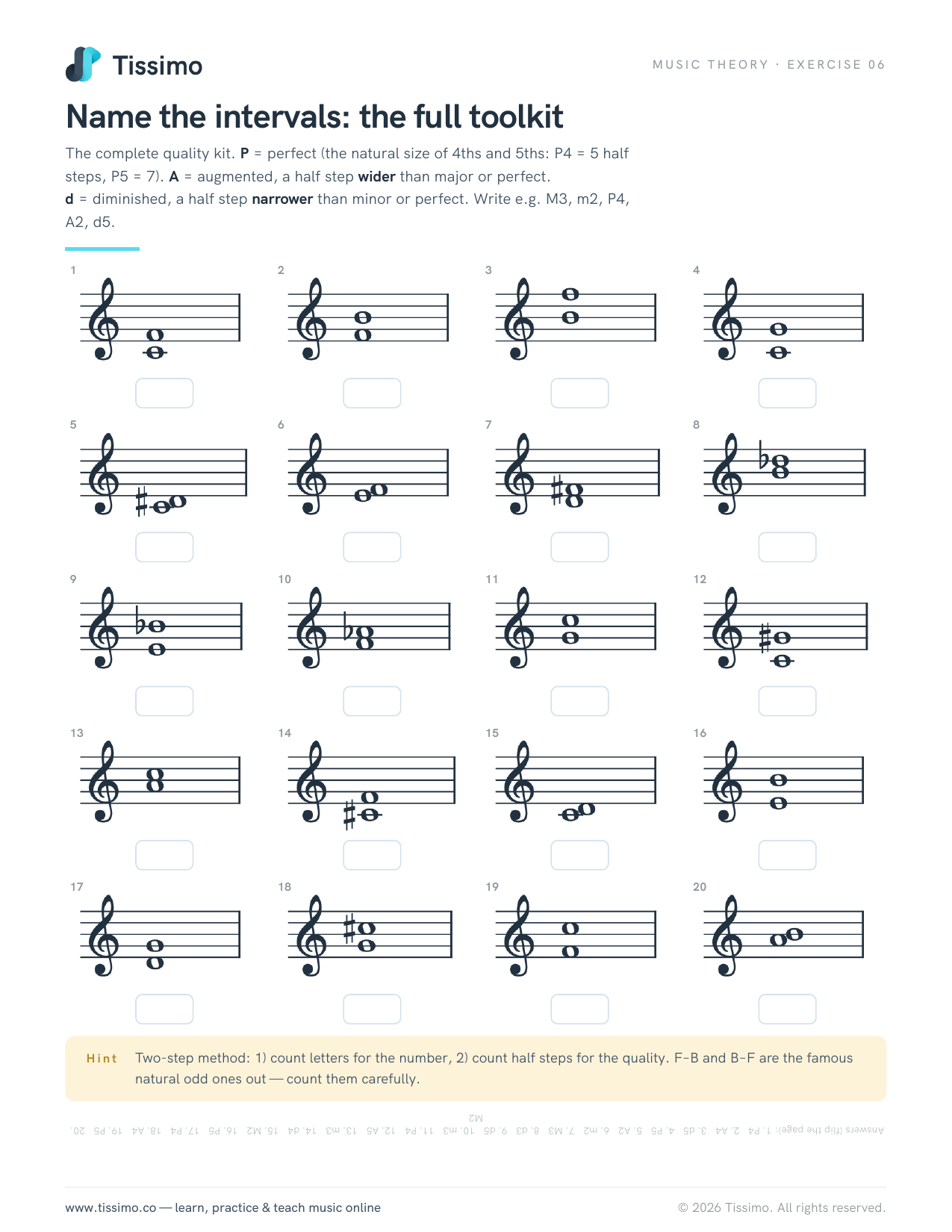 Name the intervals: the full toolkitThe complete quality kit. P = perfect (the natural size of 4ths and 5ths: P4 = 5 half steps, P5 = 7). A = augmented, a half step wider than major or perfect. d = diminished, a half step narrower than minor or perfect. Write e.g. M3, m2, P4, A2, d5.
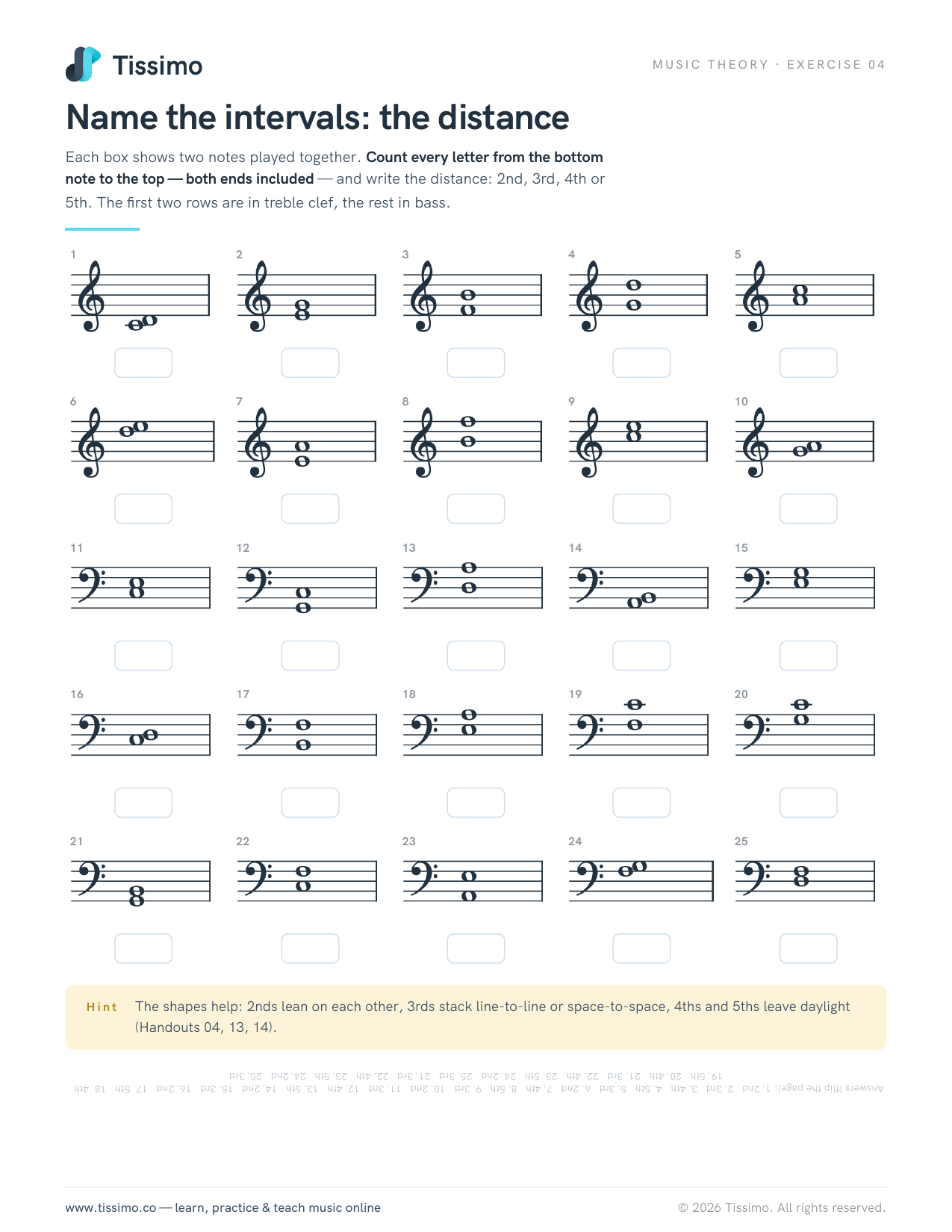 Name the intervals: the distanceEach box shows two notes played together. Count every letter from the bottom note to the top — both ends included — and write the distance: 2nd, 3rd, 4th or 5th. The first two rows are in treble clef, the rest in bass.
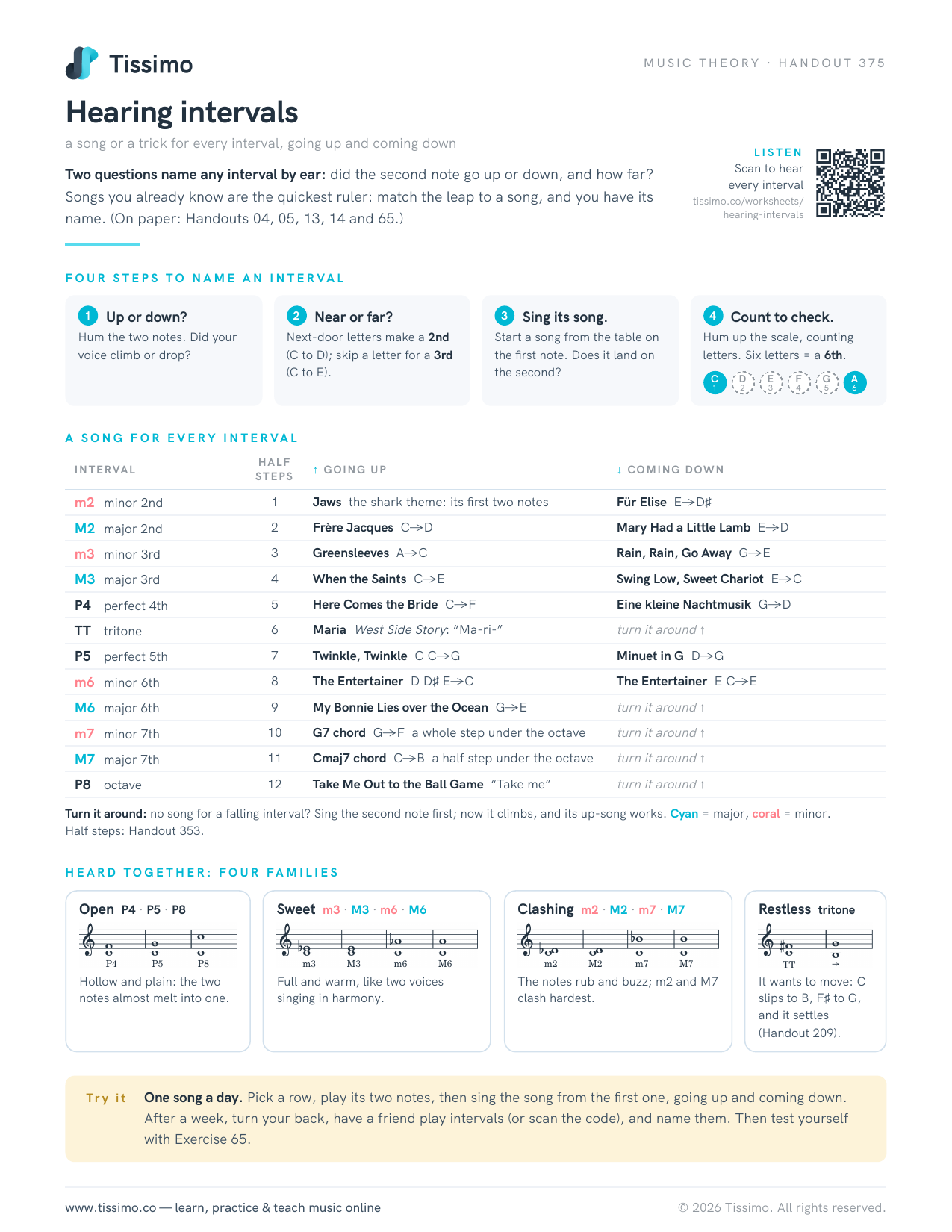 Hearing intervalsa song or a trick for every interval, going up and coming down
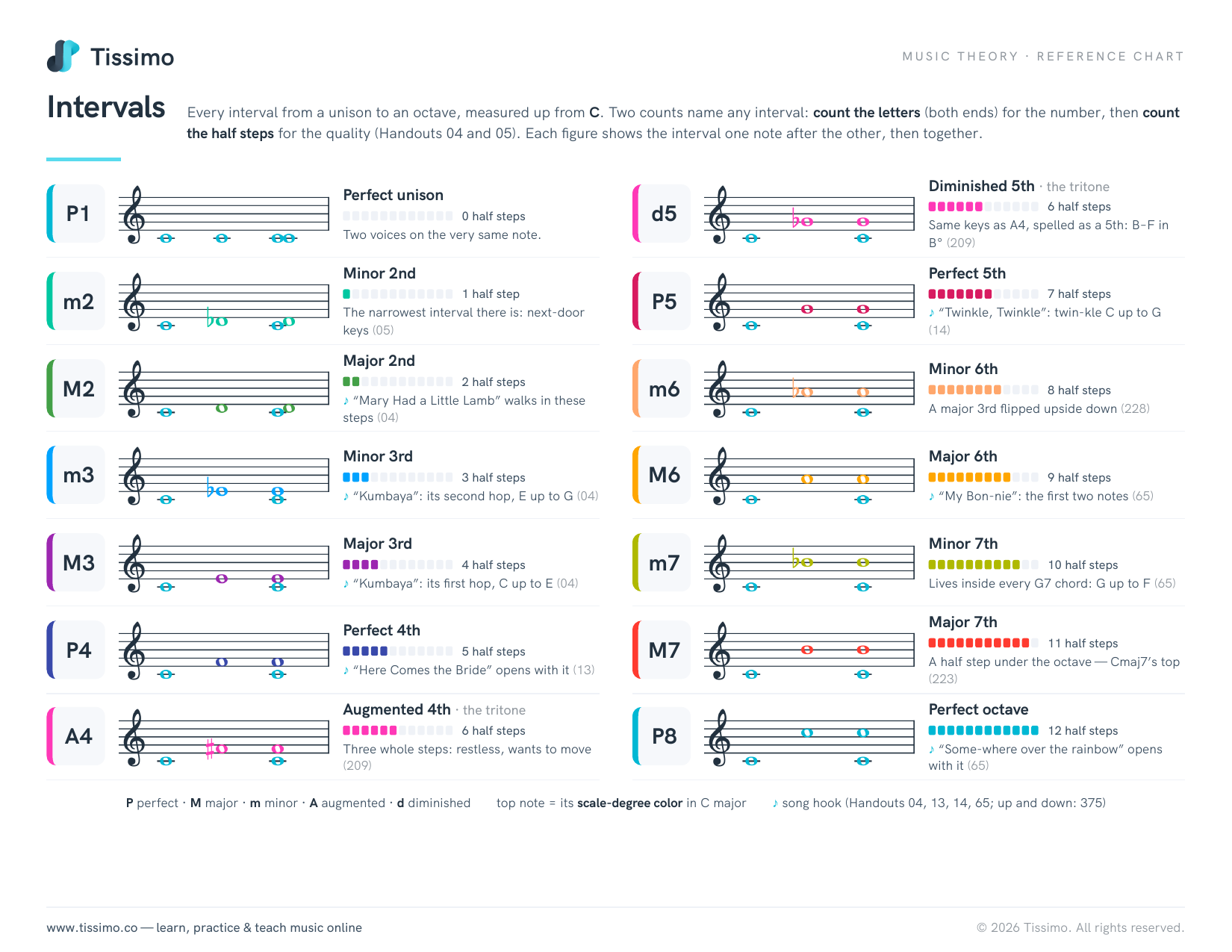 IntervalsEvery interval from a unison to an octave, measured up from C. Two counts name any interval: count the letters (both ends) for the number, then count the half steps for the quality (Handouts 04 and 05). Each figure shows the interval one note after the other, then together.