Pitch & Intervals
Perfect Interval
A perfect interval is a unison, fourth, fifth or octave in its natural size: 0, 5, 7 or 12 half steps. Perfect intervals have no major or minor form, and they invert to other perfect intervals.
Four interval numbers take the quality perfect: the unison (P1), the fourth (P4), the fifth (P5) and the octave (P8). Their compound forms are perfect too: the 11th (P11), the 12th (P12) and the double octave (P15).
- Perfect unison: 0 half steps (C–C)
- Perfect fourth: 5 half steps (C–F)
- Perfect fifth: 7 half steps (C–G)
- Perfect octave: 12 half steps (C–C)
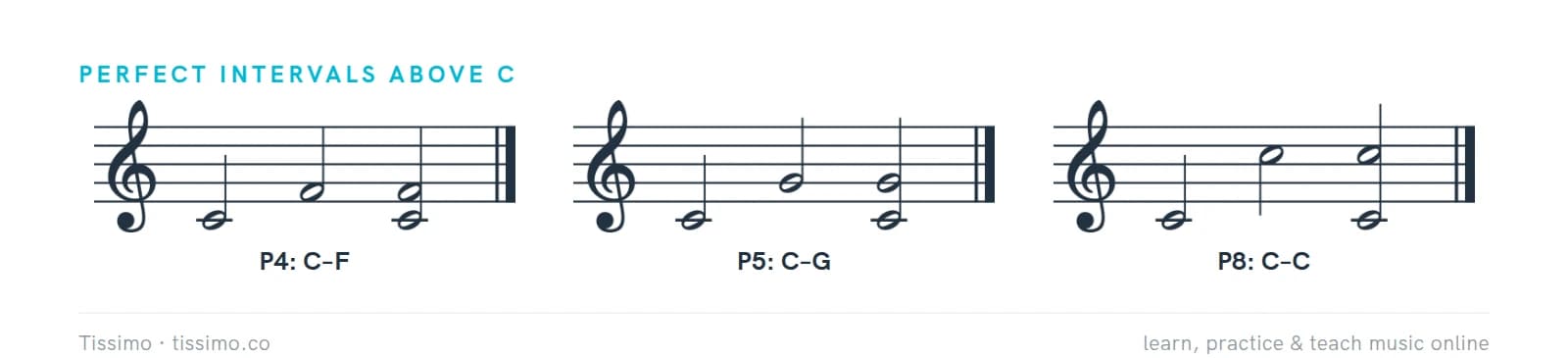
Why these four?
They have the simplest frequency ratios of all intervals: 1:1, 4:3, 3:2 and 2:1. Their two notes share many overtones and blend so smoothly that older theory called them the perfect consonances. (In counterpoint that label usually covers only the unison, fifth and octave; the fourth is a special case, explained under perfect fourth.) They are also the intervals from the tonic of a major scale up to its 1st, 4th, 5th and 8th degrees, and they are the same in major and minor keys.
Perfect, never major or minor
Seconds, thirds, sixths and sevenths come in two everyday sizes, major and minor. Perfect intervals come in only one. Change their size and they leave the perfect family:
- one half step wider: augmented (C–F♯ is an augmented fourth)
- one half step narrower: diminished (C–G♭ is a diminished fifth)
So "major fifth" and "minor fourth" are never correct names.
Checking a fourth or fifth
On white keys, every fourth and fifth is perfect except the two built from F and B: F–B is an augmented fourth and B–F a diminished fifth (both tritones). A handy rule follows: a fourth or fifth is perfect when both notes carry the same accidental (C–G, C♯–G♯, E♭–B♭), unless the letters are F and B. For F and B, the B needs a flat or the F a sharp: F–B♭, B♭–F, F♯–B and B–F♯ are all perfect.
Inversion
A perfect interval always inverts to another perfect interval (see interval inversion): a fourth becomes a fifth, a fifth a fourth, and a unison an octave.
Practice with Intervals: the 4th, Intervals: the 5th and Name the intervals: the full toolkit.
Common questions
Which intervals are perfect?
The unison, fourth, fifth and octave, plus their compound forms (the 11th, 12th and double octave). All other interval numbers, the 2nds, 3rds, 6ths and 7ths, are major or minor instead.
Can a perfect interval be major or minor?
No. A perfect interval made a half step wider is augmented, and one made a half step narrower is diminished. There is no such thing as a major fifth or a minor fourth.
Practice it: free worksheets
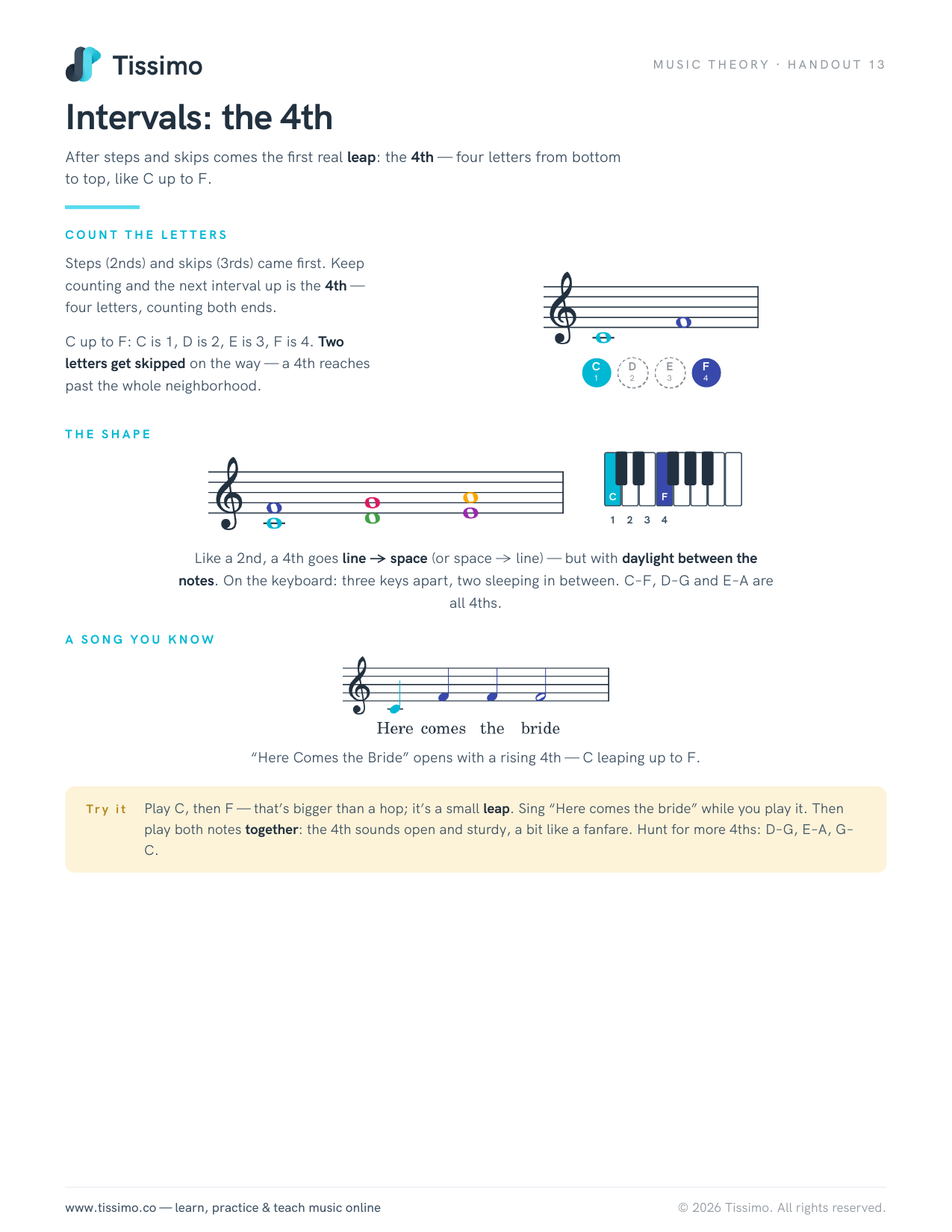 Intervals: the 4thAfter steps and skips comes the first real leap: the 4th — four letters from bottom to top, like C up to F.
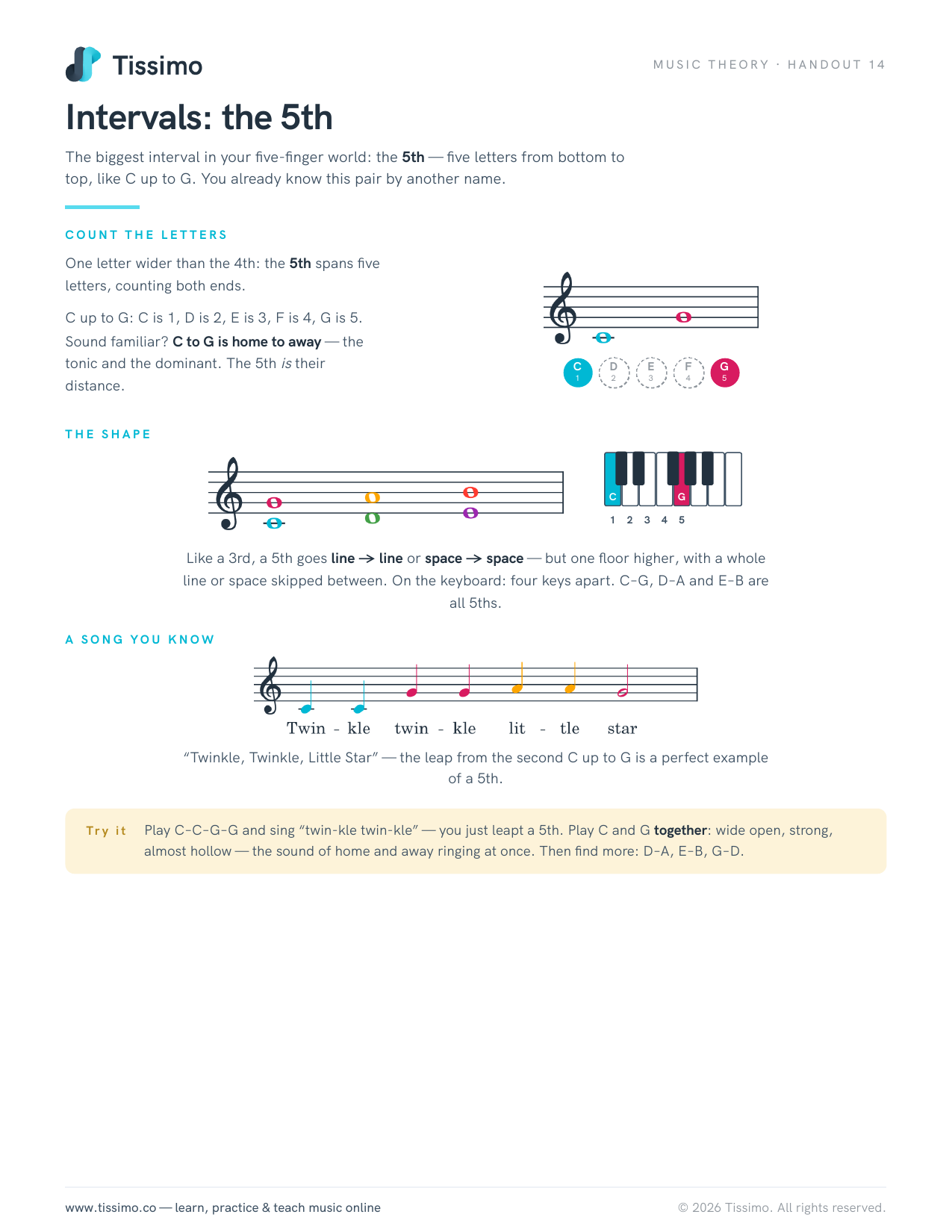 Intervals: the 5thThe biggest interval in your five-finger world: the 5th — five letters from bottom to top, like C up to G. You already know this pair by another name.
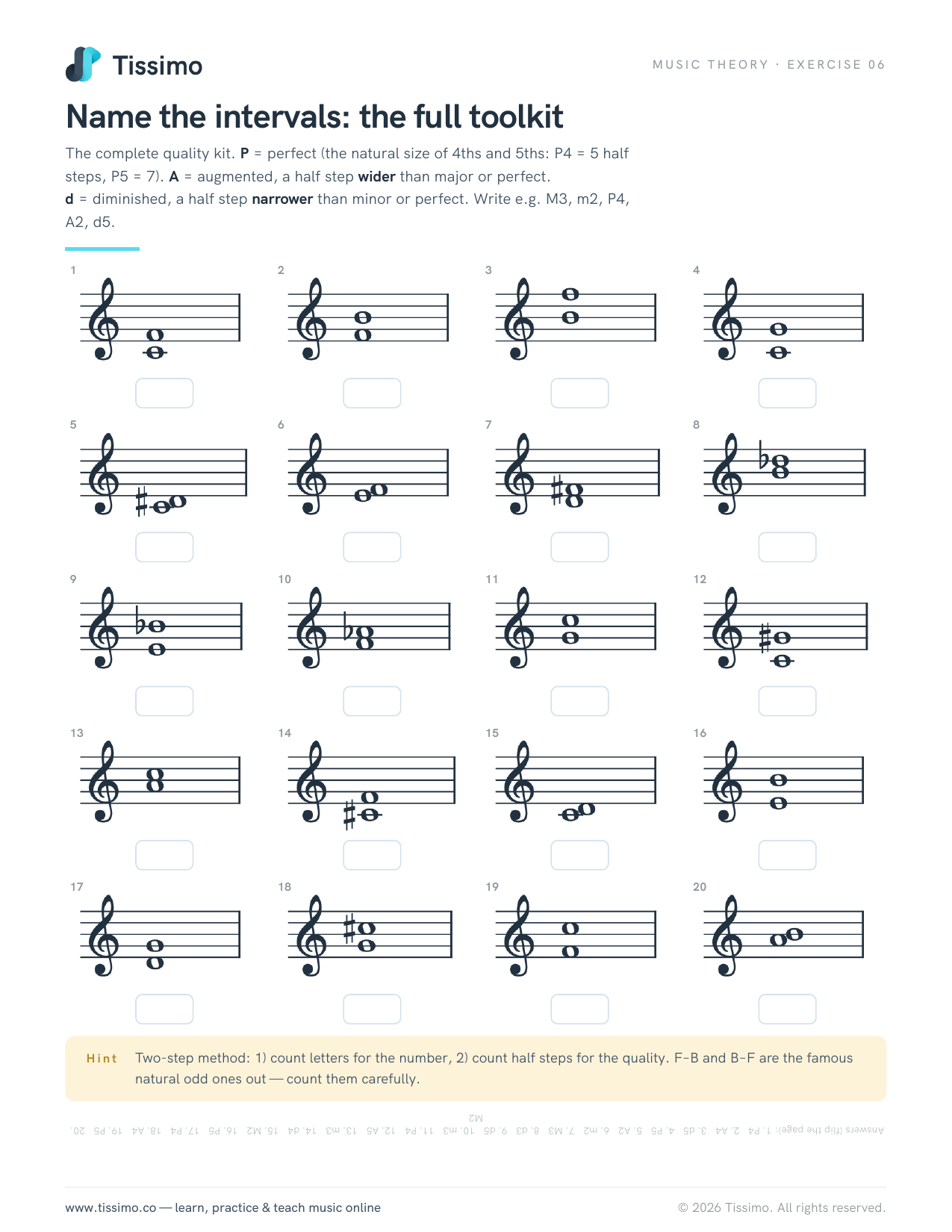 Name the intervals: the full toolkitThe complete quality kit. P = perfect (the natural size of 4ths and 5ths: P4 = 5 half steps, P5 = 7). A = augmented, a half step wider than major or perfect. d = diminished, a half step narrower than minor or perfect. Write e.g. M3, m2, P4, A2, d5.
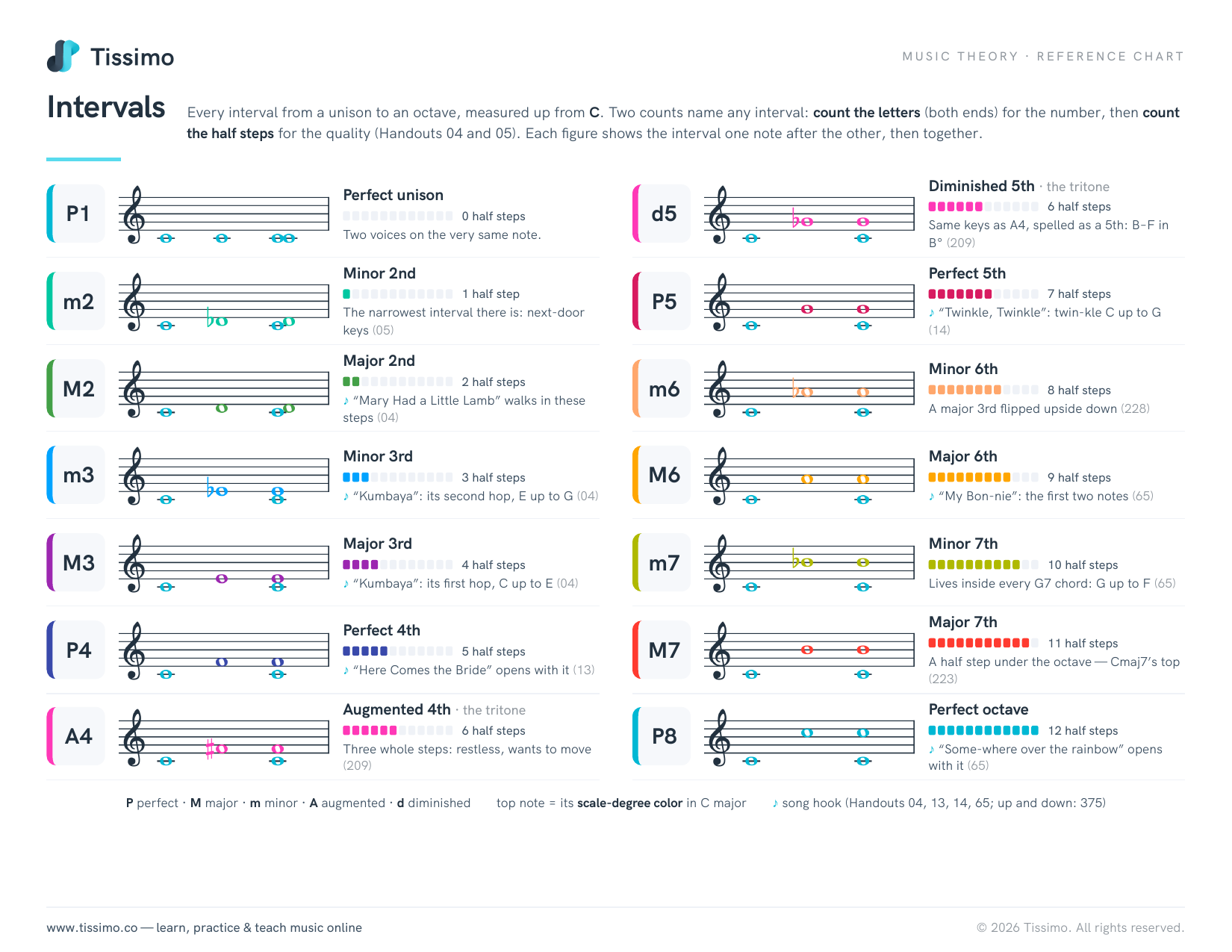 IntervalsEvery interval from a unison to an octave, measured up from C. Two counts name any interval: count the letters (both ends) for the number, then count the half steps for the quality (Handouts 04 and 05). Each figure shows the interval one note after the other, then together.
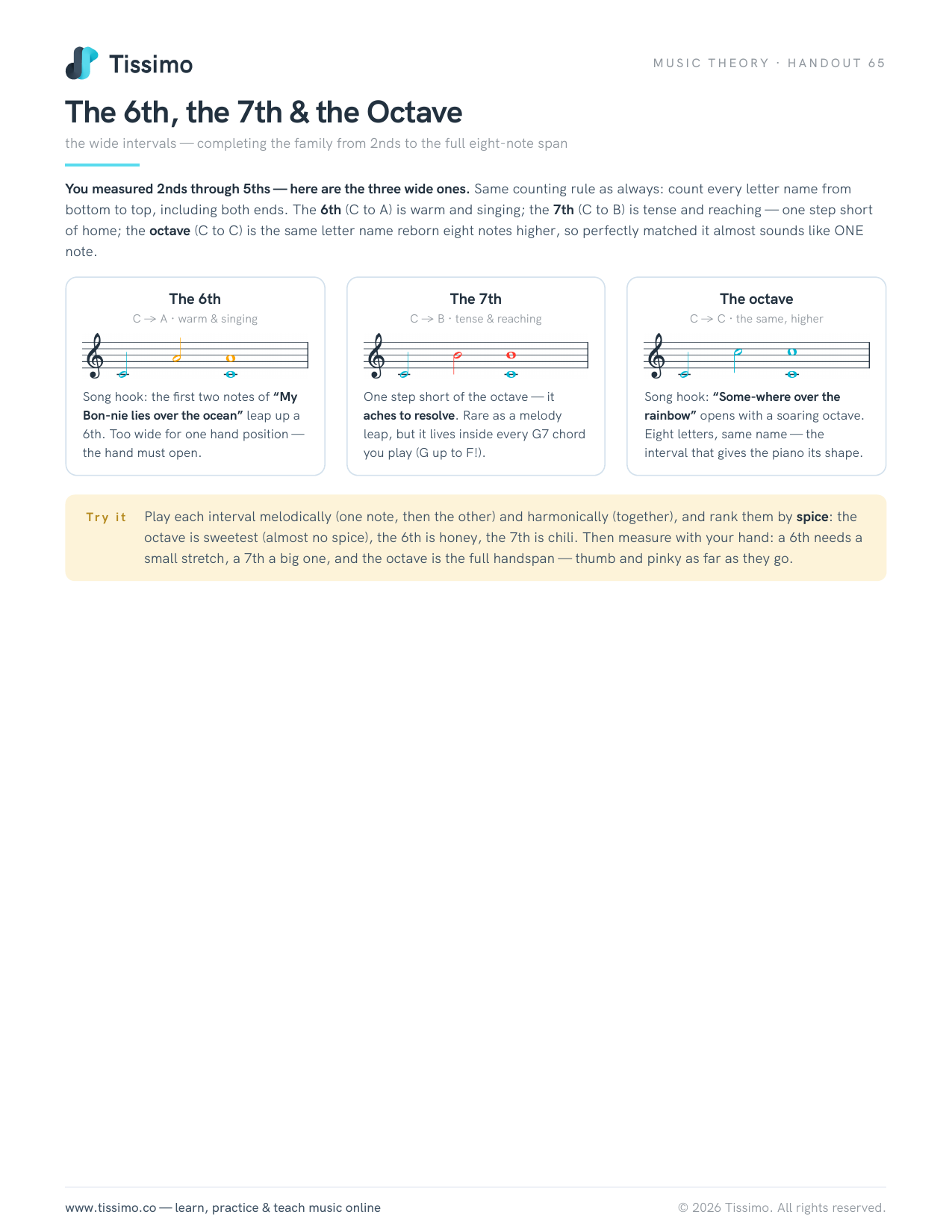 The 6th, the 7th & the Octavethe wide intervals — completing the family from 2nds to the full eight-note span