Pitch & Intervals
Interval Inversion
Interval inversion turns an interval upside down by moving its lower note up an octave, or its upper note down one. An interval and its inversion add up to 9 by number and 12 by half steps.
To invert an interval, move its lower note up an octave so that it becomes the upper note, or move the upper note down an octave. The two letter names stay the same; only their order changes. C up to E becomes E up to C.
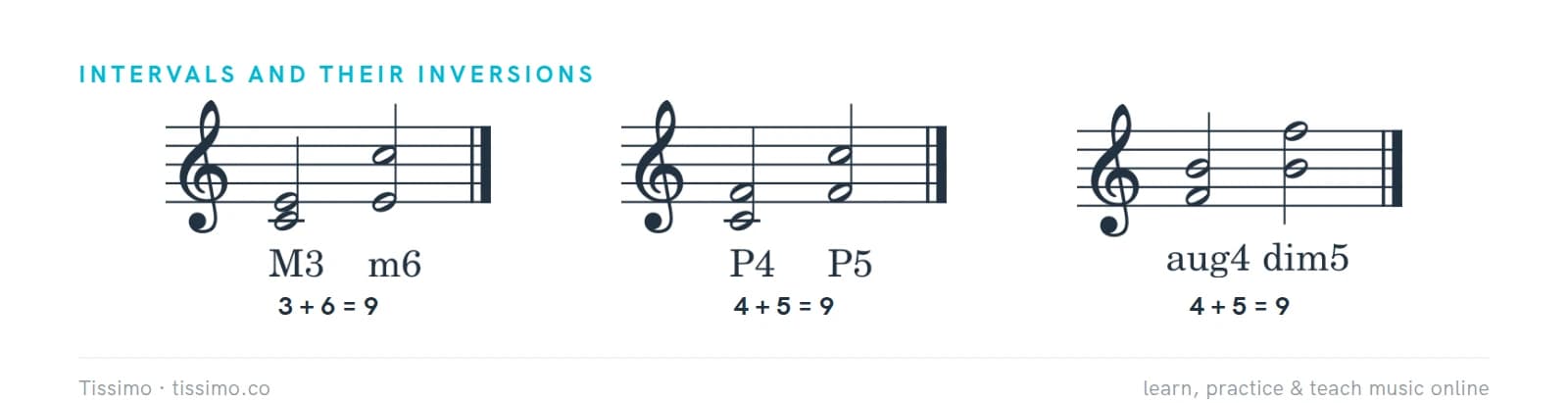
The rules of 9 and 12
Two sums give you the name of any inversion:
- The numbers add up to 9. A 3rd inverts to a 6th (3 + 6 = 9), a 2nd to a 7th, a 4th to a 5th and a unison to an octave.
- The half steps add up to 12. C–E is 4 half steps and E–C is 8; together they fill one octave.
The quality flips in a fixed way:
- perfect stays perfect
- major becomes minor, and minor becomes major
- augmented becomes diminished, and diminished becomes augmented
So a major 3rd (C–E) inverts to a minor 6th (E–C), a perfect 4th (C–F) to a perfect 5th (F–C), and an augmented 4th (F–B) to a diminished 5th (B–F).
Why it is useful
- Naming wide intervals quickly. Counting nine keys for a 6th is slow. Invert it instead: C♯ up to E is a minor 3rd, so E up to C♯ is a major 6th.
- Hearing them. Each wide interval has a narrow partner. If you know the sound of a minor 3rd, the major 6th is its mirror, and many musicians learn the wide intervals that way.
- Chords. Chord inversions change which note is in the bass, and the intervals above the bass change by exactly these rules. In a first-inversion C major chord (E–G–C), the notes above E form a 3rd and a 6th, which is where the figured bass label "6" comes from.
- Counterpoint. In counterpoint, two lines that can swap places (invertible counterpoint) only work if their intervals still sound right after inversion. Thirds become sixths, which is fine; fifths become fourths, which classical style treats with care when the bass is involved.
Two special cases
For an interval wider than an octave, reduce it to a simple interval first (compound interval): a major 10th inverts like a major 3rd, to a minor 6th. And the tritone is the only interval that inverts to its own size: six half steps plus six half steps.
Practice with Invert the intervals and Inverting intervals & compound intervals.
Common questions
How do you invert an interval?
Move the lower note up an octave, or the upper note down an octave, so the two notes swap places. The new number is 9 minus the old one; major and minor swap, augmented and diminished swap, and perfect stays perfect.
What is the inversion of a perfect fifth?
A perfect fourth. C–G inverts to G–C: the numbers add to 9 (5 + 4), and the half steps to 12 (7 + 5).
Practice it: free worksheets
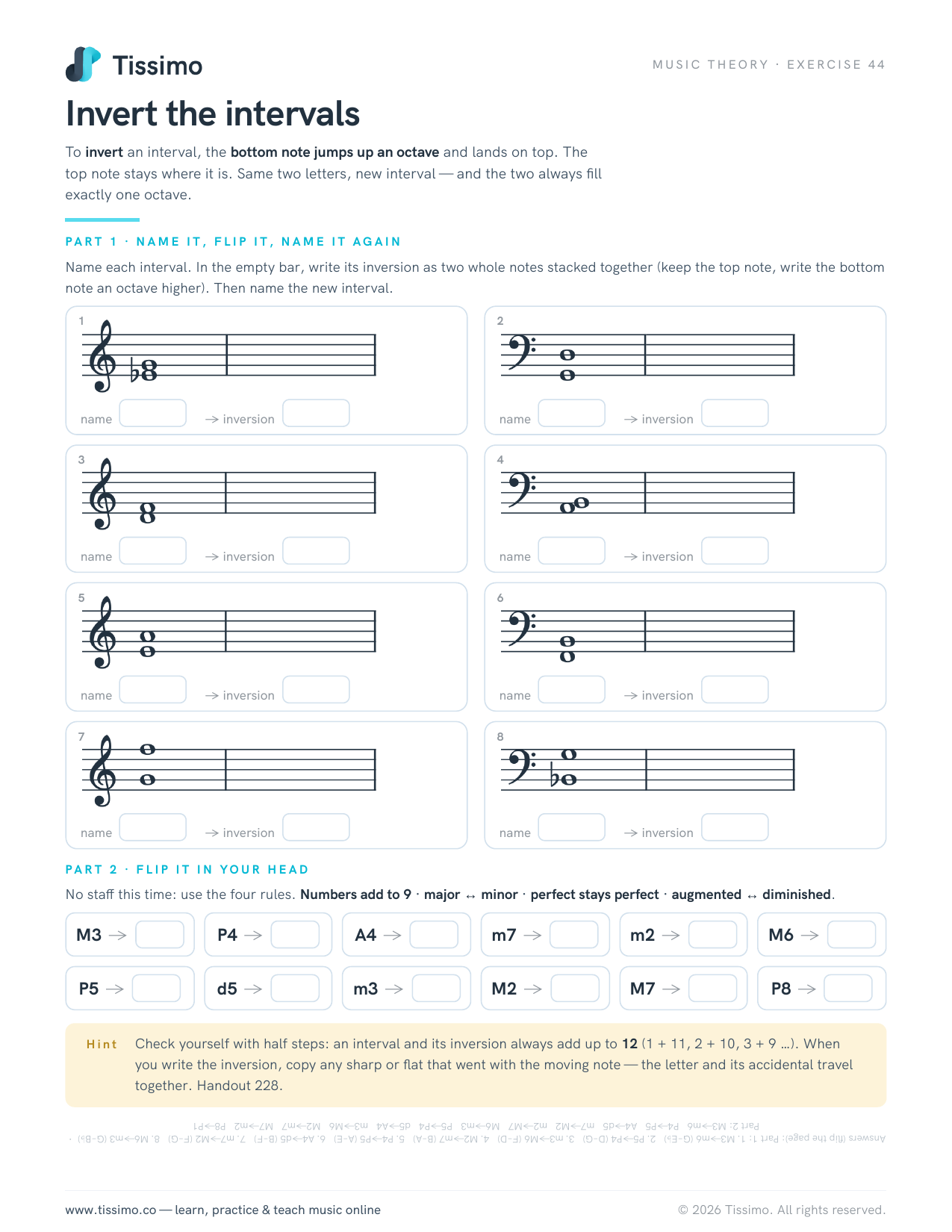 Invert the intervalsTo invert an interval, the bottom note jumps up an octave and lands on top. The top note stays where it is. Same two letters, new interval — and the two always fill exactly one octave.
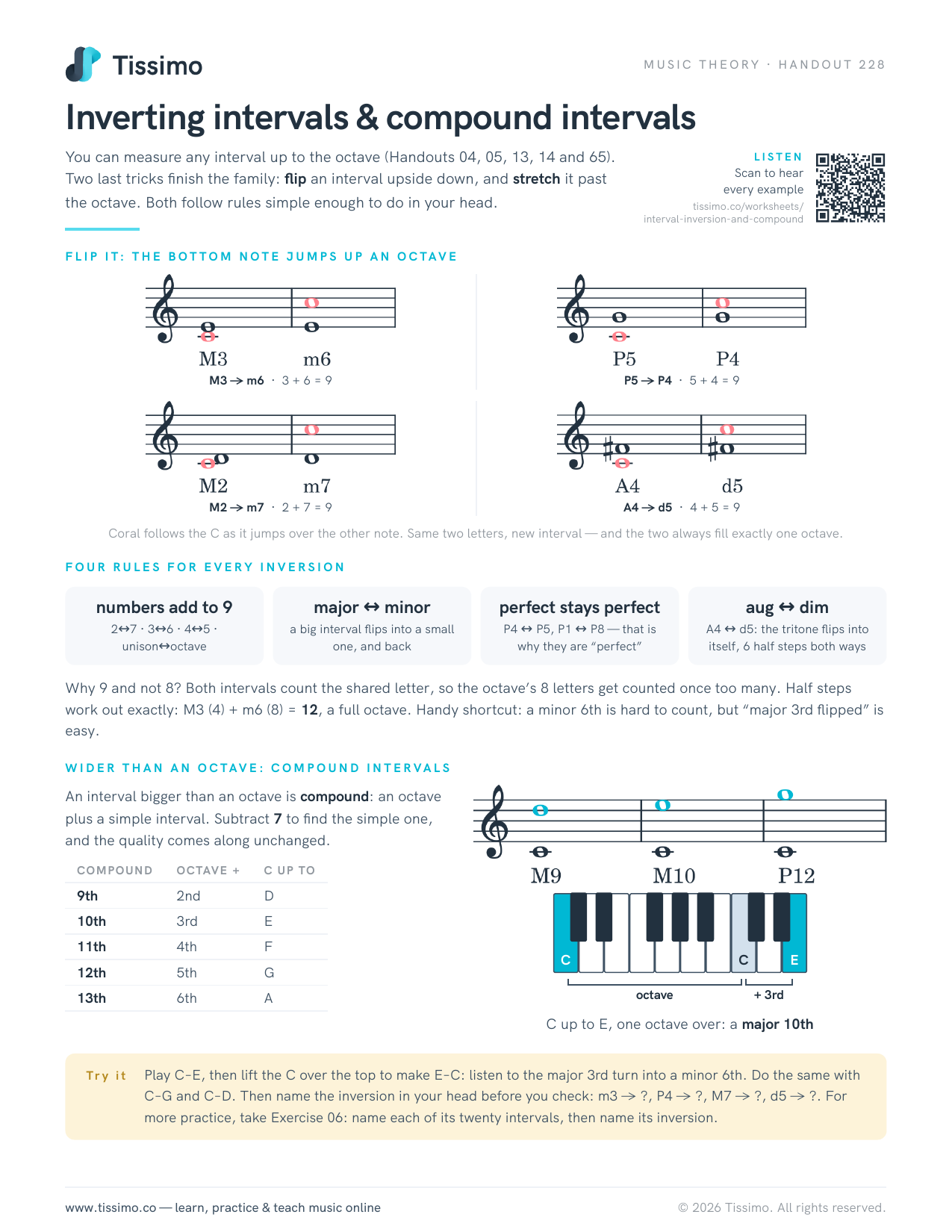 Inverting intervals & compound intervalsYou can measure any interval up to the octave (Handouts 04, 05, 13, 14 and 65). Two last tricks finish the family: flip an interval upside down, and stretch it past the octave. Both follow rules simple enough to do in your head.
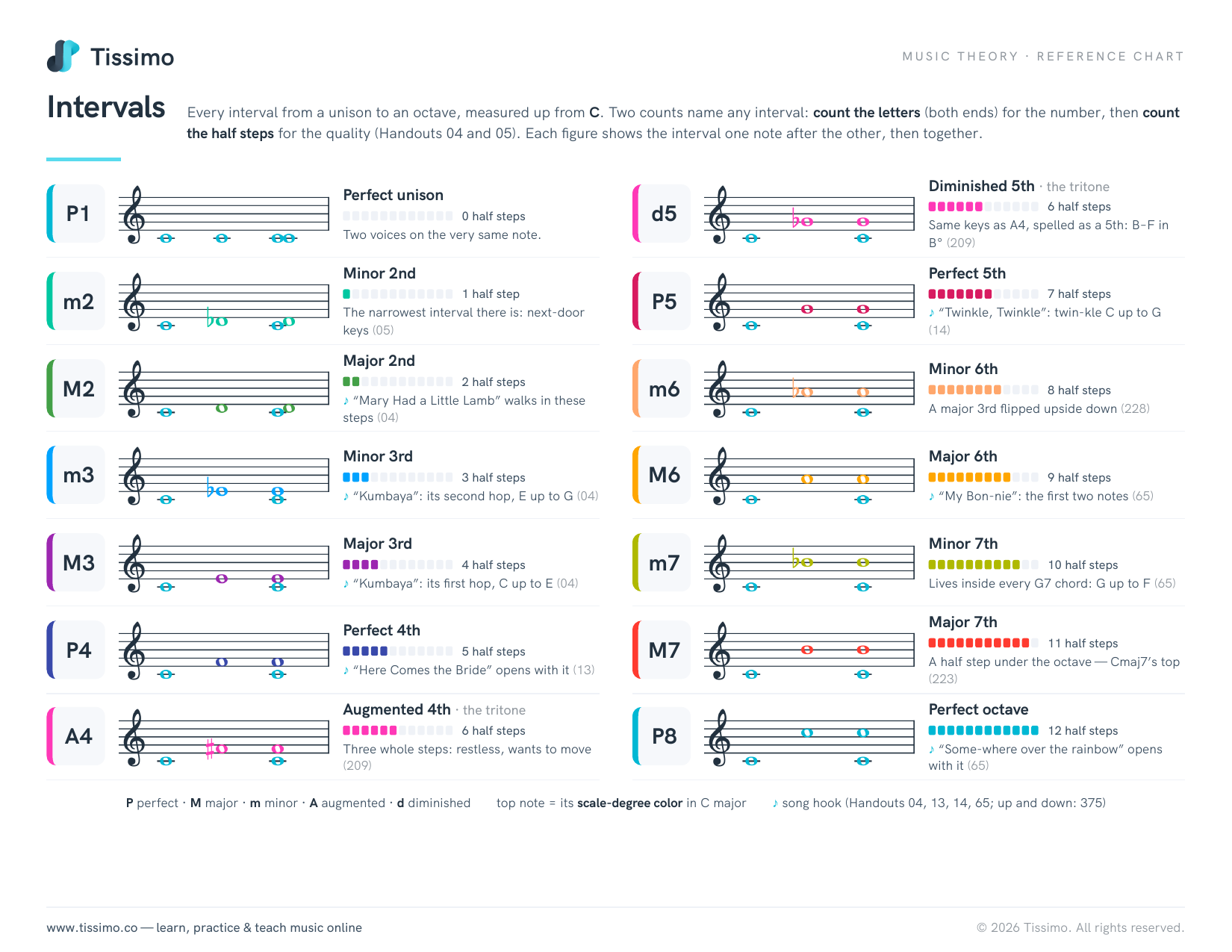 IntervalsEvery interval from a unison to an octave, measured up from C. Two counts name any interval: count the letters (both ends) for the number, then count the half steps for the quality (Handouts 04 and 05). Each figure shows the interval one note after the other, then together.
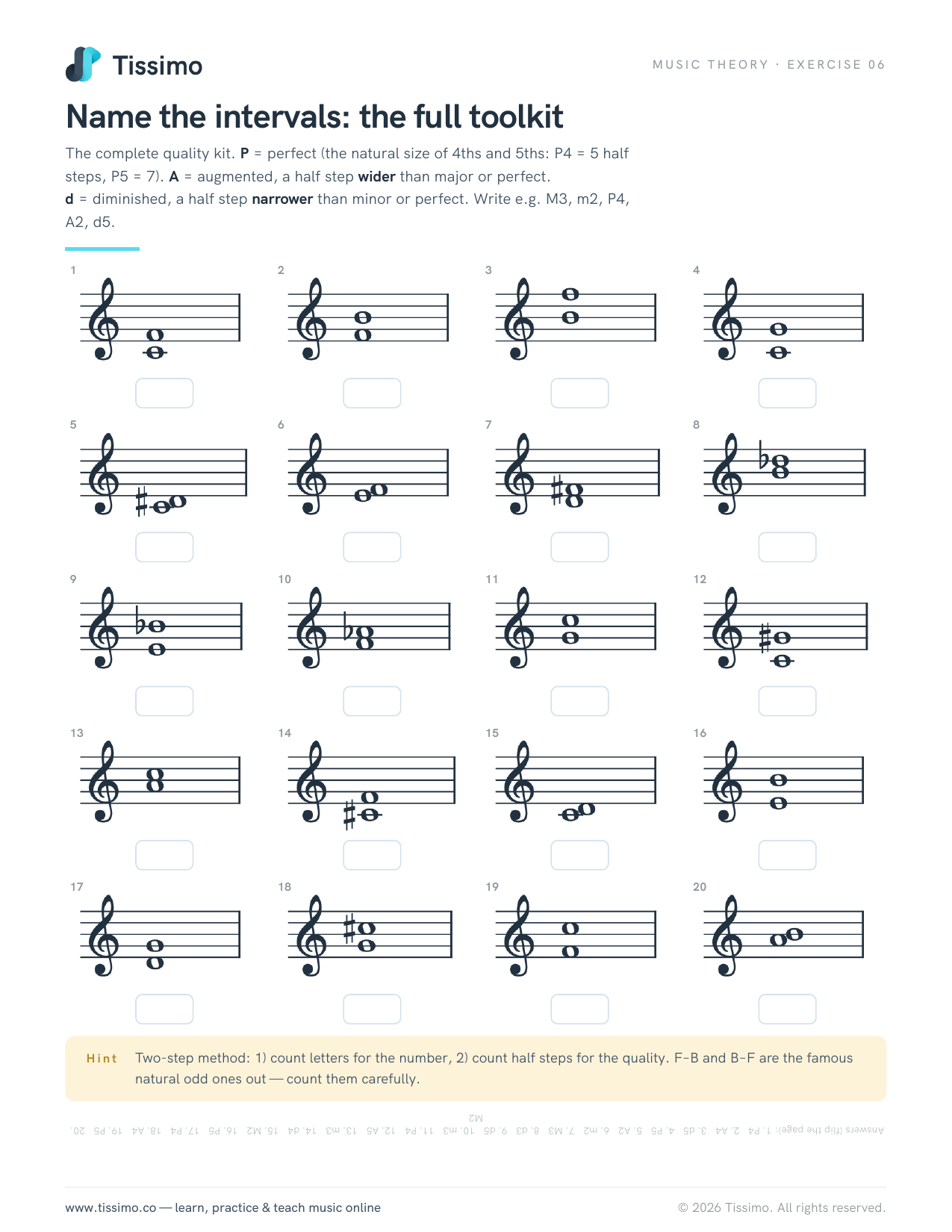 Name the intervals: the full toolkitThe complete quality kit. P = perfect (the natural size of 4ths and 5ths: P4 = 5 half steps, P5 = 7). A = augmented, a half step wider than major or perfect. d = diminished, a half step narrower than minor or perfect. Write e.g. M3, m2, P4, A2, d5.