Pitch & Intervals
Augmented Interval
Written as A
An augmented interval is one half step larger than a perfect or major interval with the same letter names, such as the augmented fourth C–F♯ or the augmented second C–D♯.
An augmented interval is a perfect or major interval stretched by one half step without changing its letter names. It is abbreviated A (or "aug"): A2, A4, A5.
- Perfect unison C–C (0) becomes augmented unison C–C♯ (1)
- Major 2nd C–D (2) becomes augmented 2nd C–D♯ (3)
- Perfect 4th C–F (5) becomes augmented 4th C–F♯ (6)
- Perfect 5th C–G (7) becomes augmented 5th C–G♯ (8)
- Major 6th C–A (9) becomes augmented 6th C–A♯ (10)
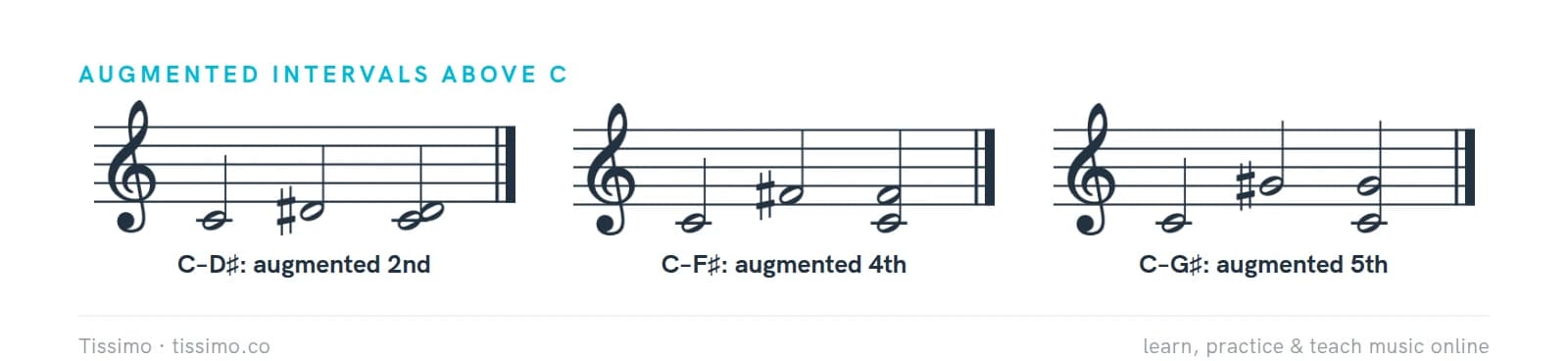
Because the letters stay put, the number does not change: C–D♯ is still a 2nd, since it spans only C and D. That is why an augmented interval often sounds exactly like an interval with another name. C–D♯ and C–E♭ are the same piano keys, but one is an augmented 2nd and the other a minor 3rd; they are enharmonic equivalent intervals.
Where augmented intervals appear
- Augmented 4th: the tritone from the 4th to the 7th degree of a major scale (F–B in C major).
- Augmented 2nd: between the 6th and 7th degrees of the harmonic minor scale (F–G♯ in A harmonic minor), the leap that gives that scale its distinctive sound.
- Augmented 5th: the outer interval of an augmented triad (C–E–G♯).
- Augmented 6th: the interval that names the augmented sixth chord (A♭ up to F♯ in C minor), which usually resolves outward to an octave on the dominant.
- Augmented unison: a chromatic half step, as in C–C♯.
Spelling them
Count letters first, then adjust the size with accidentals. For an augmented 5th above E: five letters up from E is B, and E–B is a perfect 5th (7 half steps), so raise the B to get E–B♯. Sometimes you need a double sharp: B–F♯ is already a perfect 5th, so an augmented 5th above B is B–F𝄪.
Inversion
An augmented interval inverts to a diminished one: the augmented 4th C–F♯ becomes the diminished 5th F♯–C, and the augmented 6th A♭–F♯ becomes the diminished 3rd F♯–A♭.
Augmented intervals are heard as dissonances, and they tend to resolve by widening, the way F–B opens out to E–C. Practice the whole family with Name the intervals: the full toolkit and Write the intervals.
Common questions
What is an augmented interval?
An interval one half step larger than a perfect or major interval, with the same letter names. C–F is a perfect 4th; C–F♯ is an augmented 4th.
Is an augmented 4th the same as a diminished 5th?
They sound the same, both six half steps (a tritone), but they are spelled differently: an augmented 4th spans four letter names (C–F♯), a diminished 5th five (C–G♭).
Practice it: free worksheets
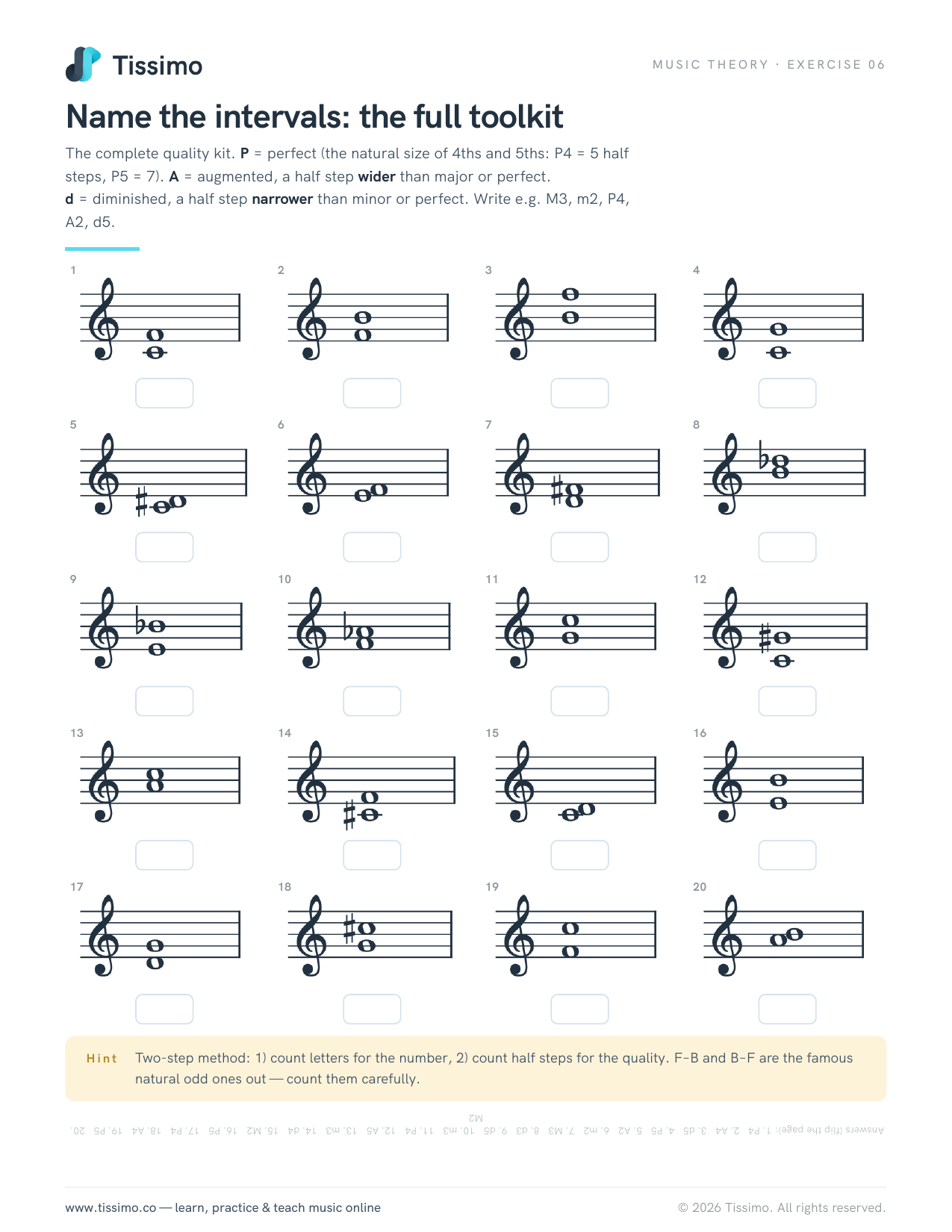 Name the intervals: the full toolkitThe complete quality kit. P = perfect (the natural size of 4ths and 5ths: P4 = 5 half steps, P5 = 7). A = augmented, a half step wider than major or perfect. d = diminished, a half step narrower than minor or perfect. Write e.g. M3, m2, P4, A2, d5.
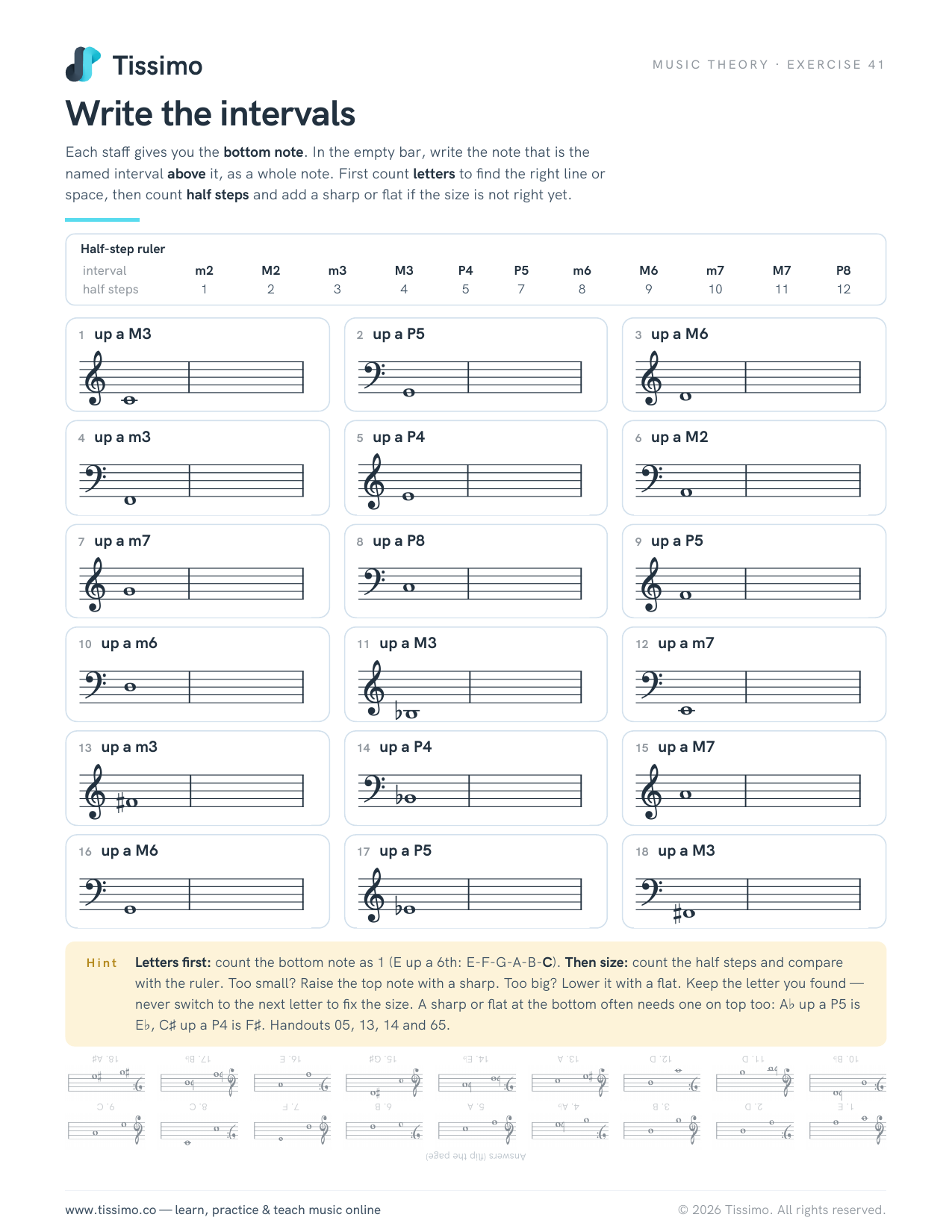 Write the intervalsEach staff gives you the bottom note. In the empty bar, write the note that is the named interval above it, as a whole note. First count letters to find the right line or space, then count half steps and add a sharp or flat if the size is not right yet.
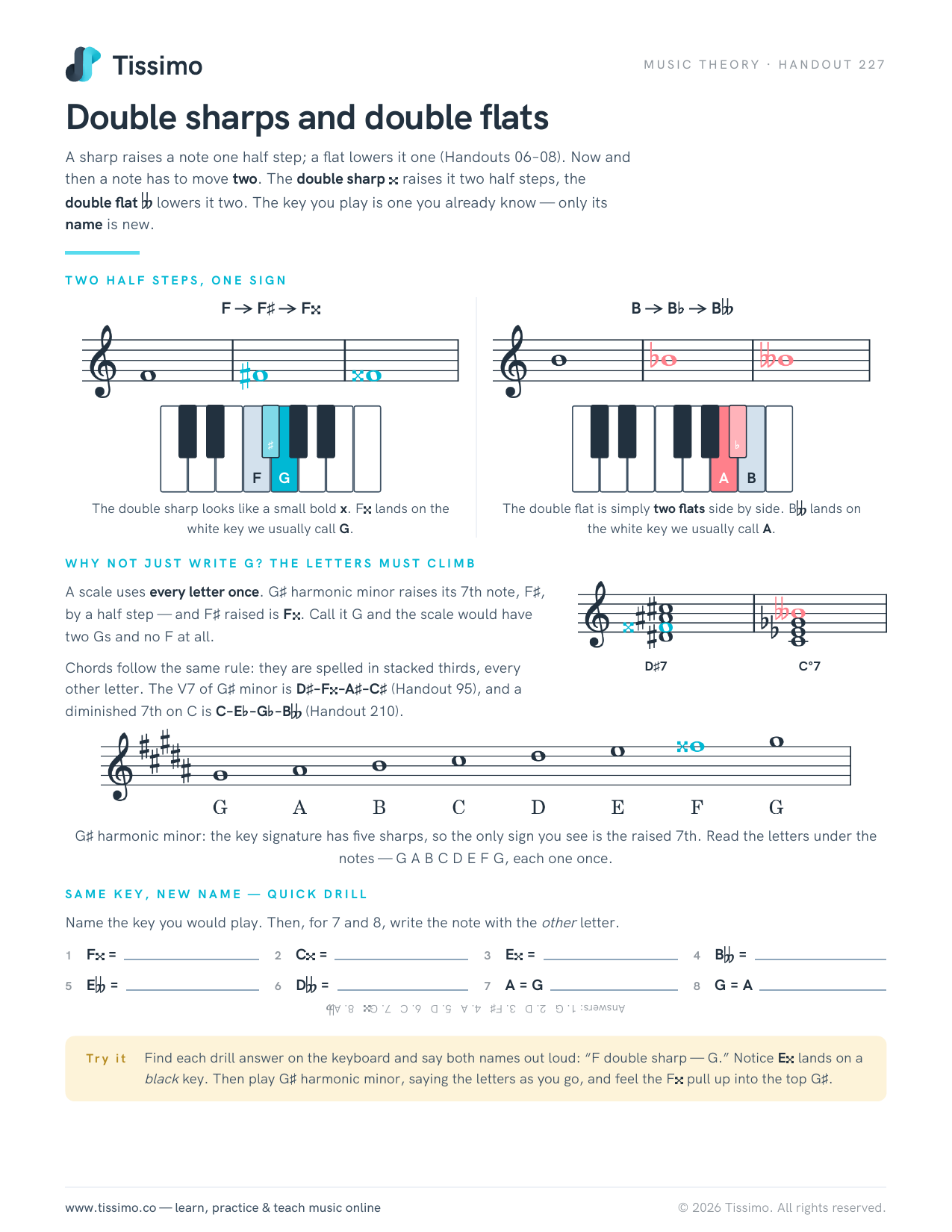 Double sharps and double flatsA sharp raises a note one half step; a flat lowers it one (Handouts 06–08). Now and then a note has to move two. The double sharp raises it two half steps, the double flat lowers it two. The key you play is one you already know — only its name is new.
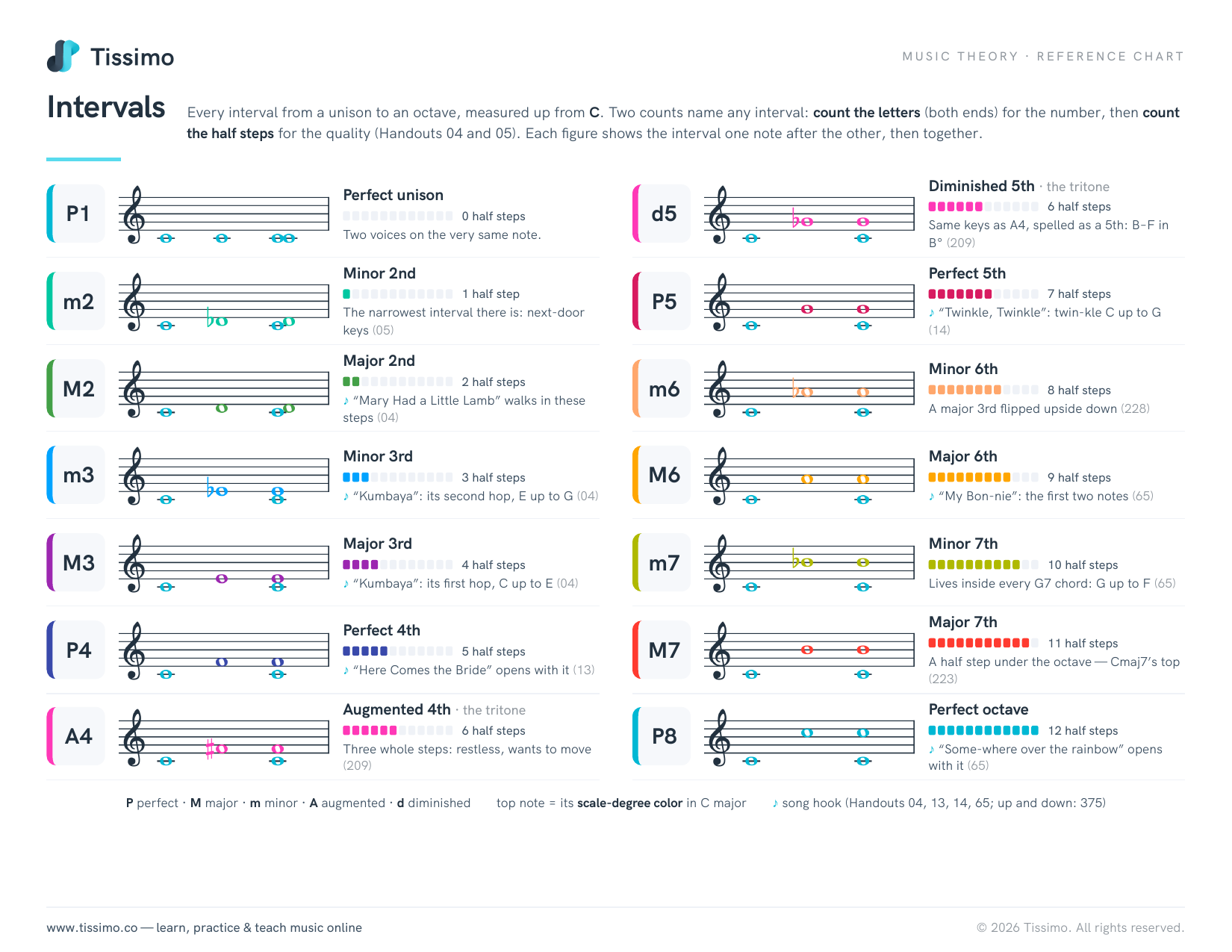 IntervalsEvery interval from a unison to an octave, measured up from C. Two counts name any interval: count the letters (both ends) for the number, then count the half steps for the quality (Handouts 04 and 05). Each figure shows the interval one note after the other, then together.
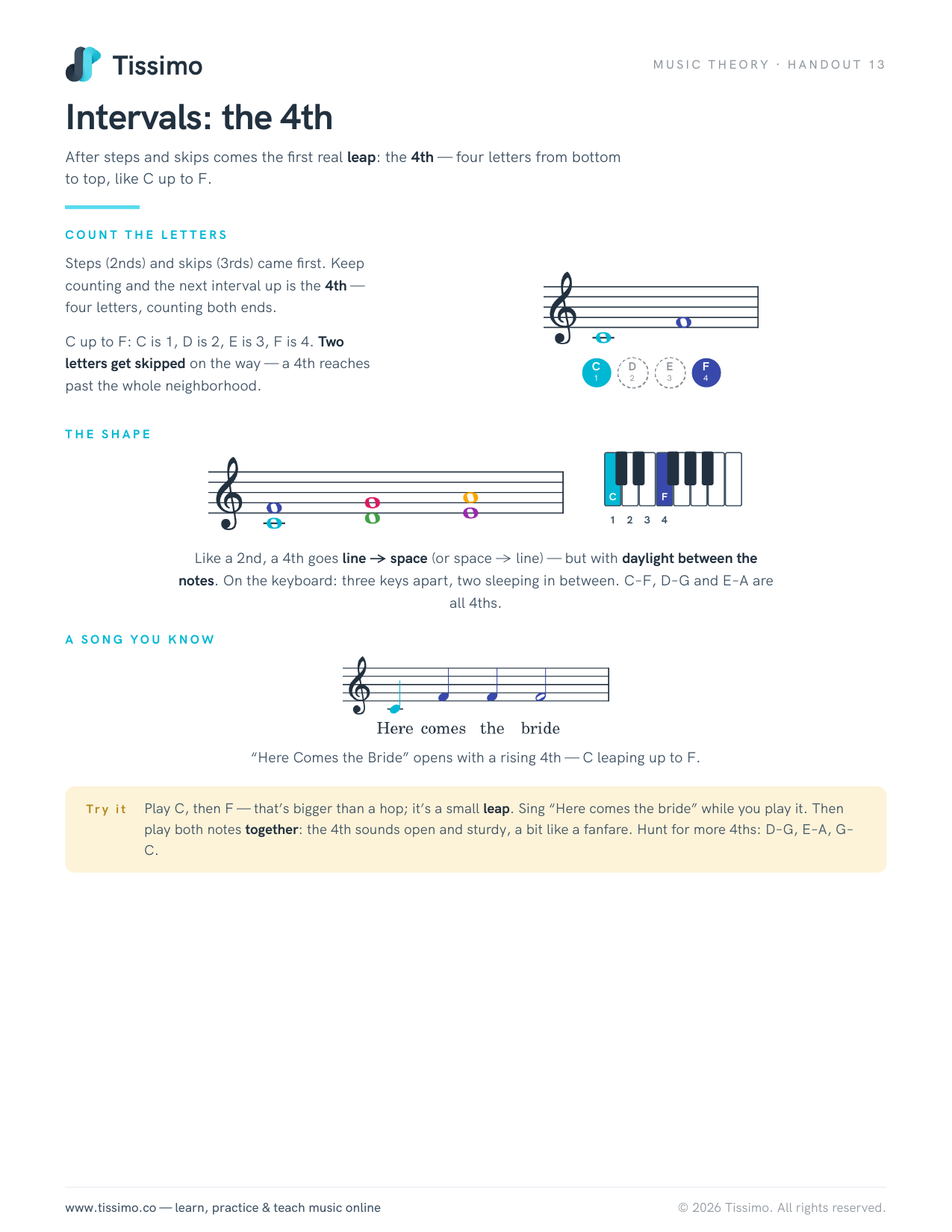 Intervals: the 4thAfter steps and skips comes the first real leap: the 4th — four letters from bottom to top, like C up to F.