Chords & Harmony
Augmented Sixth Chord
An augmented sixth chord is a predominant chord built around an augmented sixth between ♭6 and ♯4, such as F and D♯ in A minor, which expand outward to the dominant. It comes in Italian, French and German forms.
An augmented sixth chord is a chromatic predominant chord built around one interval: the augmented sixth between the lowered sixth degree in the bass and the raised fourth degree above it. In A minor those notes are F and D♯. An augmented sixth (10 half steps) wants to expand outward by half steps, F down to E and D♯ up to E, so that the two notes meet on the dominant an octave apart. That double pull into V makes these some of the most intense chords in tonal music.
The three types
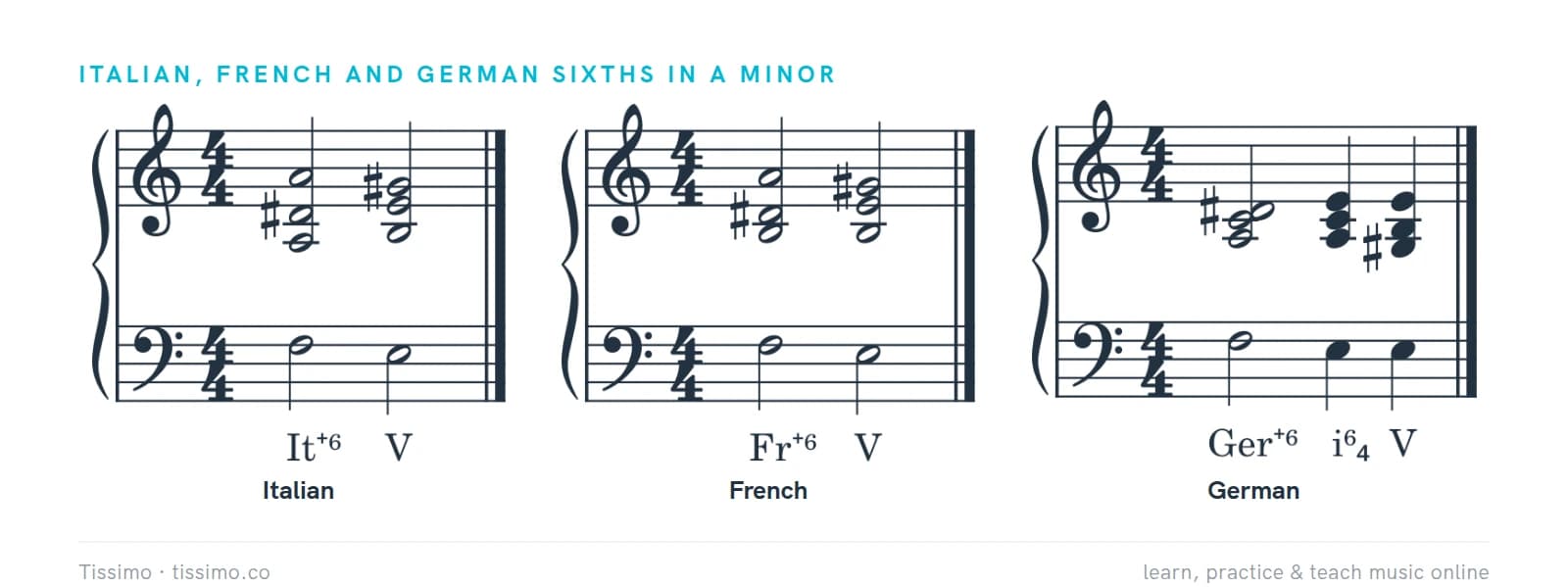
All three contain ♭6, the tonic and ♯4. They differ in their fourth note:
- Italian sixth (It+6): F–A–D♯. Just the three essential notes; in four parts the tonic (A) is doubled.
- French sixth (Fr+6): F–A–B–D♯. Adds the second degree, B, for a hollow, whole-tone sound.
- German sixth (Ger+6): F–A–C–D♯. Adds the third degree, C. It sounds exactly like a dominant seventh chord (F7), spelled differently.
How they resolve
The ♭6 falls a half step and the ♯4 rises a half step, both to the fifth degree (E), and the other notes move to the nearest notes of V. The Italian and French sixths resolve straight to V. The German sixth usually passes through a cadential six-four (i6/4) first, because moving it straight to V would create parallel fifths and octaves between F–C and E–B.
In major keys
In a major key the chords need more borrowed notes. In C major the essential interval is A♭ up to F♯: the Italian sixth is A♭–C–F♯, the French A♭–C–D–F♯, and the German A♭–C–E♭–F♯.
The names
The three national names are traditional labels from theory teaching; they are not a reliable guide to where each chord came from. Some textbooks avoid them and describe the chords by their notes instead.
Spelling matters
Because the German sixth sounds like a dominant seventh chord, composers can use it as a pivot for modulation. Heard as F7, it could lead to B♭; heard as a German sixth, it leads to E. Spelling the top note D♯ rather than E♭ tells the performer which way the chord is going.
Practice with Augmented sixth chords and Label the chromatic chords.
Common questions
Why does the German sixth sound like a dominant seventh chord?
Its notes are enharmonically the same: F–A–C–D♯ sounds identical to F–A–C–E♭, which is F7. Only the spelling, and the way it resolves, are different.
How do you resolve an augmented sixth chord?
Move the two notes of the augmented sixth outward by half step to the fifth degree, an octave apart (F to E and D♯ to E in A minor), and move the other notes to the nearest notes of V. The German sixth usually passes through a cadential six-four first.
Practice it: free worksheets
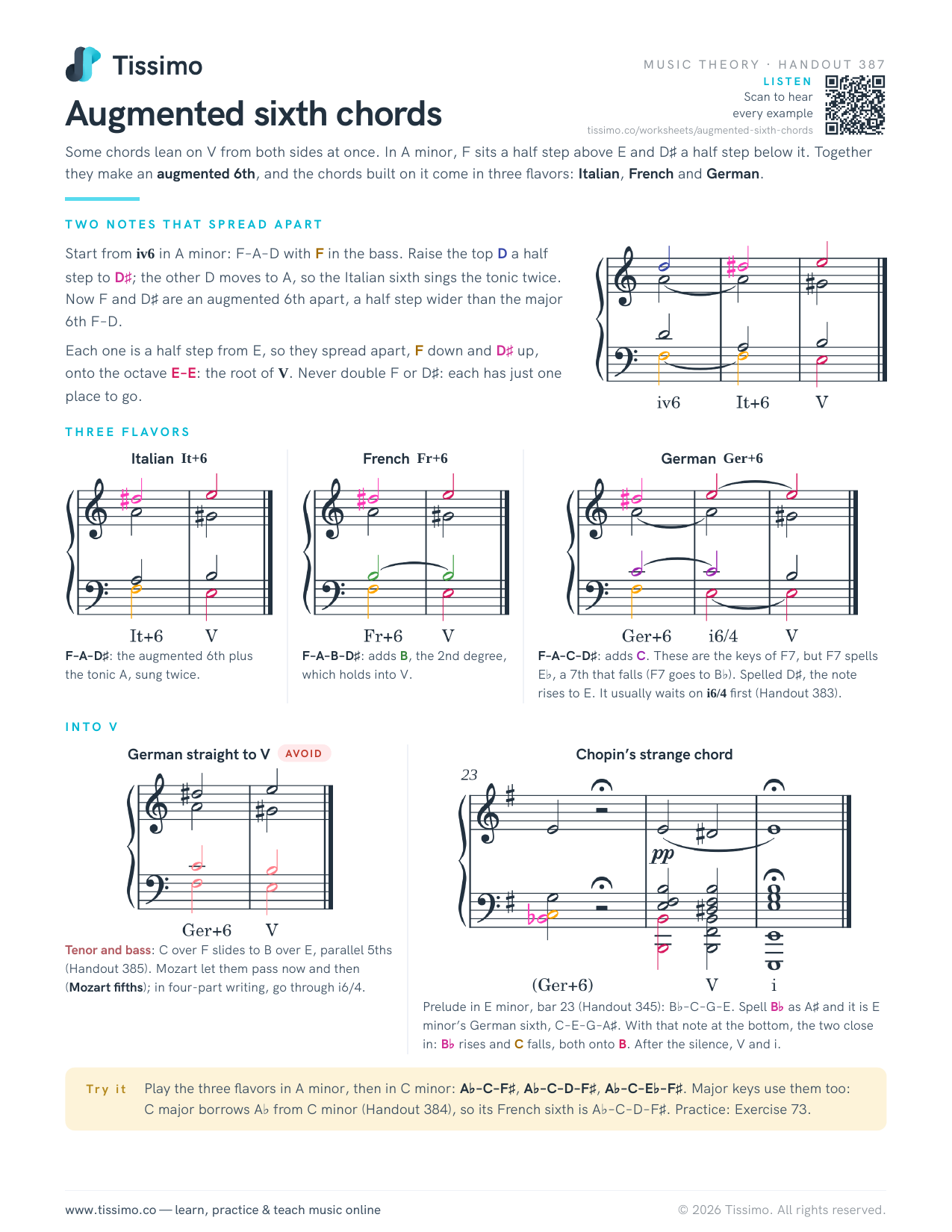 Augmented sixth chordsSome chords lean on V from both sides at once. In A minor, F sits a half step above E and D♯ a half step below it. Together they make an augmented 6th, and the chords built on it come in three flavors: Italian, French and German.
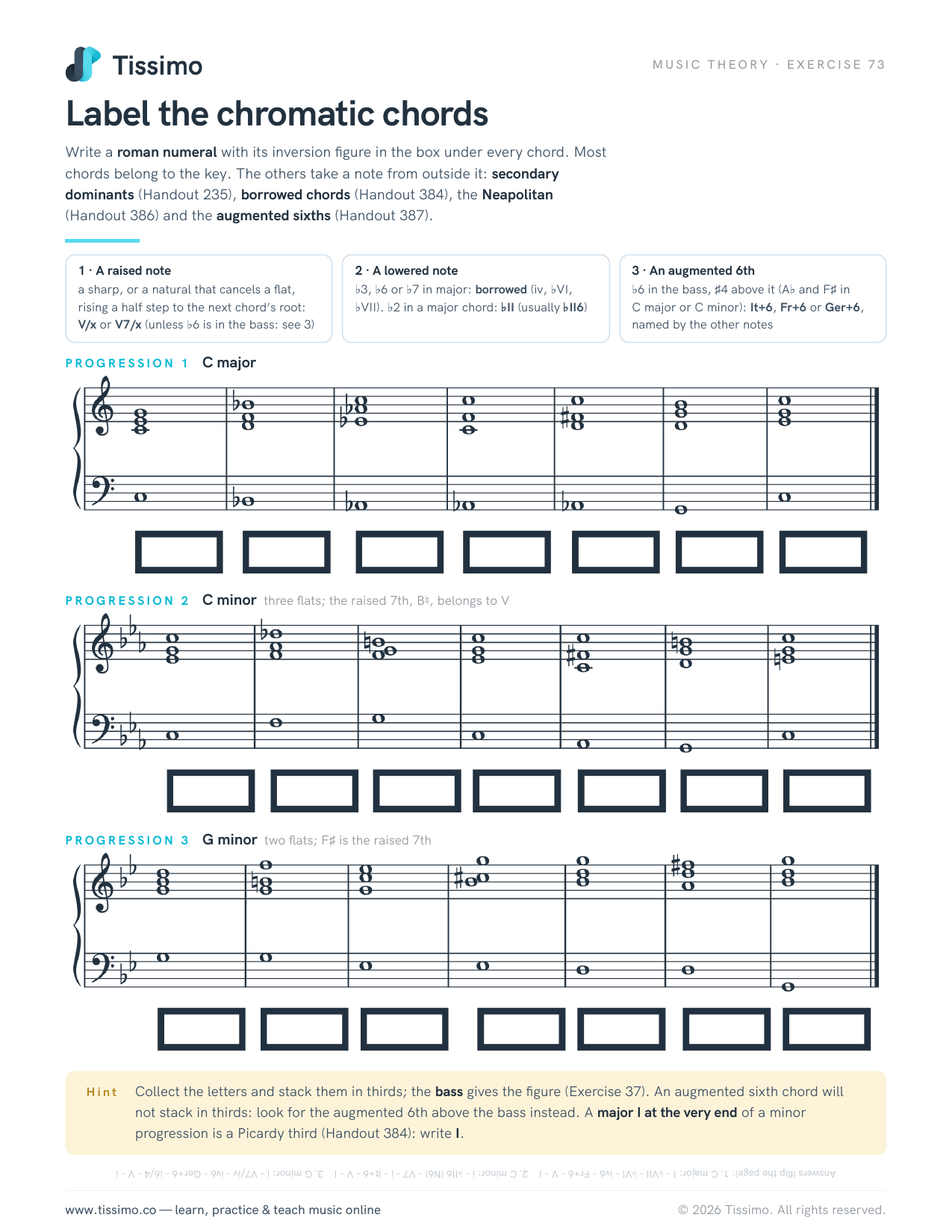 Label the chromatic chordsWrite a roman numeral with its inversion figure in the box under every chord. Most chords belong to the key. The others take a note from outside it: secondary dominants (Handout 235), borrowed chords (Handout 384), the Neapolitan (Handout 386) and the augmented sixths (Handout 387).