Chords & Harmony
Neapolitan Sixth
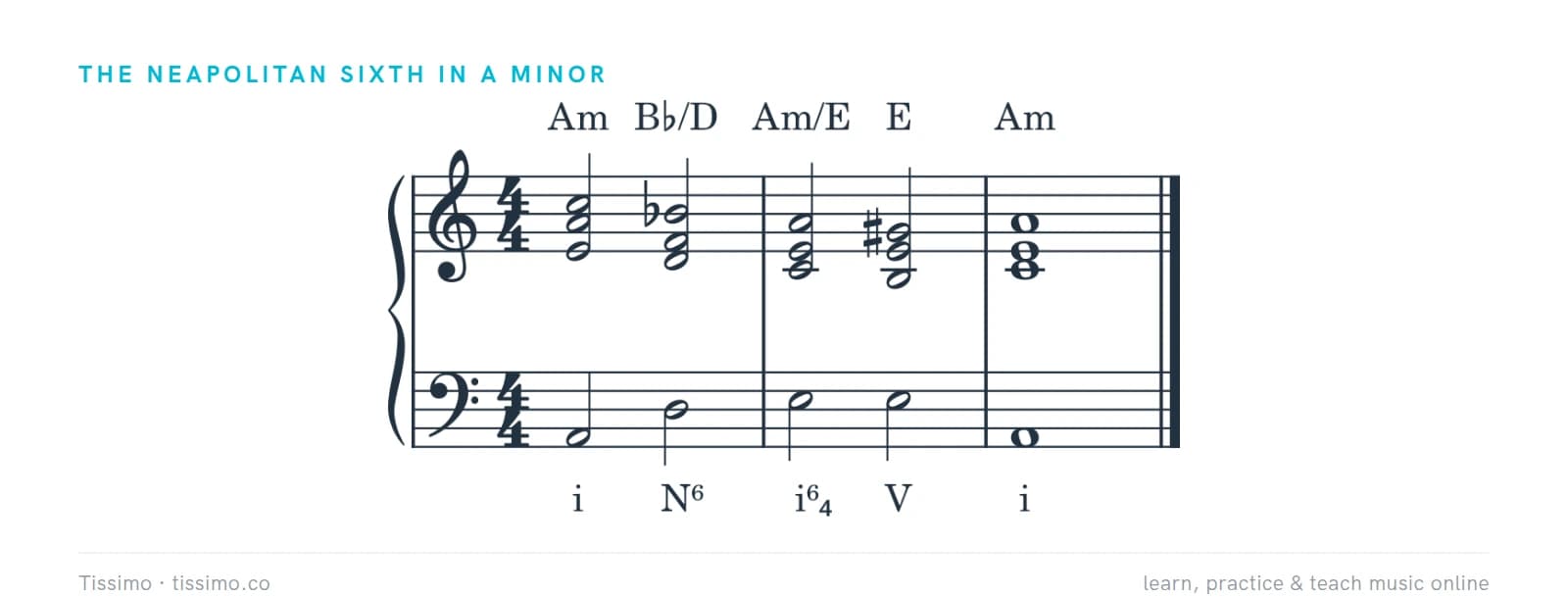
The Neapolitan sixth is a major chord built on the lowered second degree of a key, usually in first inversion: B♭/D in A minor. It is a dark, dramatic predominant chord that leads to the dominant.
The Neapolitan sixth is a major chord built on the lowered second degree of the key, usually played in first inversion. In A minor the chord is B♭–D–F with D in the bass; in C minor it is D♭–F–A♭ with F in the bass. It is written N6 or ♭II6. Its root lies a half step above the tonic, and that unexpected half step gives the chord its dark, dramatic color.
How it is built
- Lower the second degree of the scale: in A minor, B becomes B♭.
- Build a major triad on it: B♭–D–F.
- Put its third, D, in the bass. That makes it a "sixth" chord, because the root, B♭, is a sixth above the bass.
In a minor key, D and F already belong to the key, so only B♭ is chromatic. In a major key the chord needs two borrowed notes: in C major, N6 is D♭–F–A♭.
What it does
The Neapolitan is a predominant chord (harmonic function): it leads to V, either directly or through a cadential six-four chord (i6/4–V). Its lowered second degree (B♭) usually falls toward the leading tone, either through the tonic (B♭–A–G♯) or straight down a diminished third (B♭–G♯). In four-part writing the bass note (D) is usually the doubled note, and B♭ often sits in the top voice.
The name
The chord is associated with 18th-century opera composers working in Naples, although composers elsewhere used it as well, and earlier. In the Classical and Romantic periods it became a standard way to darken a cadence, especially in minor keys.
A connection to jazz
A dominant seventh chord on the same lowered second degree (B♭7 in A minor, D♭7 in C major) is the tritone substitution for V7. Jazz musicians reach the ♭II sound from a different direction, but the half-step slide down into the tonic is the same.
Practice with The Neapolitan sixth and Label the chromatic chords.
Common questions
Why is it called the Neapolitan sixth?
"Neapolitan" refers to the 18th-century opera composers in Naples associated with it, and "sixth" to its usual first inversion, in which the root is a sixth above the bass.
Can the Neapolitan chord be in root position?
Yes, though it is less common. In root position it is written ♭II (or N); the first-inversion form, N6, is the classic one.
Practice it: free worksheets
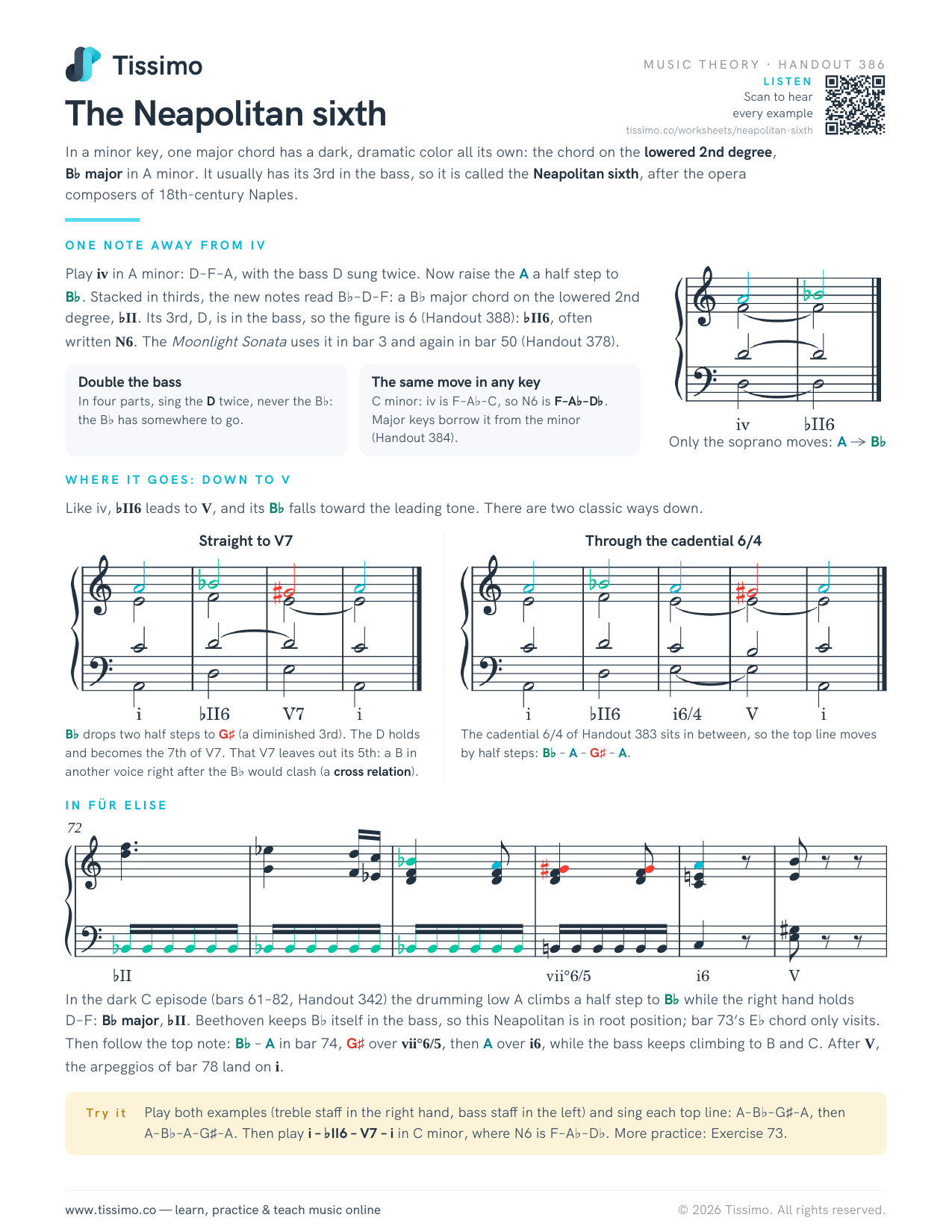 The Neapolitan sixthIn a minor key, one major chord has a dark, dramatic color all its own: the chord on the lowered 2nd degree, B♭ major in A minor. It usually has its 3rd in the bass, so it is called the Neapolitan sixth, after the opera composers of 18th-century Naples.
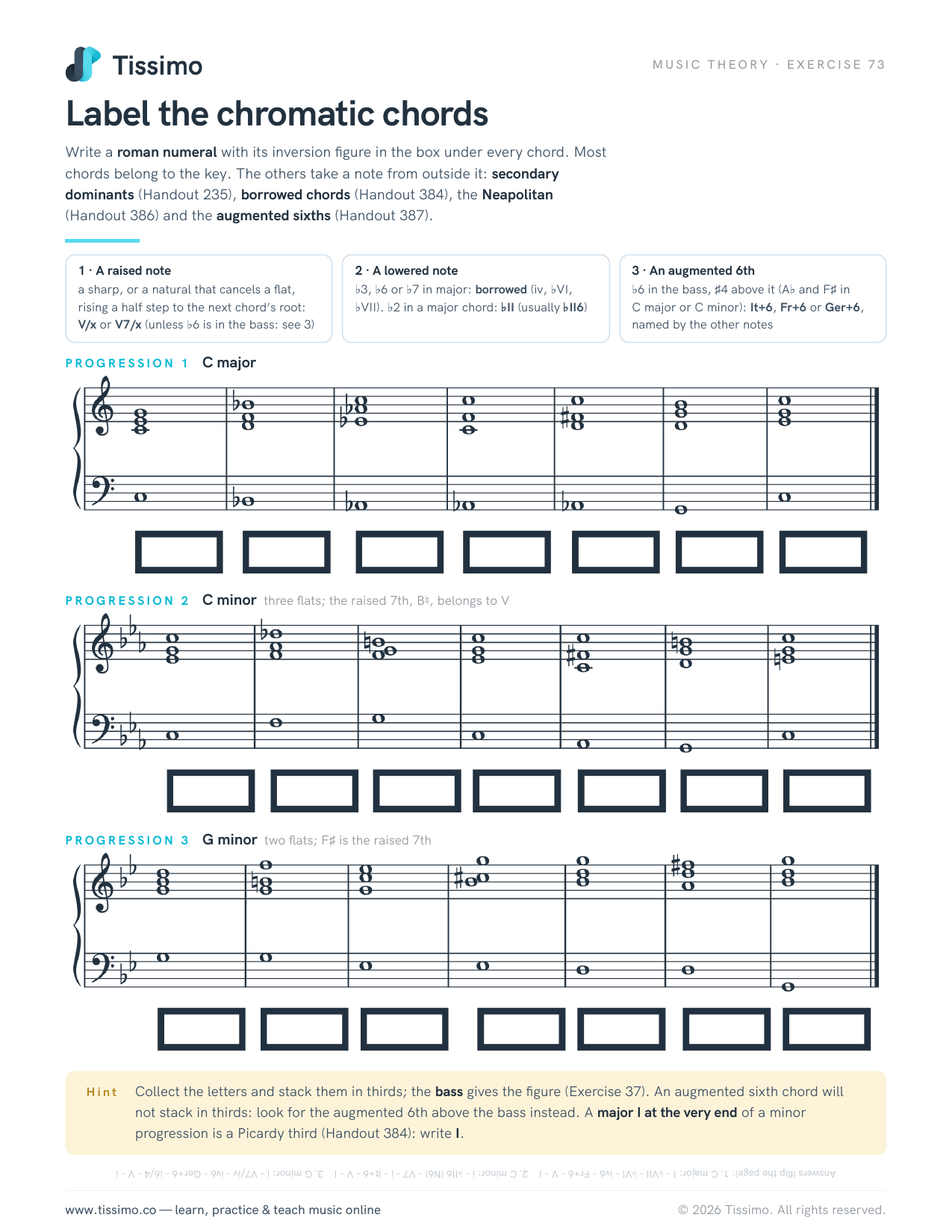 Label the chromatic chordsWrite a roman numeral with its inversion figure in the box under every chord. Most chords belong to the key. The others take a note from outside it: secondary dominants (Handout 235), borrowed chords (Handout 384), the Neapolitan (Handout 386) and the augmented sixths (Handout 387).