Chords & Harmony
Tritone Substitution
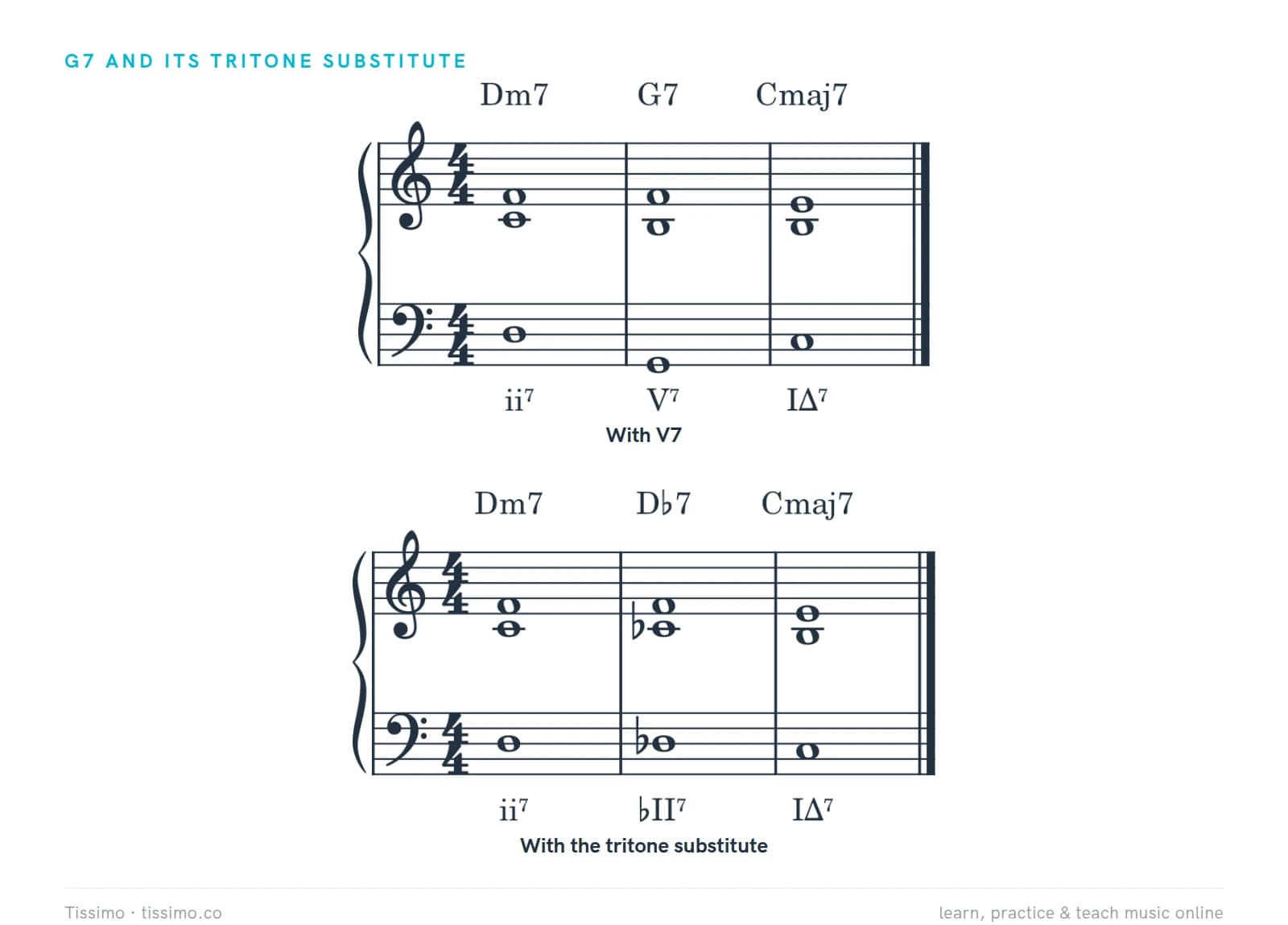
A tritone substitution replaces a dominant seventh chord with the dominant seventh a tritone away, such as D♭7 instead of G7 before C. Both chords share the same tritone, so the substitute resolves just as well.
A tritone substitution replaces a dominant seventh chord with another dominant seventh whose root is a tritone (6 half steps) away. In C major, instead of G7 (G–B–D–F) you play D♭7 (D♭–F–A♭–C♭). It is one of the most common reharmonization tricks in jazz.
Why it works
What makes a dominant seventh chord pull toward its tonic is the tritone between its third and seventh: in G7, B and F. That interval splits the octave exactly in half, so its two notes form a tritone in either order. D♭7 contains the same pair, F (its third) and C♭ (its seventh, the same piano key as B). Those two notes resolve exactly as they do in G7, to E and C, so D♭7 leads to C just as well.
What changes is the bass, which now slides down by half step (D – D♭ – C in a ii–V–I) instead of leaping, and the color: D♭7's other notes, D♭ and A♭, sound like the lowered fifth and the lowered ninth of G7, which jazz musicians hear as bluesy, tense extensions.
Writing it
- In Roman numerals the substitute is often written ♭II7 or subV7.
- You will often see D♭7's seventh written as B instead of C♭; it is the same key on the piano.
- The same trick works on secondary dominants: E♭7 can replace A7 before D minor, A♭7 can replace D7 before G.
Related sounds
A dominant seventh on the lowered second degree also connects tritone substitution to older harmony. Its root is the root of the Neapolitan sixth, and, like a German augmented sixth chord, it is a dominant-seventh sound placed a half step above the chord it leads to.
Practice the plain progression first with The ii–V–I in Every Key and Shell Voicings, then try replacing each V7 with the chord a tritone away.
Common questions
Why does a tritone substitution work?
A dominant seventh chord's pull comes from the tritone between its third and seventh. The chord a tritone away contains the same two notes (F and B in G7 and D♭7), so it resolves to the same tonic.
Can any dominant chord be replaced by its tritone substitute?
Any dominant seventh that resolves down a fifth can be. In practice jazz musicians use it most on V7 and on secondary dominants, and they choose by ear, since the substitute changes the bass line and the melody's relation to the chord.
Practice it: free worksheets
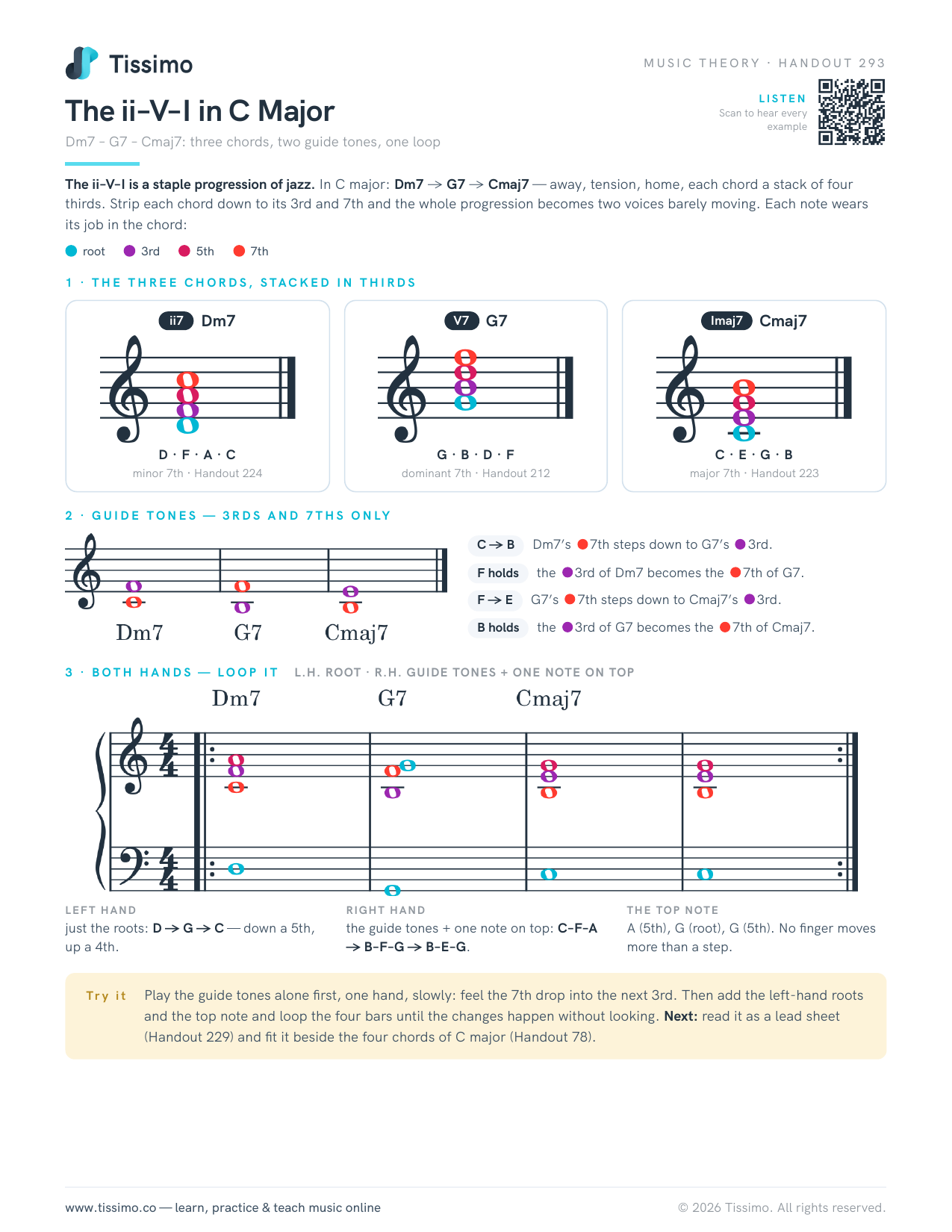 The ii–V–I in Every KeyThe most-played progression in jazz: three chords, two guide tones, one loop, in all 24 keys.
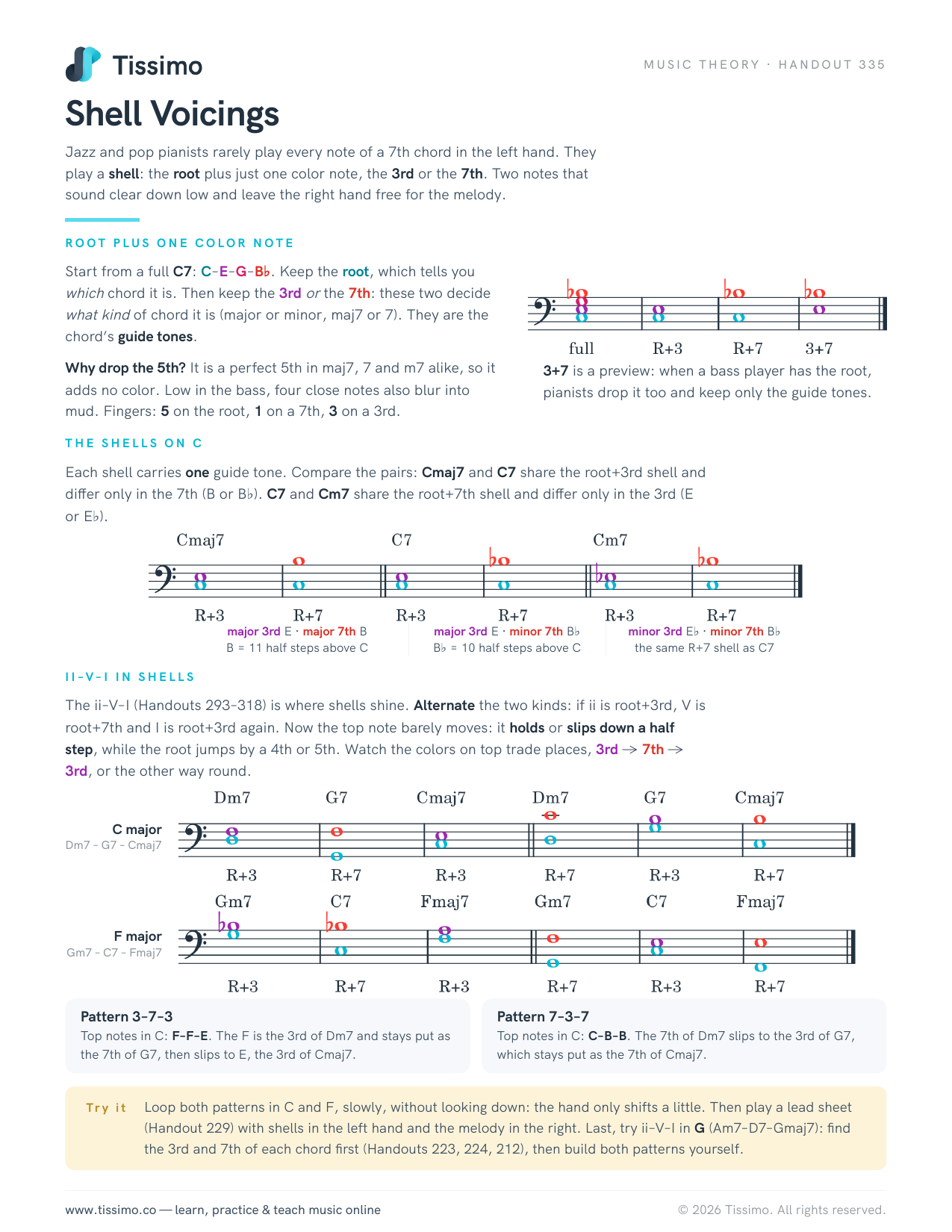 Shell VoicingsJazz and pop pianists rarely play every note of a 7th chord in the left hand. They play a shell: the root plus just one color note, the 3rd or the 7th. Two notes that sound clear down low and leave the right hand free for the melody.
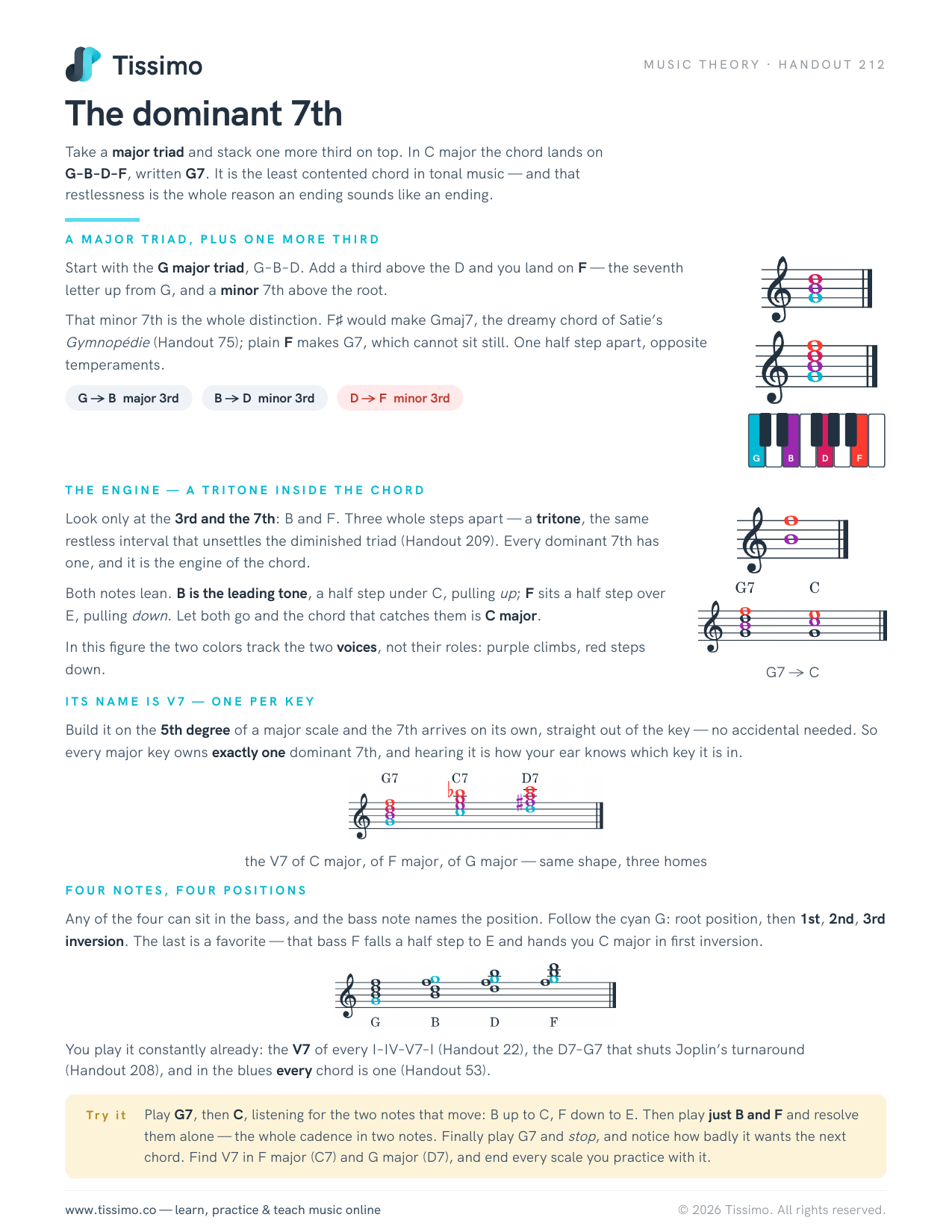 The dominant 7thTake a major triad and stack one more third on top. In C major the chord lands on G–B–D–F, written G7. It is the least contented chord in tonal music — and that restlessness is the whole reason an ending sounds like an ending.