Chords & Harmony
Secondary Dominant
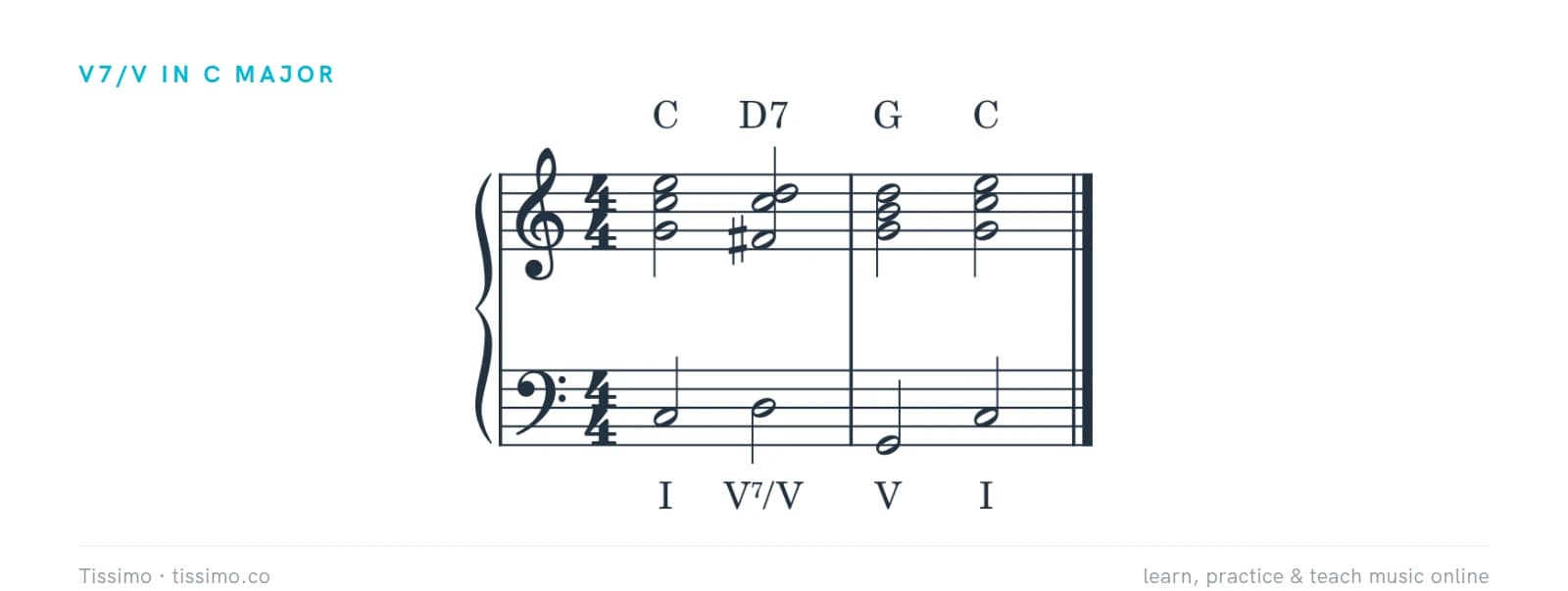
A secondary dominant is a dominant chord aimed at a chord other than the tonic, such as D7 (V7/V) leading to G in C major. It brings in a note from outside the key and briefly makes its target sound like home.
A secondary dominant is a dominant chord that belongs to a chord other than the tonic. In C major the dominant is G. But G major has a dominant of its own, D major, and when a C-major piece plays D or D7 just before G, that chord acts as "the dominant of the dominant". Analysts write it V/V or V7/V, read "five of five".
Building one
- Pick the chord you want to approach, the target: say D minor (ii) in C major.
- Count up a perfect fifth from its root: D up to A.
- Build a major triad or a dominant seventh chord there: A–C♯–E(–G).
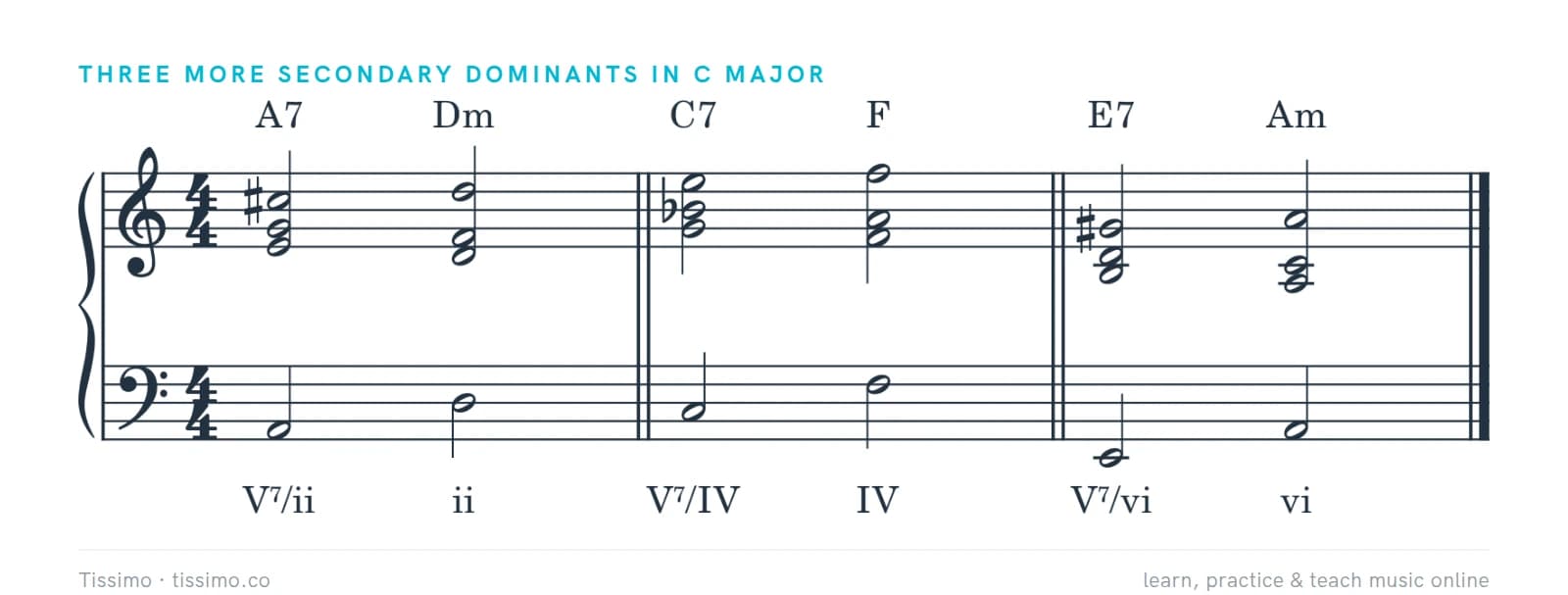
That chord, A7, is V7/ii. Its raised note, C♯, is a temporary leading tone that pulls up to the target's root, D. In C major you can write V/ii (A), V/iii (B), V/IV (C, or C7 with B♭), V/V (D) and V/vi (E). The diminished vii° has no secondary dominant, because a diminished triad cannot sound like a temporary tonic.
How to spot one
Look for an accidental that does not belong to the key and leads by half step into the root of the next chord: F♯ going to G, C♯ to D, G♯ to A. If the chord containing it is major or a dominant seventh, and the next chord's root lies a fifth below, you have found a secondary dominant. V7/IV is the exception: in C7 the borrowed note is the seventh, B♭, which falls to A.
Tonicization and modulation
For a moment, a secondary dominant makes its target sound like a tonic. This brief borrowing is called tonicization. If the music stays in the new key and confirms it with a cadence, it has gone further: that is a modulation.
In practice
Secondary dominants turn up everywhere: in Bach chorales and Classical sonatas, in ragtime and early jazz (where chains like E7 – A7 – D7 – G7 – C make each chord the dominant of the next), and in pop songs that slip a major II chord (D major in C) in before V.
Practice with Secondary dominants and Spot the secondary dominants, and train your ear with Hear the Raised Note Before Five.
Common questions
What does V/V mean?
Five of five: the dominant chord of the dominant. In C major the dominant is G, and G's own dominant is D, so V/V is D major (and V7/V is D7).
How do you find a secondary dominant?
Take the chord you want to approach, count up a perfect fifth from its root, and build a major triad or a dominant seventh chord on that note.
Practice it: free worksheets
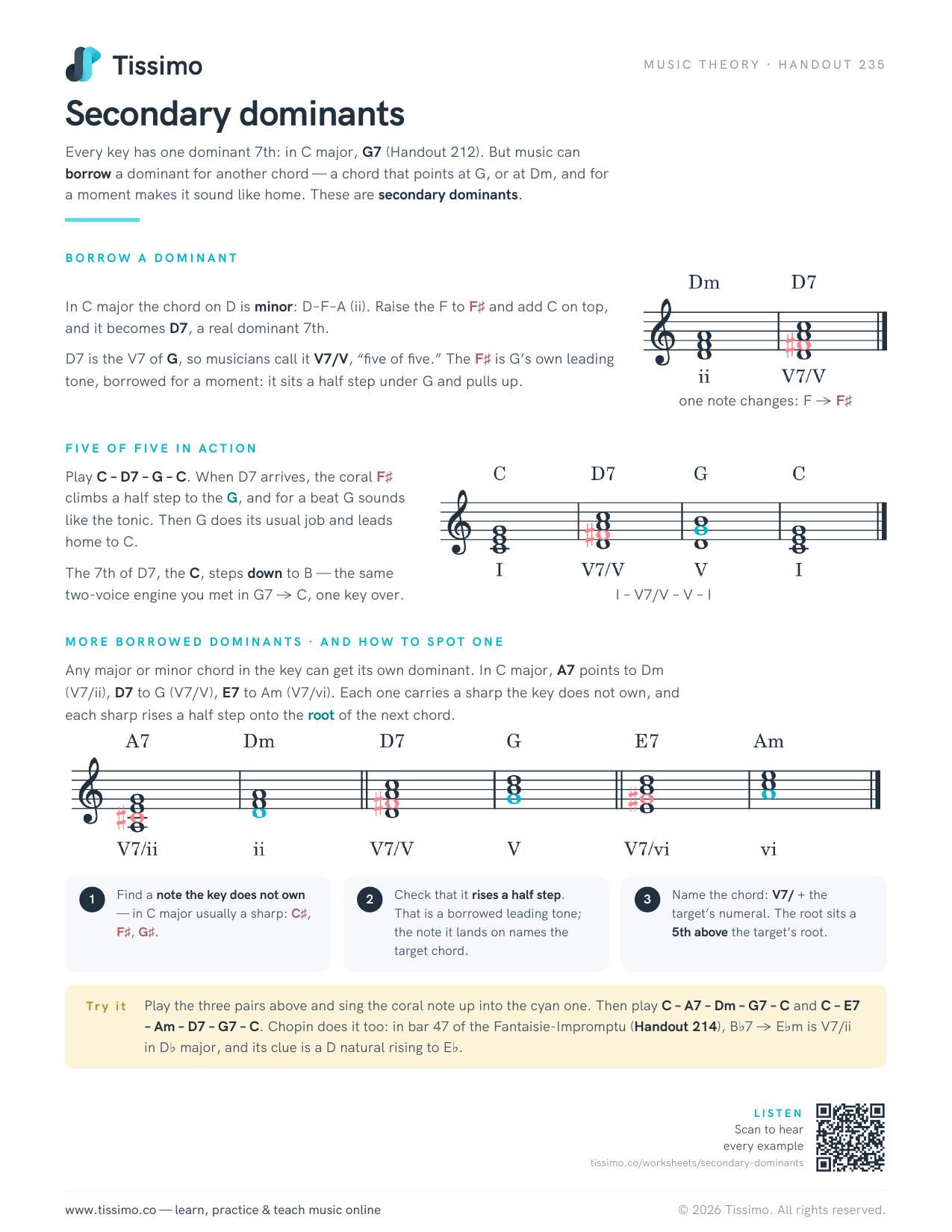 Secondary dominantsEvery key has one dominant 7th: in C major, G7 (Handout 212). But music can borrow a dominant for another chord — a chord that points at G, or at Dm, and for a moment makes it sound like home. These are secondary dominants. (Borrowing a chord from the parallel minor is different: Handout 384.)
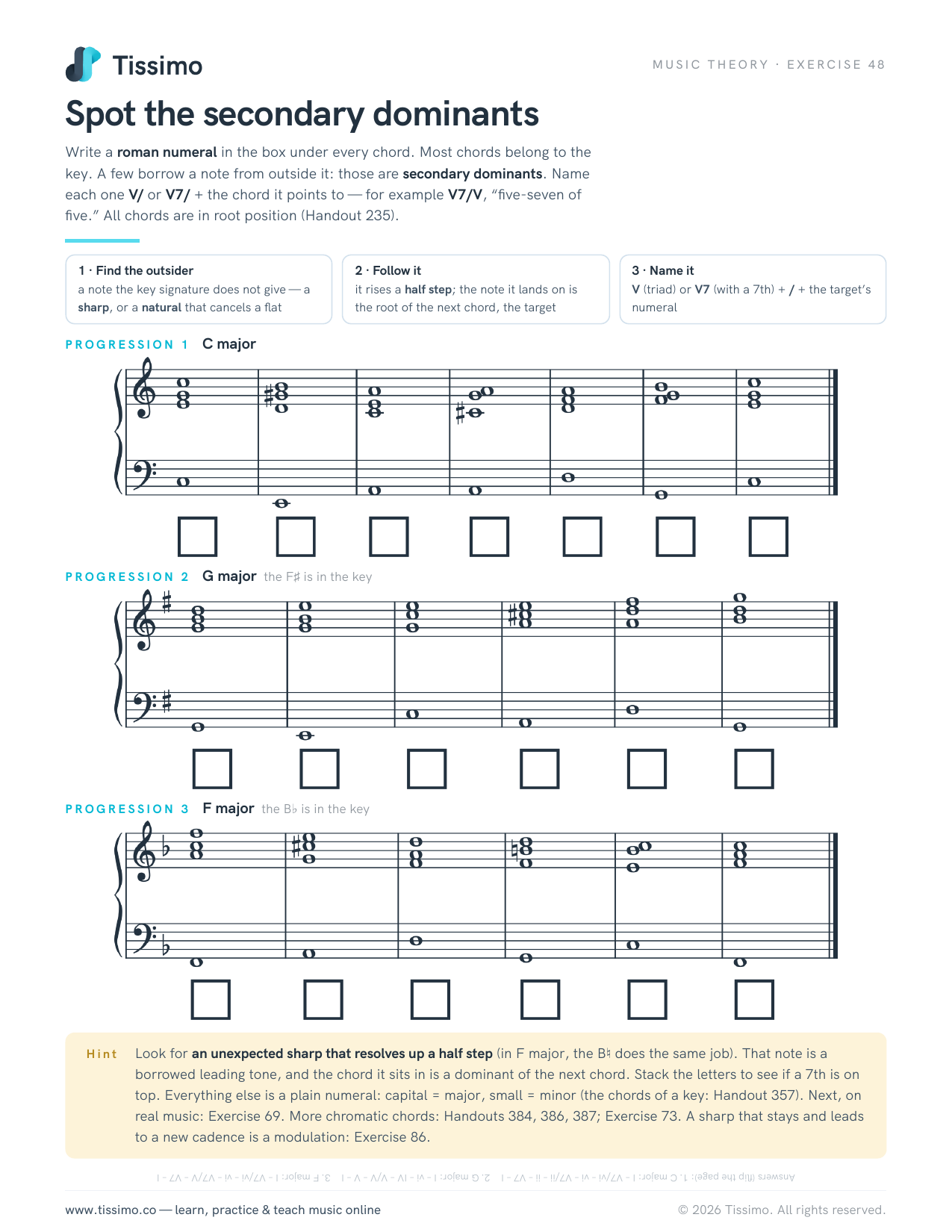 Spot the secondary dominantsWrite a roman numeral in the box under every chord. Most chords belong to the key. A few borrow a note from outside it: those are secondary dominants. Name each one V/ or V7/ + the chord it points to — for example V7/V, “five-seven of five.” All chords are in root position (Handout 235).
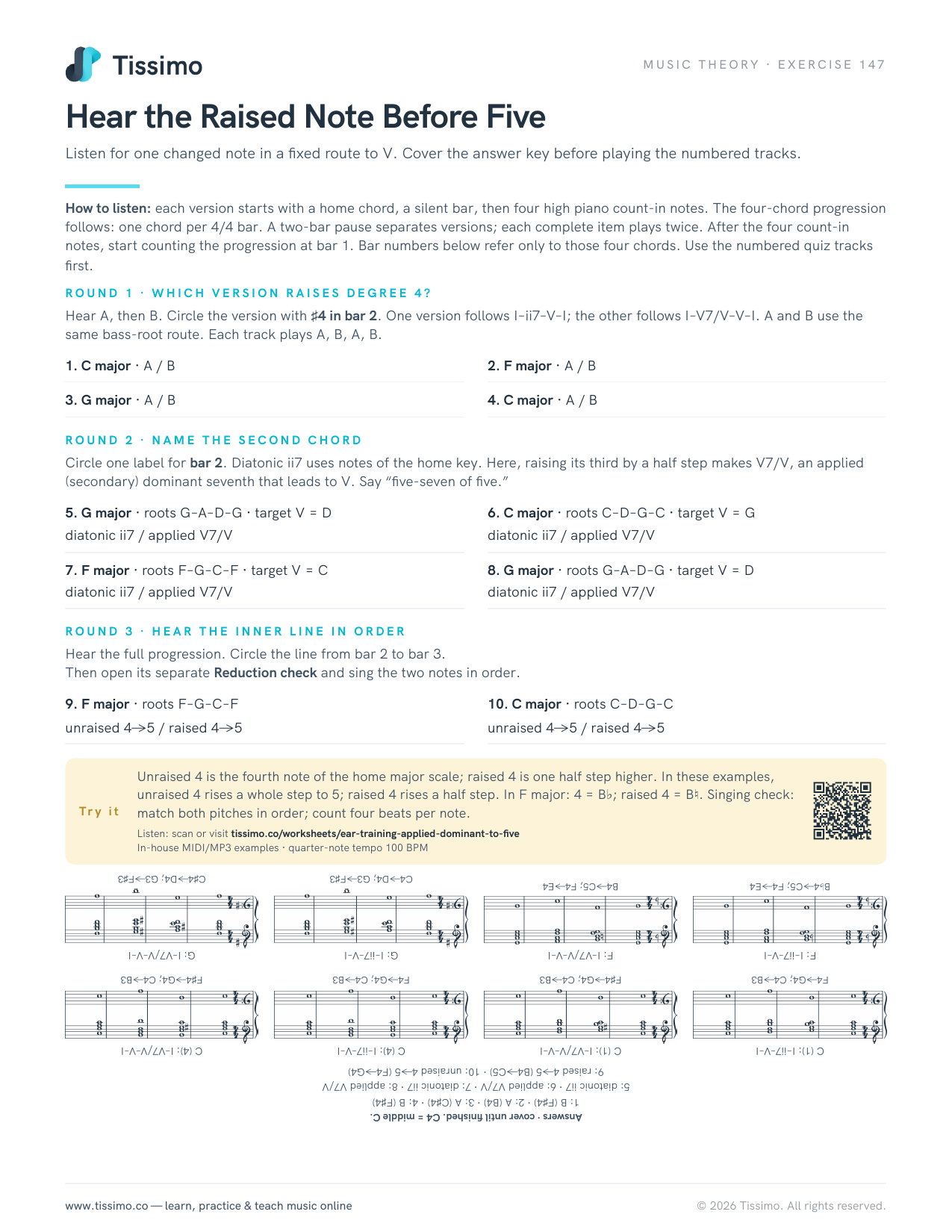 Hear the Raised Note Before FiveListen for one changed note in a fixed route to V. Cover the answer key before playing the numbered tracks.
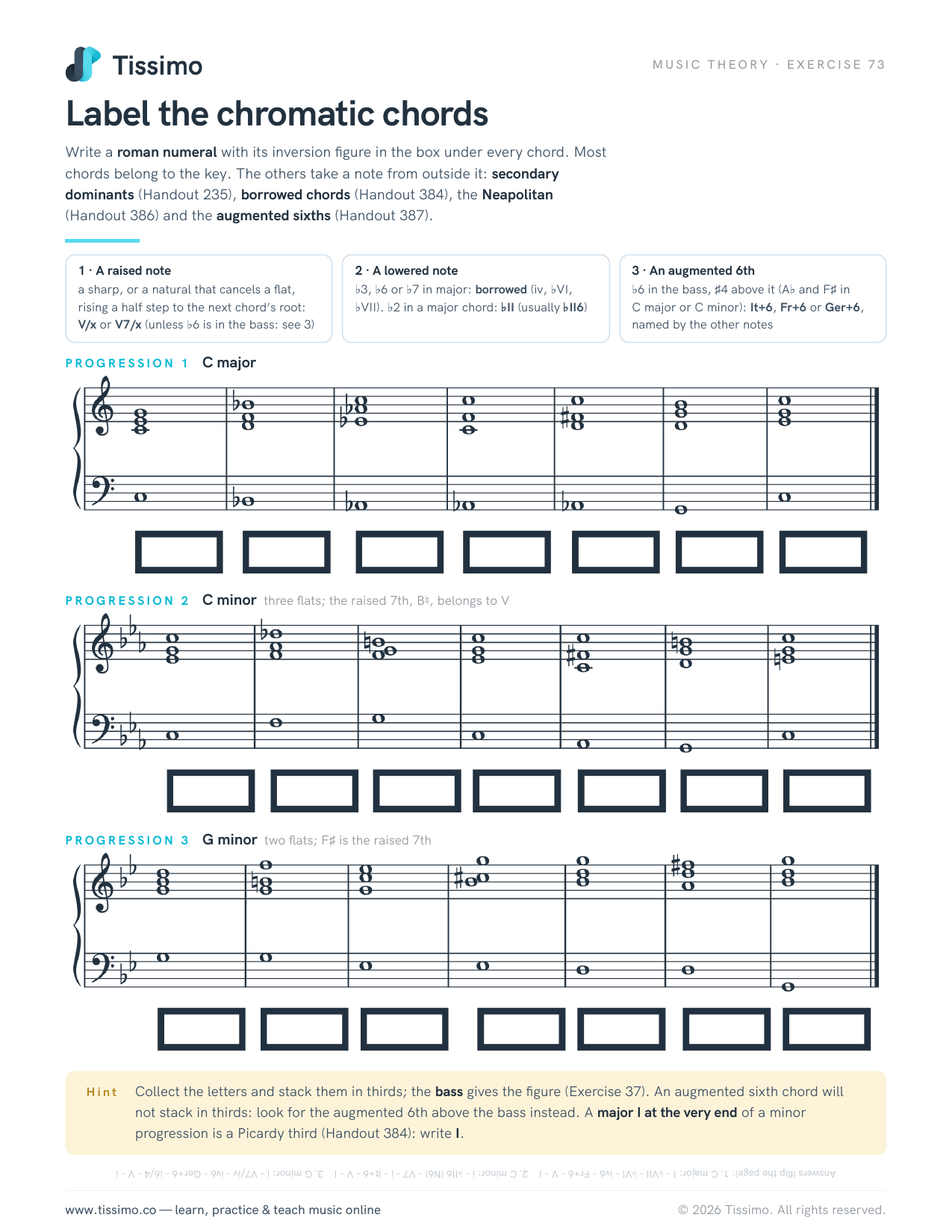 Label the chromatic chordsWrite a roman numeral with its inversion figure in the box under every chord. Most chords belong to the key. The others take a note from outside it: secondary dominants (Handout 235), borrowed chords (Handout 384), the Neapolitan (Handout 386) and the augmented sixths (Handout 387).