Chords & Harmony
Tonicization
Tonicization is the brief treatment of a chord other than the tonic as a temporary tonic, usually by placing its own dominant before it, as in D7–G in C major. Unlike a modulation, the music does not settle in a new key.
Tonicization is the brief treatment of a chord other than the tonic as if it were a temporary home. The usual tool is a secondary dominant: in C major, A7 makes D minor sound like a little tonic for a moment, and D7 does the same for G. Then the music carries on in the original key. Tonicization is a harmonic event lasting a chord or two, not a change of key.
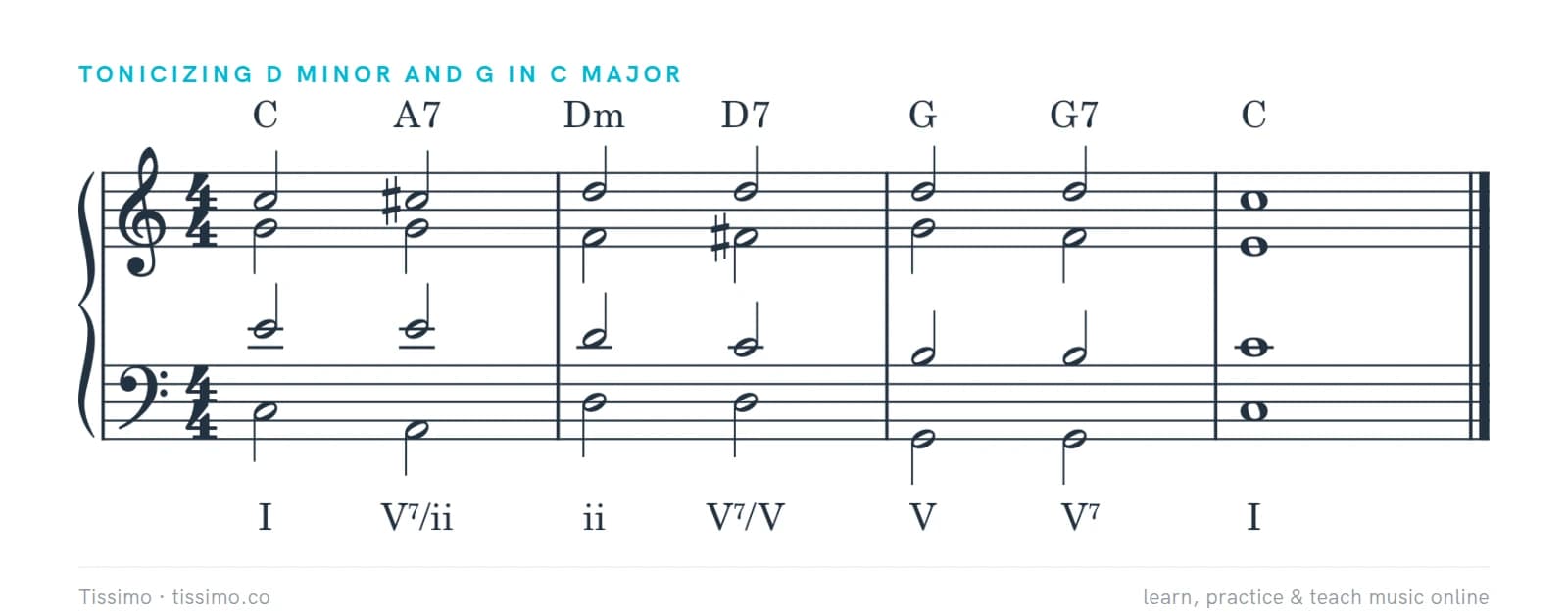
How it works
A tonic sounds like home partly because a dominant chord, with its leading tone, resolves to it. Put a dominant (or a leading-tone chord) in front of another major or minor chord of the key and that chord borrows some of the tonic's weight. In the example, C♯ acts as a temporary leading tone to D, and F♯ as a temporary leading tone to G. The diminished triad on the seventh degree is not tonicized, because a diminished chord cannot sound like a home.
Tonicization or modulation?
In a modulation the music really moves to a new key: it stays there, usually confirms it with a cadence, and the new tonic takes over as home. In a tonicization the new "tonic" lasts only a moment before the original key returns. The boundary is not always sharp. A passage that dwells on V for several bars, with its own dominant chords, can be heard either way, and analysts sometimes disagree. Length and a confirming cadence are the usual tests.
Why composers tonicize
- To give a chord extra weight, especially V before a cadence.
- To add color: the borrowed accidentals brighten or darken the harmony for a moment.
- To create momentum: chains of secondary dominants push the music from chord to chord.
- To prepare a real modulation later on.
Practice with Secondary dominants and Spot the secondary dominants, then compare with a real key change in Spot the modulation.
Common questions
What is the difference between tonicization and modulation?
Tonicization makes a chord sound like a tonic for a moment, then the original key continues. Modulation moves to a new key and stays there long enough, usually with a cadence, for it to become the new home.
Which chords can be tonicized?
Any major or minor triad of the key. In C major that means D minor, E minor, F major, G major and A minor. The diminished chord on B is not tonicized.
Practice it: free worksheets
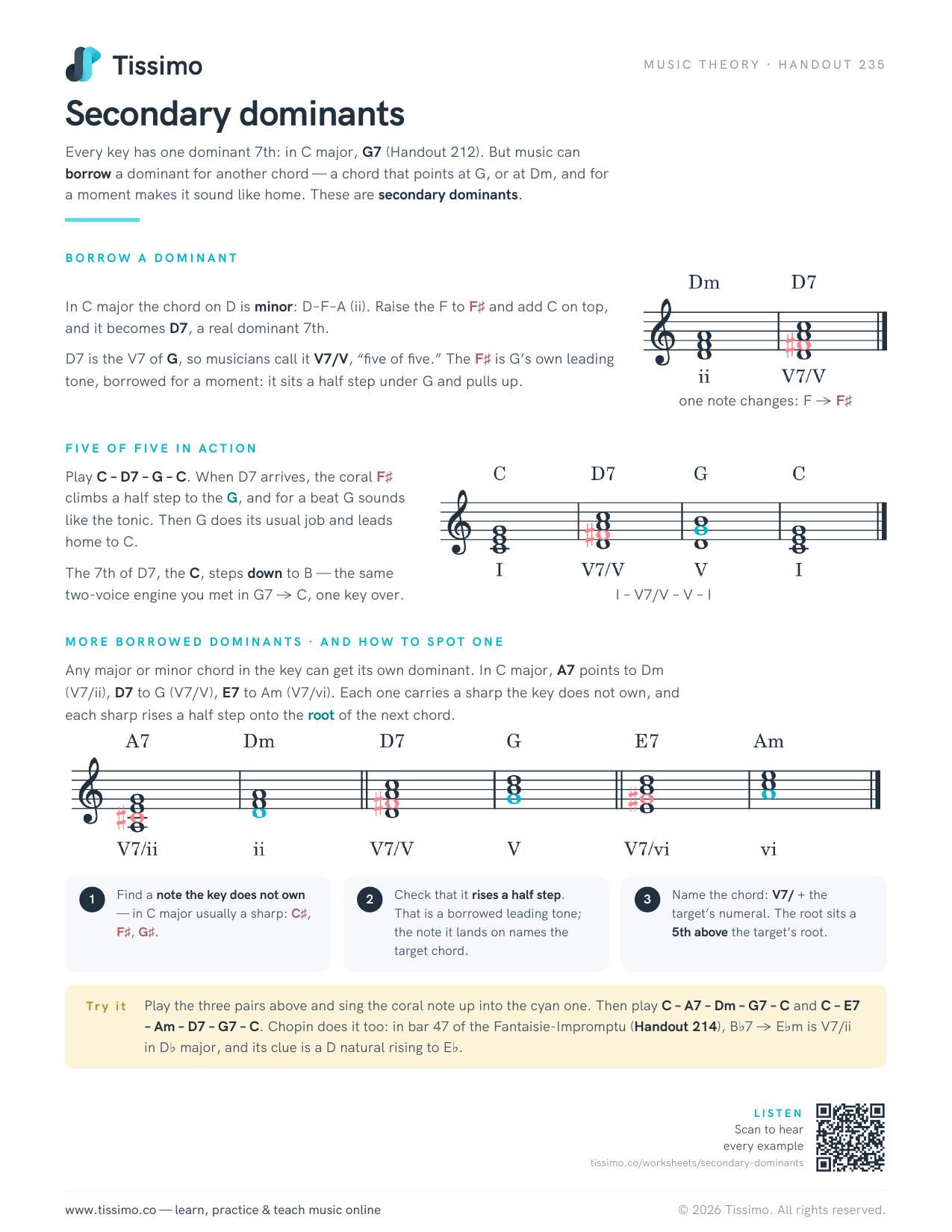 Secondary dominantsEvery key has one dominant 7th: in C major, G7 (Handout 212). But music can borrow a dominant for another chord — a chord that points at G, or at Dm, and for a moment makes it sound like home. These are secondary dominants. (Borrowing a chord from the parallel minor is different: Handout 384.)
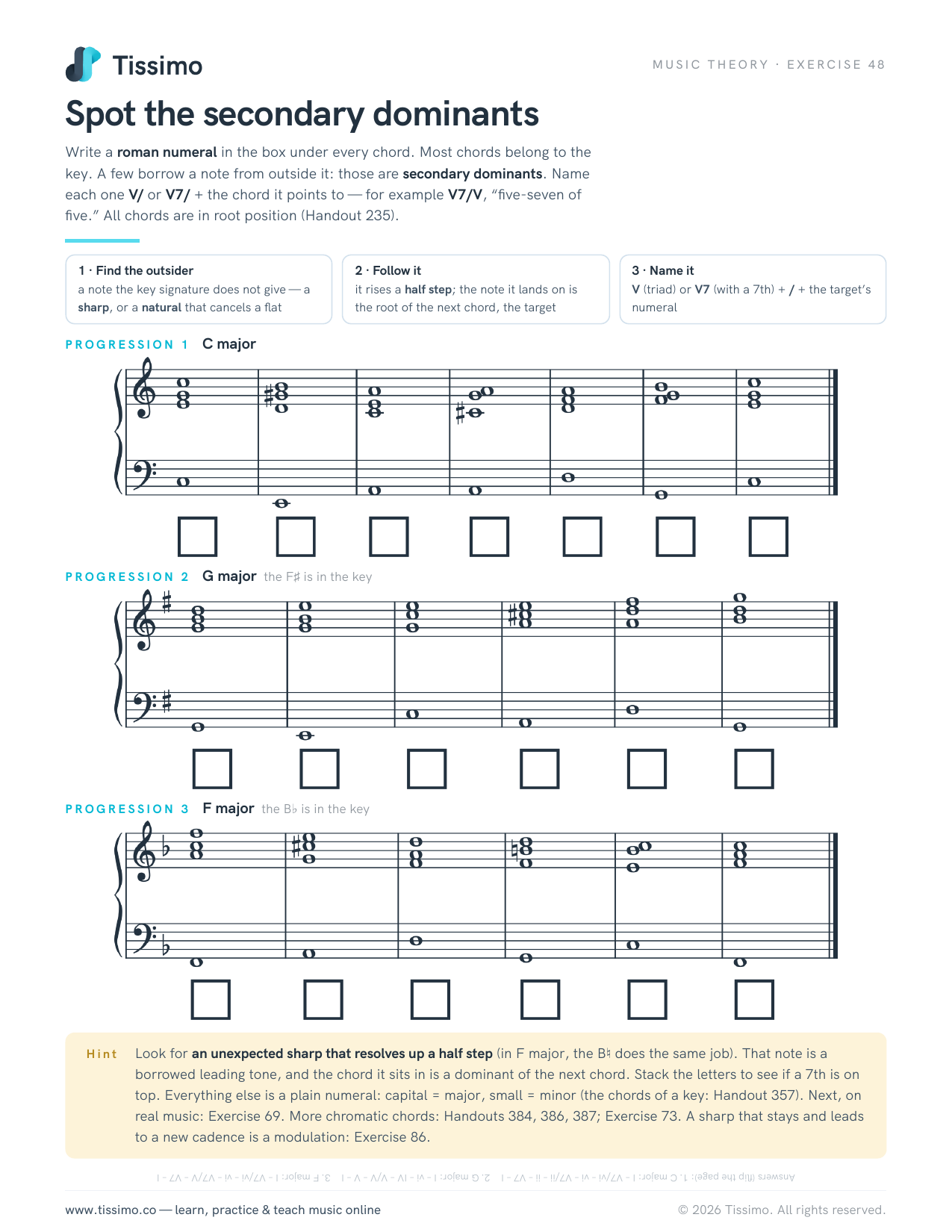 Spot the secondary dominantsWrite a roman numeral in the box under every chord. Most chords belong to the key. A few borrow a note from outside it: those are secondary dominants. Name each one V/ or V7/ + the chord it points to — for example V7/V, “five-seven of five.” All chords are in root position (Handout 235).
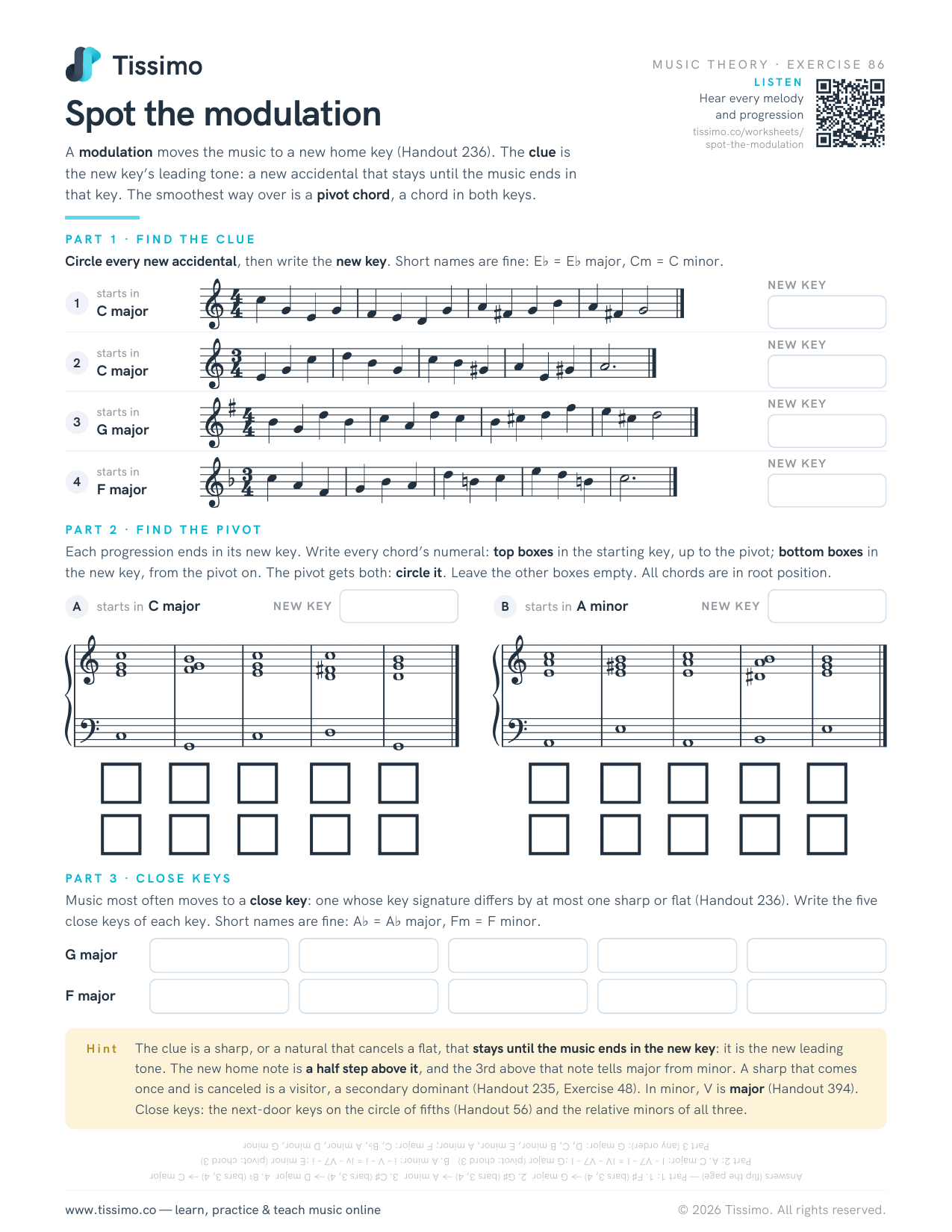 Spot the modulationA modulation moves the music to a new home key (Handout 236). The clue is the new key’s leading tone: a new accidental that stays until the music ends in that key. The smoothest way over is a pivot chord, a chord in both keys.
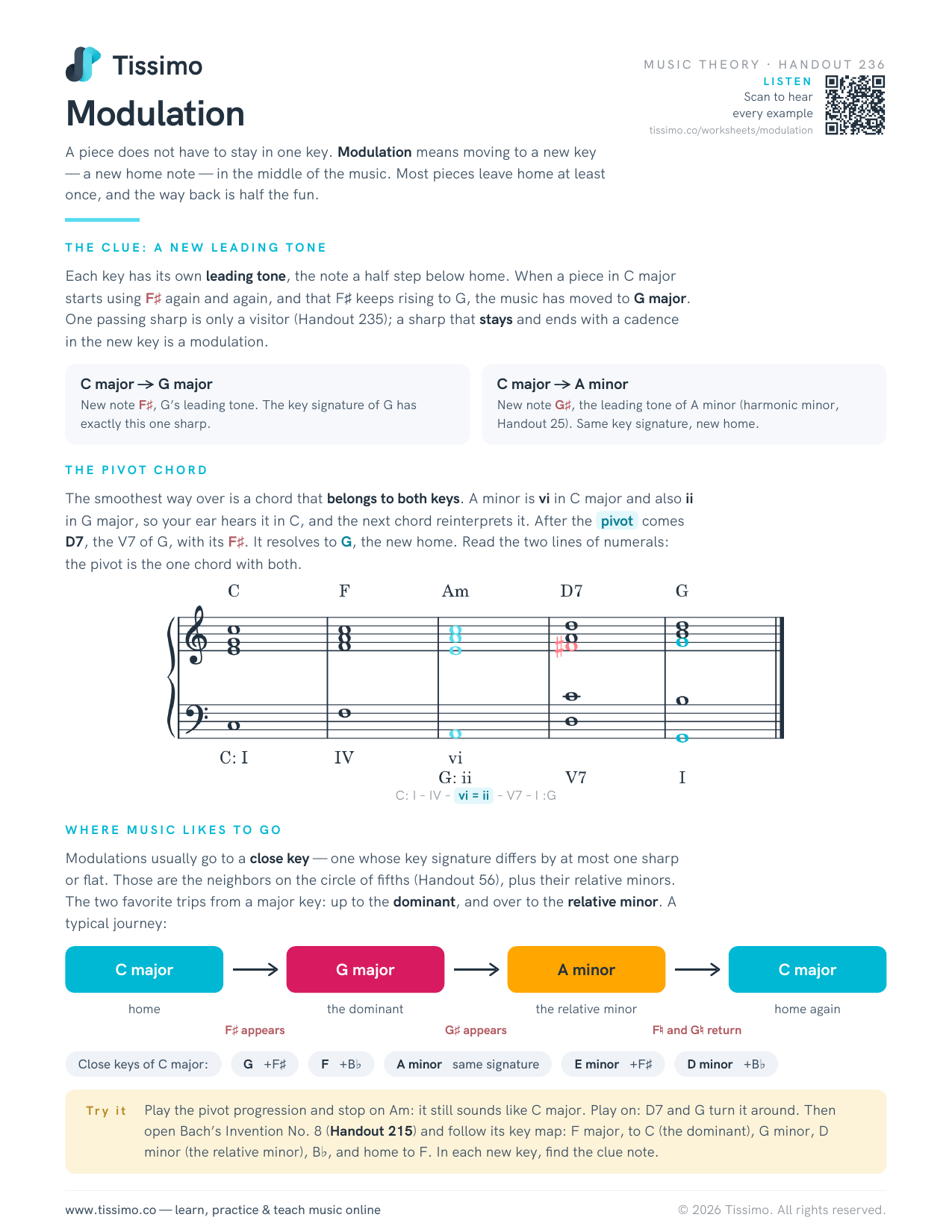 ModulationA piece does not have to stay in one key. Modulation means moving to a new key — a new home note — in the middle of the music. Most pieces leave home at least once, and the way back is half the fun.
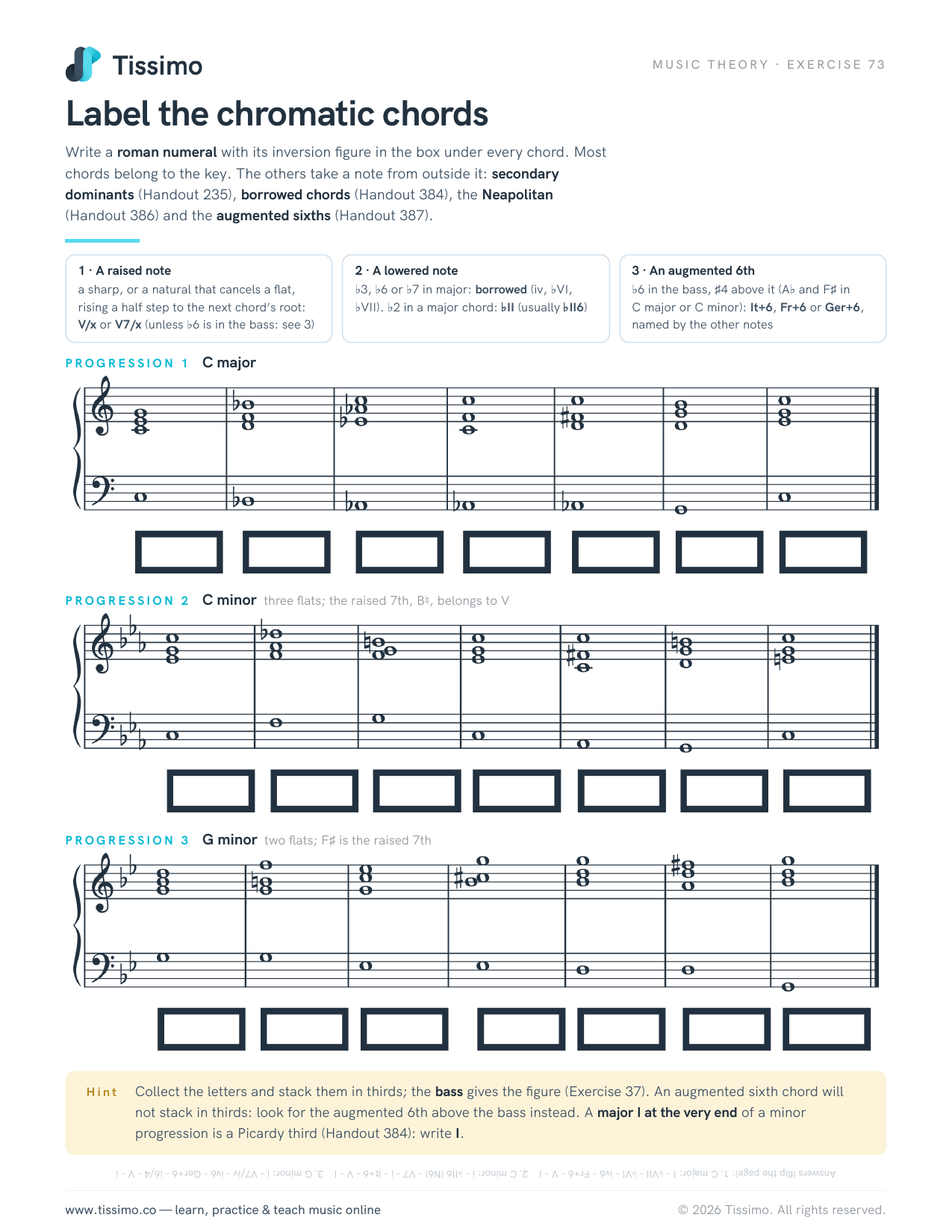 Label the chromatic chordsWrite a roman numeral with its inversion figure in the box under every chord. Most chords belong to the key. The others take a note from outside it: secondary dominants (Handout 235), borrowed chords (Handout 384), the Neapolitan (Handout 386) and the augmented sixths (Handout 387).