Chords & Harmony
Roman Numeral Analysis
Roman numeral analysis labels each chord by the scale degree of its root, such as I, IV and V in a major key. Capital letters mean major, small letters minor, and added figures show sevenths and inversions.
Roman numeral analysis names each chord by where its root sits in the key. In C major, a chord built on C is I, a chord on D is ii, a chord on G is V, and so on. The numerals show what a chord is doing in the key, not just its letter name, which makes it easy to compare pieces, spot patterns and move music to another key.
How the symbols work
- The numeral is the scale degree of the root: I, II, III, IV, V, VI, VII.
- Capital or small: capital for a major triad (I, IV, V), small for minor (ii, iii, vi).
- Extra signs: ° for diminished (vii°), + for augmented (III+), ø for half-diminished seventh chords (viiø7).
- Figures borrowed from figured bass show sevenths and inversions: V7 (a root-position seventh chord), I6 (first inversion), I6/4 (second inversion), and V6/5, V4/3 and V4/2 (the inversions of V7).
- The key is written at the start of the analysis: "C:" for C major, "a:" for A minor.
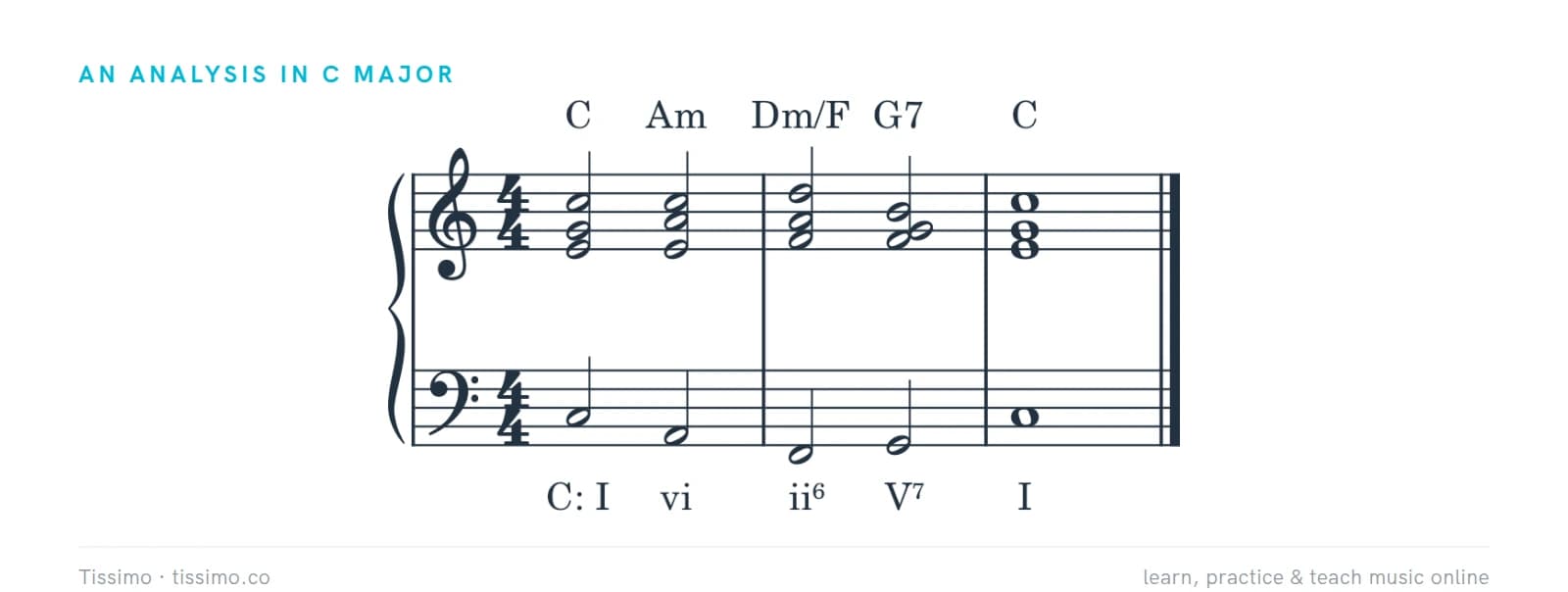
Analyzing a chord, step by step
- Find the key from the key signature and the opening and closing chords.
- Stack the chord's notes in thirds to find its root.
- Count the root's scale degree in the key: that is the numeral.
- Check the quality (major, minor, diminished or augmented) and write the numeral in the right form.
- Look at the bass note. If it is not the root, add the inversion figure.
- If the chord contains a note from outside the key, it may be a chromatic chord, such as a secondary dominant (V/V) or a borrowed chord.
In a minor key
Minor keys use the same system. The tonic chord is minor (i), the subdominant usually minor (iv), and the dominant usually major (V), because composers raise the seventh degree to give it a leading tone. In A minor, E major (E–G♯–B) is V, while E minor (E–G–B) would be v.
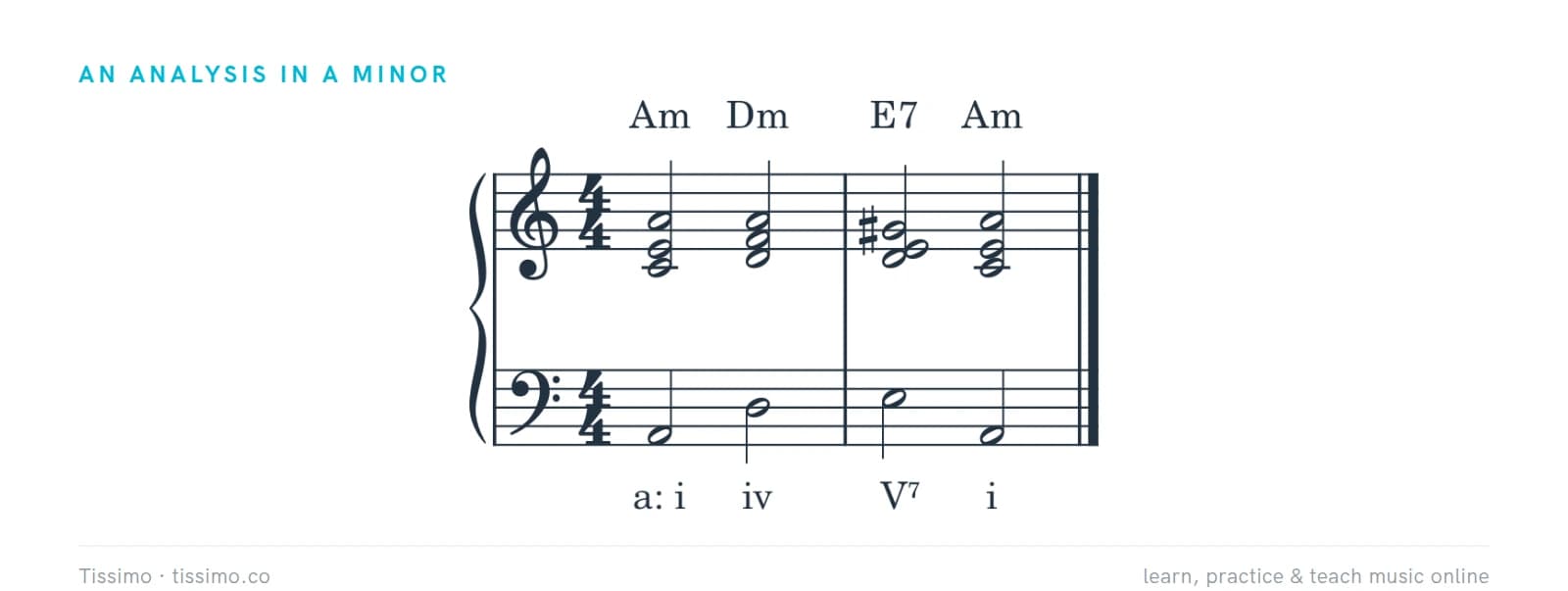
Variations you will meet
Not every book writes numerals the same way. Some use capitals for every chord and let the key show the quality; some write V65 for V6/5, or V2 for V4/2. Jazz and pop musicians often use plain numbers instead (the Nashville Number System writes 1–4–5 for I–IV–V). The idea underneath is the same: name each chord by its place in the key.
Practice with Roman numeral analysis and Name the chords of the key, then try a real piece with Analyze the Prelude in C.
Common questions
Why are some Roman numerals lowercase?
Lowercase numerals mean minor chords (ii, iii, vi), and lowercase with a small circle means diminished (vii°). Capitals mean major (I, IV, V), or augmented when followed by a plus sign.
What do the small numbers after a Roman numeral mean?
They show inversions and sevenths. I6 is a first-inversion triad and I6/4 a second-inversion triad; V7 is a root-position seventh chord, and V6/5, V4/3 and V4/2 are its three inversions.
Practice it: free worksheets
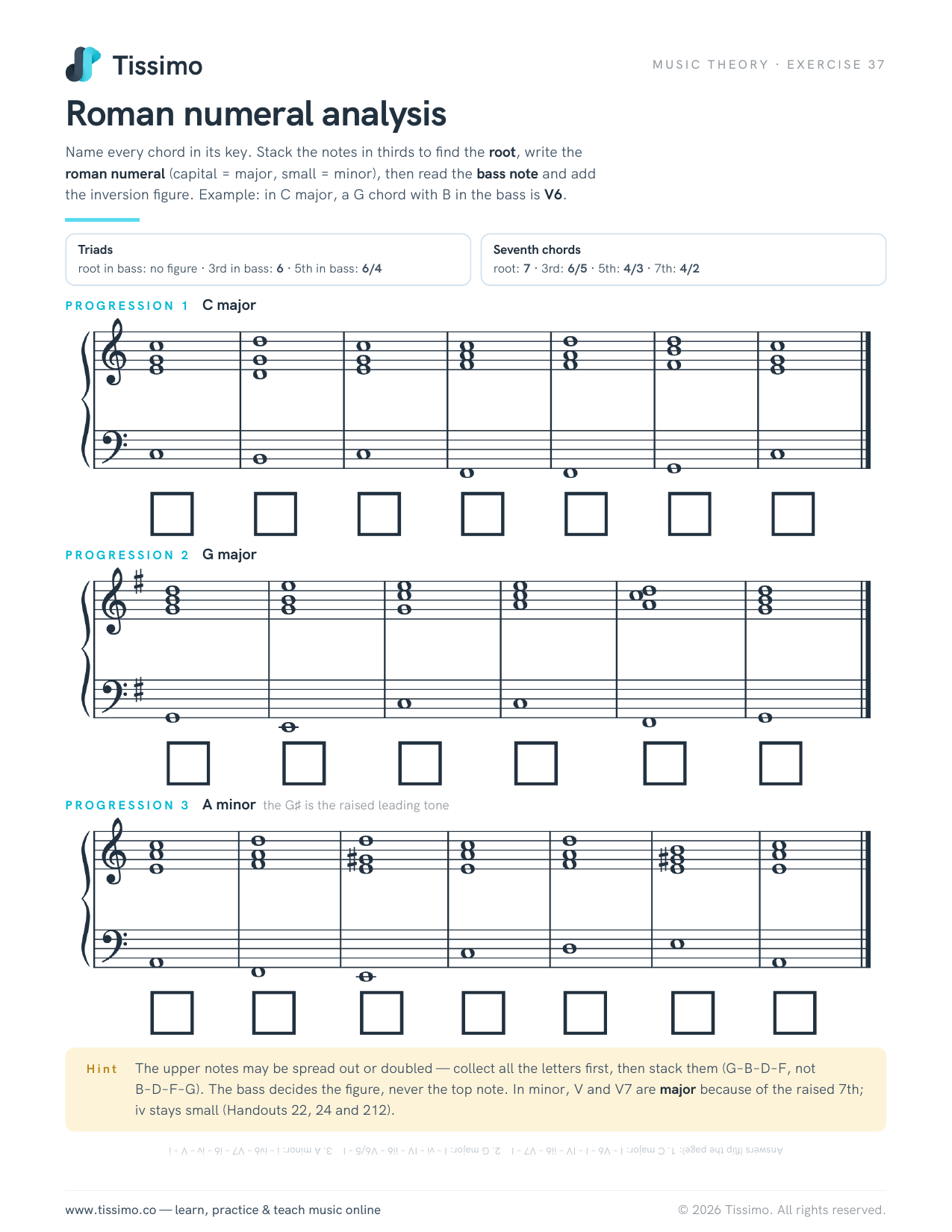 Roman numeral analysisName every chord in its key. Stack the notes in thirds to find the root, write the roman numeral (capital = major, small = minor), then read the bass note and add the inversion figure. Example: in C major, a G chord with B in the bass is V6.
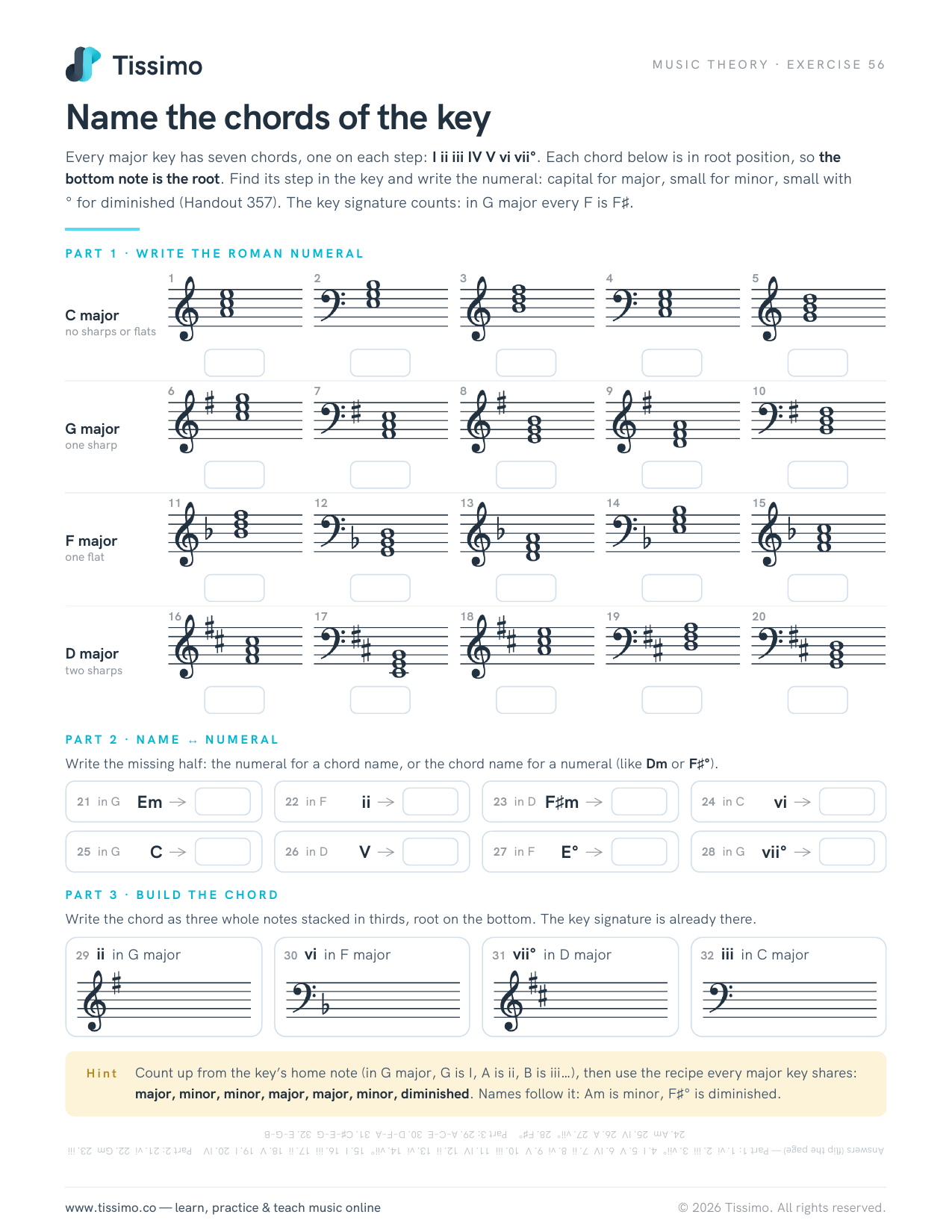 Name the chords of the keyEvery major key has seven chords, one on each step: I ii iii IV V vi vii°. Each chord below is in root position, so the bottom note is the root. Find its step in the key and write the numeral: capital for major, small for minor, small with ° for diminished (Handout 357). The key signature counts: in G major every F is F♯.
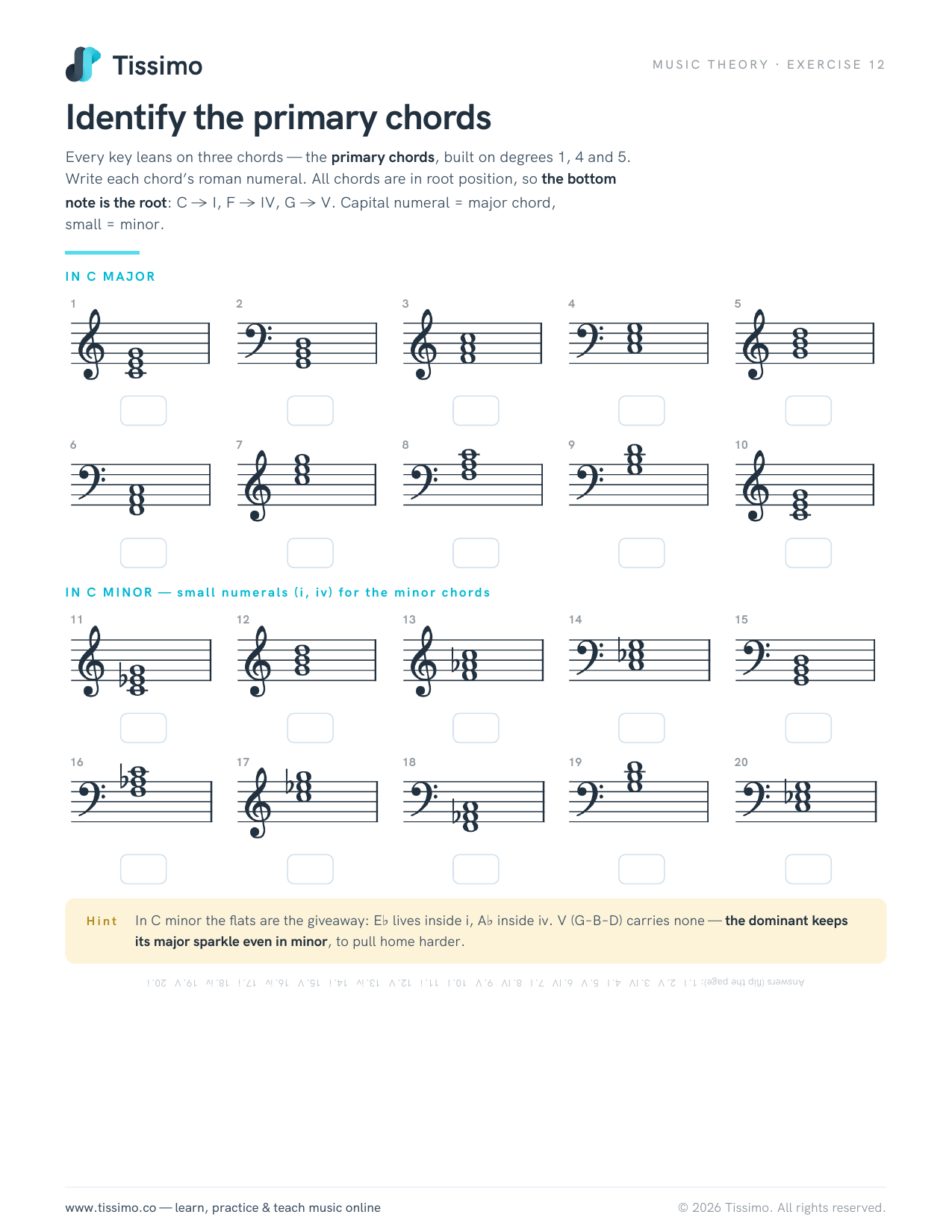 Identify the primary chordsEvery key leans on three chords — the primary chords, built on degrees 1, 4 and 5. Write each chord’s roman numeral. All chords are in root position, so the bottom note is the root: C → I, F → IV, G → V. Capital numeral = major chord, small = minor.
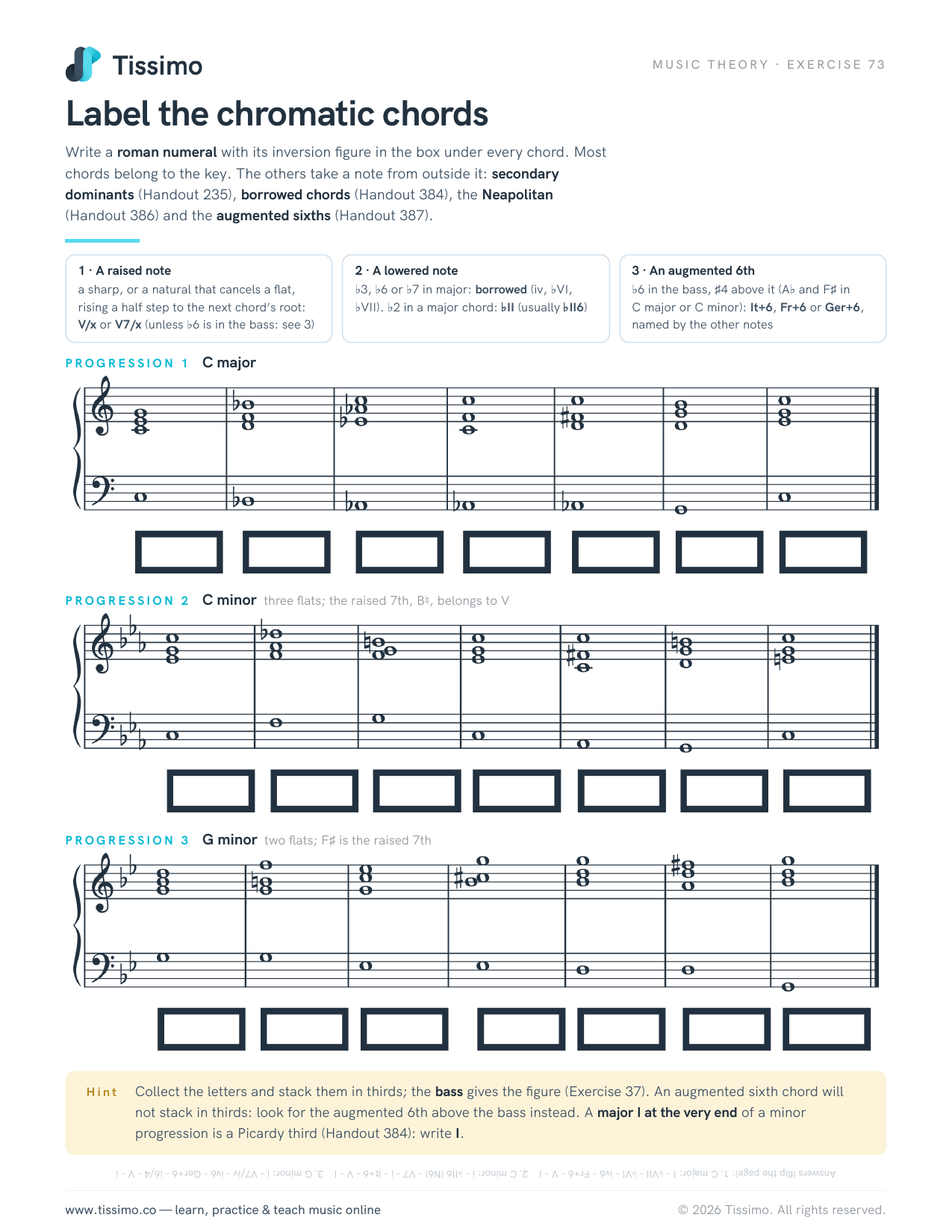 Label the chromatic chordsWrite a roman numeral with its inversion figure in the box under every chord. Most chords belong to the key. The others take a note from outside it: secondary dominants (Handout 235), borrowed chords (Handout 384), the Neapolitan (Handout 386) and the augmented sixths (Handout 387).
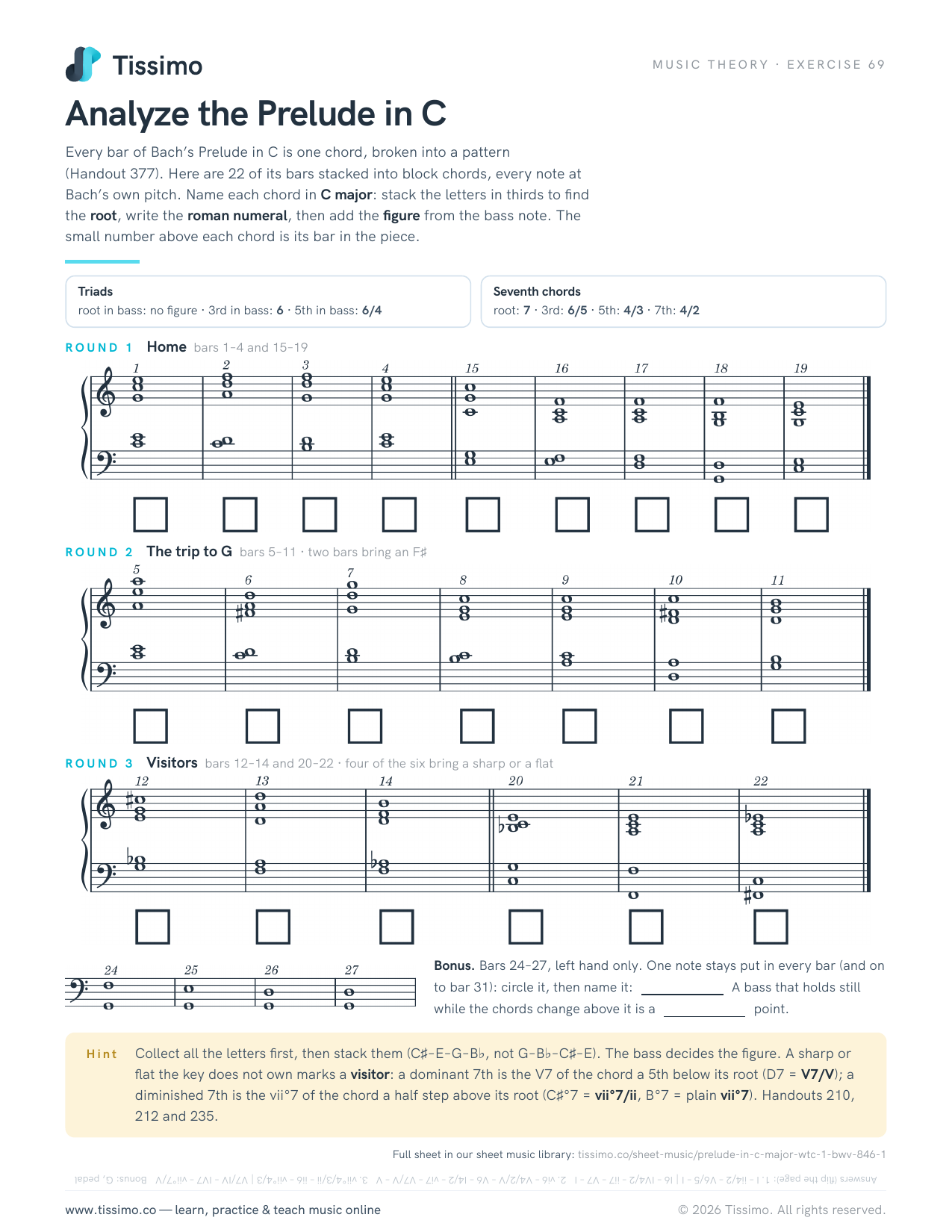 Analyze the Prelude in CEvery bar of Bach’s Prelude in C is one chord, broken into a pattern (Handout 377). Here are 22 of its bars stacked into block chords, every note at Bach’s own pitch. Name each chord in C major: stack the letters in thirds to find the root, write the roman numeral, then add the figure from the bass note. The small number above each chord is its bar in the piece.
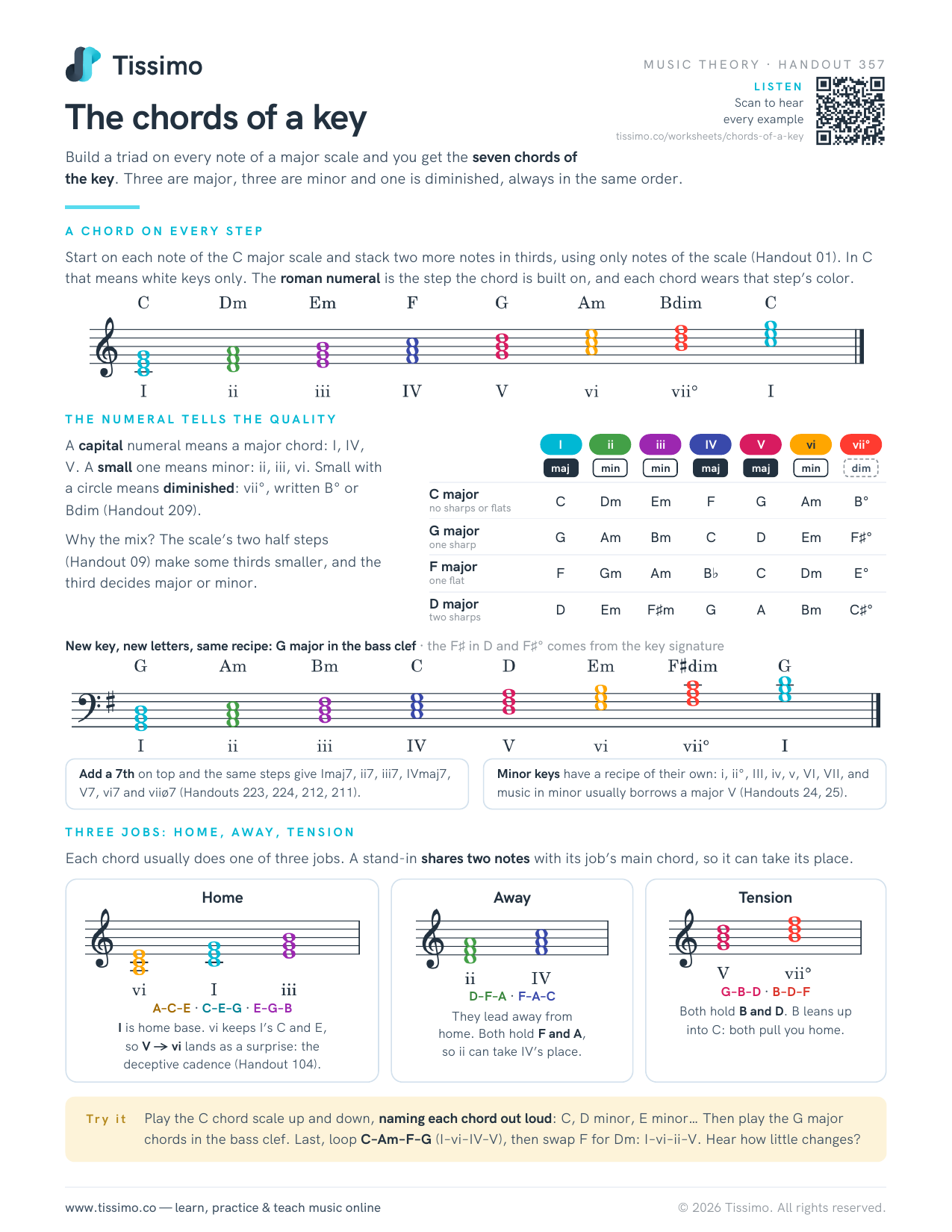 The chords of a keyBuild a triad on every note of a major scale and you get the seven chords of the key. Three are major, three are minor and one is diminished, always in the same order.