Styles, Genres & Eras
Jazz
Jazz is a musical tradition that grew out of African American communities in New Orleans in the early 1900s, built on improvisation, swing rhythm, blue notes and rich harmony.
Jazz began in the African American communities of New Orleans around the start of the 20th century. It grew from a mix of blues, ragtime, brass-band music, church music and spirituals, West African rhythmic traditions and European harmony and instruments. Within a few decades it had spread worldwide and split into many styles, but a few ingredients run through almost all of them.
Core ingredients
- Improvisation: players invent melodies on the spot, usually over the chord progression of a tune.
- Swing feel: eighth notes written evenly are played long–short, and the rhythm has a forward lift.
- Syncopation and accents on off-beats.
- Blue notes and bluesy inflections borrowed from the blues.
- Seventh chords and extended chords (ninths, elevenths, thirteenths), progressions such as the ii–V–I, and substitutions.
- Call and response between instruments or sections.
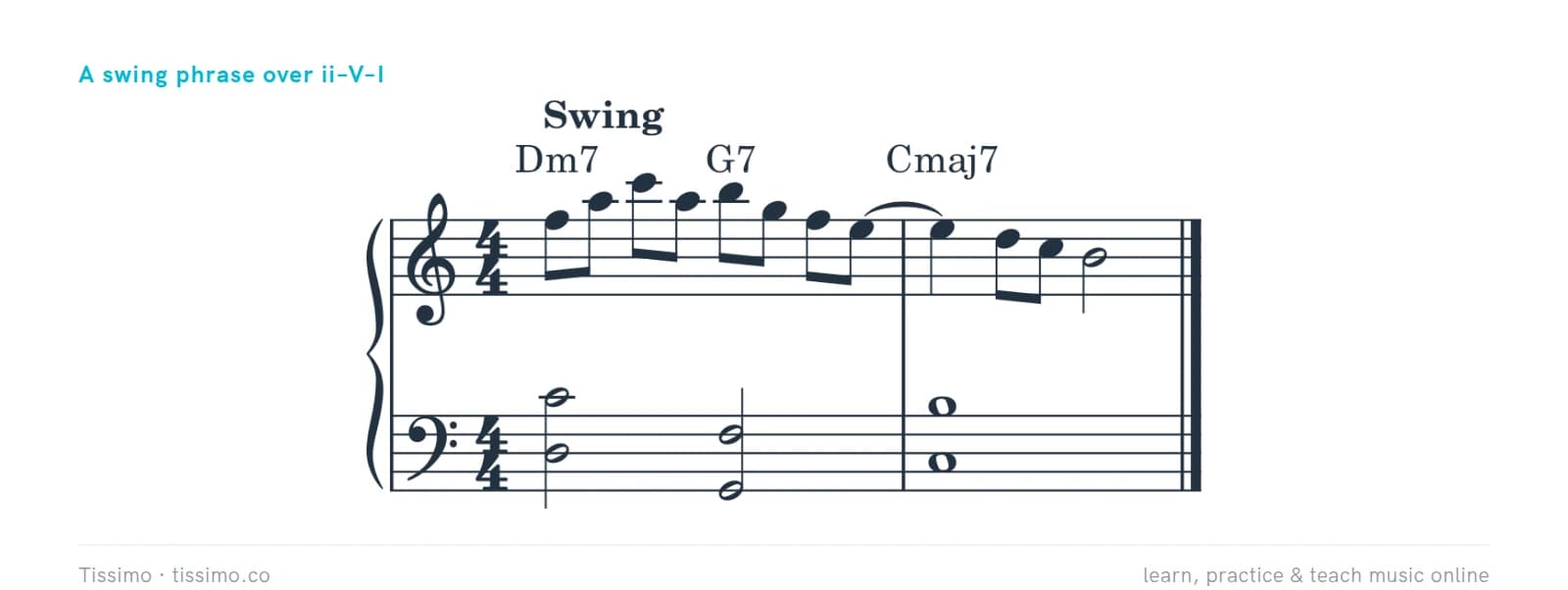
How a jazz performance is built
A typical small-group performance follows the head–solos–head plan: the band plays the tune (the head), then each soloist improvises one or more choruses over its chord progression, and the band plays the head again to finish. The music is usually read from a lead sheet that shows only the melody and chord symbols; players choose their own voicings and rhythms. Many jazz standards come from Broadway and Tin Pan Alley songs in AABA form, and the 12-bar blues is another staple.
A short timeline
- 1910s–20s: New Orleans jazz and its spread to Chicago and New York; Louis Armstrong transforms the solo.
- 1930s–40s: the swing era of big bands led by Duke Ellington, Count Basie and Benny Goodman.
- 1940s: bebop, with Charlie Parker and Dizzy Gillespie; Afro-Cuban jazz, with Machito, Mario Bauzá and the Gillespie–Chano Pozo collaboration.
- 1950s–60s: cool jazz, hard bop, modal jazz (Miles Davis's Kind of Blue, 1959) and free jazz (Ornette Coleman).
- Late 1960s–1970s on: jazz-rock fusion and further cross-genre developments. Latin jazz had already developed decades earlier.
Getting started
Learn a few standards from lead sheets, practice Swing Eighths, learn The ii–V–I in several keys, play Shell Voicings in the left hand, and above all listen to recordings and copy what you hear.
Common questions
Where did jazz originate?
In African American communities in New Orleans around the beginning of the 20th century, drawing on blues, ragtime, brass-band and church music.
What makes music jazz?
No single feature, but most jazz combines improvisation, a swing feel, syncopation, blue notes and harmony built on seventh and extended chords.
Practice it: free worksheets
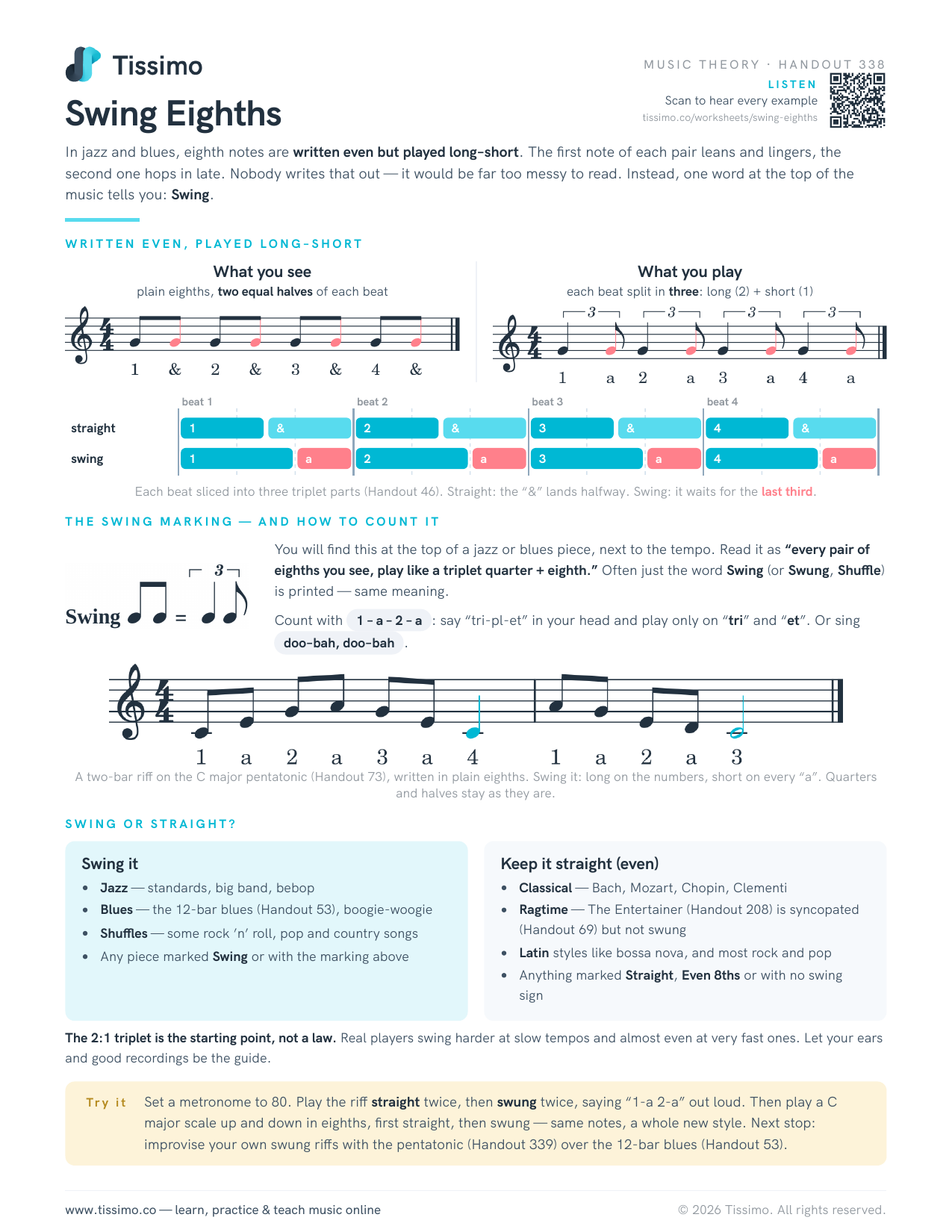 Swing EighthsIn jazz and blues, eighth notes are written even but played long–short. The first note of each pair leans and lingers, the second one hops in late. Nobody writes that out — it would be far too messy to read. Instead, one word at the top of the music tells you: Swing.
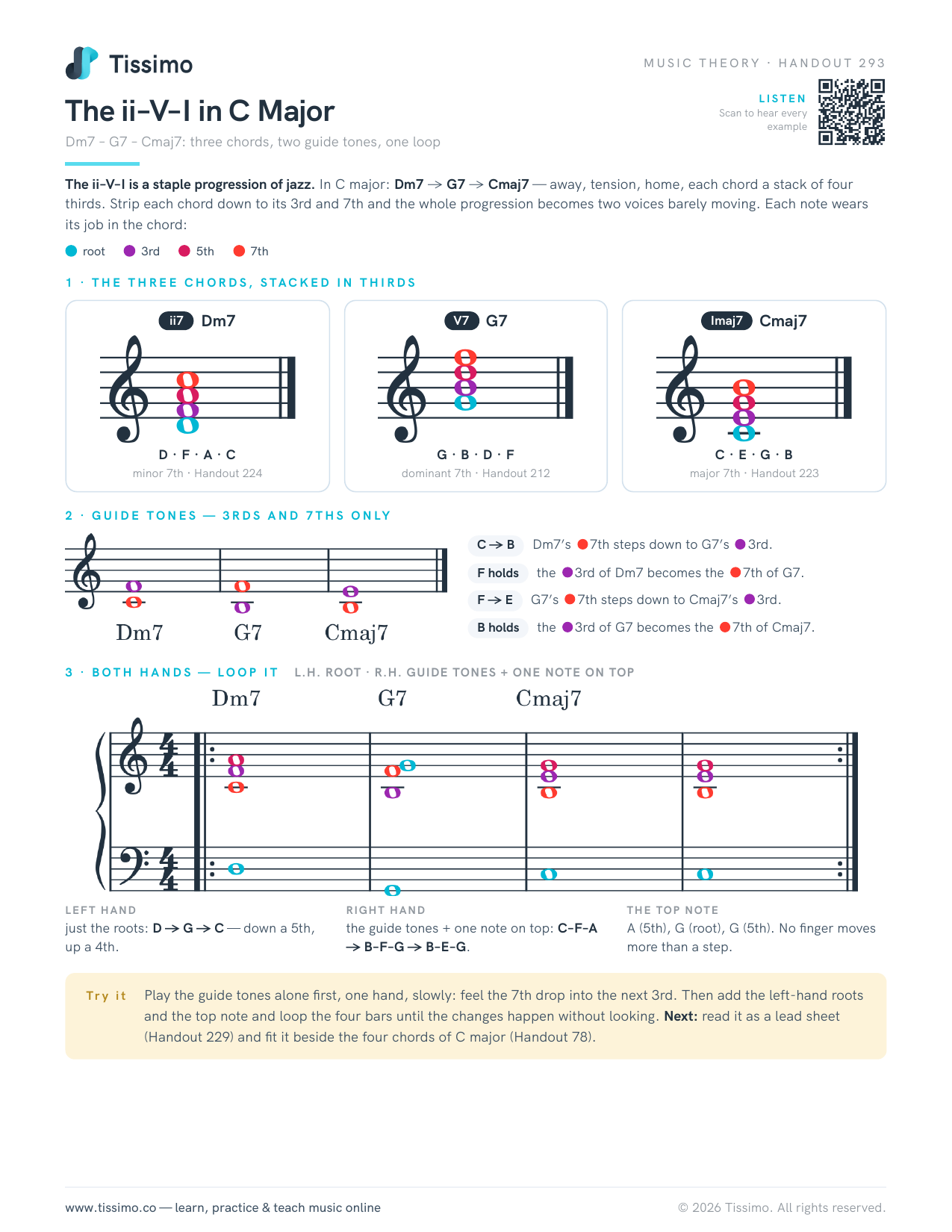 The ii–V–I in Every KeyThe most-played progression in jazz: three chords, two guide tones, one loop, in all 24 keys.
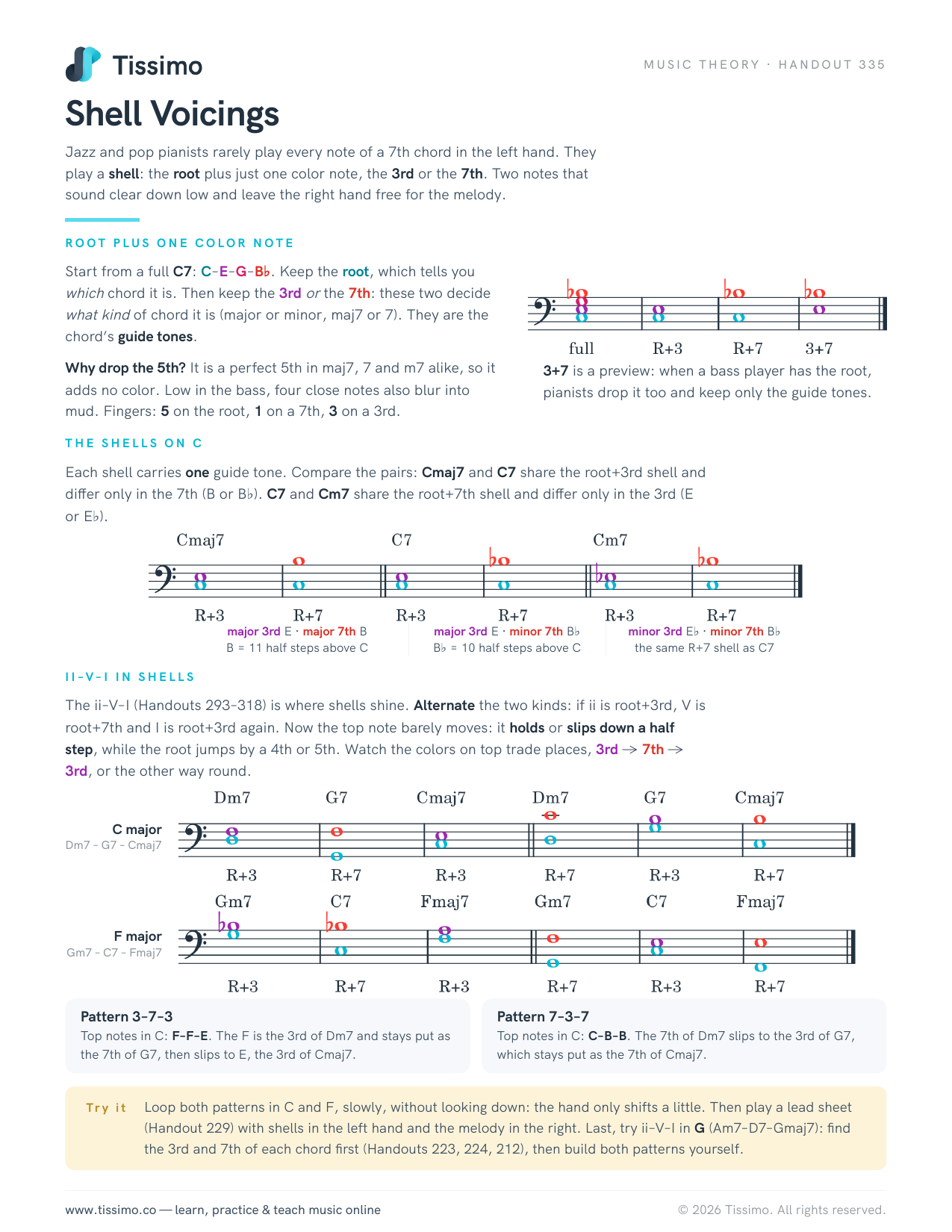 Shell VoicingsJazz and pop pianists rarely play every note of a 7th chord in the left hand. They play a shell: the root plus just one color note, the 3rd or the 7th. Two notes that sound clear down low and leave the right hand free for the melody.
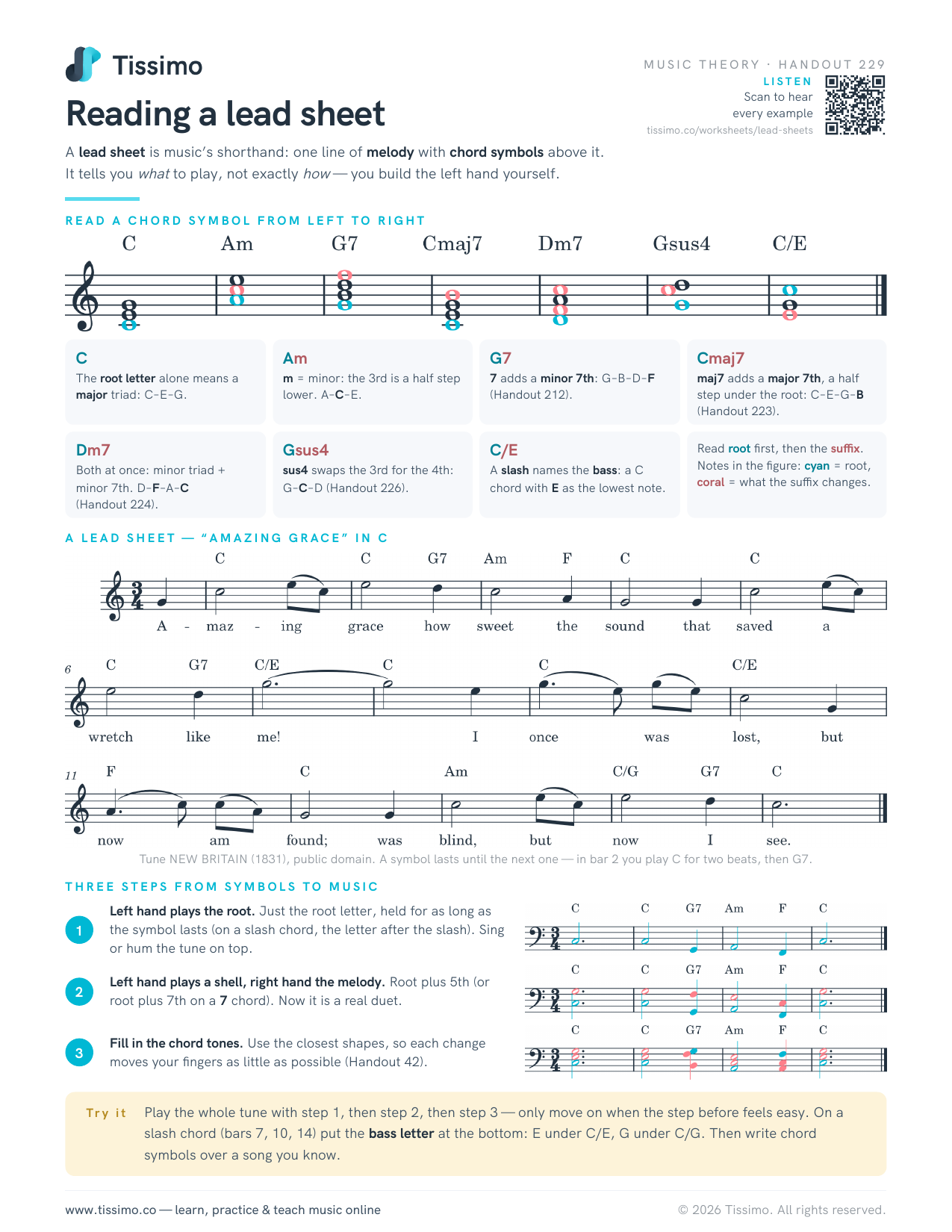 Reading a lead sheetA lead sheet is music’s shorthand: one line of melody with chord symbols above it. It tells you what to play, not exactly how — you build the left hand yourself.
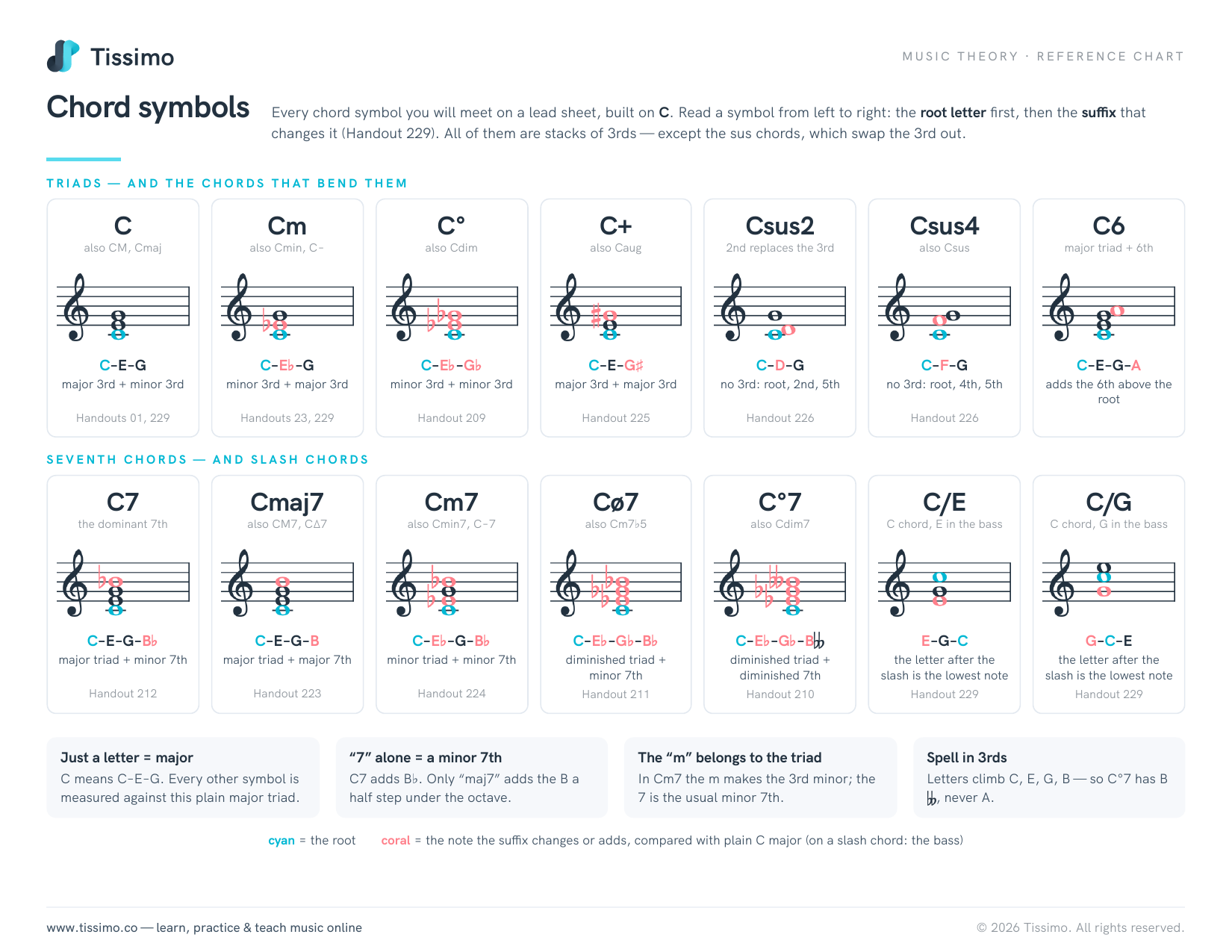 Chord symbolsEvery chord symbol you will meet on a lead sheet, built on C. Read a symbol from left to right: the root letter first, then the suffix that changes it (Handout 229). All of them are stacks of 3rds — except the sus chords, which swap the 3rd out.
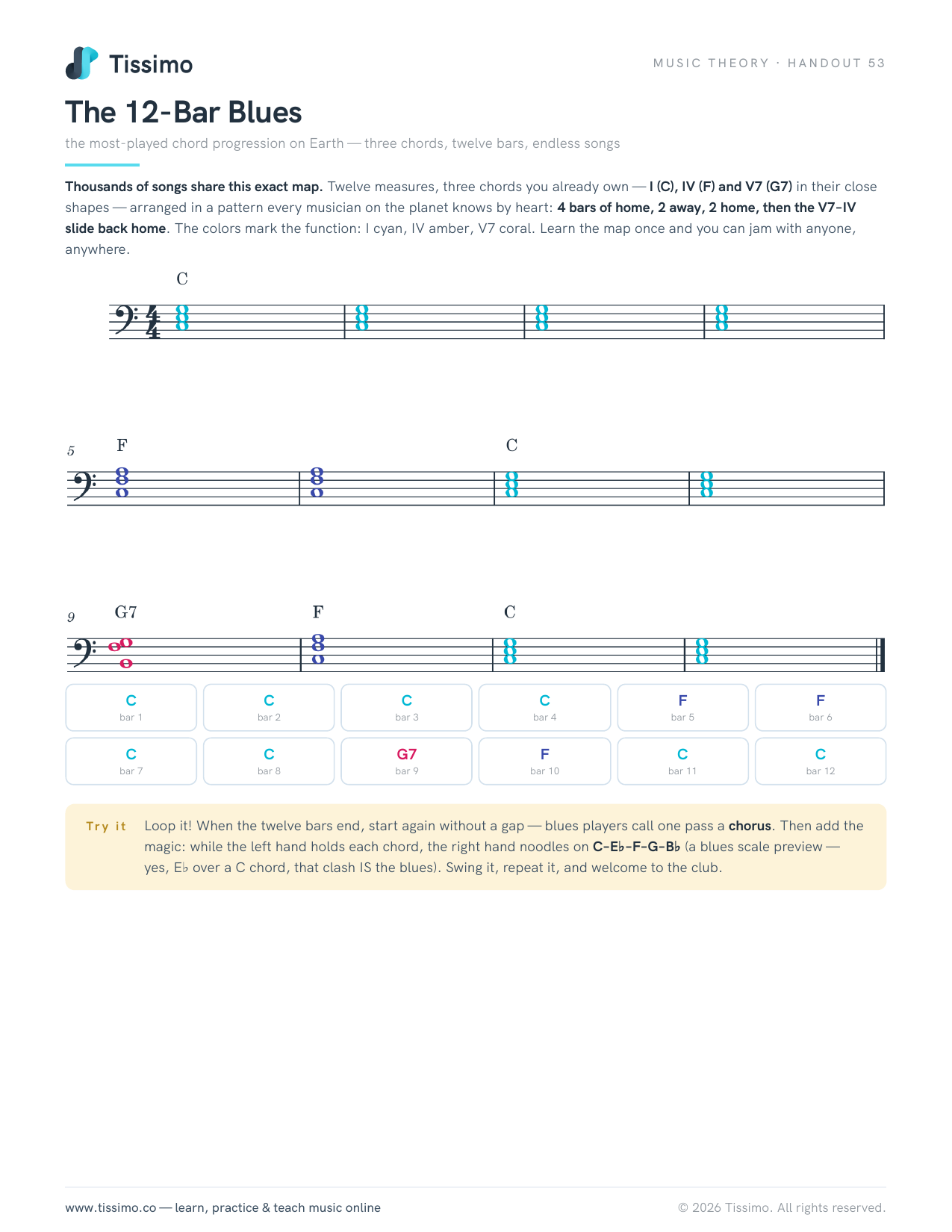 The 12-Bar Bluesone of the best-known chord progressions — three chords, twelve bars, endless songs