Rhythm & Meter
Syncopation
Syncopation is rhythm that puts the emphasis where you don't expect it: on a weak beat or between beats, often by holding a note across a strong beat or leaving the strong beat silent.
Syncopation happens when the rhythm pushes against the meter. Normally the strong beats of a bar carry the weight: beat 1, and in 4/4 also beat 3. Syncopation moves the weight somewhere else, onto a weak beat or onto the "&" between beats, so the music seems to lean forward, trip pleasantly or bounce. For it to work you need a steady beat to push against; without one, the rhythm just sounds random.
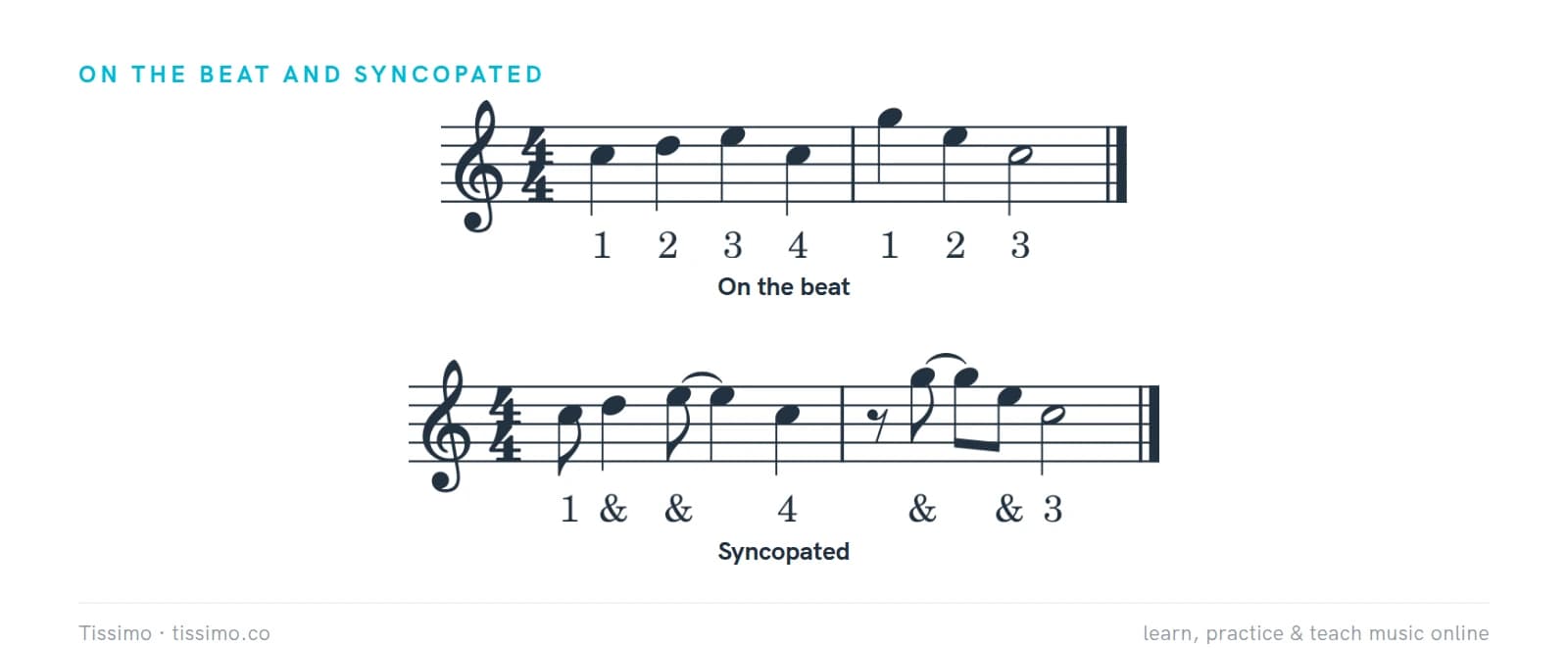
How syncopation is made
- A note that starts off the beat and is held across the next beat. This is the classic syncopation, often written with a tie or as the eighth-quarter-eighth pattern "1 & (2) &".
- Silence on the strong beat. A rest on beat 1 followed by a note on the "&" makes the listener feel the missing downbeat.
- Accents on weak beats. An accent on beat 2 or 4, or on an "&", shifts the weight even when the notes themselves are even. The backbeat of rock and pop is often described as a built-in syncopation of this kind.
Where you hear it
Syncopation is everywhere: in Baroque and Classical music as well as in ragtime, where a syncopated right hand dances over a steady left hand, and in jazz, Latin music, funk, reggae and pop. A common pop-song habit is the "push" or anticipation: a note or chord that arrives an eighth note early, on the "&" of beat 4, and is tied over into the next bar.
How to play syncopated rhythms
- Count the subdivision out loud: "1 & 2 & 3 & 4 &".
- Clap only where the notes start, keeping the counting steady.
- Feel the beats you are not playing. Tapping your foot on every beat helps.
- Hold tied notes for their full length, through the beat, and do not let the next note come in early.
Work through Syncopation, and practice counting ties in Write the Counts 3: Triplets & Ties.
Common questions
What is an example of syncopation?
The eighth-quarter-eighth pattern "1 & (2) &", where the quarter note starts between beats and holds through the next beat, is one of the most common. A note on the & of beat 4 tied into the next bar, heard in countless pop songs, is another.
Is syncopation the same as playing on the offbeat?
Playing on the offbeats is one way to create syncopation, but syncopation is broader: any rhythm that shifts the expected emphasis away from the strong beats, whether by ties, rests or accents.
Practice it: free worksheets
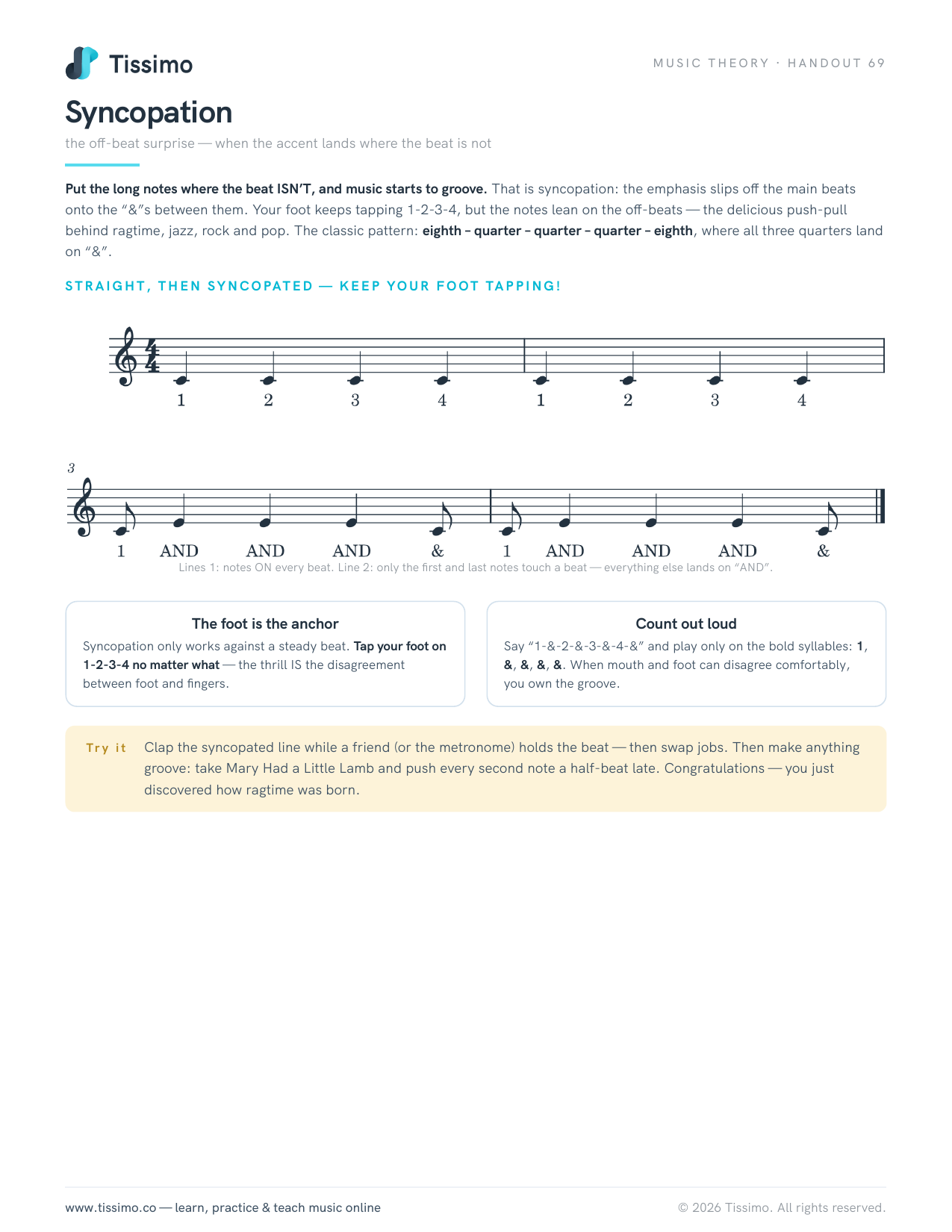 Syncopationthe off-beat surprise — when the accent lands where the beat is not
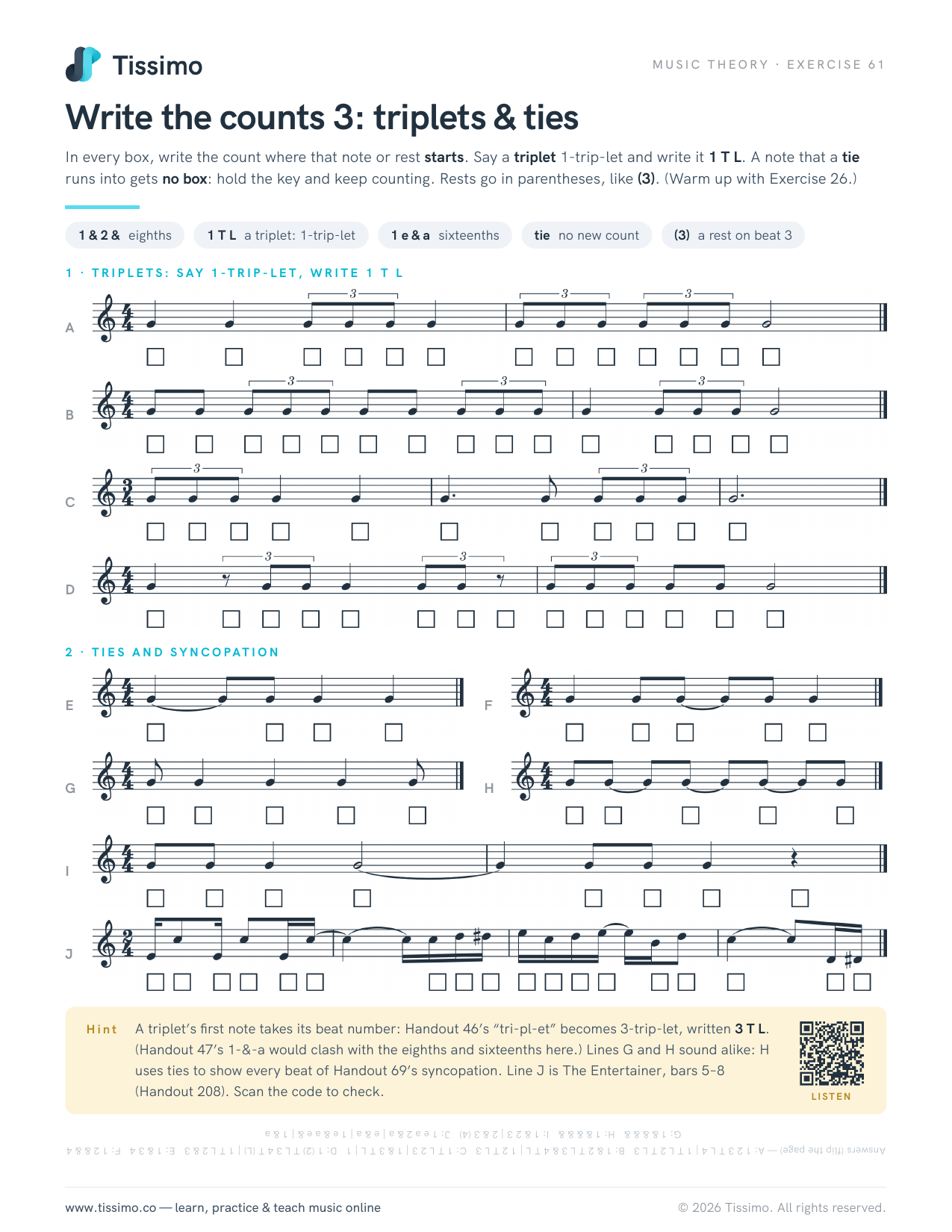 Write the counts 3: triplets & tiesIn every box, write the count where that note or rest starts. Say a triplet 1-trip-let and write it 1 T L. A note that a tie runs into gets no box: hold the key and keep counting. Rests go in parentheses, like (3). (Warm up with Exercise 26.)
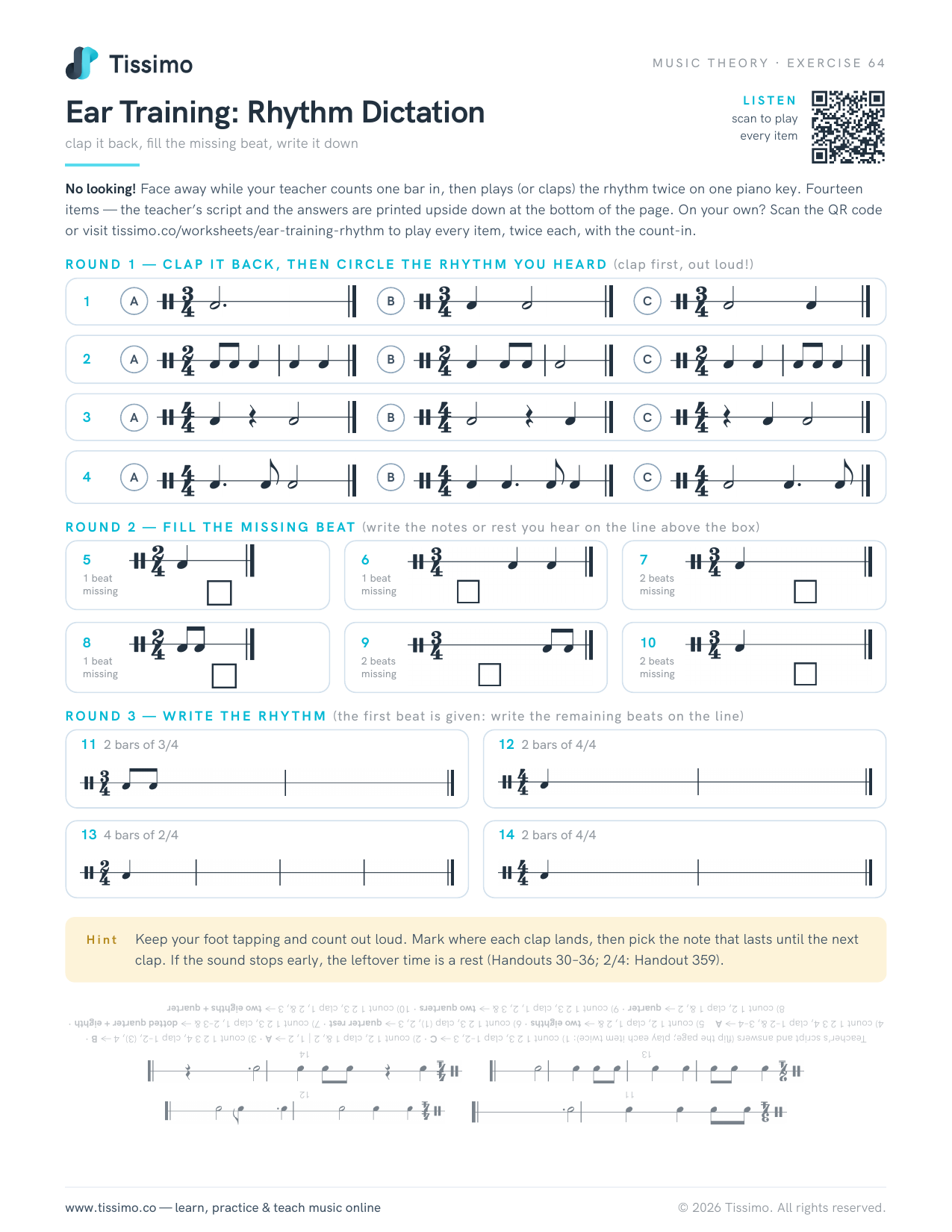 Ear Training: Rhythm Dictationclap it back, fill the missing beat, write it down