Rhythm & Meter
Downbeat
The downbeat is the first beat of a bar, usually the strongest. The name comes from the conductor's downward stroke on beat 1, and it is also used loosely for any strong beat.
The downbeat is beat 1 of a bar: the beat right after each bar line. In most music it is the strongest beat, the point where the meter starts its pattern over again. If you tap along to a song and count "1, 2, 3, 4", every "1" is a downbeat.
Why it is called the downbeat
The name comes from conducting. Whatever the meter, a conductor's hand or baton comes straight down on beat 1, so the whole ensemble can see where each bar begins. The last beat of the bar is shown with an upward lift, the upbeat, which prepares the next downbeat.
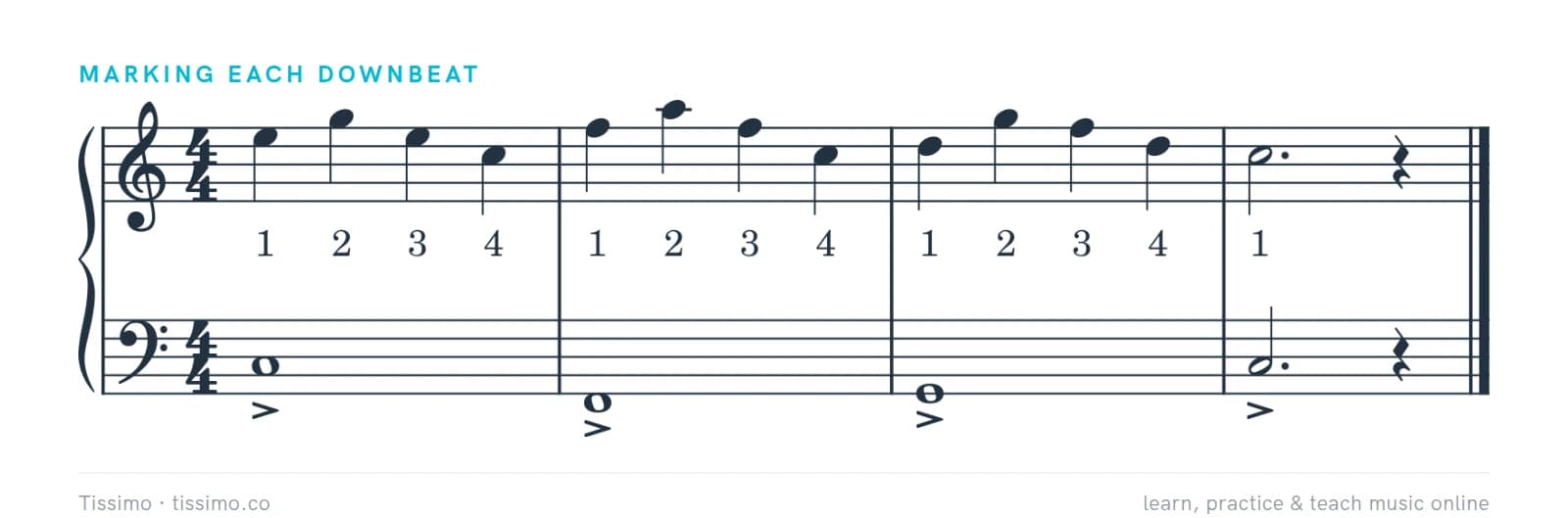
Feeling the downbeat
Harmony and bass lines usually make the downbeat easy to hear: chords tend to change there, and the bass often plays its lowest or longest note there. Melodies frequently land on important notes on the downbeat, and pickups lead into it. In funk and related styles, musicians talk about "the one" and often give beat 1 extra weight, so the whole band lands on it together.
When the downbeat is hidden
Composers sometimes play with the downbeat. A rest on beat 1, a note tied over the bar line, or a strong accent somewhere else (syncopation) can blur it for a moment, and part of the excitement is hearing it return. Even in music with a heavy backbeat on beats 2 and 4, the downbeat is still felt as the start of each bar. In music with changing time signatures, finding each new downbeat takes careful counting; practice it with Find the New Downbeat.
Other uses of the word
Musicians also say "on the downbeat" to mean the very start of a piece or section: "everyone comes in on the downbeat". Loosely, "downbeat" can mean any strong beat, as opposed to the off-beats. Outside music, "downbeat" can also mean gloomy, which has nothing to do with rhythm.
Find the downbeat in tunes that start with a pickup in Meter Detective and Pickup Notes.
Common questions
What is the difference between a downbeat and an upbeat?
The downbeat is the first, strongest beat of the bar, shown by the conductor's downward stroke. The upbeat is the last, weakest beat before it, shown by the upward lift that prepares the next downbeat.
Is the downbeat always beat 1?
In the strict sense, yes: the downbeat is the first beat of the bar. People also use the word loosely for any strong beat, or for the moment a piece or section starts.
Practice it: free worksheets
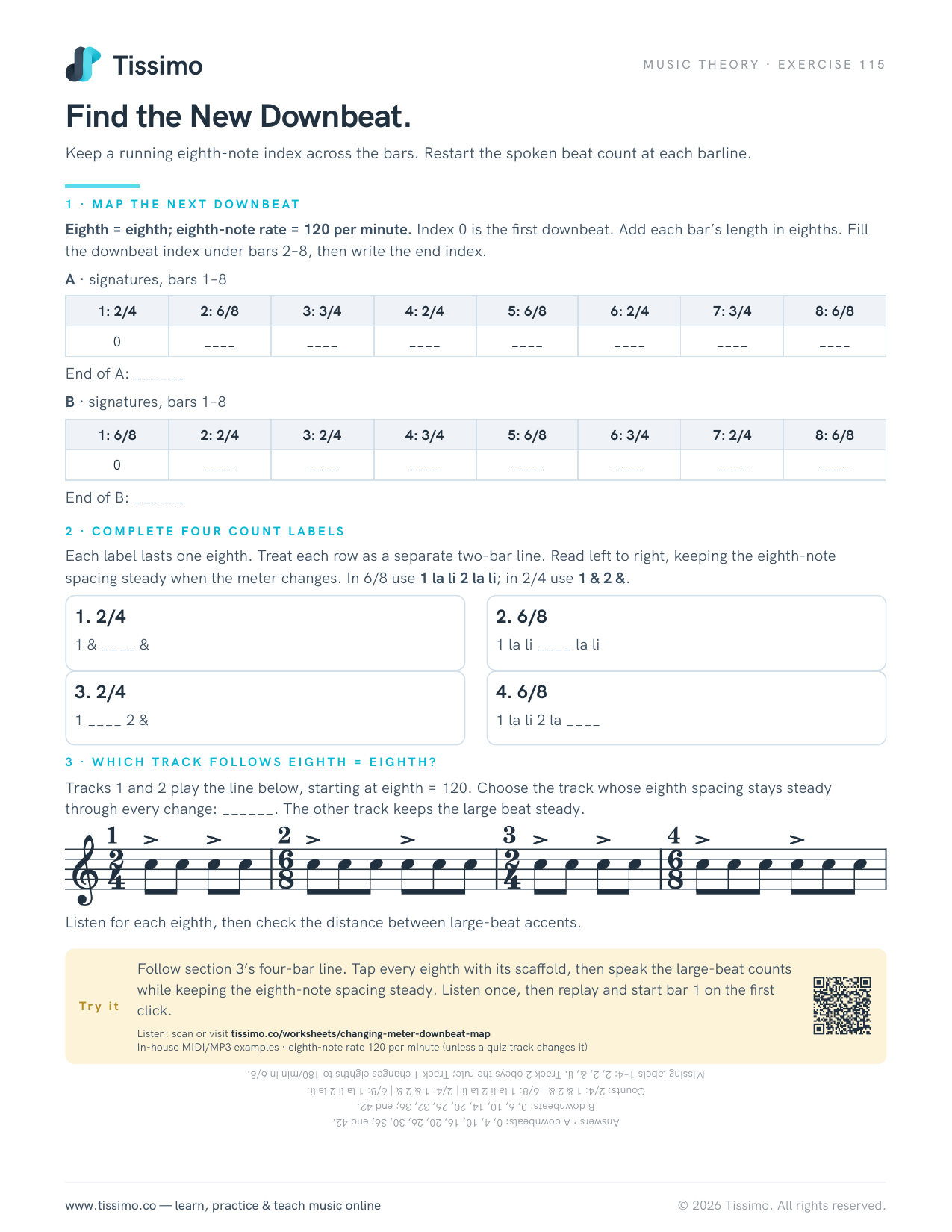 Find the New Downbeat.Keep a running eighth-note index across the bars. Restart the spoken beat count at each barline.
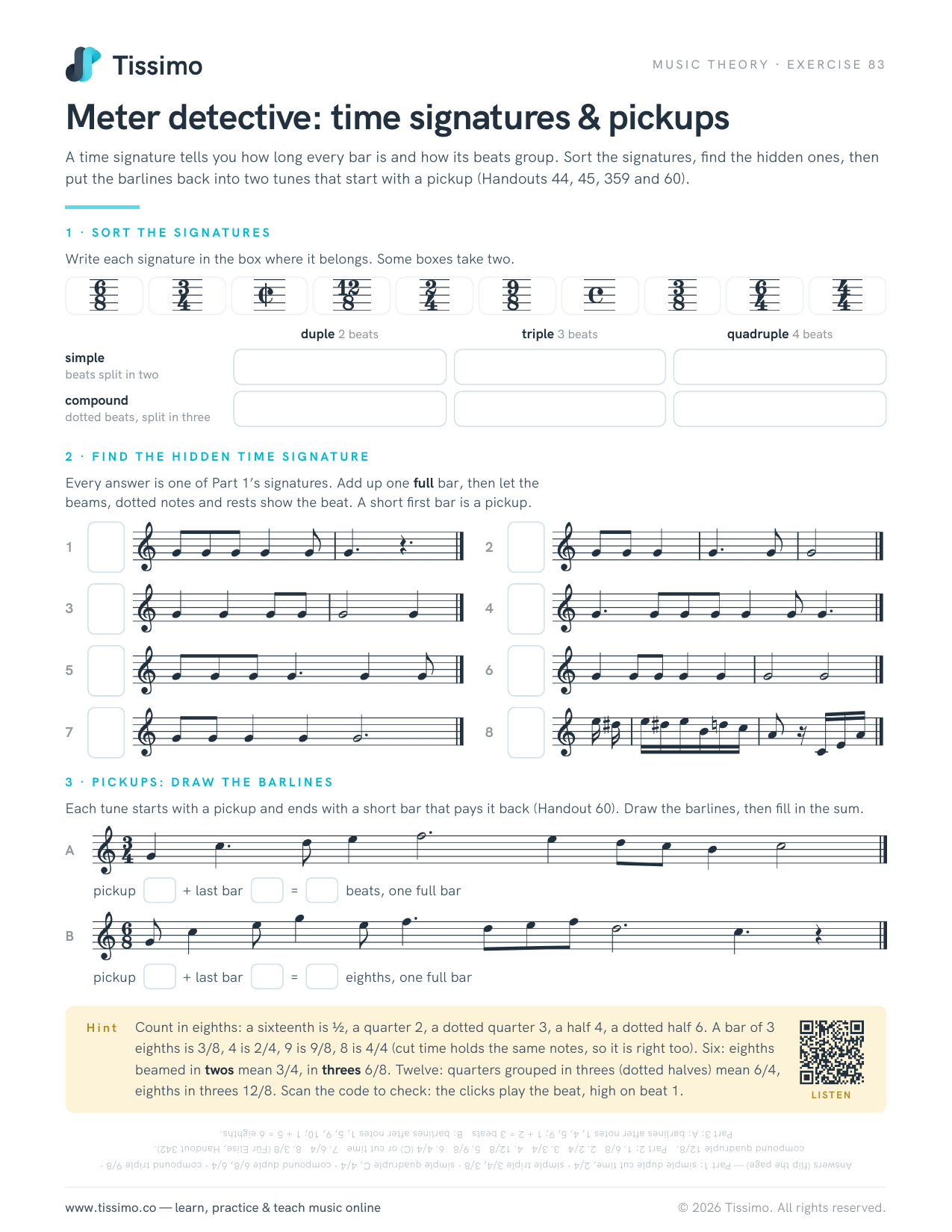 Meter detective: time signatures & pickupsA time signature tells you how long every bar is and how its beats group. Sort the signatures, find the hidden ones, then put the barlines back into two tunes that start with a pickup (Handouts 44, 45, 359 and 60).
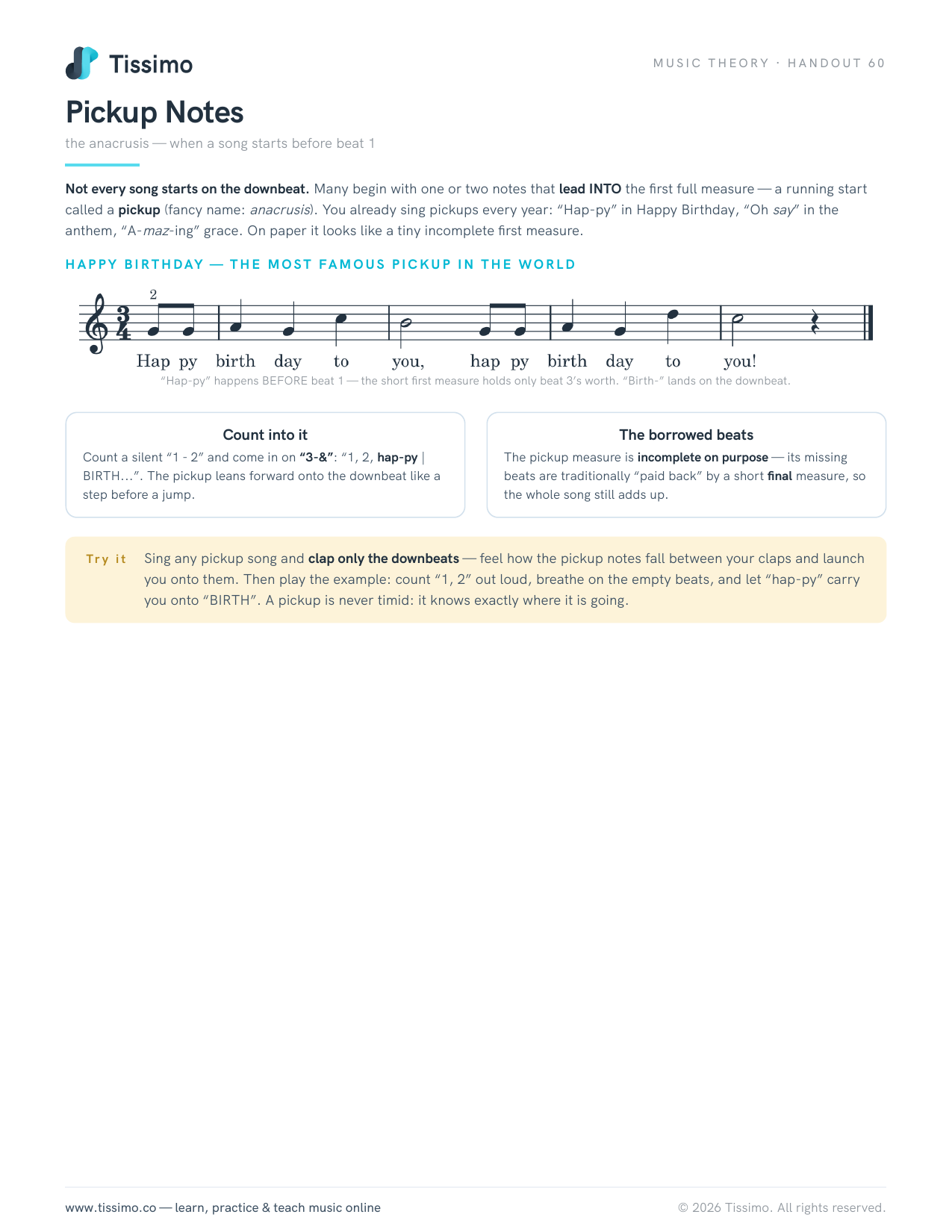 Pickup Notesthe anacrusis — when a song starts before beat 1