Rhythm & Meter
Compound Meter
A compound meter is one whose beats divide into three equal parts, such as 6/8, 9/8 and 12/8. Each beat is a dotted note, usually a dotted quarter worth three eighth notes.
In a compound meter, each beat divides into three equal parts instead of two. The beat is a dotted note, most often a dotted quarter, which holds three eighth notes. Compound meters have a rolling, lilting feel: think of a jig, a lullaby rocking back and forth, or a slow blues ballad in 12/8.
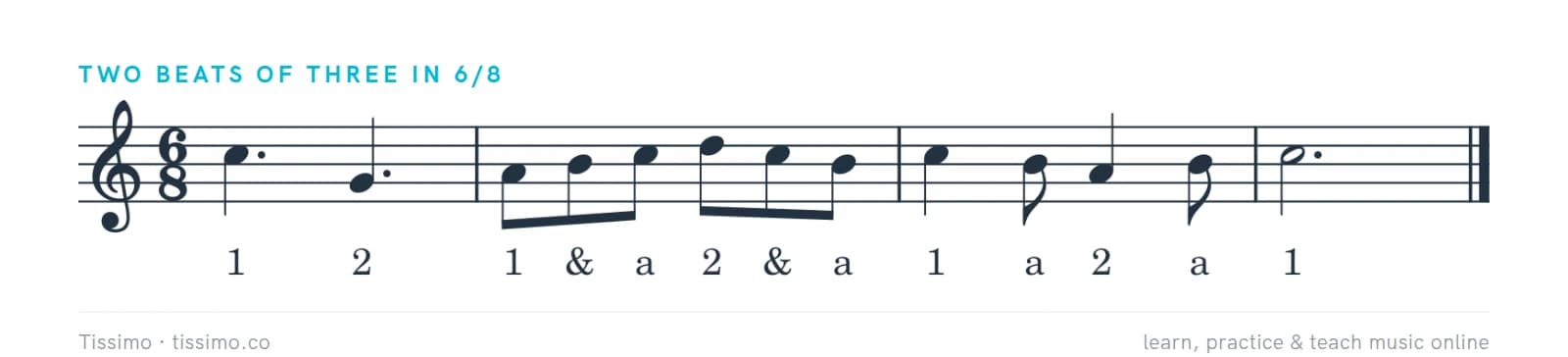
Reading a compound time signature
The top number of a common compound signature is 6, 9 or 12, and it counts the small notes, not the beats. To find the beats, divide the top number by three:
- 6/8: six eighth notes, two dotted-quarter beats (compound duple)
- 9/8: nine eighth notes, three dotted-quarter beats (compound triple)
- 12/8: twelve eighth notes, four dotted-quarter beats (compound quadruple)
- 6/4: six quarter notes, two dotted-half beats (compound duple)
In 6/8, 9/8 and 12/8, eighth notes are beamed in threes, one group per dotted-quarter beat. In 6/4, the dotted-half beat instead contains six eighth notes.
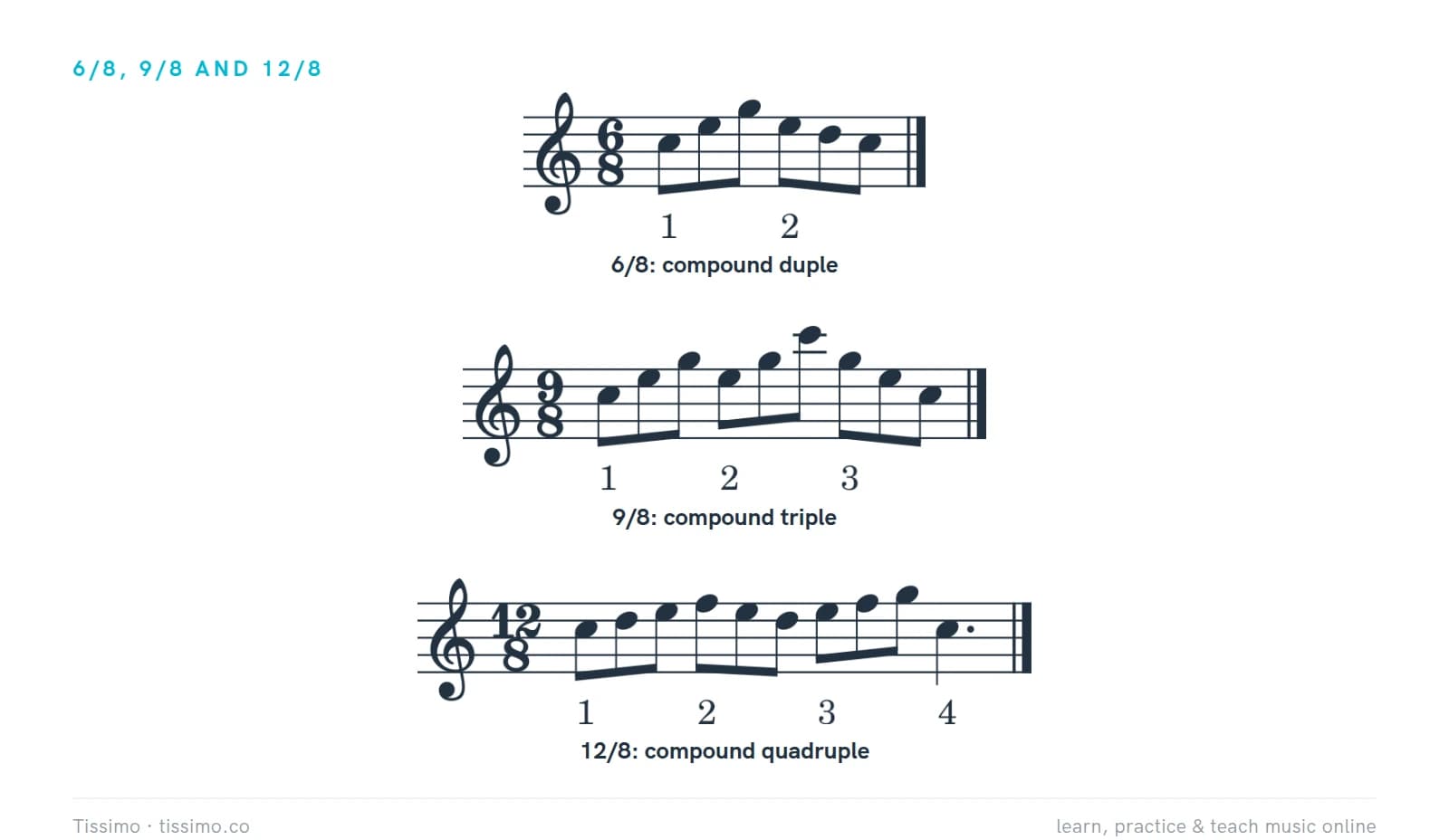
Counting compound meter
There are two common ways to count 6/8:
- Count the beats and their thirds: "1 & a 2 & a". This keeps the two big beats in front of you, and it works at any tempo.
- Count every eighth note: "1 2 3 4 5 6", with the beats on 1 and 4. This is handy at slow tempos and when you are first learning a rhythm. The Write the Counts 4 worksheet counts this way.
Choose one system and stay with it inside a piece. Practice hearing two beats of three with Rhythm Dictation: Two Beats, Three Parts Each.
Compound or simple?
A compound meter can sound like a simple meter full of triplets, and in a sense it is: the beat splits into three in both cases. The difference is that in compound time the three-way split is the normal state of the music, so it needs no 3 over each group. The reverse also happens: a compound meter can borrow a two-way split, written as a duplet (see tuplet).
The most common confusion is 6/8 against 3/4. Both hold six eighth notes, but 6/8 groups them 3+3 (two beats) and 3/4 groups them 2+2+2 (three beats). Time Signatures II: Compound Time works through the whole family.
Common questions
Why is 6/8 counted in two and not in six?
Because its six eighth notes are grouped in two sets of three, and each set forms one beat, a dotted quarter. At slow tempos players often count all six, but the music still moves in two big beats.
Are triplets the same as compound meter?
Eighth-note triplets can divide a quarter-note beat into three, like the normal three-part division of a compound beat. But triplets can span other durations too. In compound meter, the ordinary three-part beat division needs no tuplet sign.
Practice it: free worksheets
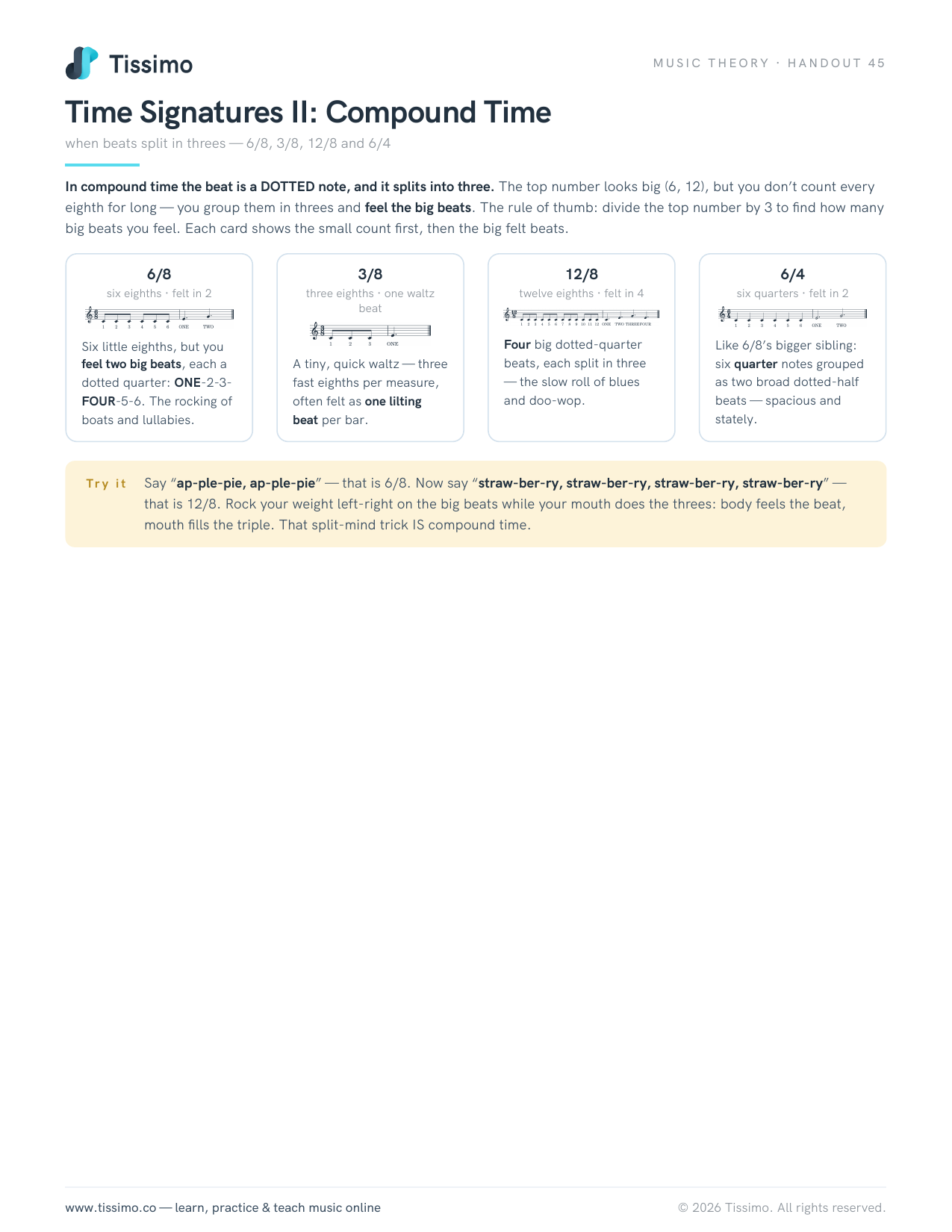 Time Signatures II: Compound Timewhen beats split in threes — 6/8, 9/8, 12/8 and 6/4
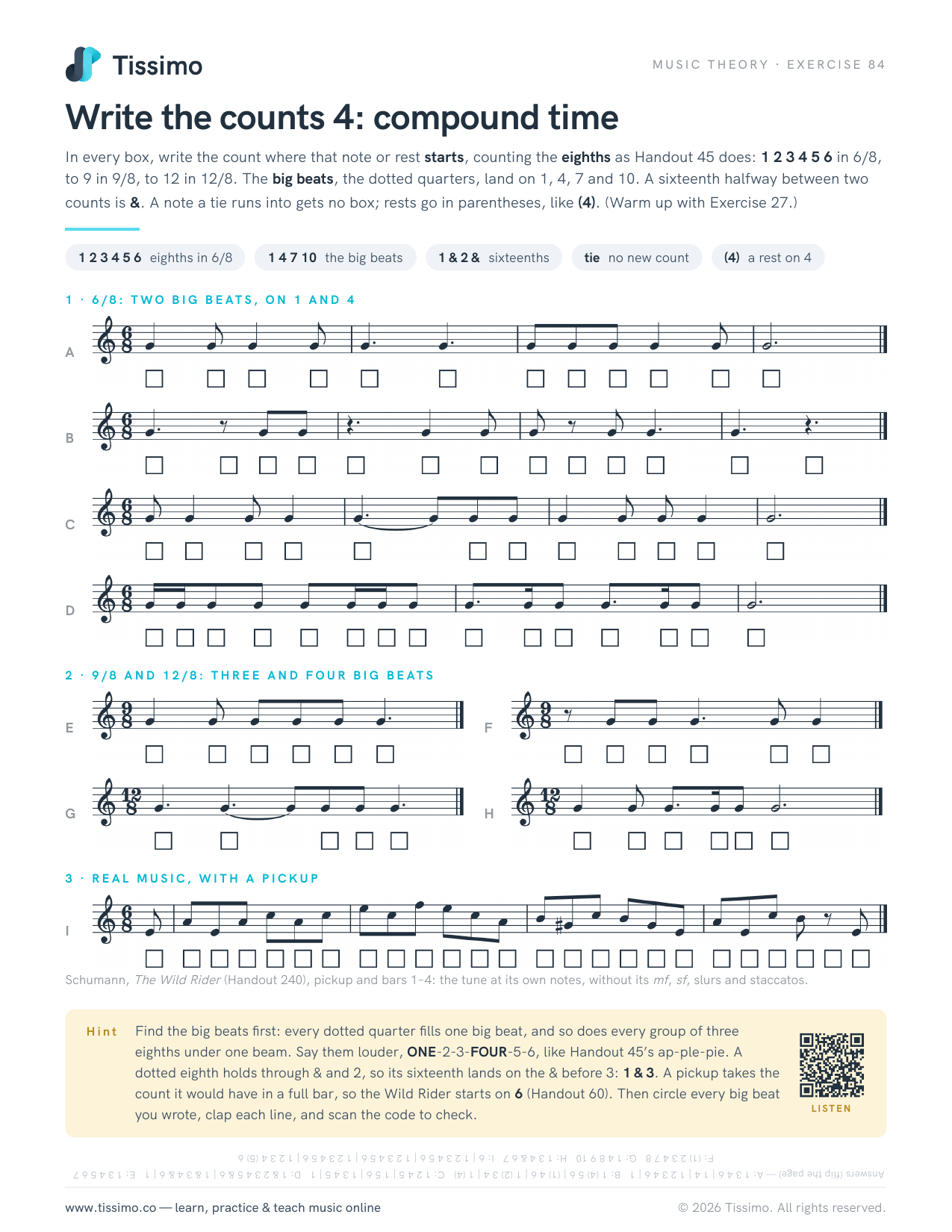 Write the counts 4: compound timeIn every box, write the count where that note or rest starts, counting the eighths as Handout 45 does: 1 2 3 4 5 6 in 6/8, to 9 in 9/8, to 12 in 12/8. The big beats, the dotted quarters, land on 1, 4, 7 and 10. A sixteenth halfway between two counts is &. A note a tie runs into gets no box; rests go in parentheses, like (4). (Warm up with Exercise 27.)
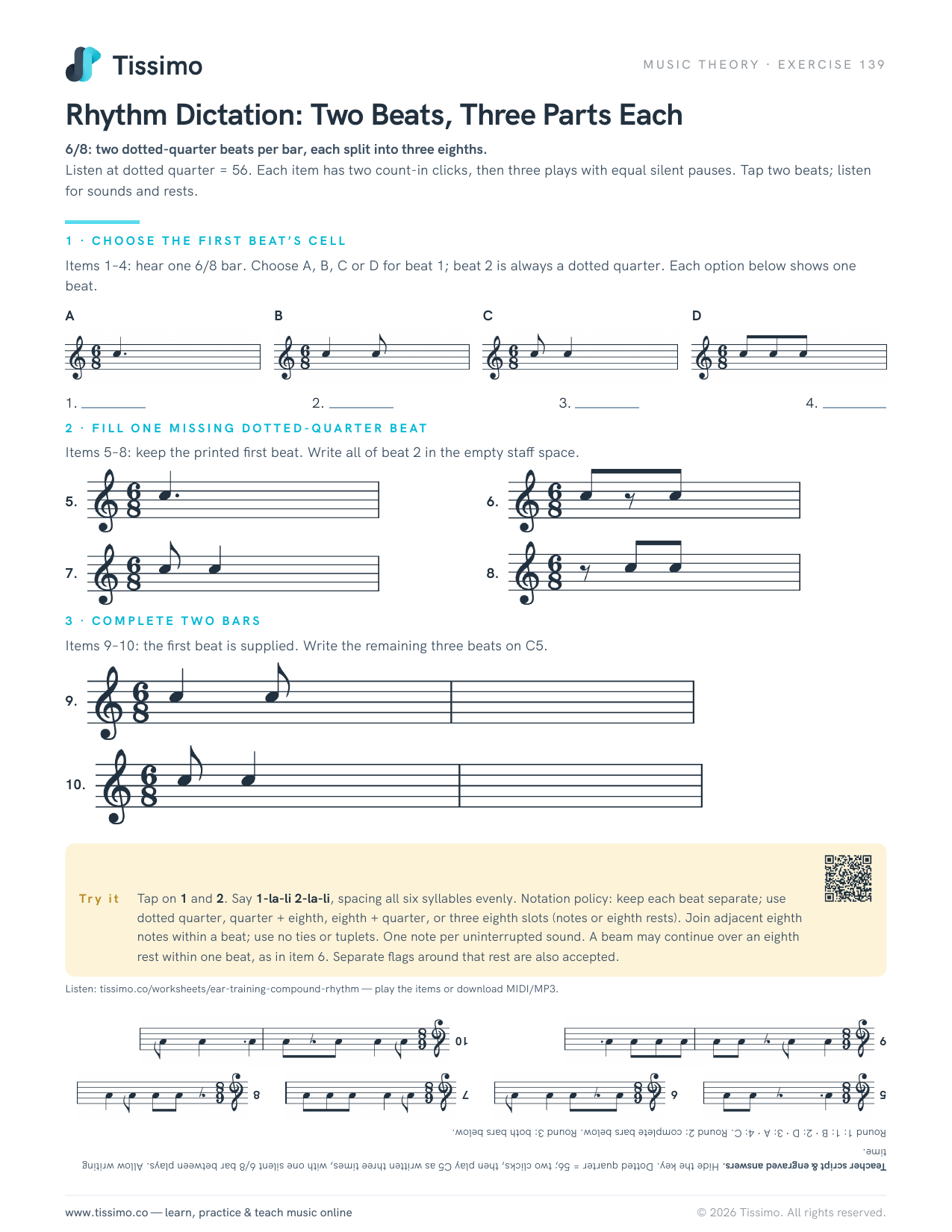 Rhythm Dictation: Two Beats, Three Parts Each6/8: two dotted-quarter beats per bar, each split into three eighths. Listen at dotted quarter = 56. Each item has two count-in clicks, then three plays with equal silent pauses. Tap two beats; listen for sounds and rests.