Rhythm & Meter
Note Value
A note value is how long a note lasts compared with other notes: whole, half, quarter, eighth, sixteenth and so on. Each value in the series lasts half as long as the one before it.
A note value tells you how long a note lasts compared with other notes. Each value in the standard series is half as long as the one before it: a whole note equals two half notes, a half note equals two quarter notes, and so on down to sixteenths, thirty-seconds and beyond. The shape of a note tells you its value, and the time signature and tempo turn those proportions into real time.
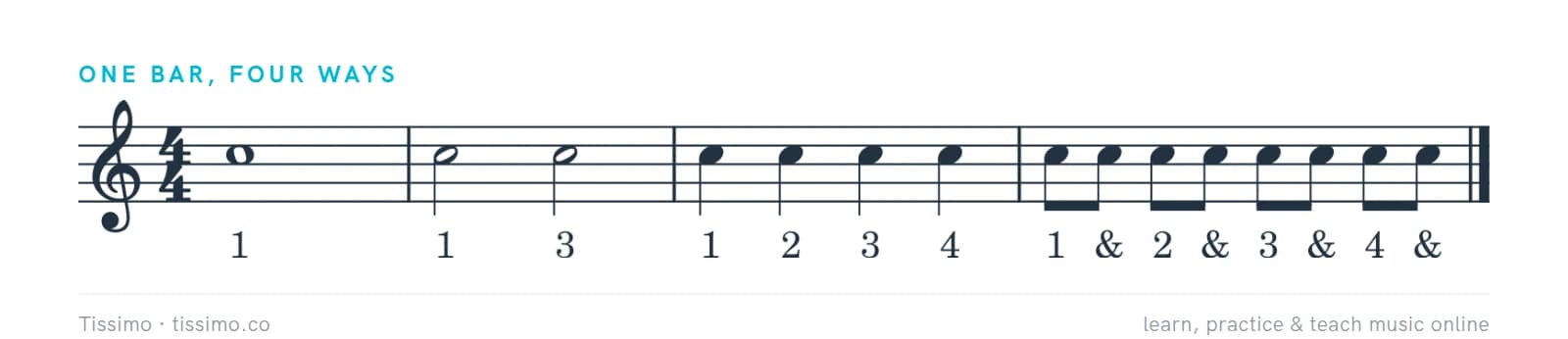
Reading the shapes
- Whole note: an open (hollow) oval with no stem.
- Half note: an open notehead with a stem.
- Quarter note: a filled notehead with a stem.
- Eighth note: a filled notehead, a stem and one flag (or one beam).
- Sixteenth note: two flags or beams.
- Thirty-second note: three flags or beams.
Each extra flag or beam halves the length again. Notes shorter than a quarter note are usually beamed together in groups that show the beats.
How many beats?
In 2/4, 3/4 and 4/4, where the quarter note gets one beat:
- whole note: 4 beats
- half note: 2 beats
- quarter note: 1 beat
- eighth note: 1/2 beat
- sixteenth note: 1/4 beat
These numbers depend on the time signature. In cut time the half note is the beat, so a quarter note lasts half a beat. The proportions between the values stay fixed; only the value that counts as one beat changes.
Making notes longer or shorter
A dot adds half the note's value again, a tie joins two notes into one longer sound, and a fermata asks you to hold a note beyond its written length. A triplet or another tuplet fits notes into an unusual share of the beat. Each value also has a matching rest for a silence of the same length.
American and British names
American English names the values by fraction. British English uses older names:
- whole note: semibreve
- half note: minim
- quarter note: crotchet
- eighth note: quaver
- sixteenth note: semiquaver
- thirty-second note: demisemiquaver
There is also a double whole note, called a breve, worth two whole notes. You will meet it mainly in older music.
Work through the values one at a time, starting with The Quarter Note, then The Half Note and The Whole Note.
Common questions
Which note value gets one beat?
The bottom number of the time signature tells you. In simple meters a 4 means the quarter note gets the beat, a 2 means the half note does, and an 8 means the eighth note does. In compound meters such as 6/8 the beat is a dotted note.
What are the British names for note values?
Semibreve (whole note), minim (half note), crotchet (quarter note), quaver (eighth note), semiquaver (sixteenth note) and demisemiquaver (thirty-second note).
Practice it: free worksheets
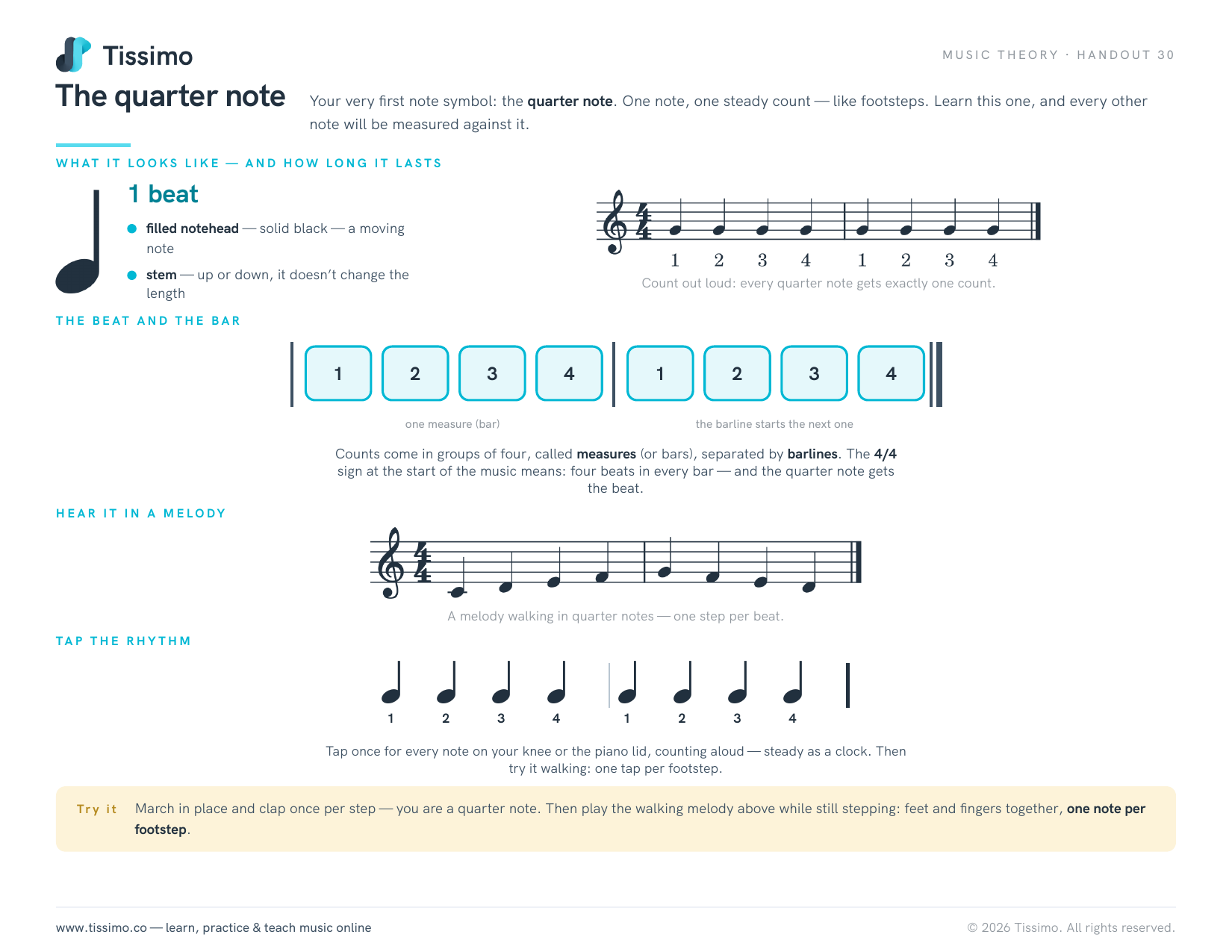 The quarter noteYour very first note symbol: the quarter note. One note, one steady count — like footsteps. Learn this one, and every other note will be measured against it.
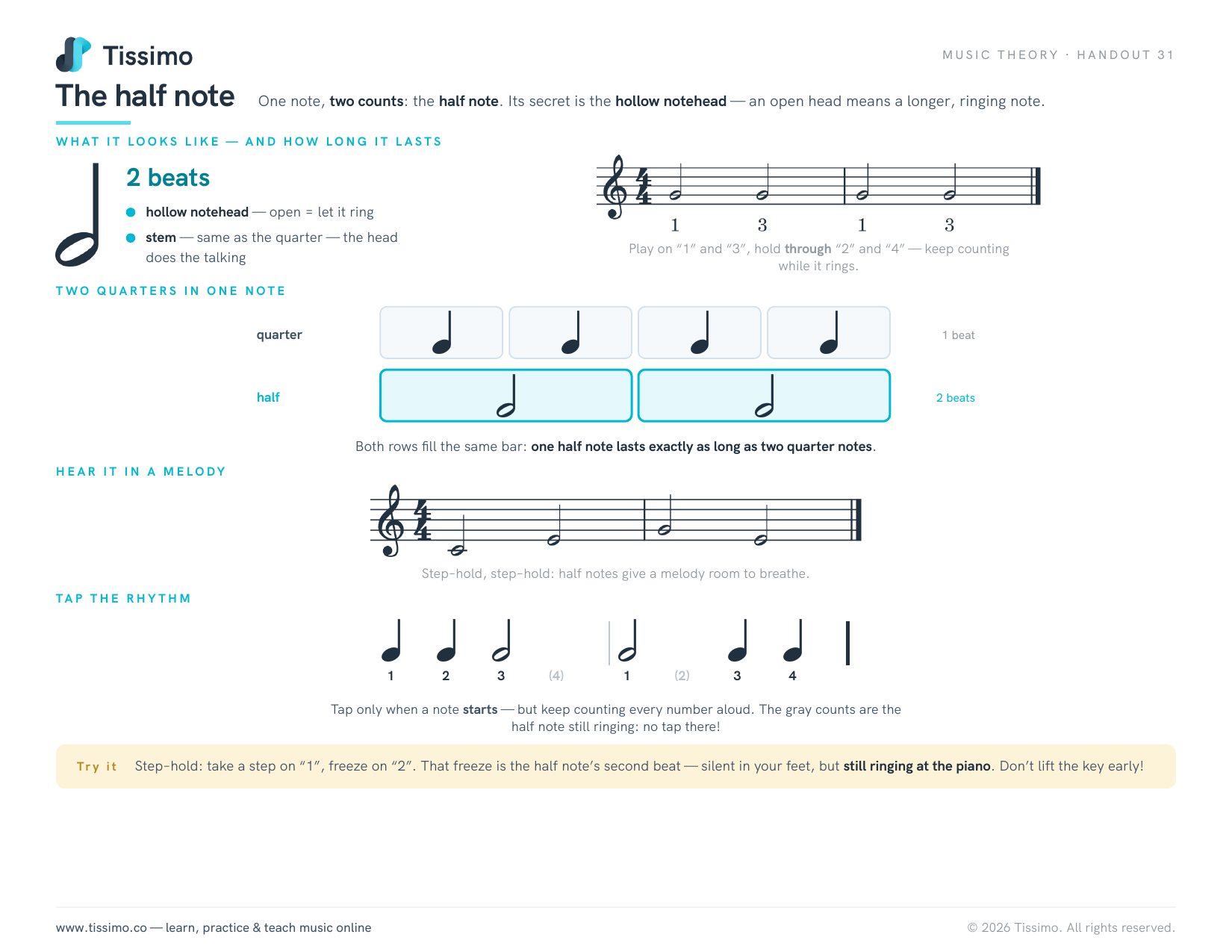 The half noteOne note, two counts: the half note. Its secret is the hollow notehead — an open head means a longer, ringing note.
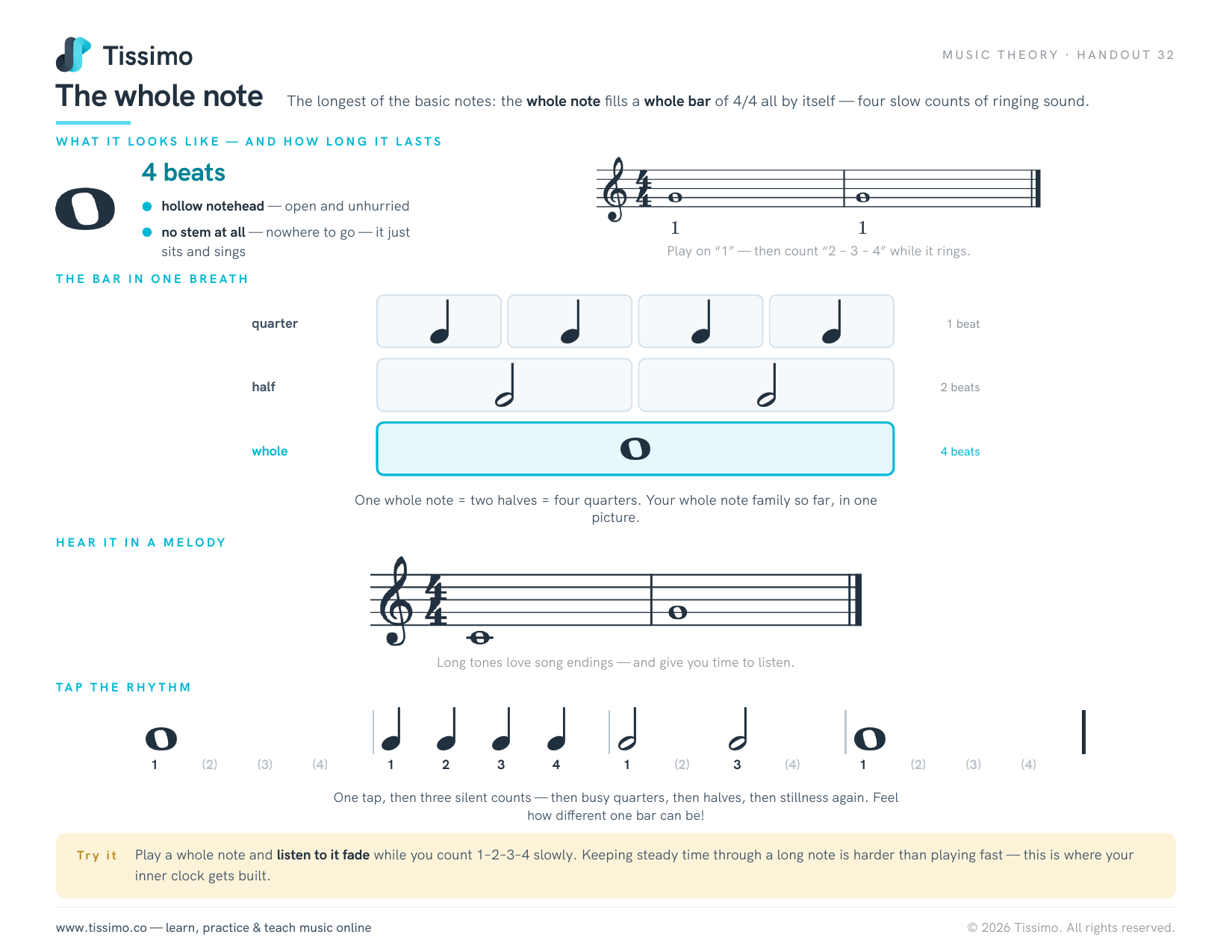 The whole noteThe longest of the basic notes: the whole note fills a whole bar of 4/4 all by itself — four slow counts of ringing sound.
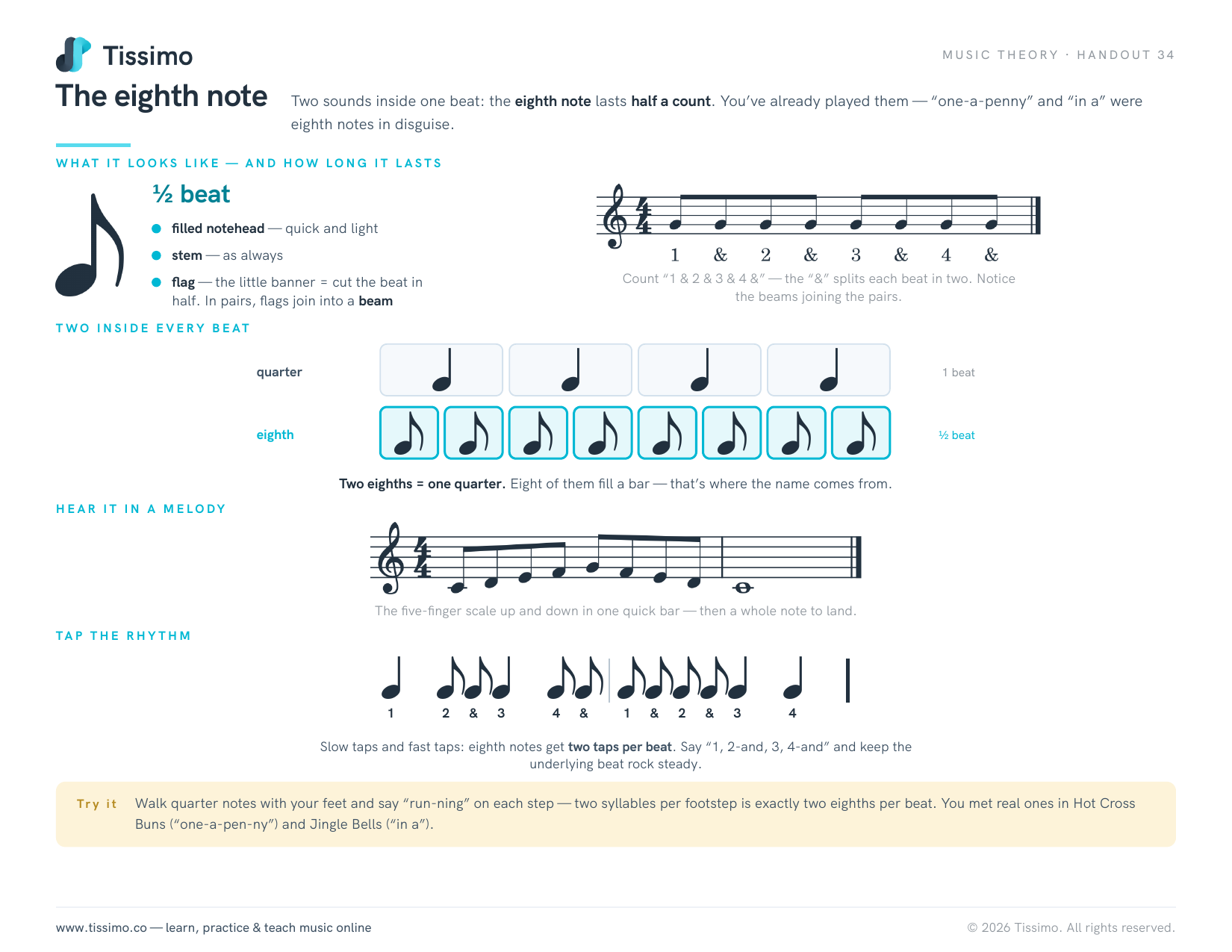 The eighth noteTwo sounds inside one beat: the eighth note lasts half a count. You’ve already played them — “one-a-penny” and “in a” were eighth notes in disguise.
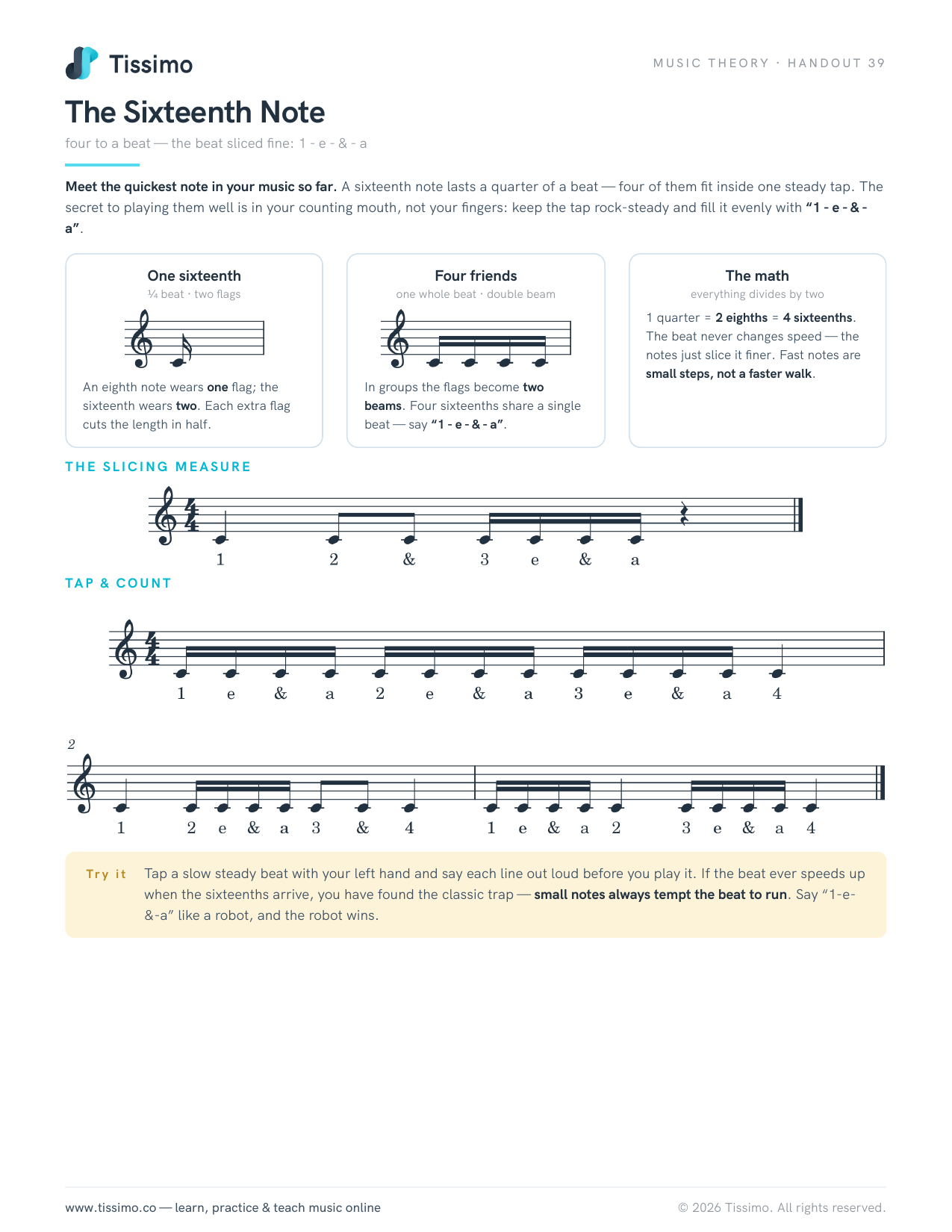 The Sixteenth Notefour to a beat — the beat sliced fine: 1 - e - & - a
 The Rest Familyevery note has a silent twin — all five rests, whole to sixteenth