Rhythm & Meter
Irregular Meter
An irregular meter has beats of unequal length, usually a mix of two- and three-pulse groups, as in 5/8 (3+2) or 7/8 (3+2+2). It is also called an asymmetrical, additive or odd meter.
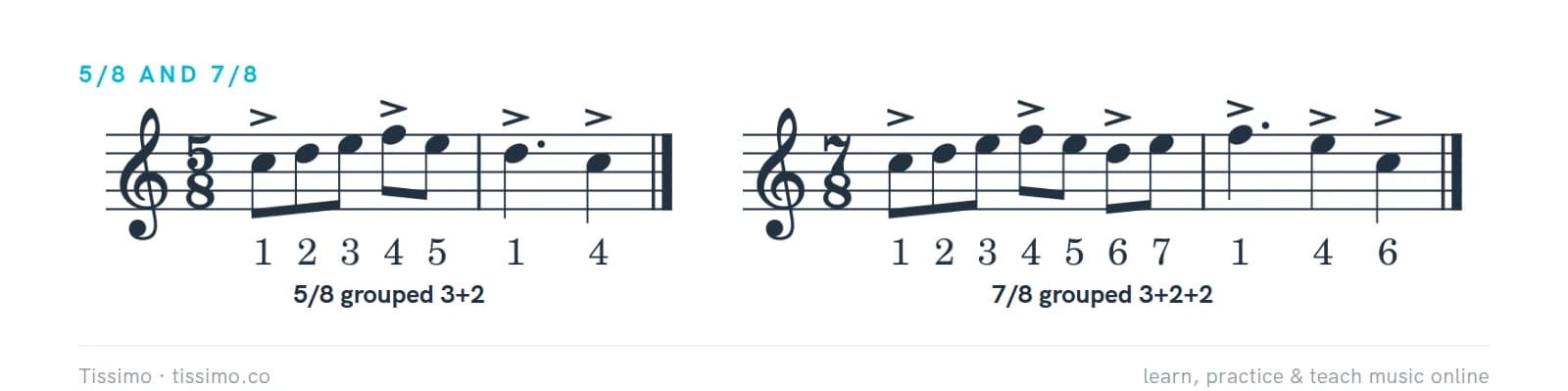
In most meters each beat is the same length. In an irregular meter they are not. A bar of 5/8 holds five eighth notes, commonly grouped as 3+2 or 2+3: one long beat and one short. Although you can count all five eighth notes evenly, these larger groups are unequal. A bar of 7/8 might be 2+2+3, 3+2+2 or 2+3+2. The result is a limping, dancing or driving feel that keeps the listener pleasantly off balance.
How the grouping is shown
- Beaming is the usual guide. In 7/8 the eighth notes are beamed 2+2+3 or 3+2+2, so you can see where the long beat falls.
- A split time signature such as 3+2 over 8 spells the grouping out in numbers.
- Longer notes show the beats when no eighth notes are present: in 5/8, a dotted quarter plus a quarter is a 3+2 bar.
When the grouping is not marked, look at where the melody's longer notes and accents fall, and listen for which beats the bass and chords move on.
Counting irregular meters
Count the small notes and lean on the start of each group. In 5/8 grouped 3+2, count "1 2 3 4 5" with weight on 1 and 4, or count the groups themselves: "1 2 3, 1 2". Some players use syllables, such as "1 & a 2 &". The aim is the same: feel two beats of different lengths, not five equal ones. A steady eighth-note pulse is the key. If the small notes stay even, the long and short beats fall into place.
Where you hear it
Irregular meters are at home in the folk dance music of the Balkans, Greece and Turkey, where 7/8, 9/8 grouped 2+2+2+3 and longer patterns are everyday dance rhythms. They are also common in jazz, progressive rock, film scores and twentieth-century concert music. Two well-known orchestral examples in 5/4 are "Mars" from Gustav Holst's The Planets and the second movement of Tchaikovsky's Sixth Symphony.
Irregular, mixed and changing meter
An irregular meter can repeat the same uneven pattern bar after bar, but its grouping can also change without a new time signature, for example from 2+2+3 to 3+2+2 within 7/8. A mixed or changing meter switches time signatures as it goes, for example 3/4, then 2/4, then 5/8. Many pieces use both.
Build 5/8 and 7/8 from groups of two and three in Feeling 5/8 and 7/8, keep the eighth note steady across changing bars in New Meter, Same Eighth, and practice finding each bar's start in Find the New Downbeat.
Common questions
Is 5/4 an irregular meter?
Usually, yes. Five beats cannot split into equal groups, so a bar of 5/4 is normally felt as 3+2 or 2+3. Some writers keep the word "irregular" for meters whose beats are different lengths, such as 5/8, and simply call 5/4 a five-beat meter.
What is the difference between irregular meter and mixed meter?
An irregular meter uses uneven groups, such as 7/8 grouped 2+2+3. Its grouping may stay the same or vary. Mixed (or changing) meter means the time signature itself changes.
Practice it: free worksheets
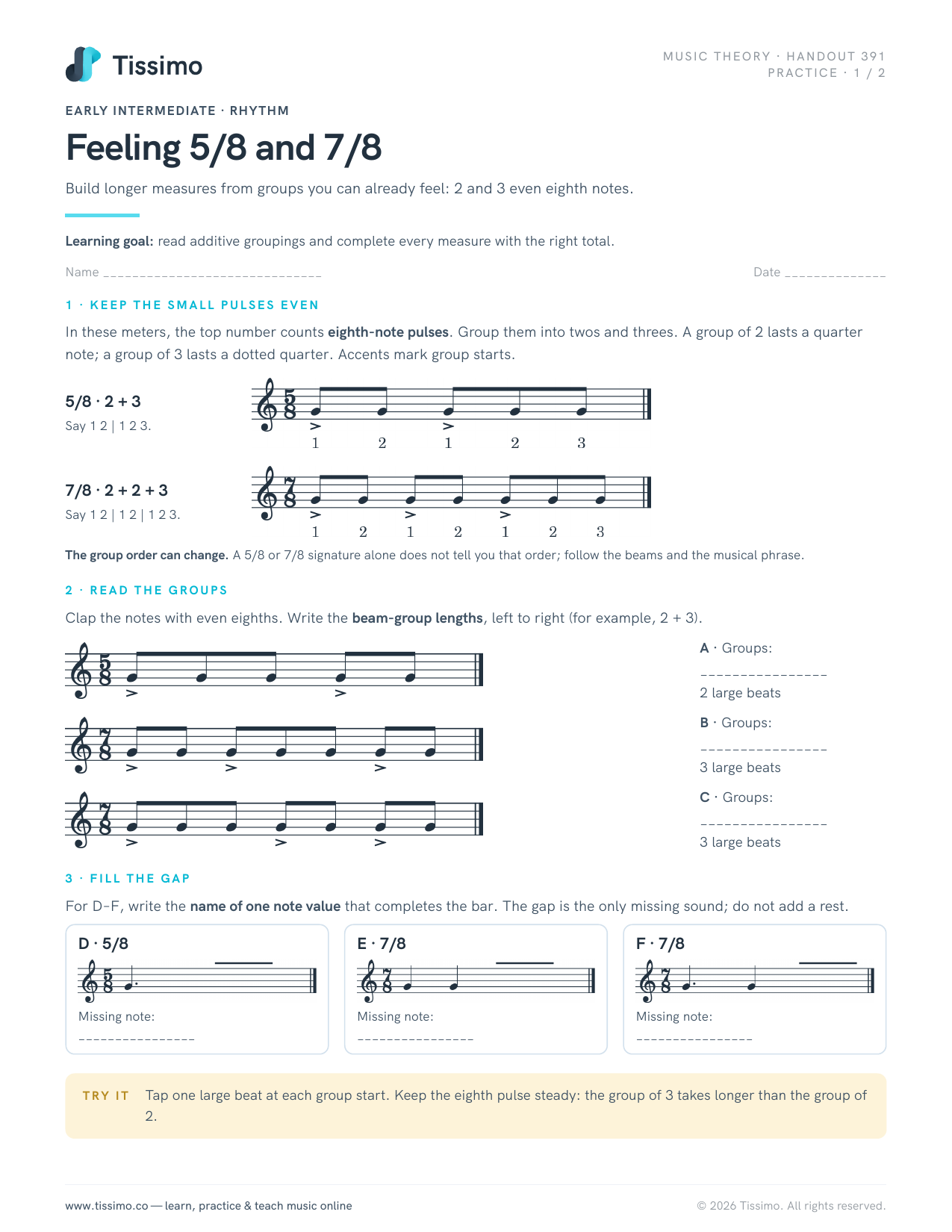 Feeling 5/8 and 7/8Build longer measures from groups you can already feel: 2 and 3 even eighth notes.
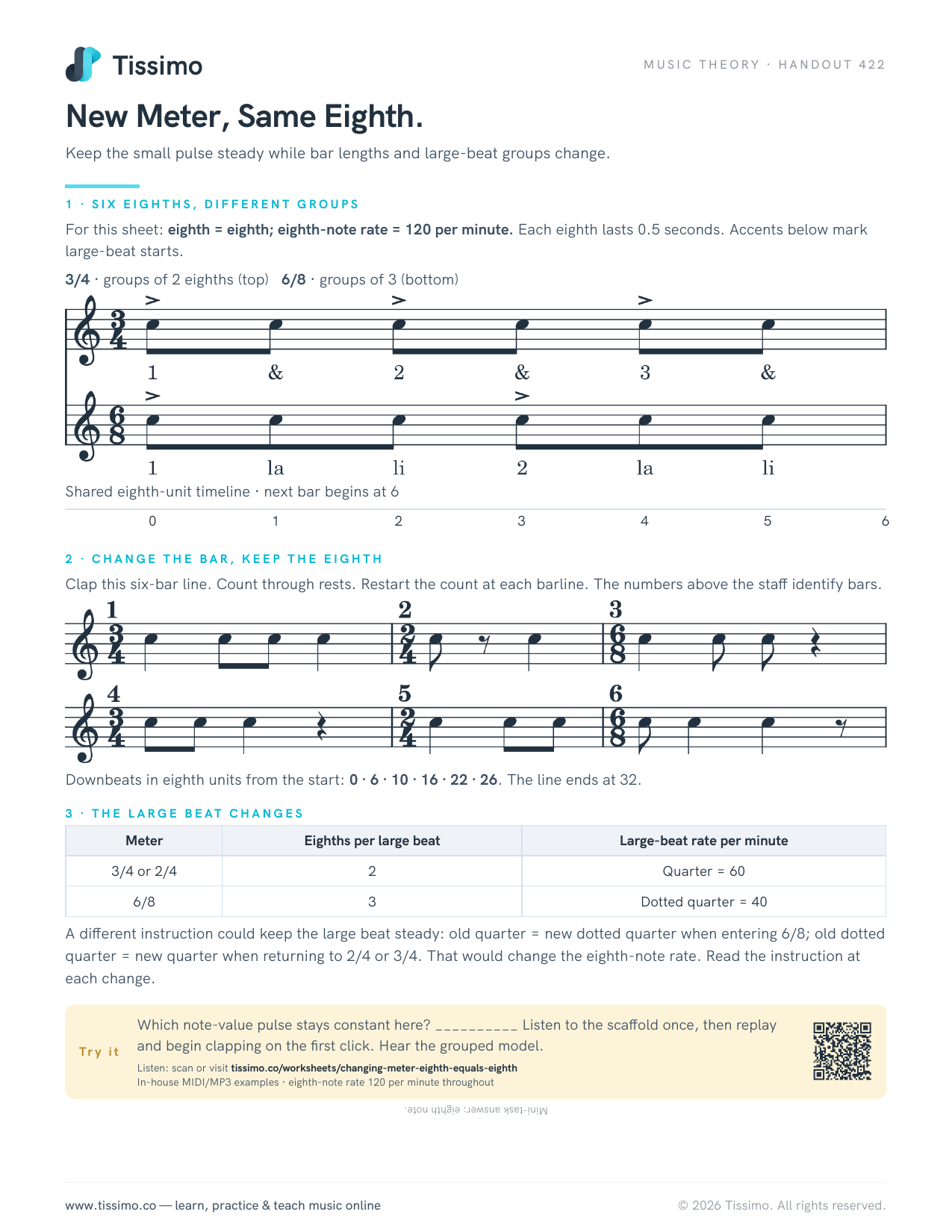 New Meter, Same Eighth.Keep the small pulse steady while bar lengths and large-beat groups change.
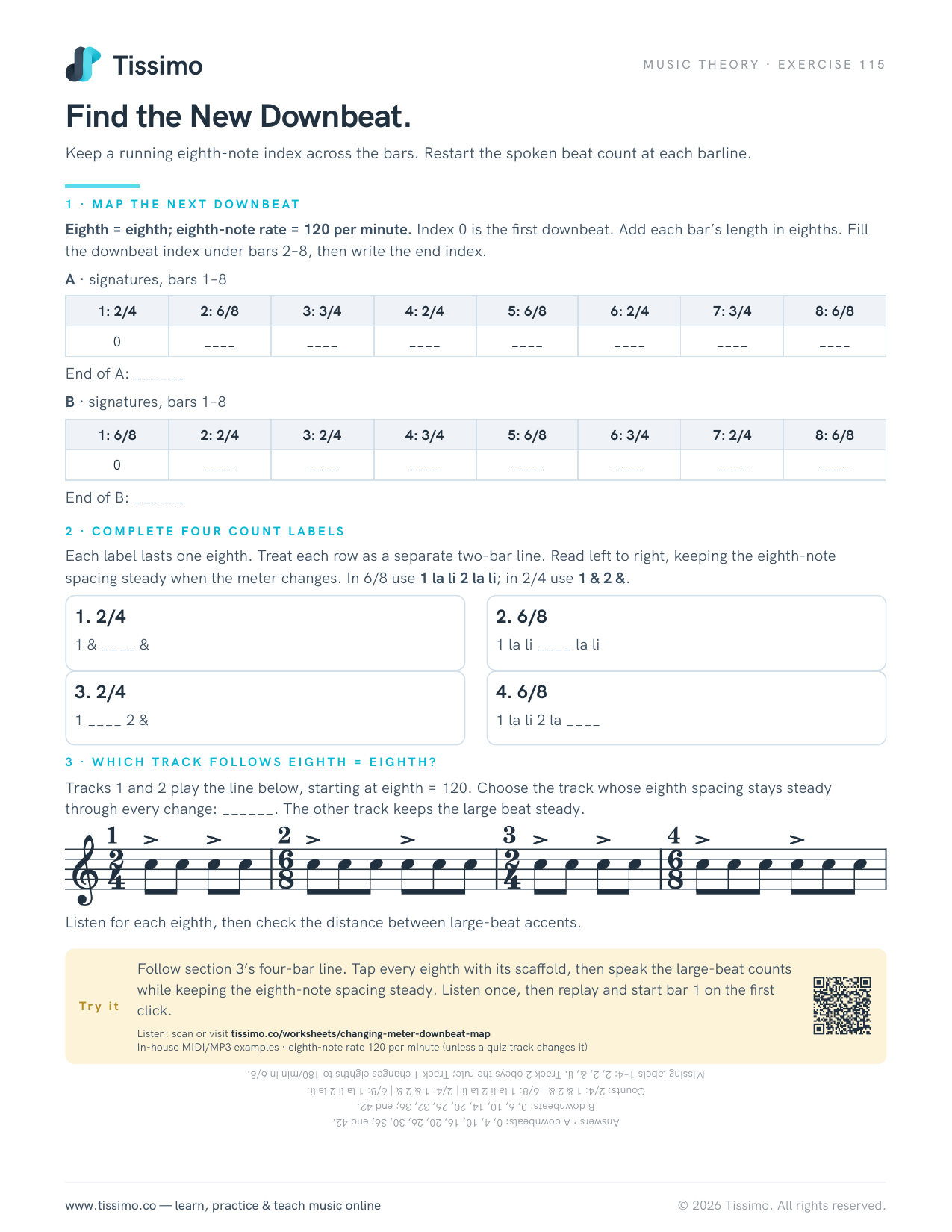 Find the New Downbeat.Keep a running eighth-note index across the bars. Restart the spoken beat count at each barline.