Rhythm & Meter
Polyrhythm
A polyrhythm is two or more conflicting rhythms played at the same time, such as three even notes against two. Each part divides the same span of time into a different number of equal pulses.
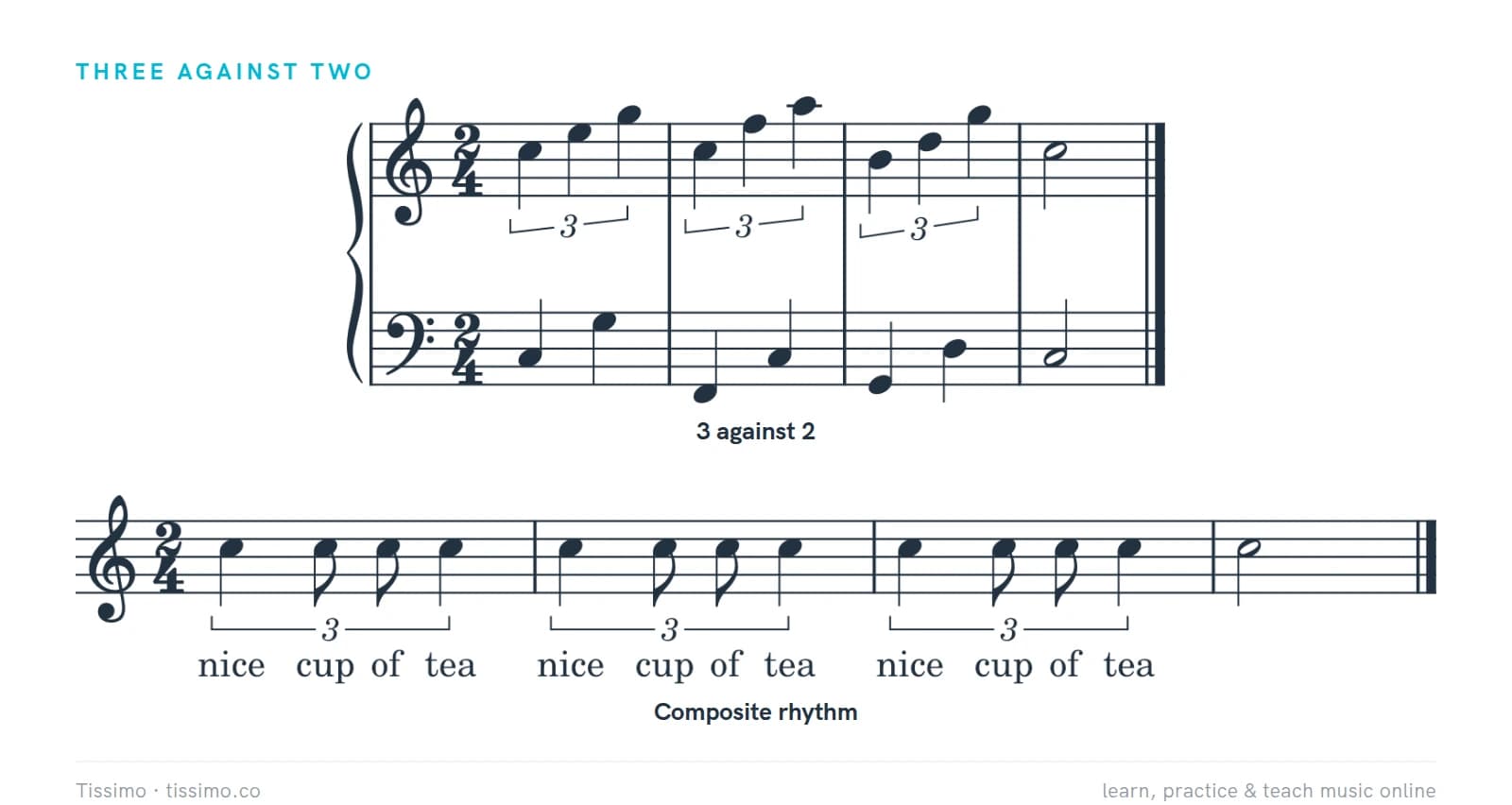
A polyrhythm sets two different divisions of time against each other. The simplest and most common is 3 against 2 (written 3:2): one part plays three even notes while another plays two in the same span. Both parts start together, drift apart, and meet again at the start of the next span. Other common ones are 4 against 3 and 2 against 3. The word is often used interchangeably with cross-rhythm, though some writers keep that term for a pattern that contradicts the main meter.
How the parts fit together
To see where every note falls, find a pulse that both rhythms share. For 3 against 2, divide the span into six equal parts. The threes fall on pulses 1, 3 and 5; the twos on pulses 1 and 4. Played together they make a composite rhythm, long-short-short-long, which many teachers fit to the words "nice cup of tea": "nice" in both parts, "cup" on the second of the three, "of" on the second of the two, and "tea" on the third of the three.
For 4 against 3, use twelve pulses. A phrase often used for its composite rhythm is "pass the golden butter".
Learning 3 against 2 at the piano
- Tap the composite rhythm on a table: right hand on "nice", "cup" and "tea"; left hand on "nice" and "of".
- Say the words slowly in that long-short-short-long rhythm, not as four equally spaced syllables, until the hands feel independent.
- Move it to the keyboard with simple notes, then speed up gradually.
- Finally, listen to one hand, then the other, without losing the combined rhythm.
The Polyrhythms worksheet walks through exactly this. Building hand independence this way pays off far beyond polyrhythms.
Where you hear it
Layered, interlocking rhythms are central to much West African drumming and to Afro-Cuban and other Afro-Caribbean music, where several percussion parts lock together. In classical piano music, triplets in one hand against duplets in the other are common, especially in the nineteenth century. Jazz drummers and progressive rock bands use polyrhythms to build tension against a steady meter.
Polyrhythm, polymeter and hemiola
A polyrhythm divides the same span of time into different numbers of notes. Polymeter is different: two parts share the same pulse but use bars of different lengths, such as a three-beat pattern against a four-beat pattern, so their bar lines drift apart and realign later. A hemiola is a special case of 3 against 2 in which the meter itself seems to regroup for a moment.
Common questions
How do you play 3 against 2 on the piano?
Learn the composite rhythm first. Divide the span into six equal pulses: the hand playing three plays on pulses 1, 3 and 5, and the hand playing two on 1 and 4. Say "nice cup of tea" with the syllables on pulses 1, 3, 4 and 5, not equally spaced: "nice" in both hands, "cup" and "tea" in the three-hand and "of" in the two-hand.
What is the difference between polyrhythm and polymeter?
A polyrhythm divides the same span of time into different numbers of equal notes, such as 3 against 2. Polymeter combines bars of different lengths on the same pulse, so the parts' bar lines drift apart and realign later.