Chords & Harmony
Six-Four Chord
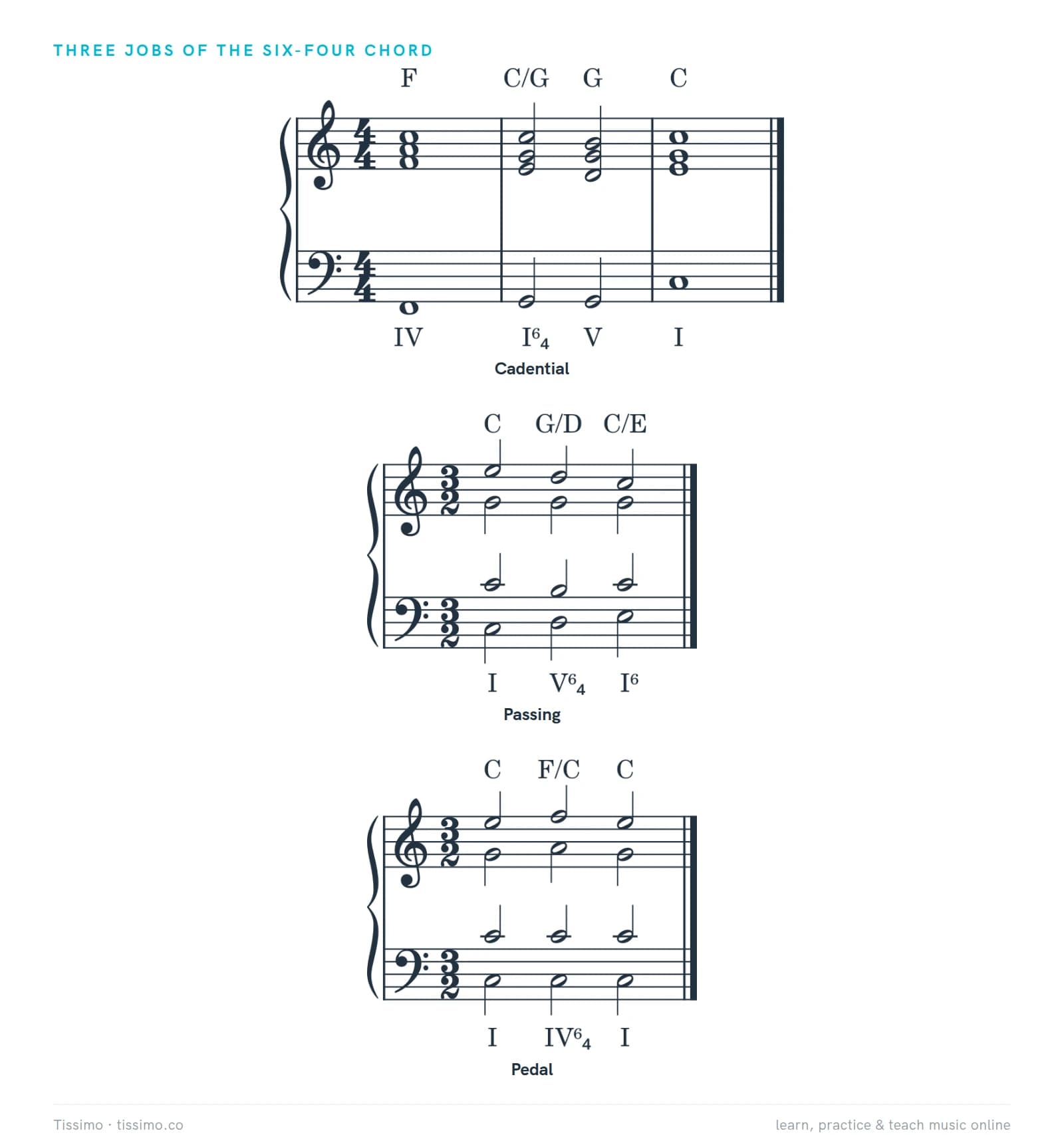
A six-four chord is a triad in second inversion, with its fifth in the bass, such as C/G. Its fourth above the bass makes it unstable, so classical harmony uses it in a few set patterns: cadential, passing and pedal.
A six-four chord is a triad in second inversion: its fifth is in the bass. C/G (G–C–E) is a six-four chord, named after its figured bass figures, 6/4, because E is a sixth and C a fourth above the bass G. In Roman numerals it is written with ⁶₄, as in I6/4.
Why it is special
In common-practice harmony the fourth above the bass is treated as a dissonance. That makes a six-four chord sound unsettled, as if it is leaning toward something else, so composers rarely use it as a free-standing chord. Instead it appears in a few standard patterns, each with its own job. In all of them, the bass note is usually the doubled note.
The cadential six-four
The most important one. Just before a cadence the bass arrives on the dominant note (G), but the upper voices still hold C and E. Then they slip down to B and D, turning the chord into V: the sixth above the bass falls to a fifth and the fourth falls to a third. The six-four sits on a stronger beat than the V that follows, and it makes the arrival on the dominant feel weightier. Because it really decorates V, many theorists label it V6/4–5/3 rather than I6/4.
The passing six-four
Here the bass passes by step between two positions of another chord: I – V6/4 – I6, with the bass walking C–D–E. The six-four falls on a weak beat, and the upper voices often move against the bass, as in the voice exchange in the example (C–D–E in the bass, E–D–C in the soprano).
The pedal six-four
Over a held bass note, two upper voices step up and back: C – F/C – C, with E–F–E and G–A–G above a C bass. The middle chord, IV6/4, is a neighbor chord over a pedal. It is common at the end of hymns, as a gentle plagal color.
Other six-fours
In accompaniment patterns such as a waltz bass, the left hand may touch the fifth of a chord on its way through (sometimes called an arpeggiated six-four). It is part of a broken chord rather than a separate harmony.
Practice with The 6/4 chord: three jobs and Name the 6/4 chords.
Common questions
Why is a six-four chord considered unstable?
Because of the fourth above the bass. Traditional harmony treats that fourth as a dissonance that should resolve, so a second-inversion triad sounds as if it is leaning toward another chord.
What is a cadential six-four?
A second-inversion tonic chord (I6/4) over the dominant bass note just before a cadence. Its upper notes fall by step to form V, so it works as a decoration of the dominant chord.
Practice it: free worksheets
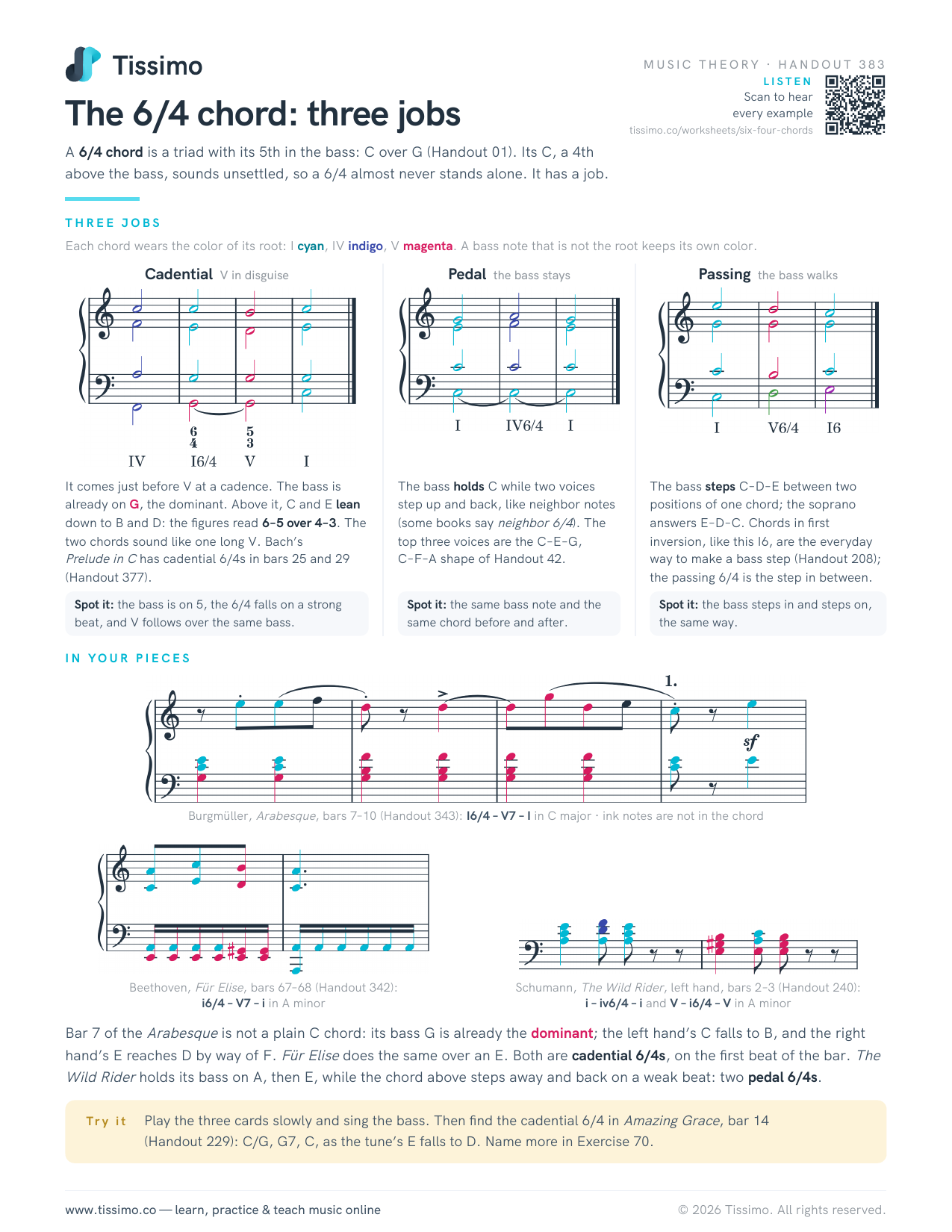 The 6/4 chord: three jobsA 6/4 chord is a triad with its 5th in the bass: C over G (Handout 01). Its C, a 4th above the bass, sounds unsettled, so a 6/4 almost never stands alone. It has a job.
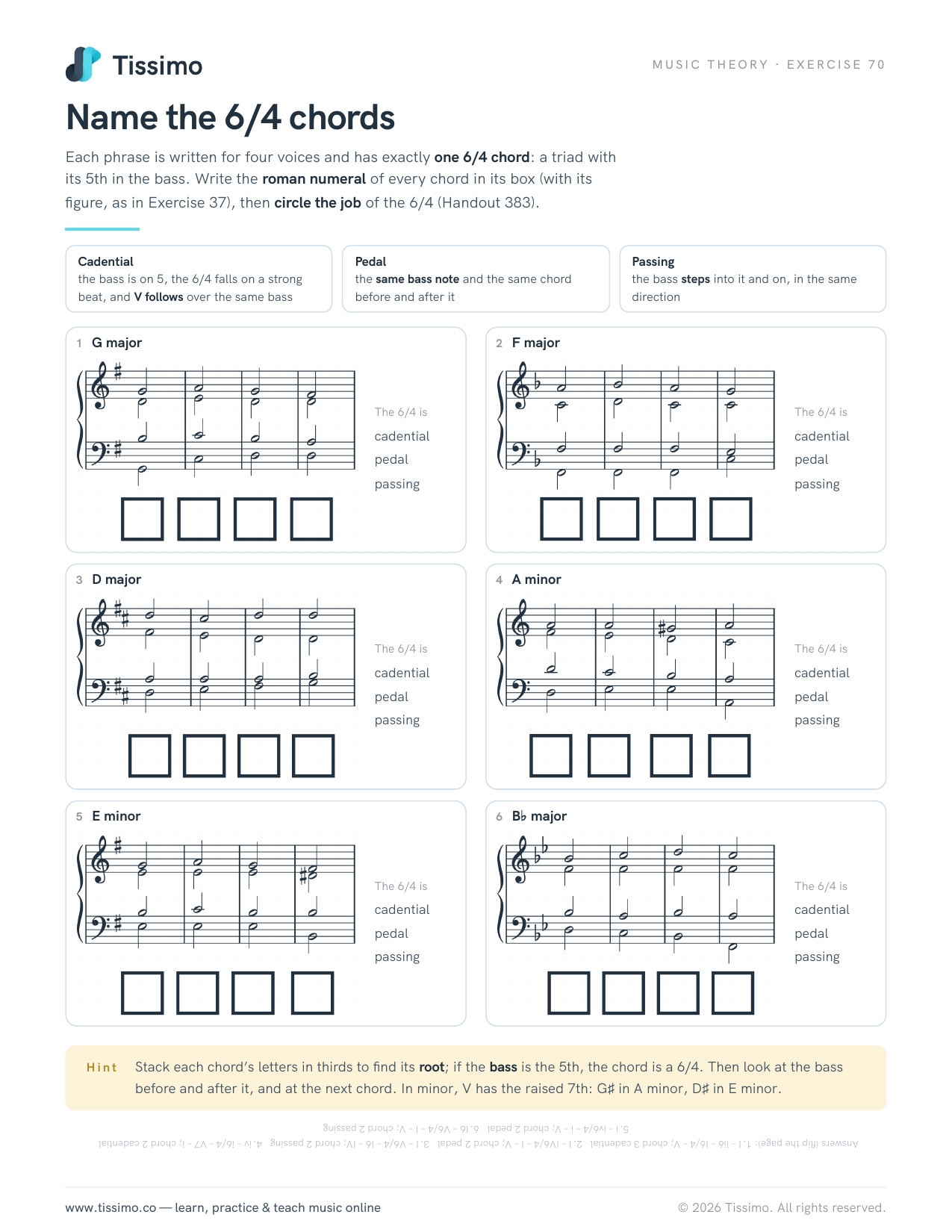 Name the 6/4 chordsEach phrase is written for four voices and has exactly one 6/4 chord: a triad with its 5th in the bass. Write the roman numeral of every chord in its box (with its figure, as in Exercise 37), then circle the job of the 6/4 (Handout 383).
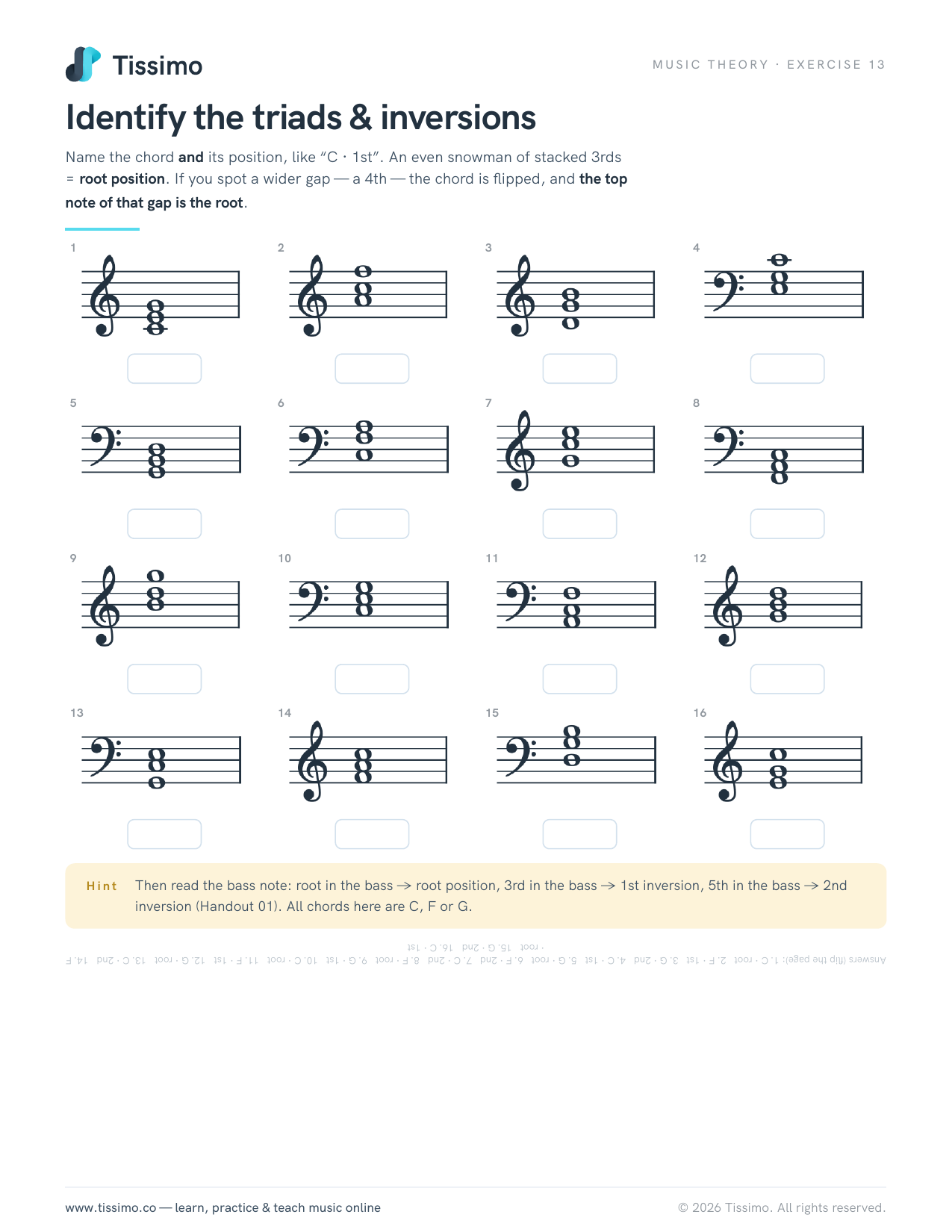 Identify the triads & inversionsName the chord and its position, like “C · 1st”. An even snowman of stacked 3rds = root position. If you spot a wider gap — a 4th — the chord is flipped, and the top note of that gap is the root.
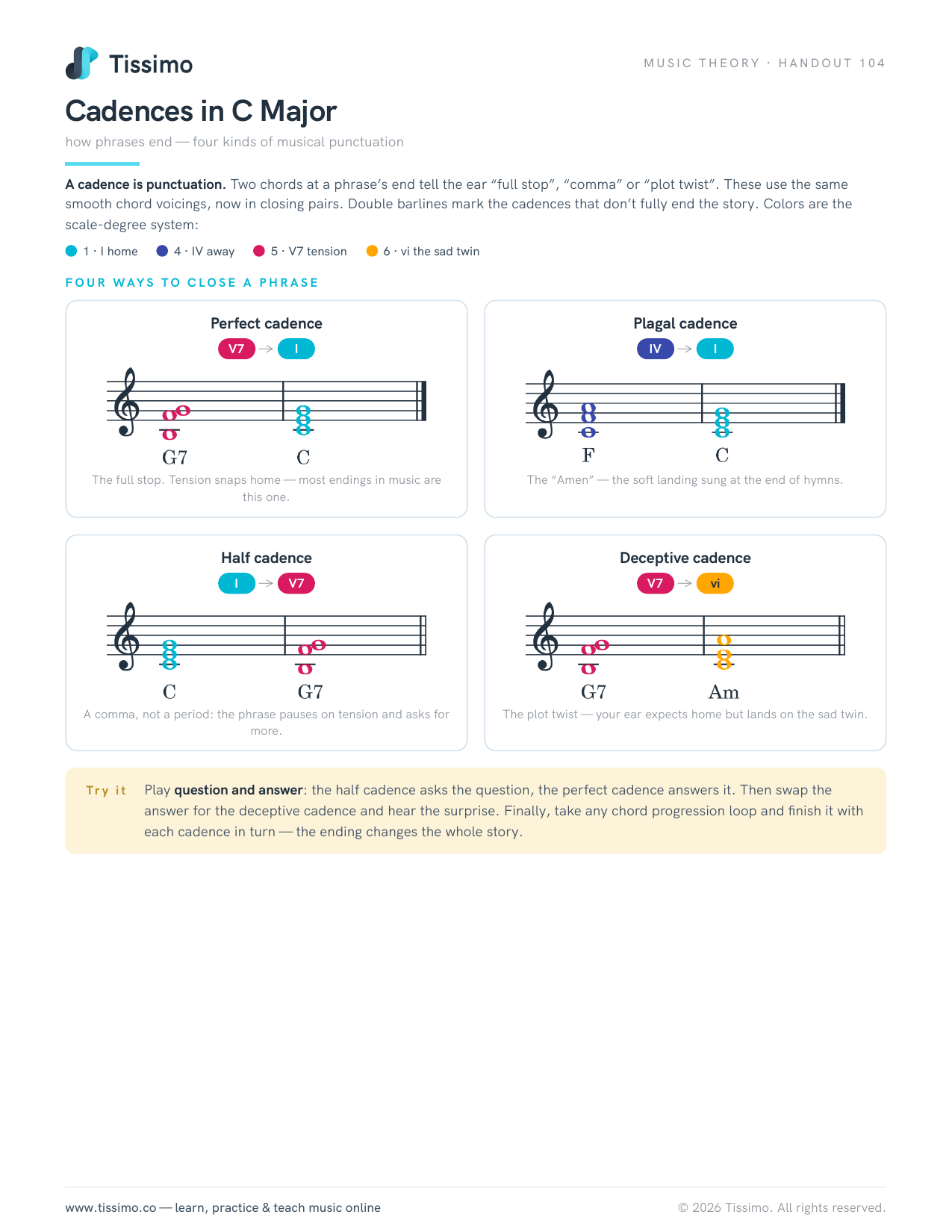 Cadences in Every KeyHow phrases end — the four kinds of musical punctuation, written out in all 24 keys.