Melody, Texture & Counterpoint
Counterpoint
Counterpoint is the art of combining two or more independent melodies so that each makes sense on its own and together they make convincing harmony. The texture it produces is polyphony.
Counterpoint is the art of combining independent melodies. The name comes from the Latin punctus contra punctum, "point against point," meaning note against note. Each line has to work as a melody on its own, and the lines together have to make convincing harmony. Music written this way is called contrapuntal, and the texture it creates is polyphony.
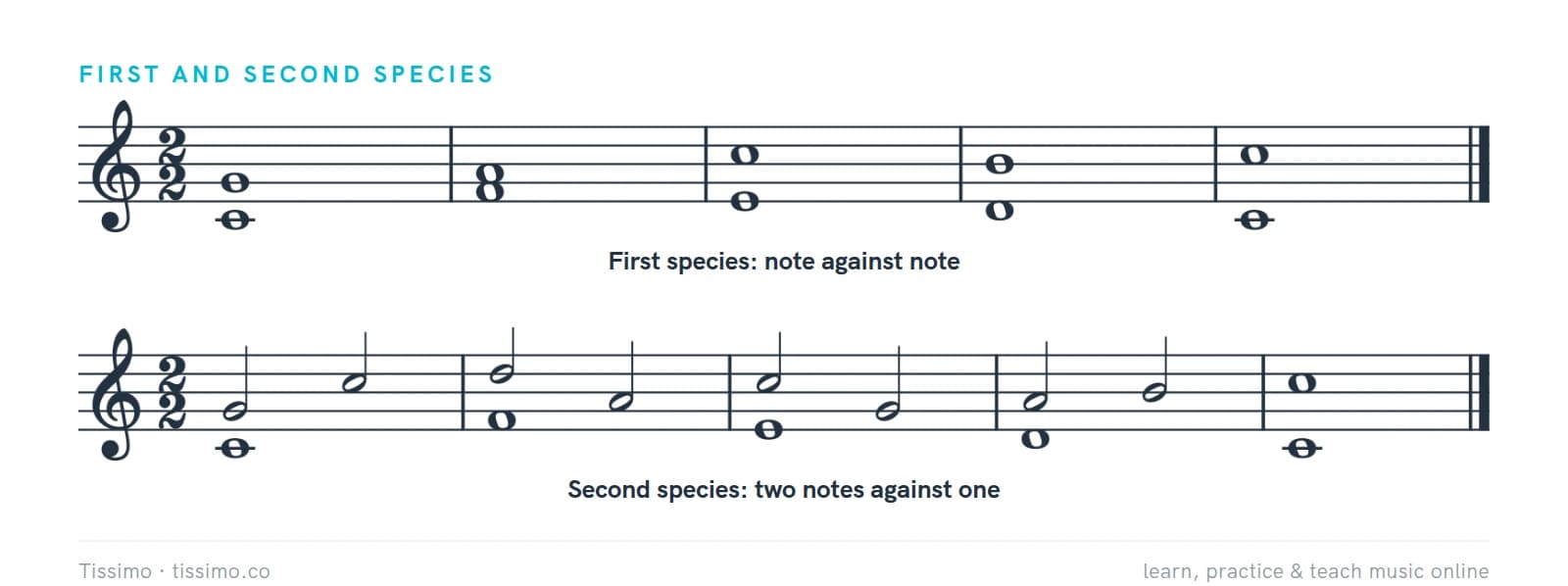
The main guidelines
The counterpoint taught in most theory courses, based on music from the Renaissance to the 19th century, follows a handful of principles:
- Keep the lines independent. Favor contrary and oblique motion, and do not let the voices move in parallel for too long.
- Avoid parallel fifths and octaves: two voices a perfect fifth or octave apart that move in the same direction to another fifth or octave blend into one sound and lose their independence.
- Place consonances on the strong beats. Thirds, sixths, perfect fifths and octaves are the stable intervals. Dissonances are allowed, but only in controlled ways: as passing notes, neighbor notes and suspensions.
- Write good melodies. Mostly steps, leaps balanced by steps in the other direction, one clear high point.
- Cadence clearly. A classic two-voice ending moves from a sixth to an octave, as both examples do.
Species counterpoint
In 1725 Johann Joseph Fux published Gradus ad Parnassum, a textbook that teaches counterpoint step by step, in five "species," by adding a new line to a given melody called the cantus firmus:
- First species: note against note.
- Second species: two notes against one.
- Third species: four notes against one.
- Fourth species: tied, syncopated notes that create suspensions.
- Fifth species: a free mixture of all of these.
Composers studied from Fux's book for generations, and species exercises are still the backbone of many counterpoint courses. Try them with Two Lines, One Note at a Time and Complete and Check the Counterpoint.
Where you hear counterpoint
In Renaissance choral music, in Bach's inventions and fugues, in the fugal passages of Classical symphonies, in New Orleans jazz, and in any song where the bass line and the melody form a good partnership. Even simple pop songs depend on solid two-voice counterpoint between the tune and the bass.
Common questions
What is the difference between counterpoint and harmony?
They are two views of the same music. Harmony looks at the notes sounding together, chord by chord; counterpoint looks at the lines moving through time and how they fit against each other.
What are the five species of counterpoint?
Note against note; two notes against one; four notes against one; tied notes making suspensions; and a free mixture of all four. They come from Fux's textbook Gradus ad Parnassum (1725).
Practice it: free worksheets
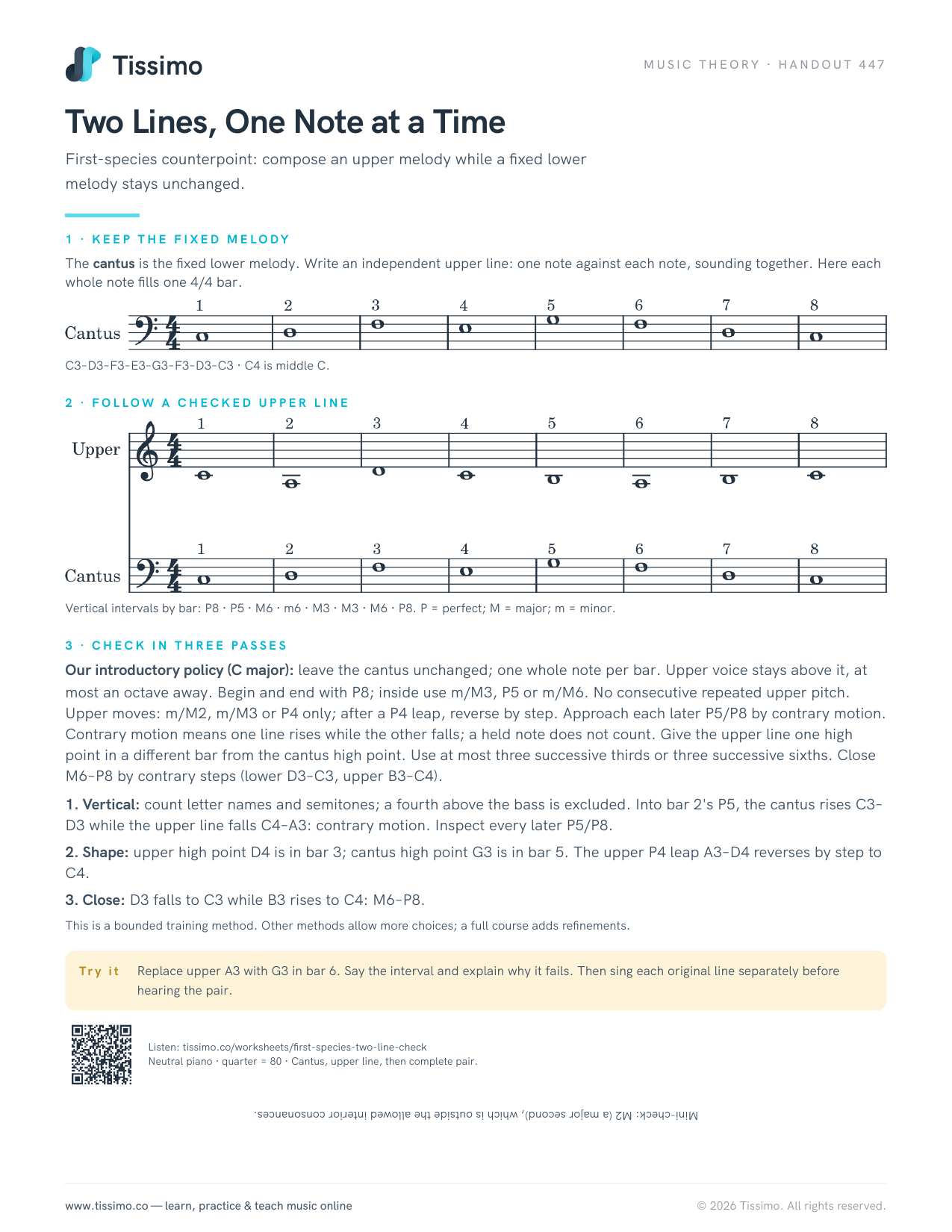 Two Lines, One Note at a TimeFirst-species counterpoint: compose an upper melody while a fixed lower melody stays unchanged.
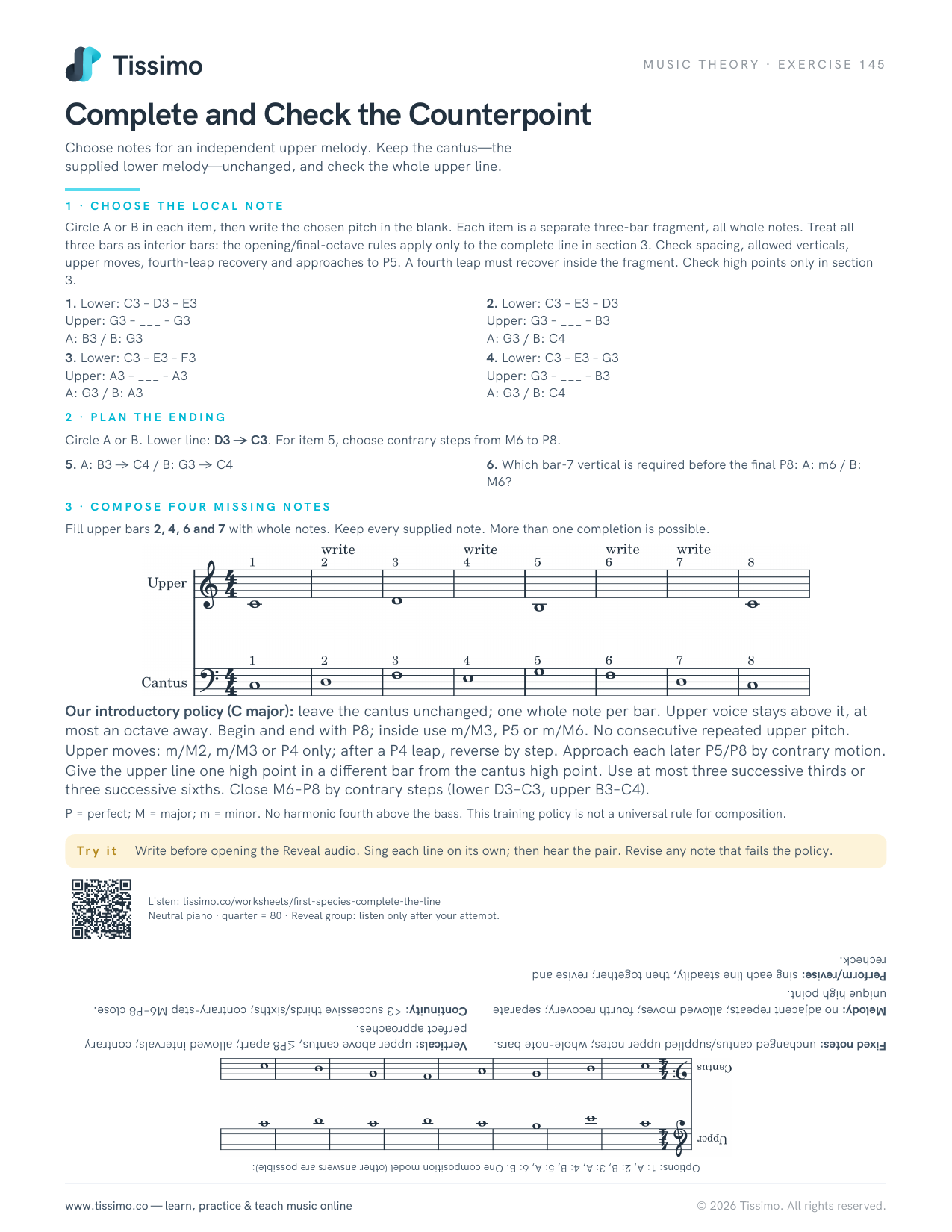 Complete and Check the CounterpointChoose notes for an independent upper melody. Keep the cantus—the supplied lower melody—unchanged, and check the whole upper line.
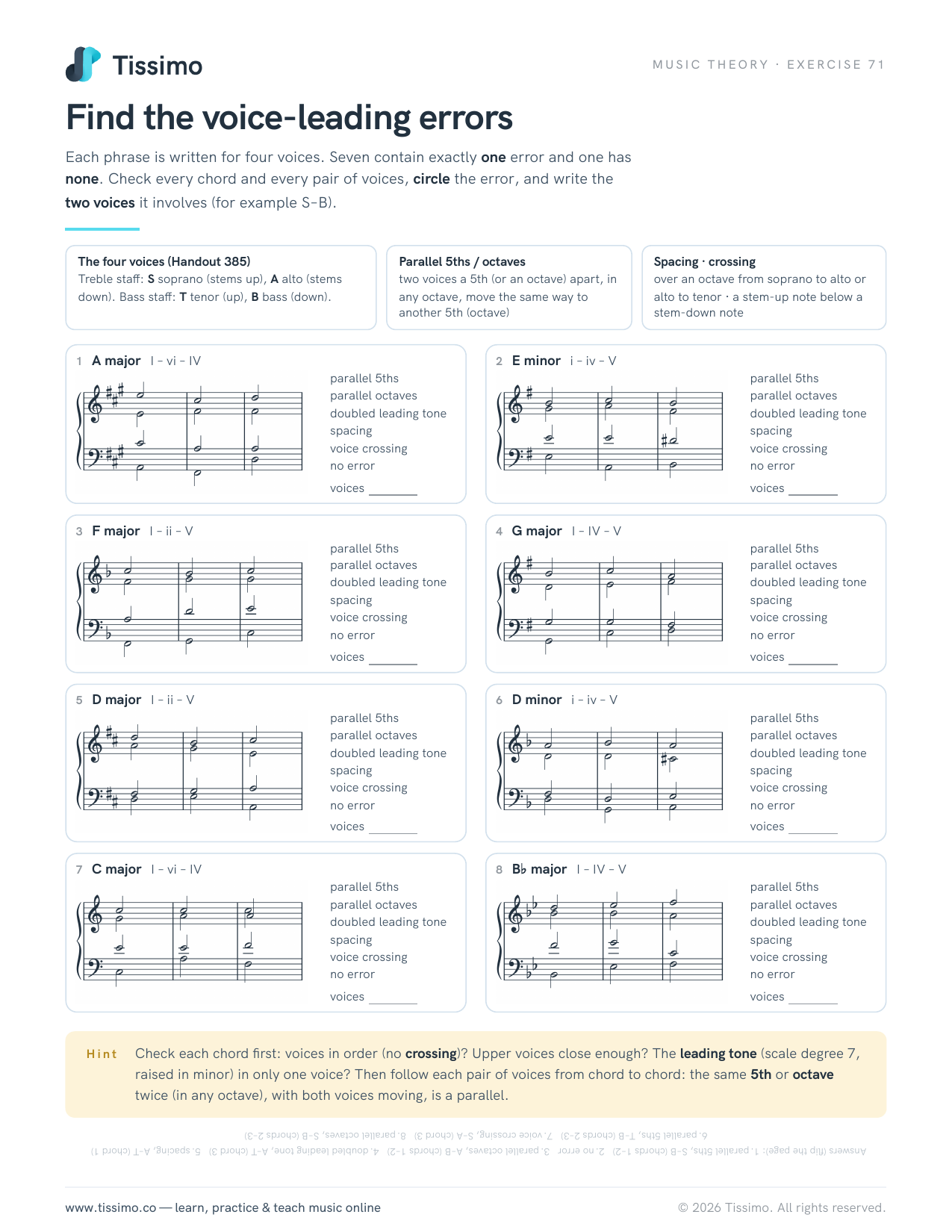 Find the voice-leading errorsEach phrase is written for four voices. Seven contain exactly one error and one has none. Check every chord and every pair of voices, circle the error, and write the two voices it involves (for example S–B).
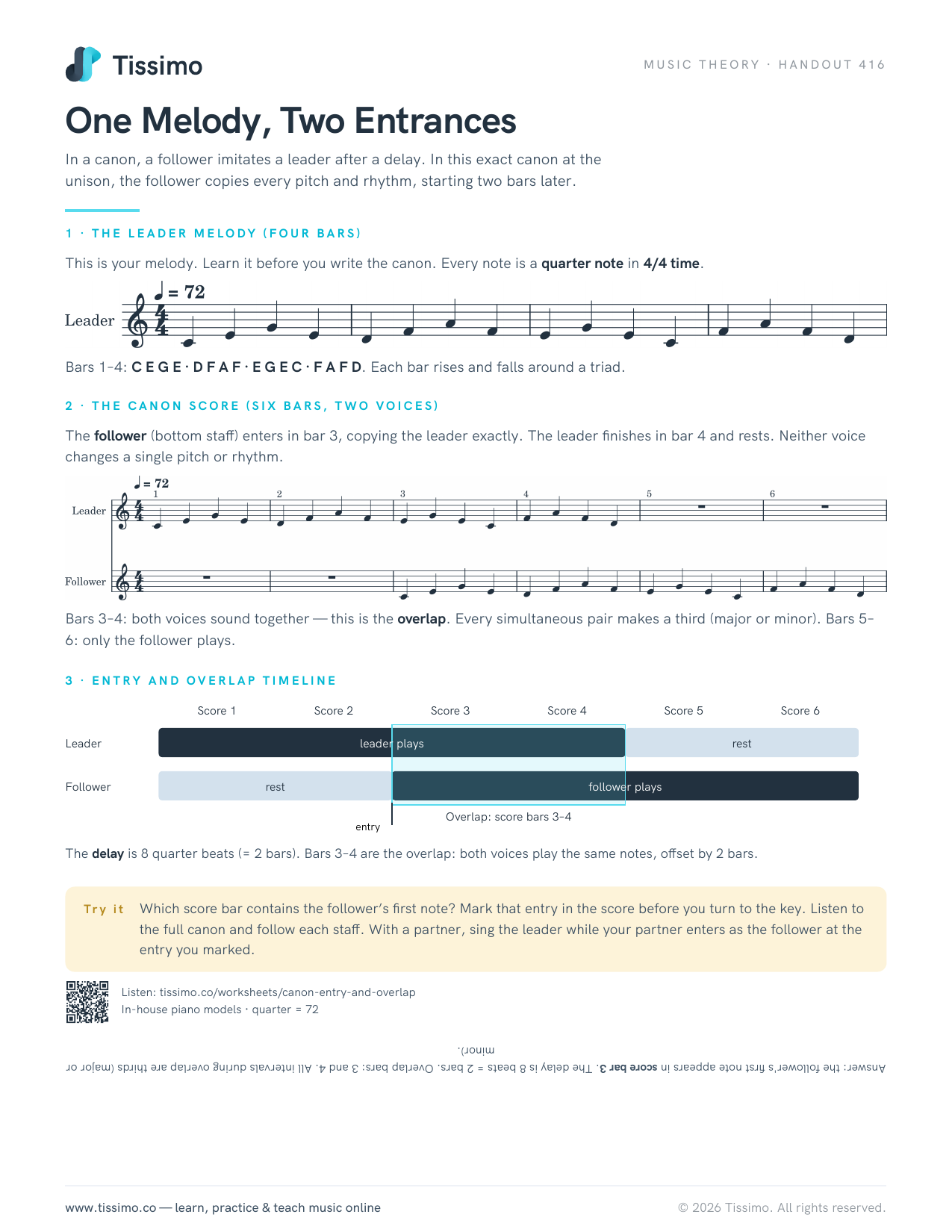 One Melody, Two EntrancesIn a canon, a follower imitates a leader after a delay. In this exact canon at the unison, the follower copies every pitch and rhythm, starting two bars later.