Melody, Texture & Counterpoint
Canon (Round)
A canon is a piece in which one melody is imitated strictly by one or more voices, each entering after the one before. A round is a canon at the same pitch that can loop back to the start.
A canon is music in which one melody is copied strictly by one or more other voices, each entering after the one before. The first voice, the leader, sets off; the second, the follower, begins the same melody a little later, while the leader carries on with the next part of the tune. More voices can join the same way. The name comes from the Greek kanon, "rule": the later voices follow the rule set by the first.
A round is the simplest kind of canon. Every voice sings the same melody at the same pitch, or an octave apart, and when a voice reaches the end it can go straight back to the beginning, so the round can circle as long as the singers like. "Row, Row, Row Your Boat" and "Frère Jacques" are well-known rounds.
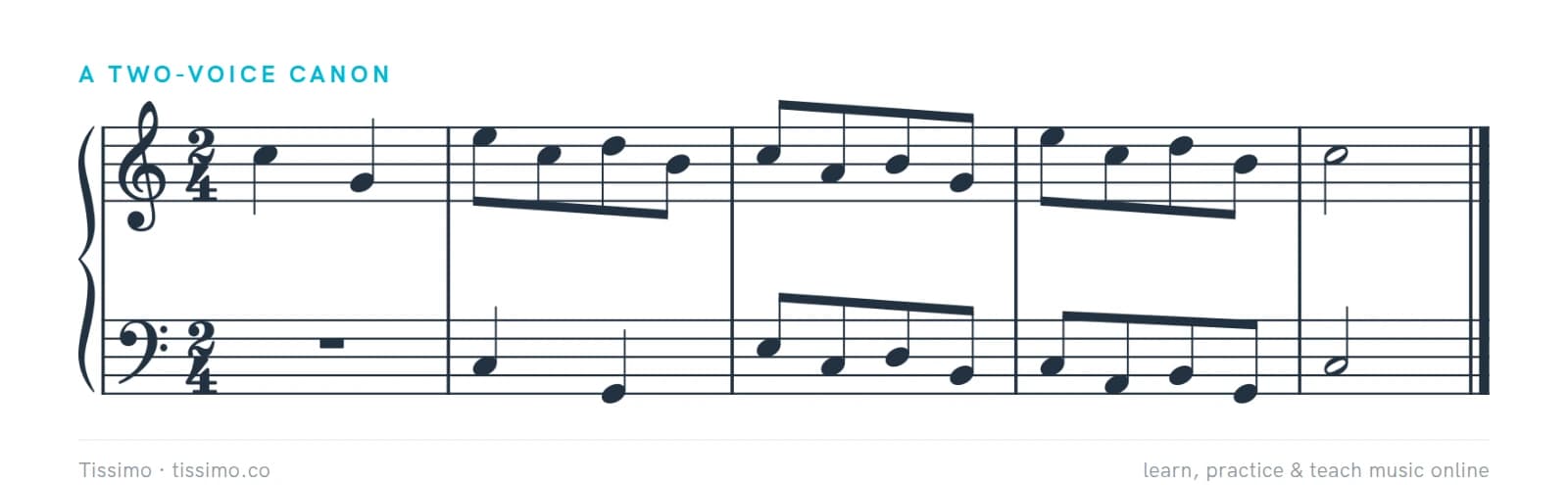
How a canon works
The art is in writing a melody that harmonizes with itself when it overlaps. In the example, every bar of the tune sounds good against the bar before it, so when the follower enters one bar behind, each pair of bars fits. Rounds are usually built over one repeated chord or a short chord pattern, which is why they are so easy to sing.
Kinds of canon
- By interval: the follower can start at the unison or octave (as in a round), at the fifth, or at any other interval.
- By distance: one beat behind, one bar, two bars or more.
- Transformed: the follower can be upside down (canon by inversion), in longer notes (canon by augmentation), or even backwards (a crab canon).
- Accompanied: the canon voices play over a free bass. Pachelbel's Canon in D is a canon for three violins over a repeating bass line.
In J. S. Bach's Goldberg Variations, variations 3, 6, 9 and so on through 27 are canons, with the interval between the canon voices growing from the unison to the ninth. Variation 30 breaks the pattern with a quodlibet combining familiar tunes.
Singing or playing a canon
Learn the whole melody securely on your own first. When you sing it in canon, keep your own line steady and do not let the other voice pull you along; once that feels safe, start listening to how the parts fit. Practice with One Melody, Two Entrances, then write your own with Build a Canon: Copy, Overlap, Check.
Common questions
What is the difference between a canon and a round?
A round is one kind of canon: the voices sing the same melody at the same pitch (or an octave apart) and can loop back to the start. Canons in general can be at other intervals, and can end instead of looping.
Is Pachelbel's Canon a real canon?
Yes. Three violins play the same melody in canon, each entering a few bars after the one before, above a short bass line that repeats throughout.
Practice it: free worksheets
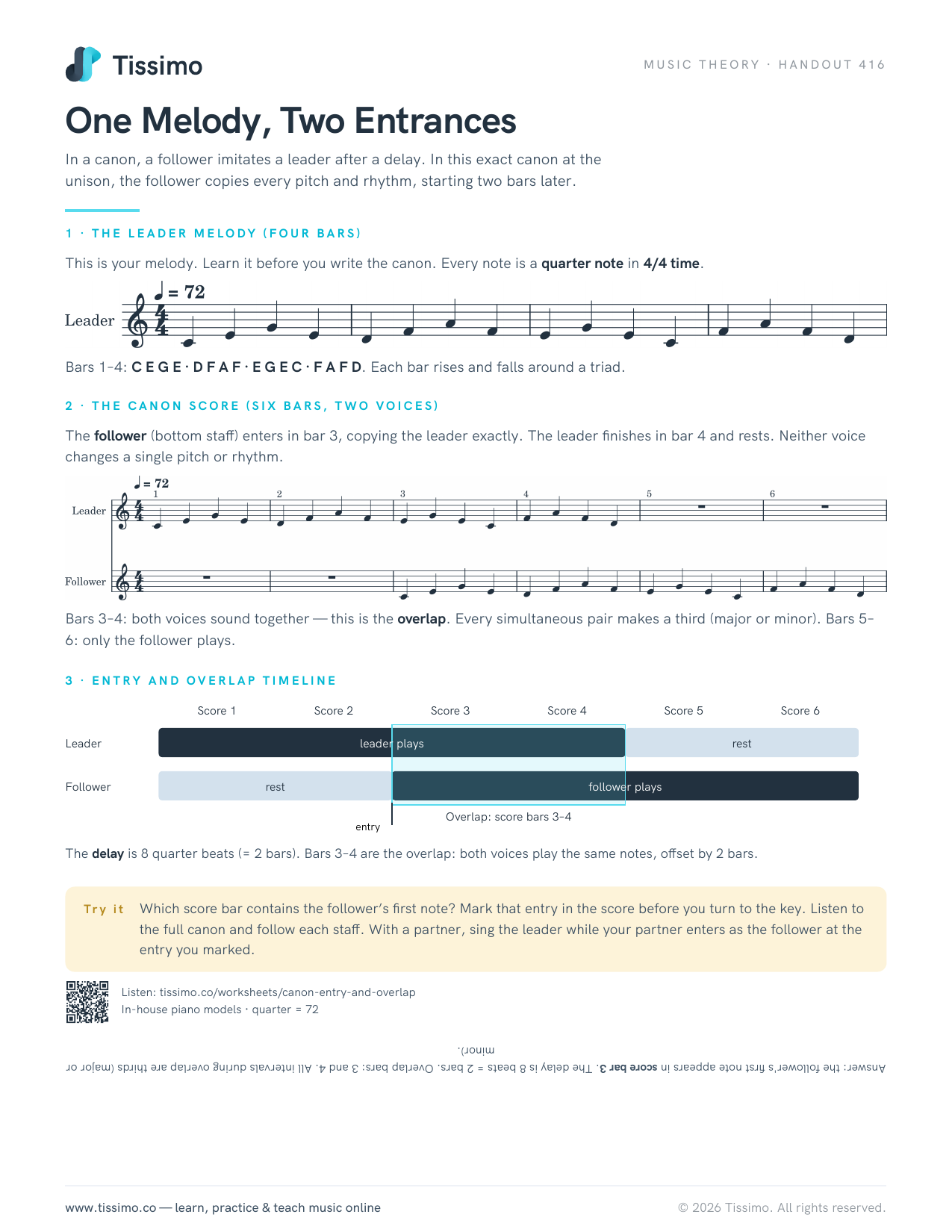 One Melody, Two EntrancesIn a canon, a follower imitates a leader after a delay. In this exact canon at the unison, the follower copies every pitch and rhythm, starting two bars later.
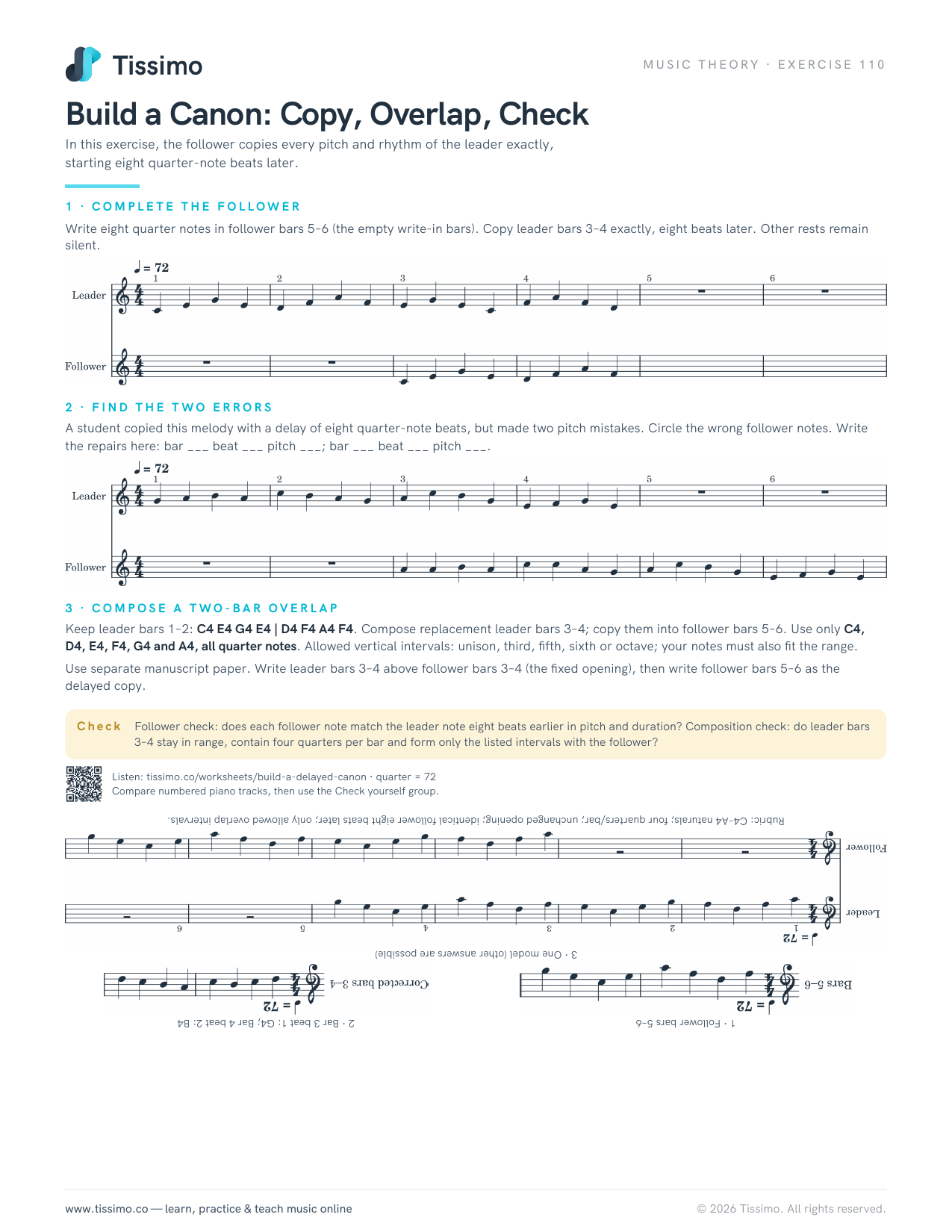 Build a Canon: Copy, Overlap, CheckIn this exercise, the follower copies every pitch and rhythm of the leader exactly, starting eight quarter-note beats later.