Form & Structure
Invention
An invention is a short keyboard piece in two-part counterpoint, built from one musical idea that the hands imitate and develop. The name comes from J. S. Bach's fifteen Two-Part Inventions.
An invention is a short contrapuntal piece for keyboard in which a single musical idea, the motif or subject, is passed between the voices and developed. The word is used mainly for J. S. Bach's fifteen Two-Part Inventions (BWV 772–786) and their companions, the fifteen Three-Part Sinfonias (BWV 787–801), sometimes called three-part inventions.
Why Bach wrote them
Bach wrote the Inventions and Sinfonias as teaching pieces. The preface to his 1723 fair copy explains their purpose: to teach keyboard players to play cleanly in two and then three parts, to develop a singing (cantabile) style, and to give them a taste of how to compose with good ideas. They are still core repertoire for intermediate pianists, as a step toward the larger preludes and fugues.
How an invention works
There is no fixed plan, but most two-part inventions follow a similar process:
- Statement: one hand plays the short motif, often in the home key.
- Imitation: the other hand repeats it, frequently an octave lower, while the first hand continues with a contrasting line.
- Development: the motif is moved through related keys using sequences, turned upside down (inversion), shortened, or combined with itself.
- Return: the motif comes back in the home key, and a firm cadence closes the piece.
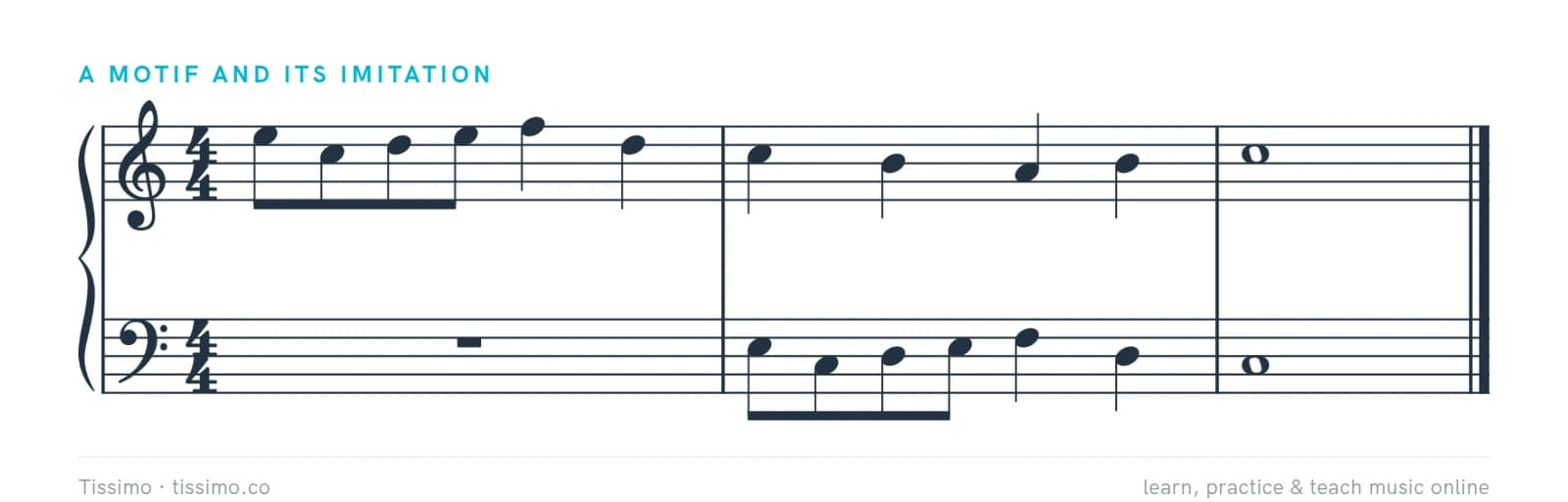
The fifteen inventions are arranged by key, rising from C major: C major, C minor, D major, D minor, E-flat major, E major, E minor, F major, F minor, G major, G minor, A major, A minor, B-flat major and B minor.
Invention or fugue?
Both are contrapuntal and built from imitation. A fugue is usually larger and stricter: the subject enters in every voice at the start in a regular pattern, with an answer in the dominant. An invention is freer and shorter, more like a study in imitation.
Practicing an invention
- Hands separately first, until each line sounds like a complete melody with its own shape.
- Mark every appearance of the motif in both hands, including inversions.
- Match articulation in both hands: if the motif is played detached in the right hand, play it the same way when the left hand imitates it.
- Choose a calm tempo. Clarity matters more than speed.
The Two Lines, One Note at a Time and One Melody, Two Entrances worksheets practice the two-voice thinking an invention needs.
Common questions
What is the difference between an invention and a fugue?
Both use imitation, but a fugue follows stricter conventions: every voice enters with the subject in turn at the start, with an answer in the dominant. An invention is shorter and freer, built from a motif passed between two (or three) voices.
How many inventions did Bach write?
Fifteen Two-Part Inventions (BWV 772–786) and fifteen Three-Part Sinfonias (BWV 787–801), which are sometimes called three-part inventions.
Practice it: free worksheets
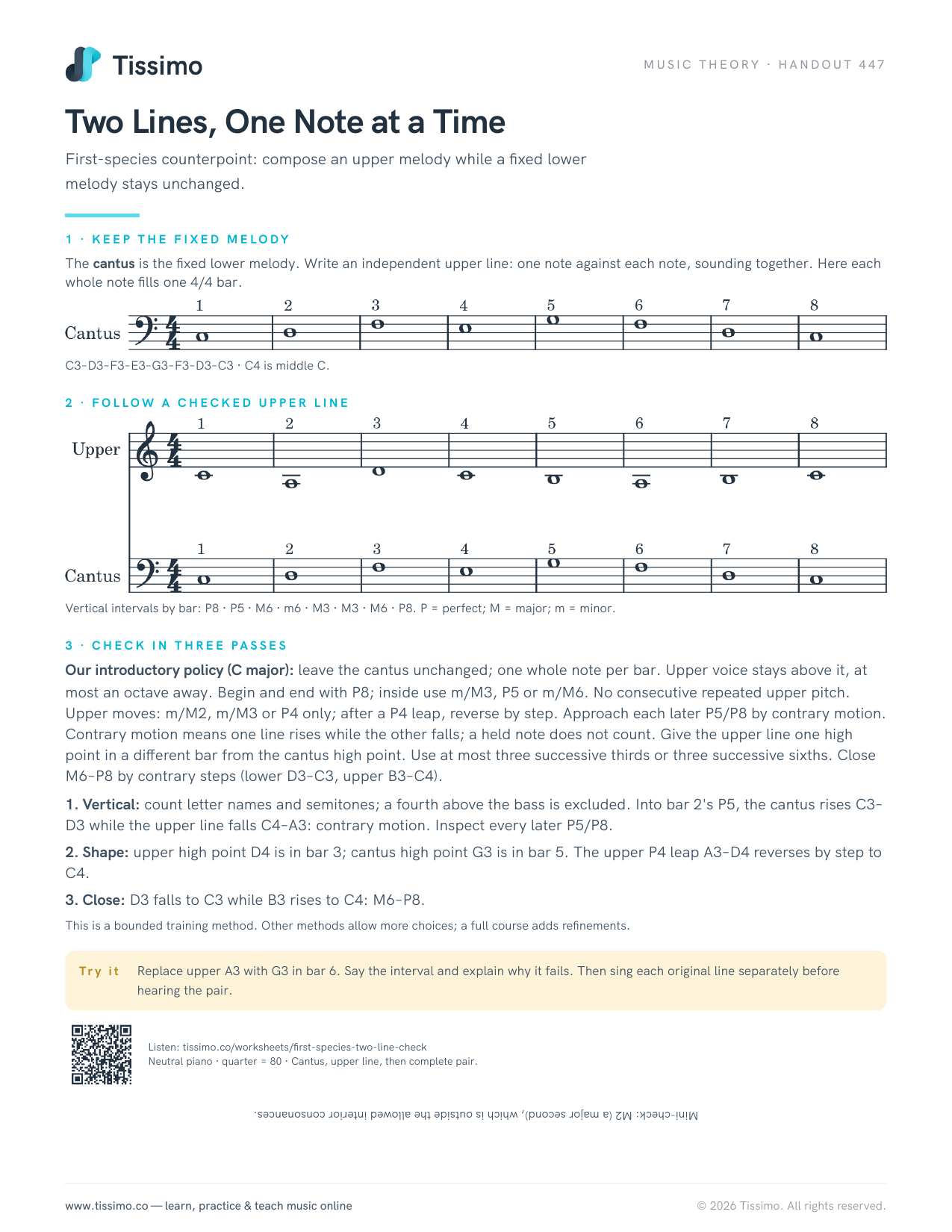 Two Lines, One Note at a TimeFirst-species counterpoint: compose an upper melody while a fixed lower melody stays unchanged.
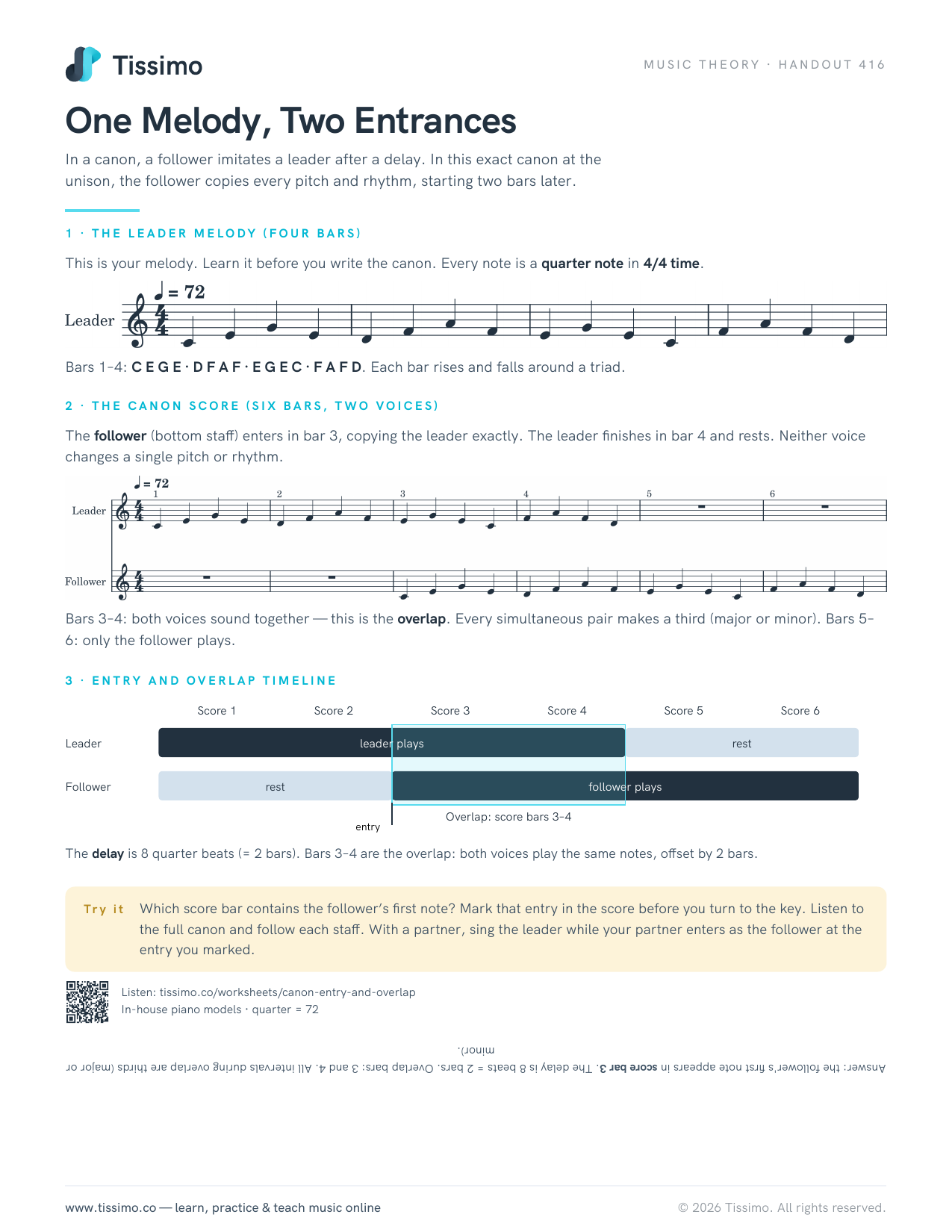 One Melody, Two EntrancesIn a canon, a follower imitates a leader after a delay. In this exact canon at the unison, the follower copies every pitch and rhythm, starting two bars later.
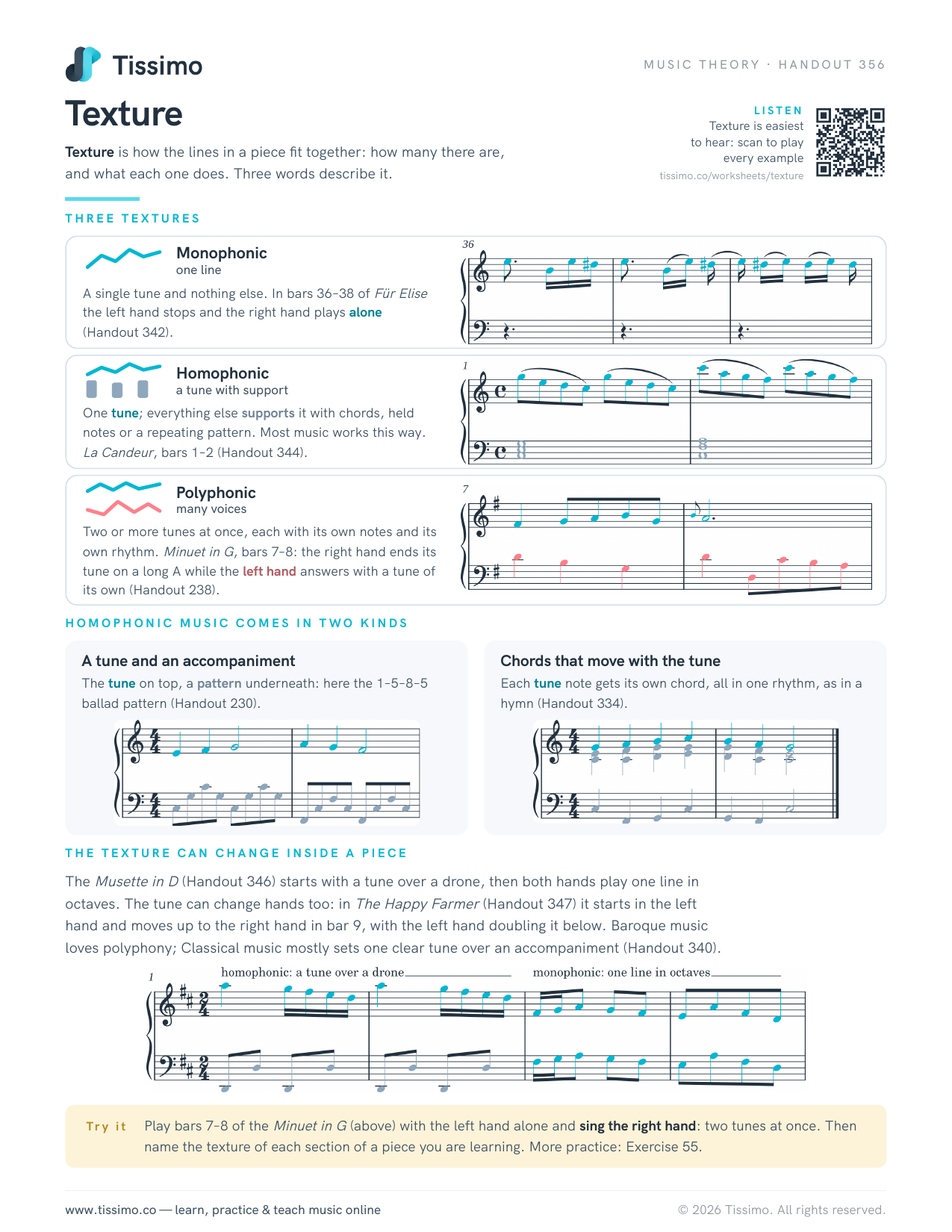 TextureTexture is how the lines in a piece fit together: how many there are, and what each one does. Three words describe it.
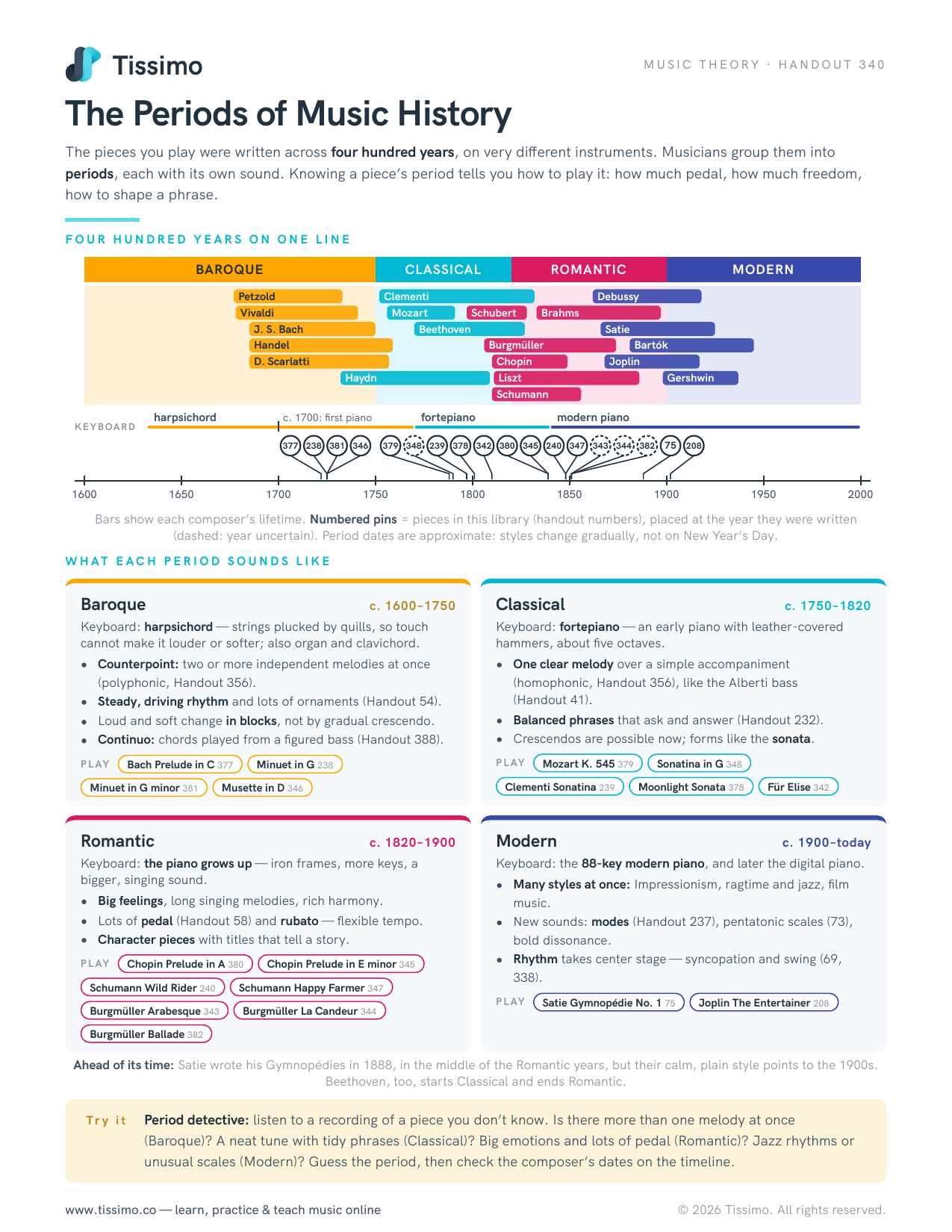 The Periods of Music HistoryThe pieces you play were written across four hundred years, on very different instruments. Musicians group them into periods, each with its own sound. Knowing a piece’s period tells you how to play it: how much pedal, how much freedom, how to shape a phrase.