Form & Structure
Fugue
Pronounced FYOOG
A fugue is a contrapuntal composition in which a short melody, the subject, is introduced by one voice and then imitated by each other voice in turn, and is developed throughout the piece.
A fugue is the most elaborate form of imitation. One voice states a short, memorable melody called the subject. A second voice then enters with the same melody while the first continues with new material, then a third voice, and so on. Once all the voices have entered, the subject keeps returning in different voices and keys until the end. Most fugues have three or four voices, though two- and five-voice fugues exist.
Many musicians describe fugue as a technique or texture rather than a fixed form like sonata form, because no two fugues follow quite the same plan. But the building blocks are always similar.
The parts of a fugue
- Subject: the main theme, stated alone at the start.
- Answer: the second entry, the subject moved to the dominant key (a fifth higher or a fourth lower). If the answer is an exact transposition it is a real answer; if a note or two are adjusted to keep the music in the home key, it is a tonal answer.
- Countersubject: a melody that accompanies the answer and later entries. It is designed to fit against the subject above or below it.
- Exposition: the opening section, until every voice has entered with the subject or answer.
- Episodes: passages without a complete subject entry, often built from fragments of it in sequence, that move to new keys.
- Middle entries: the subject returns in related keys.
- Stretto: entries that overlap, the next voice starting before the previous one has finished, often used to build intensity near the end.
- Final entry in the home key, sometimes over a pedal point.
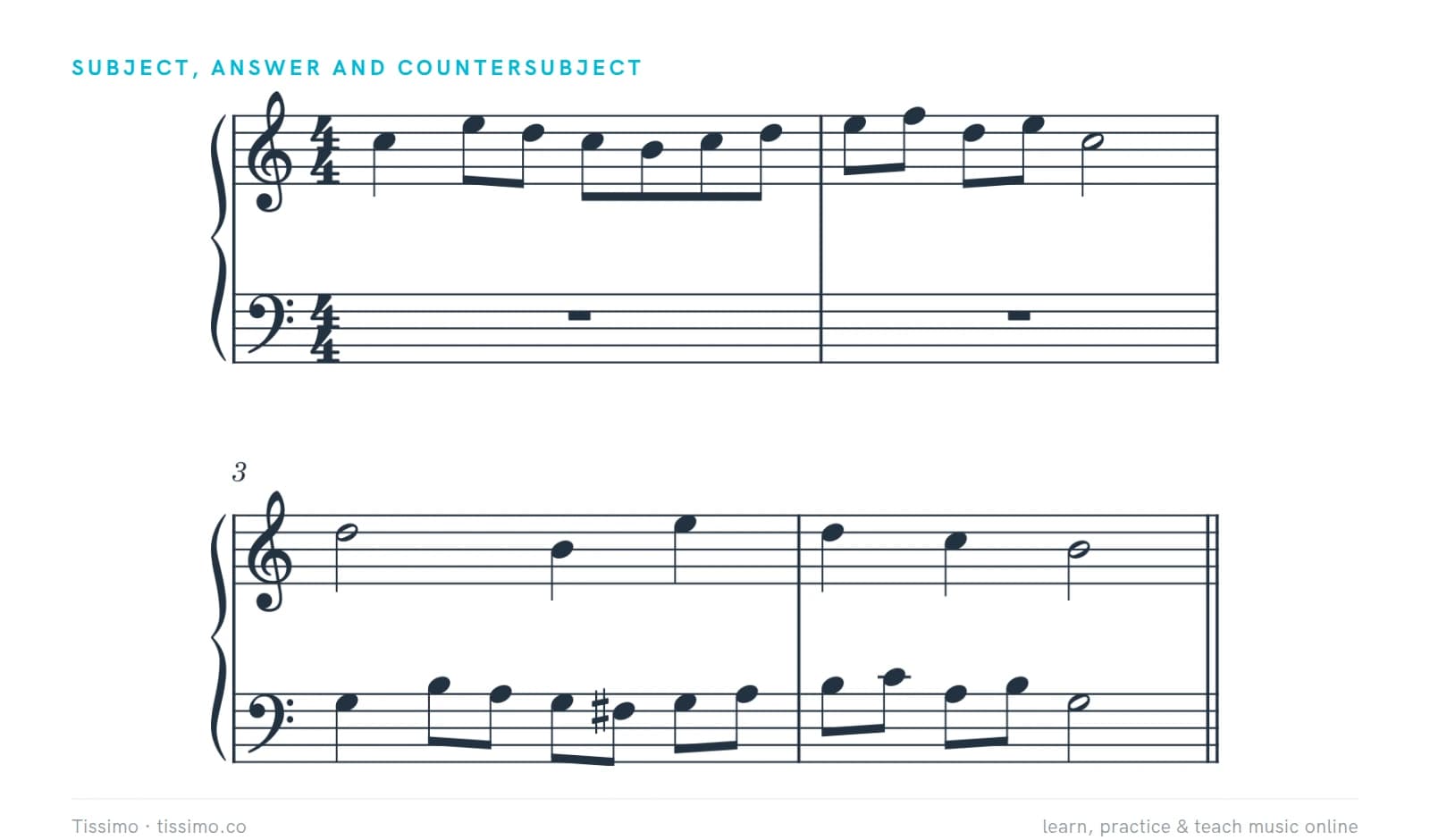
Bach and the fugue
The fugue reached its peak in the late Baroque, above all with J. S. Bach. His Well-Tempered Clavier contains 48 preludes and fugues, one pair in every major and minor key in each of its two books, and The Art of Fugue explores a single subject in many fugues of increasing complexity. Handel, too, wrote powerful fugal choruses in his oratorios.
After the Baroque
Later composers kept writing fugues, usually as special moments: the finale of Mozart's "Jupiter" Symphony mixes fugal writing into sonata form, Beethoven wrote massive fugues in late works such as the Grosse Fuge, and 20th-century composers such as Shostakovich wrote complete sets of preludes and fugues. A short fugal passage inside a larger piece is called a fugato.
How to listen to a fugue
Learn the subject first: sing it or play it until you can recognize it in any voice. Then follow it through the piece, noting each entry, its voice and its key. When you play a fugue, practice each voice alone and in pairs; it is the best way to hear the lines as independent melodies.
Common questions
What is the difference between a fugue and a canon?
In a canon, the following voices copy the leader exactly all the way through. In a fugue, voices imitate only the subject at their entry and then continue freely, and the subject keeps returning in different keys.
What is a fugue subject?
The short main melody of a fugue, stated alone by one voice at the start and then taken up by every other voice. The whole fugue is built from it.
Practice it: free worksheets
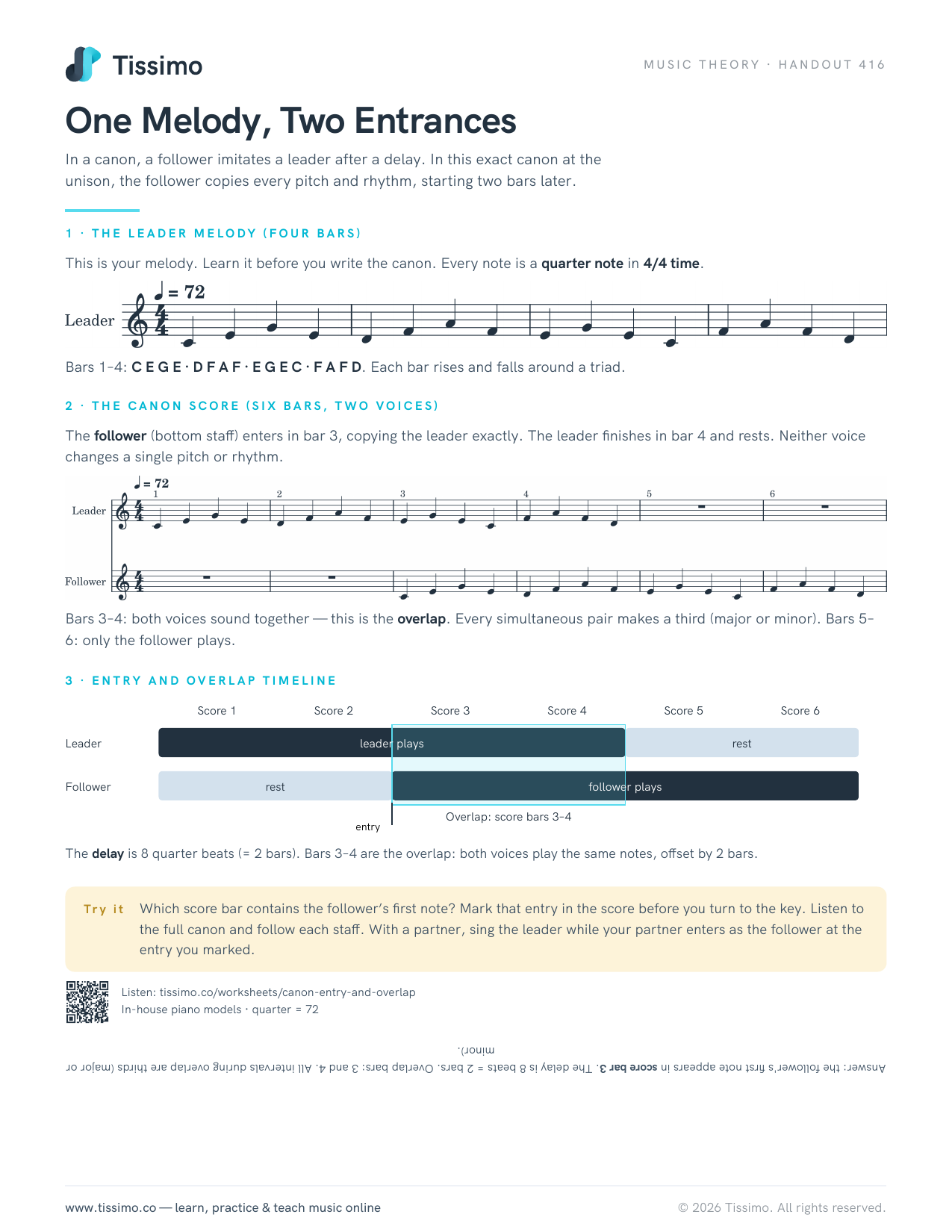 One Melody, Two EntrancesIn a canon, a follower imitates a leader after a delay. In this exact canon at the unison, the follower copies every pitch and rhythm, starting two bars later.
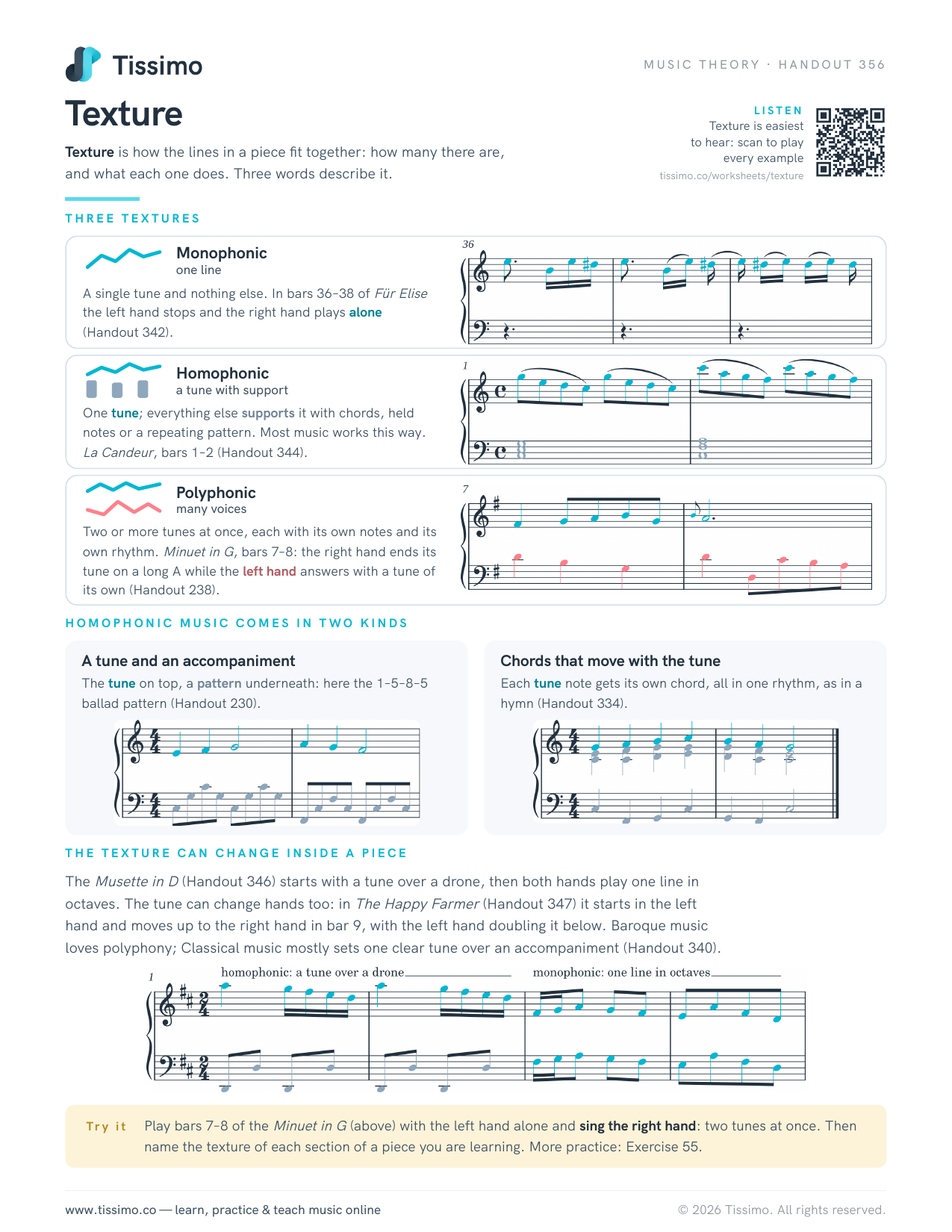 TextureTexture is how the lines in a piece fit together: how many there are, and what each one does. Three words describe it.
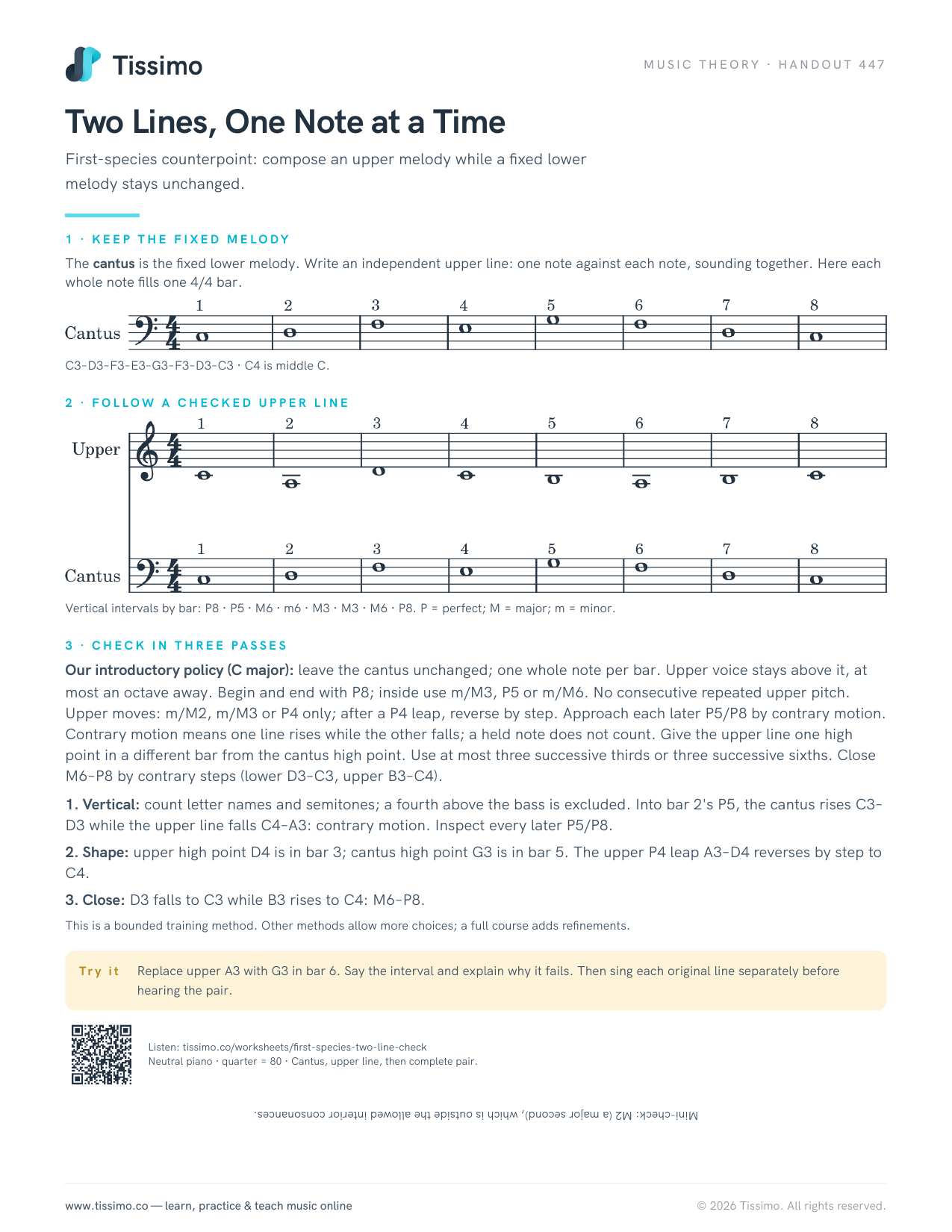 Two Lines, One Note at a TimeFirst-species counterpoint: compose an upper melody while a fixed lower melody stays unchanged.
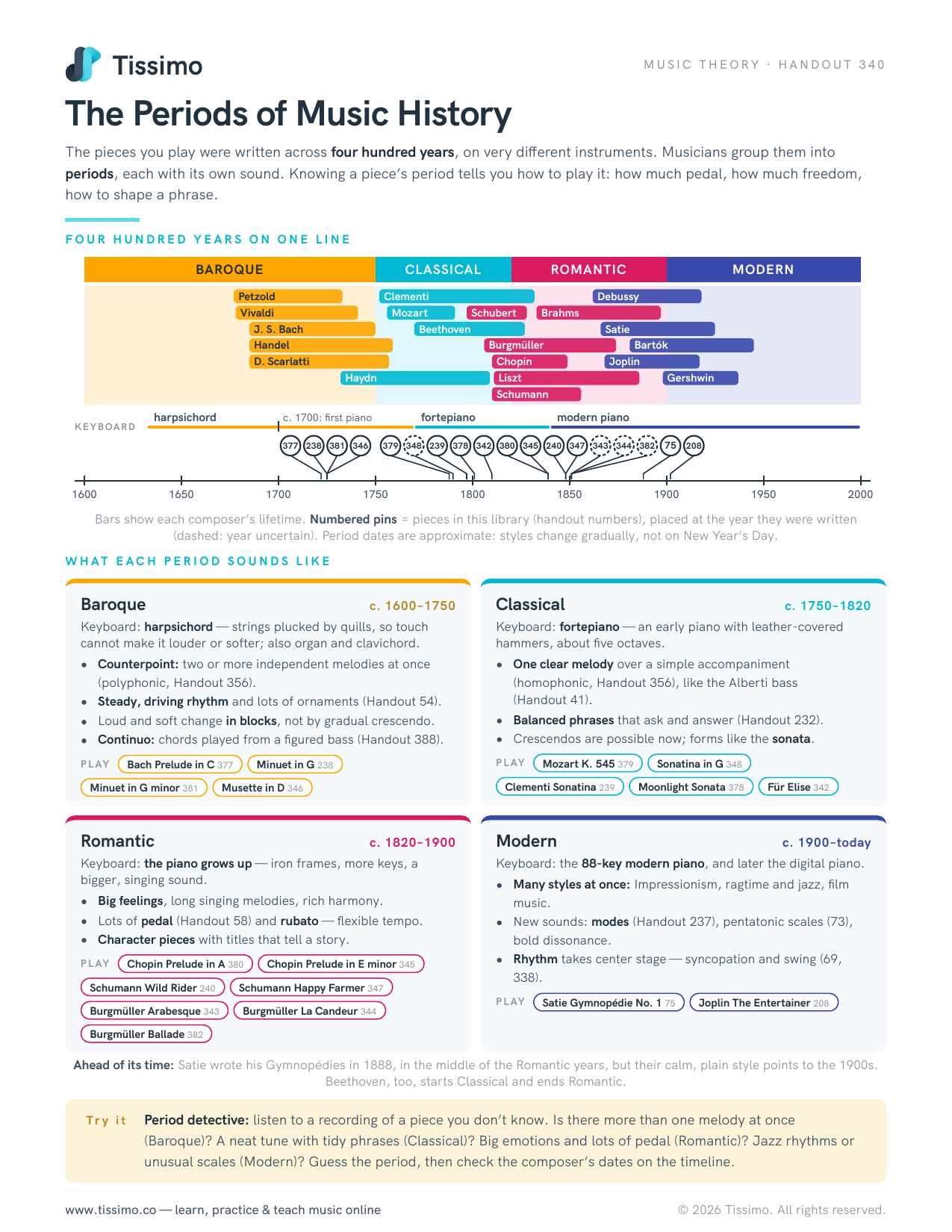 The Periods of Music HistoryThe pieces you play were written across four hundred years, on very different instruments. Musicians group them into periods, each with its own sound. Knowing a piece’s period tells you how to play it: how much pedal, how much freedom, how to shape a phrase.