Form & Structure
Ternary Form
Ternary form is a three-part musical form, ABA: an opening section, a contrasting middle section, and a return of the opening section.
Ternary form has three sections: A, a contrasting B, then A again. Leaving home and coming back is one of the most satisfying shapes in music, which is why ternary form turns up everywhere, from children's pieces to opera arias.
The outline
- A: the main idea, in the home key, usually ending with a full cadence.
- B: something different. It may change key (often to the relative or parallel key, or to the subdominant), change texture, character or tempo, or put the tune in another hand.
- A again: the opening section returns. It may be an exact repeat or a varied one (A′), and a short coda can follow.
Writing it with D.C. al Fine
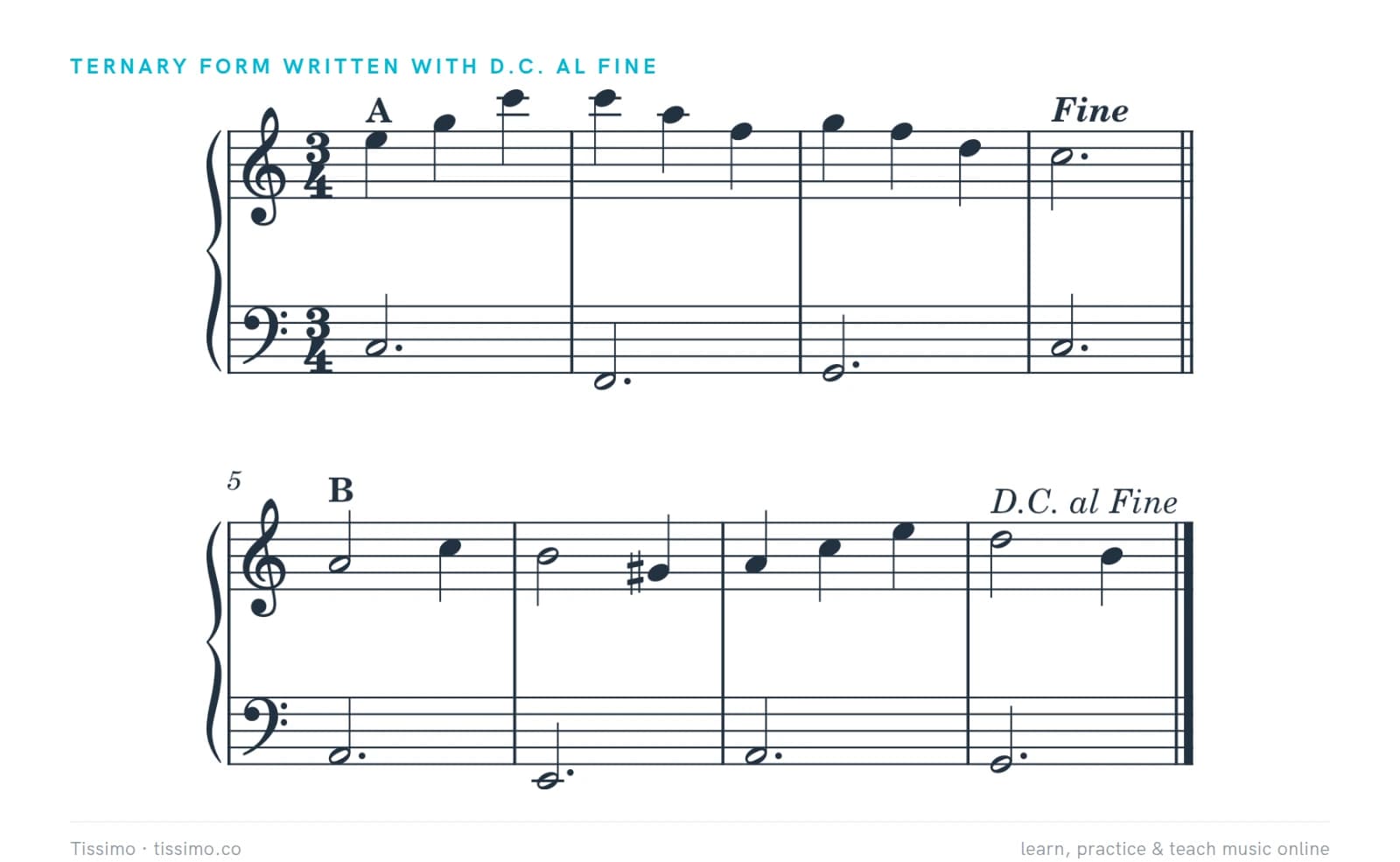
Composers often save paper by not writing the return at all. The A section ends with Fine ("end"), B ends with D.C. al Fine, and the player goes back to the beginning and stops at Fine. That is how the original example below is written: eight bars on the page, twelve bars when played.
Ternary or rounded binary?
When the opening tune returns at the end, ask two questions. Is B a section of its own, with its own key or character and its own ending? And does all of A come back, not just its first phrase? If both answers are yes, the form is ternary. If the return is shortened and repeated together with B (||: A :||: B A′ :||), it is rounded binary. The Binary, rounded binary & ternary worksheet compares real examples side by side.
Where you will find it
- Minuet and trio: a minuet, a contrasting trio, then the minuet again (minuet–trio–minuet). Because each part is itself a small binary form, this is called compound ternary form.
- The da capo aria of Baroque opera and oratorio, where the singer adds ornaments to the returning A section (see aria).
- Romantic character pieces: many nocturnes, intermezzi and preludes. Chopin's "Raindrop" Prelude, Op. 28 No. 15, is a well-known ABA.
- Teaching pieces such as Schumann's "The Wild Rider" from the Album for the Young: a galloping A minor tune, a middle section in F major with the tune in the left hand, then the opening again note for note.
Common questions
What is an example of ternary form?
A minuet and trio (minuet, trio, minuet again), a Baroque da capo aria, Chopin's "Raindrop" Prelude and Schumann's "The Wild Rider" are all in ABA ternary form.
Is ABA the same as ternary form?
Yes. ABA is the letter outline of ternary form. The return can be exact or varied (ABA′), and a short coda may follow.
Practice it: free worksheets
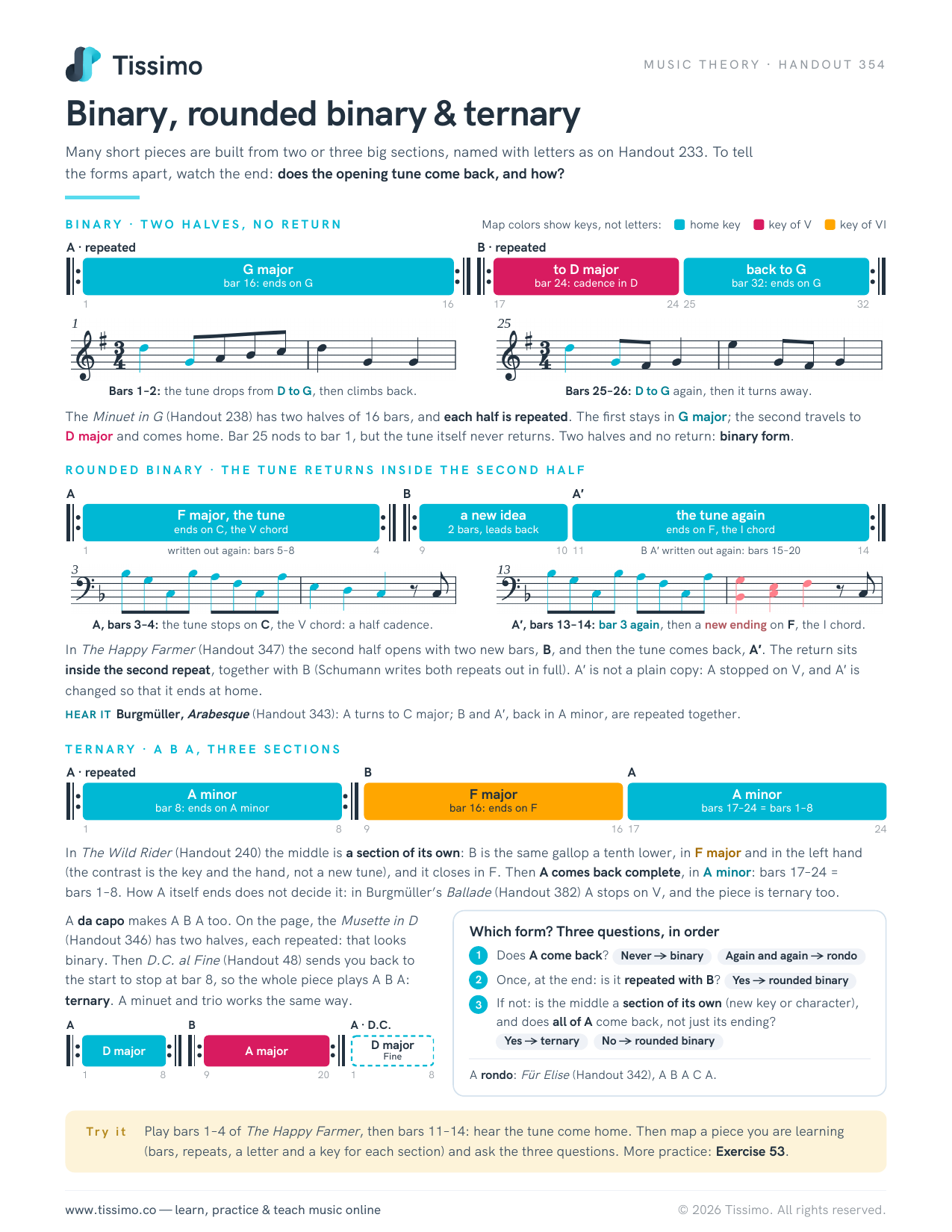 Binary, rounded binary & ternaryMany short pieces are built from two or three big sections, named with letters as on Handout 233. To tell the forms apart, watch the end: does the opening tune come back, and how?
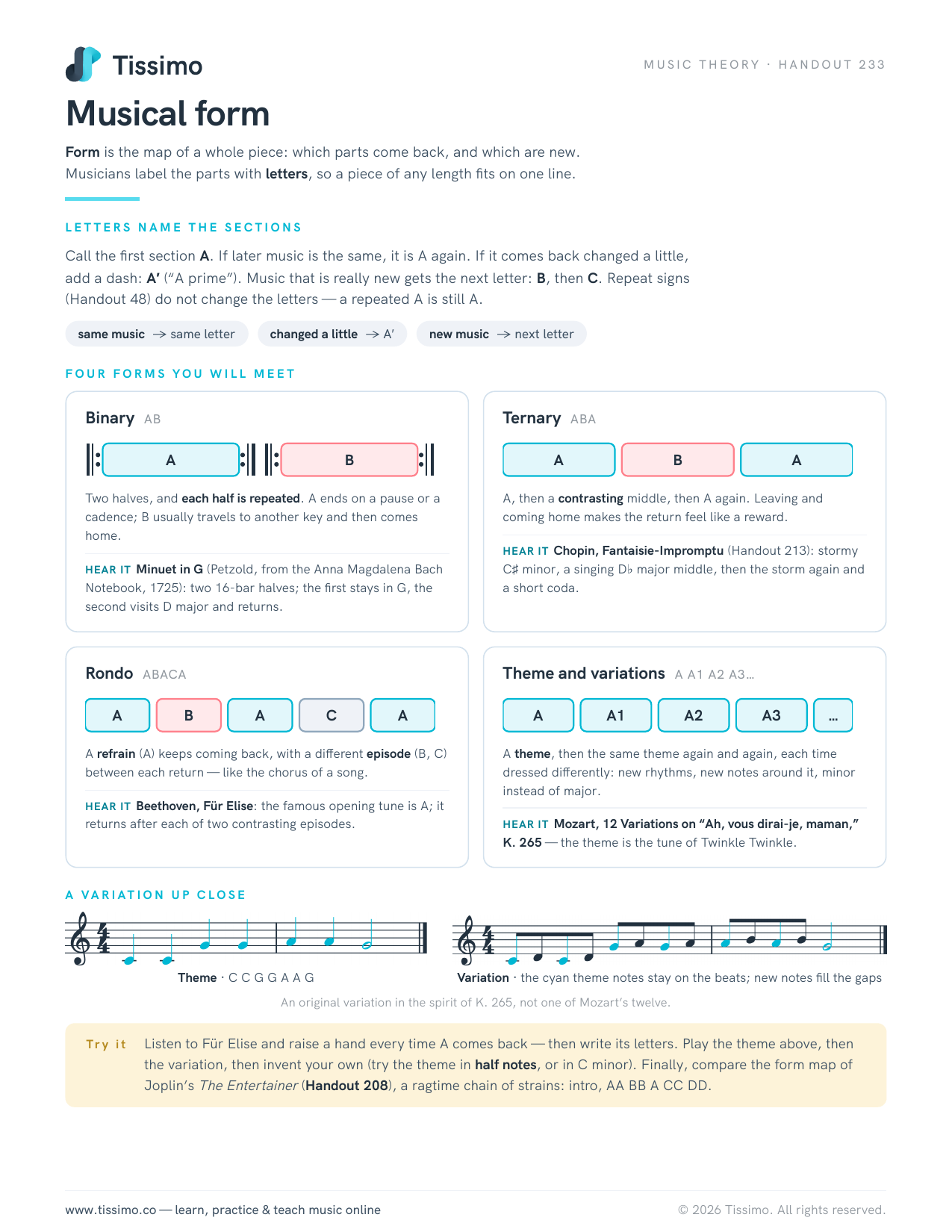 Musical formForm is the map of a whole piece: which parts come back, and which are new. Musicians label the parts with letters, so a piece of any length fits on one line.
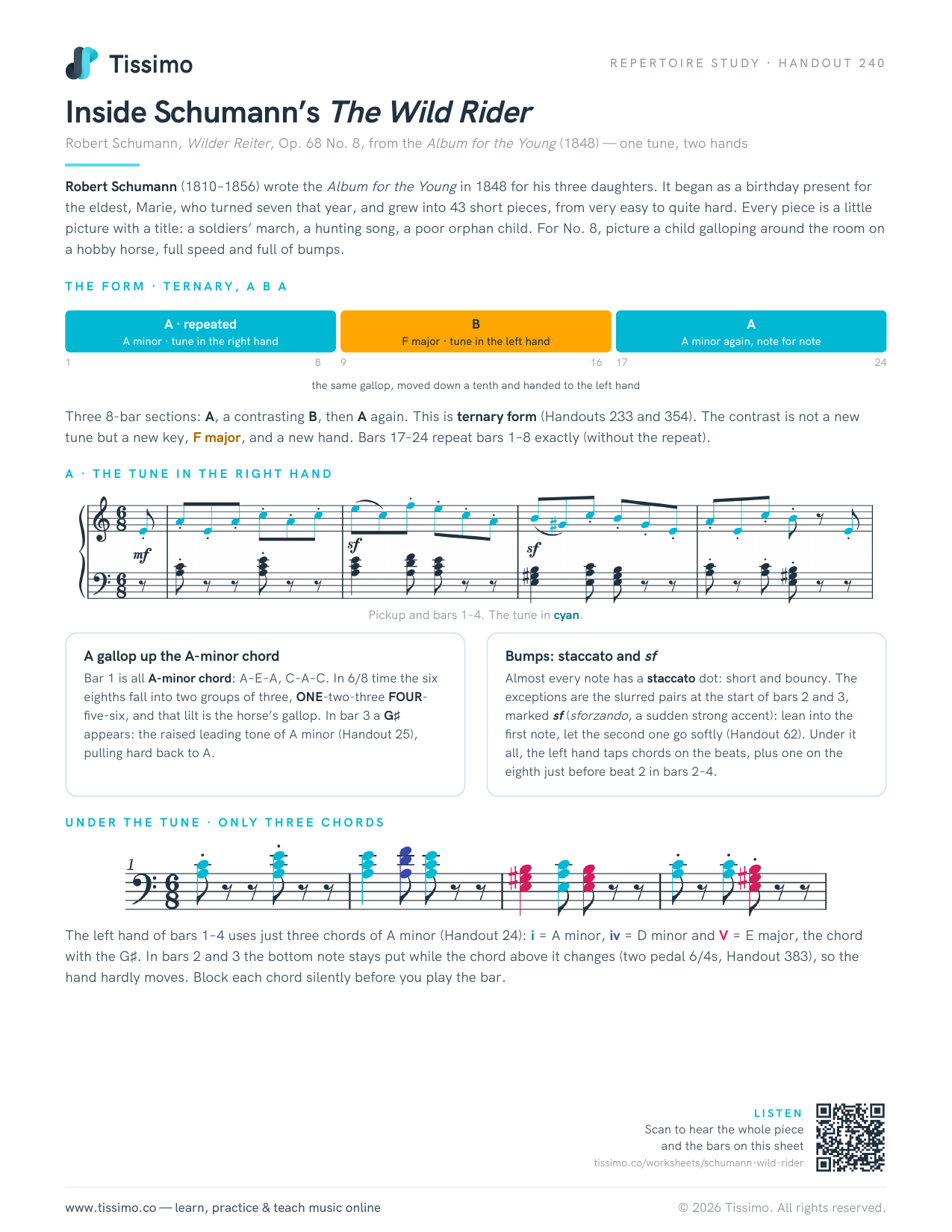 Inside Schumann’s The Wild RiderRobert Schumann, Wilder Reiter, Op. 68 No. 8, from the Album for the Young (1848) — one tune, two hands
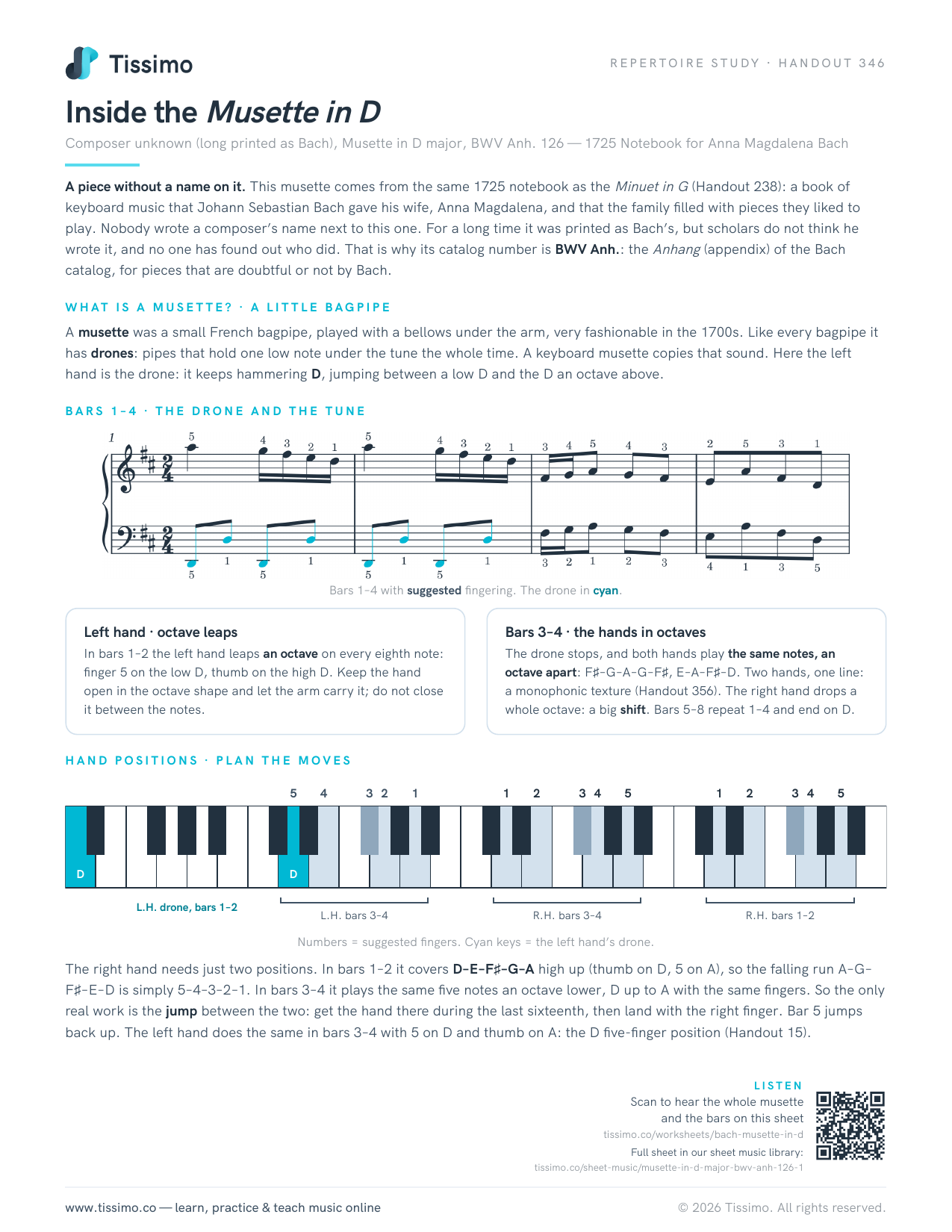 Inside the Musette in DComposer unknown (long printed as Bach), Musette in D major, BWV Anh. 126 — 1725 Notebook for Anna Magdalena Bach