Notation & Symbols
Da Capo (D.C.)
Pronounced dah KAH-pohWritten as D.C.
Da capo, abbreviated D.C., is Italian for 'from the beginning'. It tells you to go back to the start of the piece and play again, usually as far as the word Fine or until a jump to the coda.
Da capo is Italian for "from the head", meaning from the beginning. Written as D.C. near the end of a piece or section, it sends you back to the very first bar to play again. Most of the time it comes with an instruction that says where to stop.
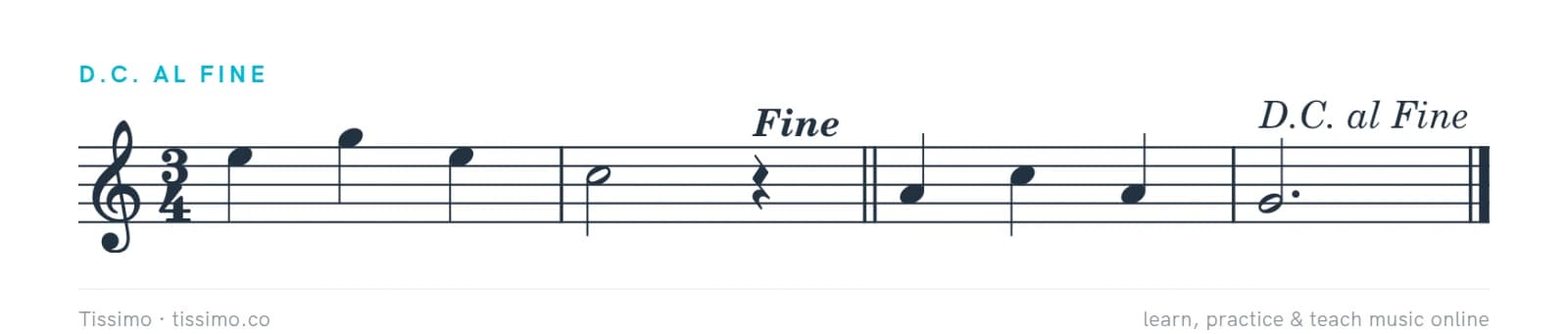
The common versions
- D.C. al Fine: go back to the beginning and play until the word fine ("end"), then stop.
- D.C. al Coda: go back to the beginning, play until "To Coda" or the coda sign, then jump to the section marked coda and play it to the end.
- D.C. on its own: go back to the beginning and play the whole piece again, through to the final bar.
Compare dal segno (D.S.), which sends you back to a sign partway through the piece instead of to the very beginning.
Repeats after a D.C.
By convention, when a D.C. sends you back, you skip repeats the second time around and play only the last of any endings. Some editions say this in words; if the score asks for the repeats, take them. When in doubt, ask your teacher or conductor.
Da capo in larger forms
The instruction has given its name to two well-known shapes, both A–B–A (ternary form):
- In a Classical minuet and trio, the words "Menuetto da capo" after the trio send the players back to play the minuet again.
- In Baroque opera and oratorio, the da capo aria has an A section, a contrasting B section and then a return of A, which singers traditionally decorated with ornaments of their own.
Practice reading the route in Navigation Signs and Trace the road map.
Common questions
What does D.C. al Fine mean?
Go back to the beginning and play until the word Fine, then stop.
What is the difference between D.C. and D.S.?
D.C. (da capo) sends you back to the beginning. D.S. (dal segno) sends you back to the segno sign, somewhere later in the piece.
Practice it: free worksheets
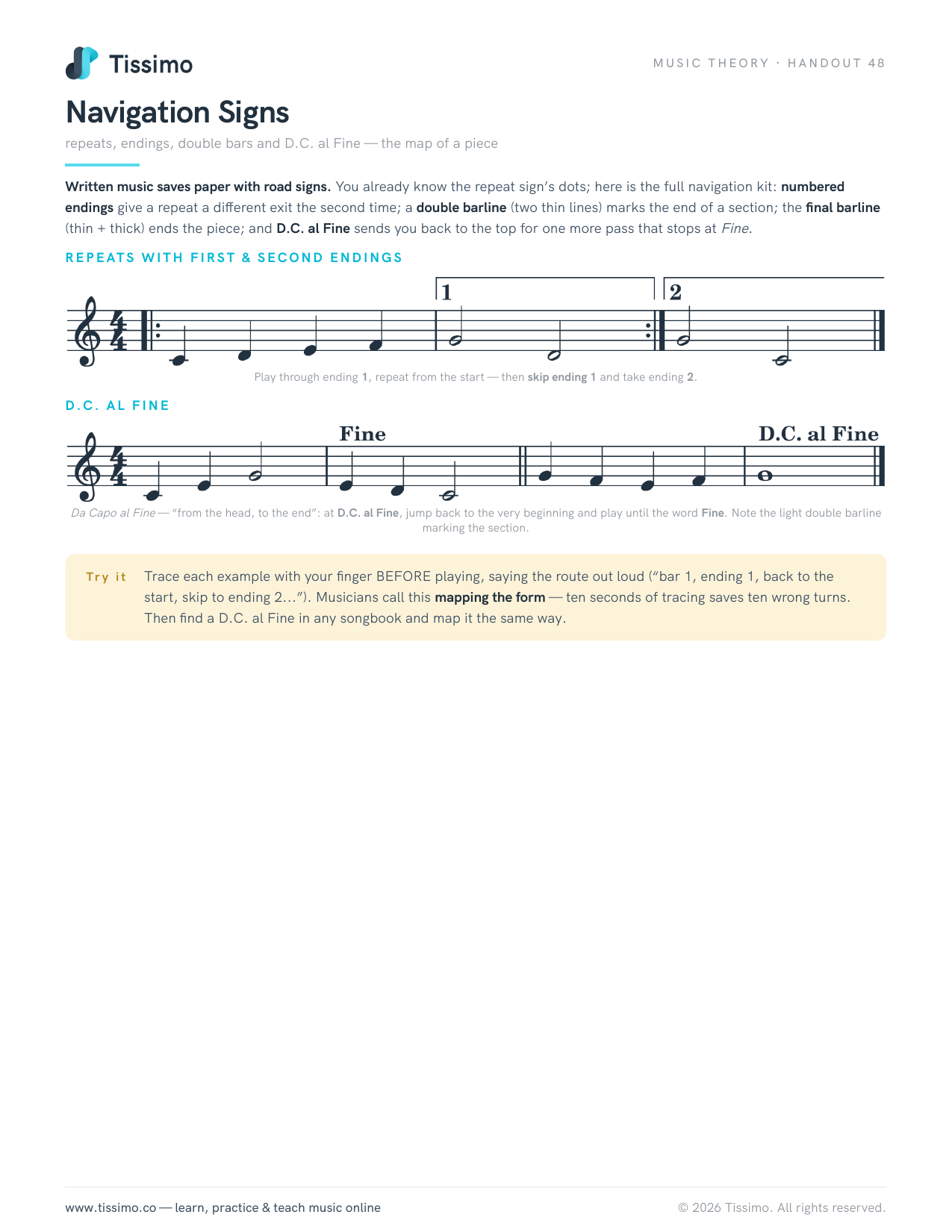 Navigation Signsrepeats, endings, double bars and D.C. al Fine — the map of a piece
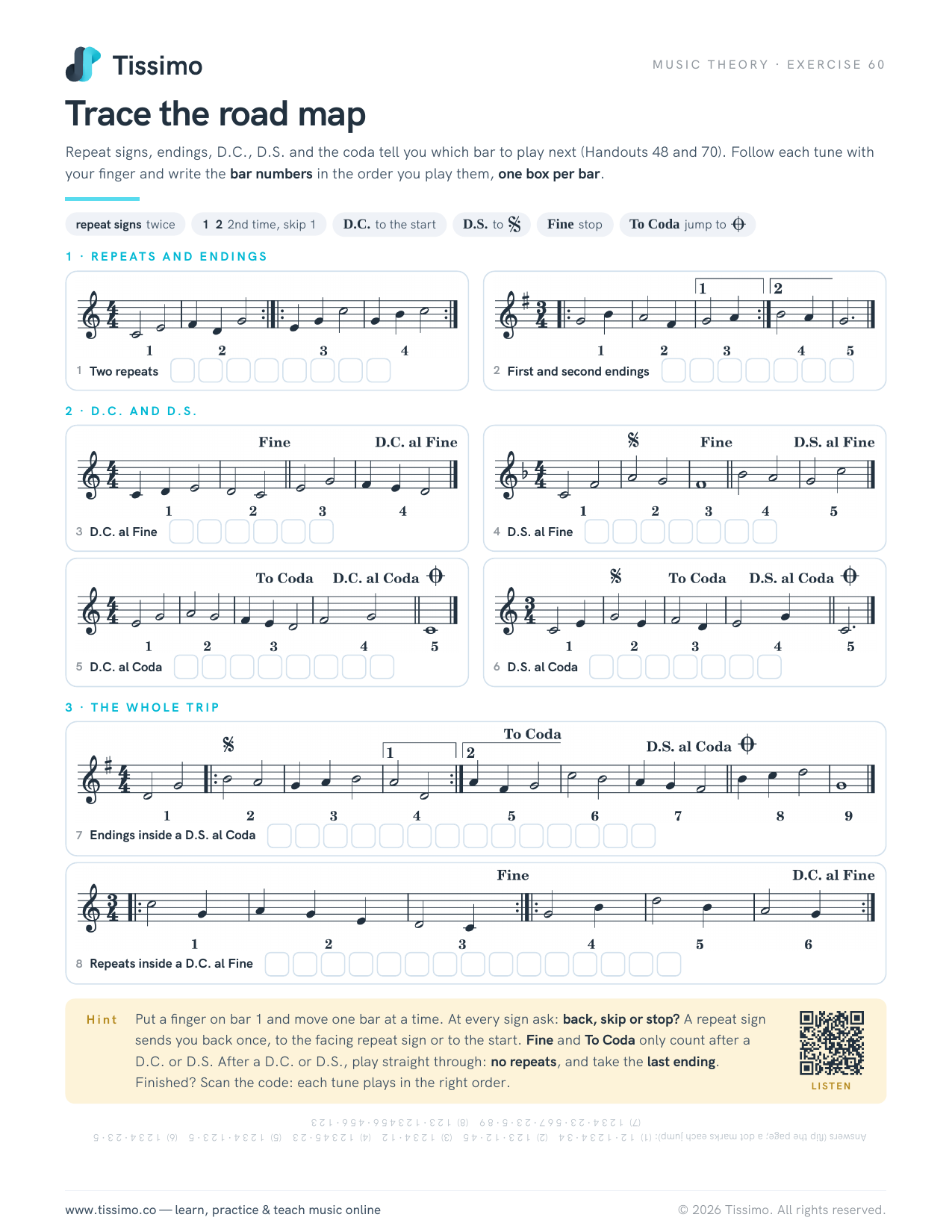 Trace the road mapRepeat signs, endings, D.C., D.S. and the coda tell you which bar to play next (Handouts 48 and 70). Follow each tune with your finger and write the bar numbers in the order you play them, one box per bar.
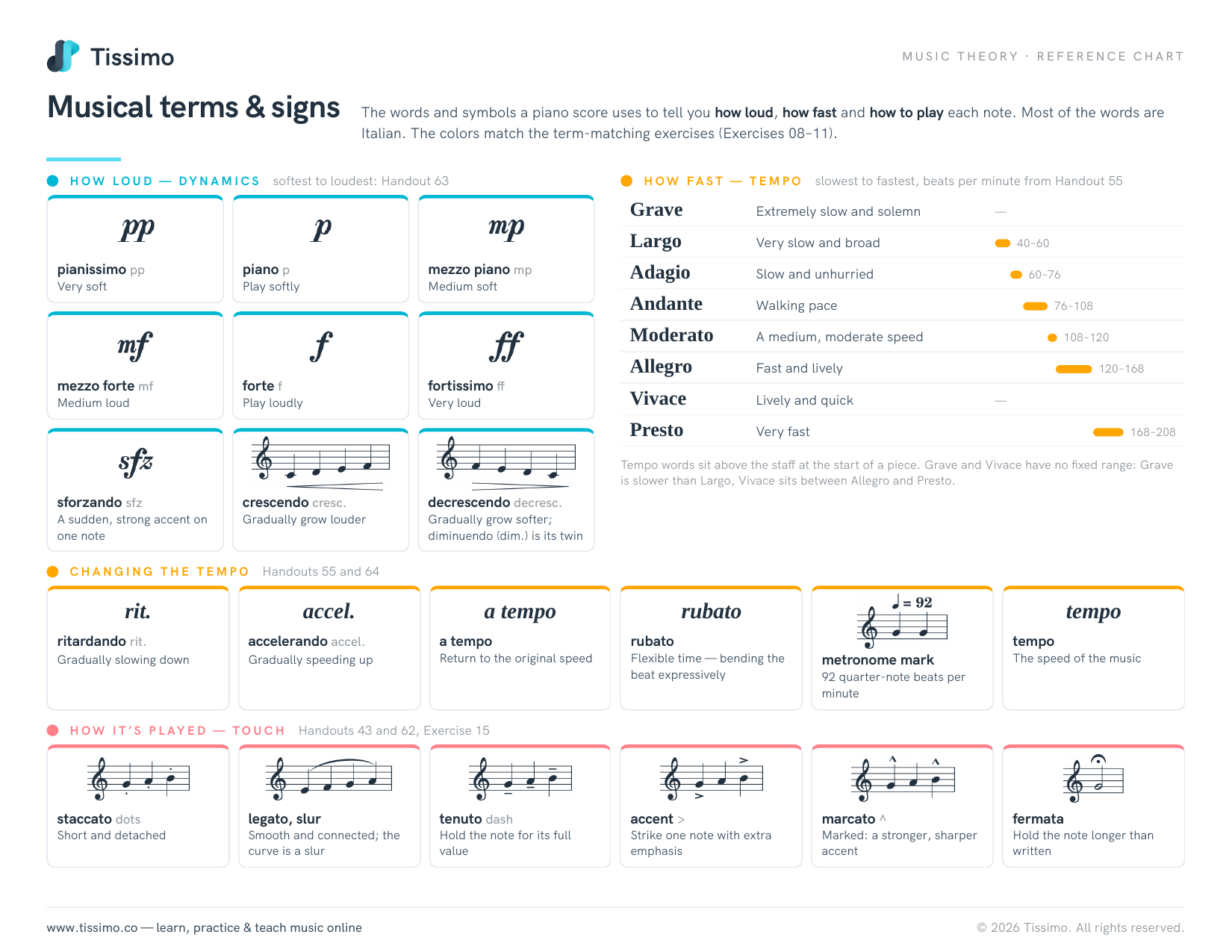 Musical terms & signsThe words and symbols a piano score uses to tell you how loud, how fast and how to play each note. Most of the words are Italian. The colors match the term-matching exercises (Exercises 08–11, 74 and 75).