Notation & Symbols
Fine
Pronounced FEE-nay
Fine (pronounced FEE-nay) is Italian for 'end'. It marks where a piece finishes, often after a D.C. or D.S. has sent you back to an earlier passage.
Fine is Italian for "end". It is printed above the staff at the bar where the piece will finally stop, often working together with D.C. al Fine or D.S. al Fine. Say it the Italian way, "FEE-nay", not like the English word fine.
How it works
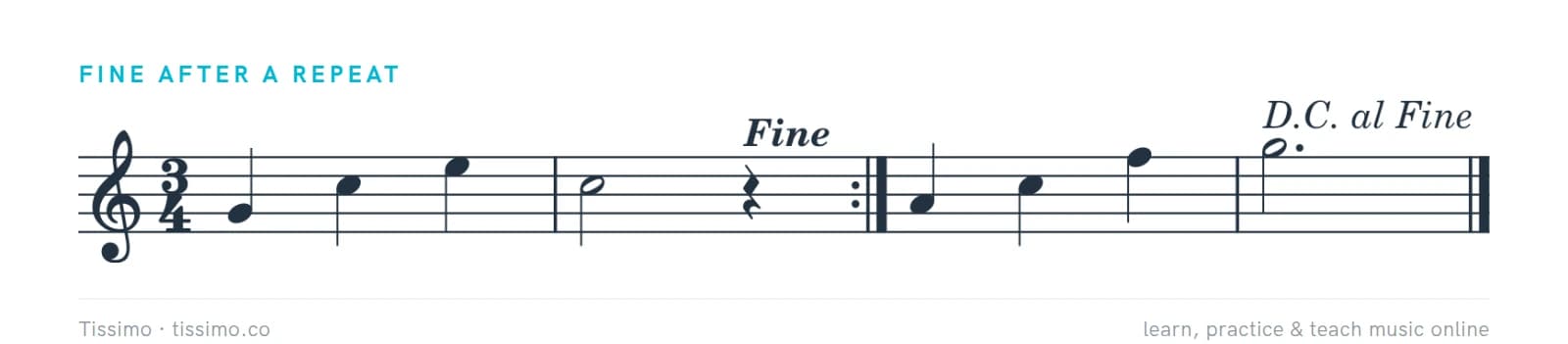
In a D.C. al Fine or D.S. al Fine route, play past Fine the first time and stop there after the jump has sent you back. That is why Fine so often appears in the middle of a page: the last bars printed are not the last bars played. Fine can also simply label the end when there is no return instruction.
Fine usually sits at a double bar line, so your eye can find it quickly when you come back around.
Fine and the form
D.C. al Fine is the classic way to write an A–B–A shape, ternary form, without printing the A section twice: play A, play B, go back to the beginning and play A again, ending at Fine. Many minuet-and-trio movements, marches and teaching pieces are laid out this way.
A common mistake
In the example, the first section has its own repeat sign. When the D.C. brings you back, you usually play that section only once, straight through to Fine, because repeats are normally skipped after a D.C. or D.S. If your edition or teacher wants the repeat taken, the score usually says so.
Practice the route in Navigation Signs and see A–B–A shapes in Binary, rounded binary & ternary.
Common questions
How do you pronounce Fine in music?
FEE-nay, as in Italian. It means "end" and has nothing to do with the English word fine.
Do you stop at Fine the first time you reach it?
In a D.C. al Fine or D.S. al Fine route, play past it first and stop there after the return. Without that repeat route, Fine can simply mark the end; follow the complete set of directions.
Practice it: free worksheets
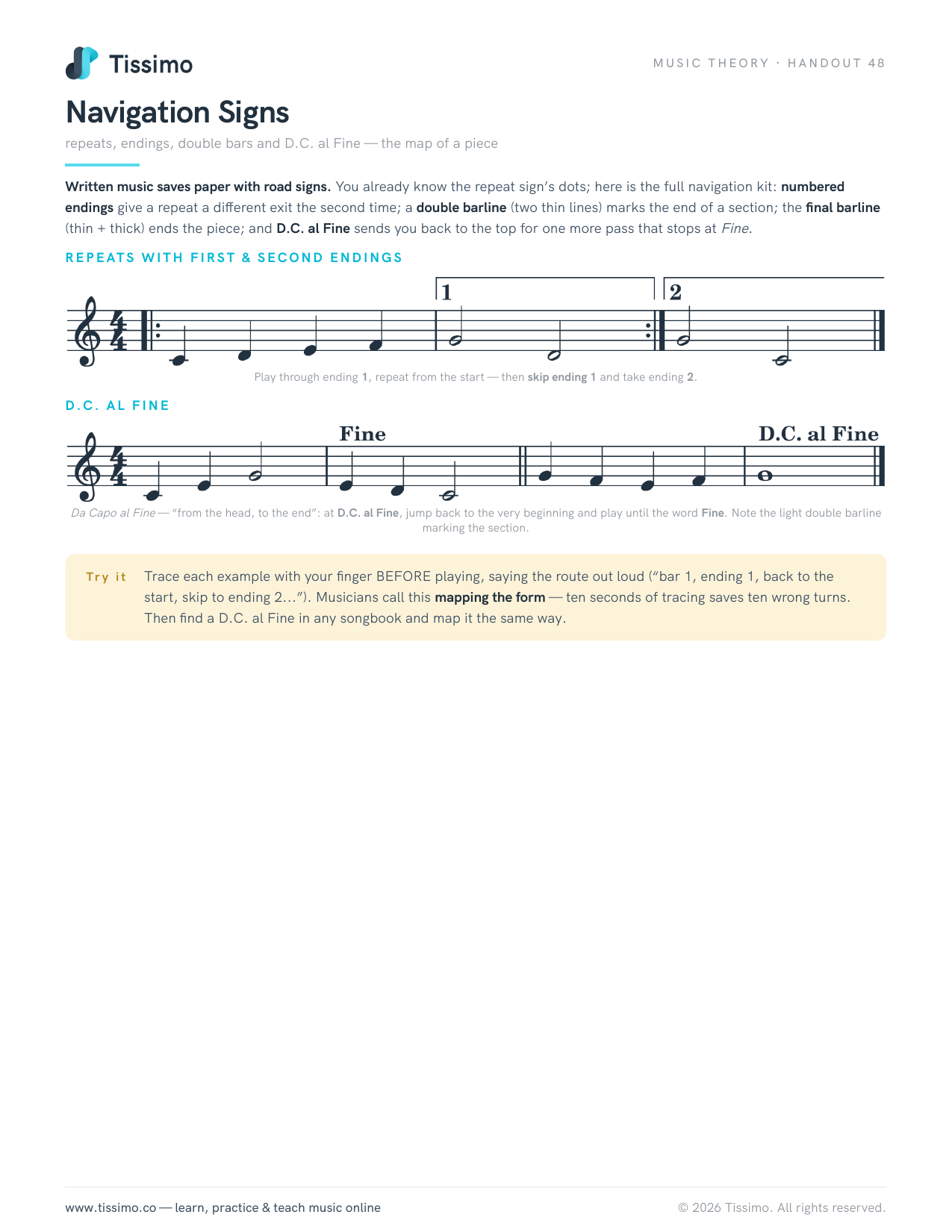 Navigation Signsrepeats, endings, double bars and D.C. al Fine — the map of a piece
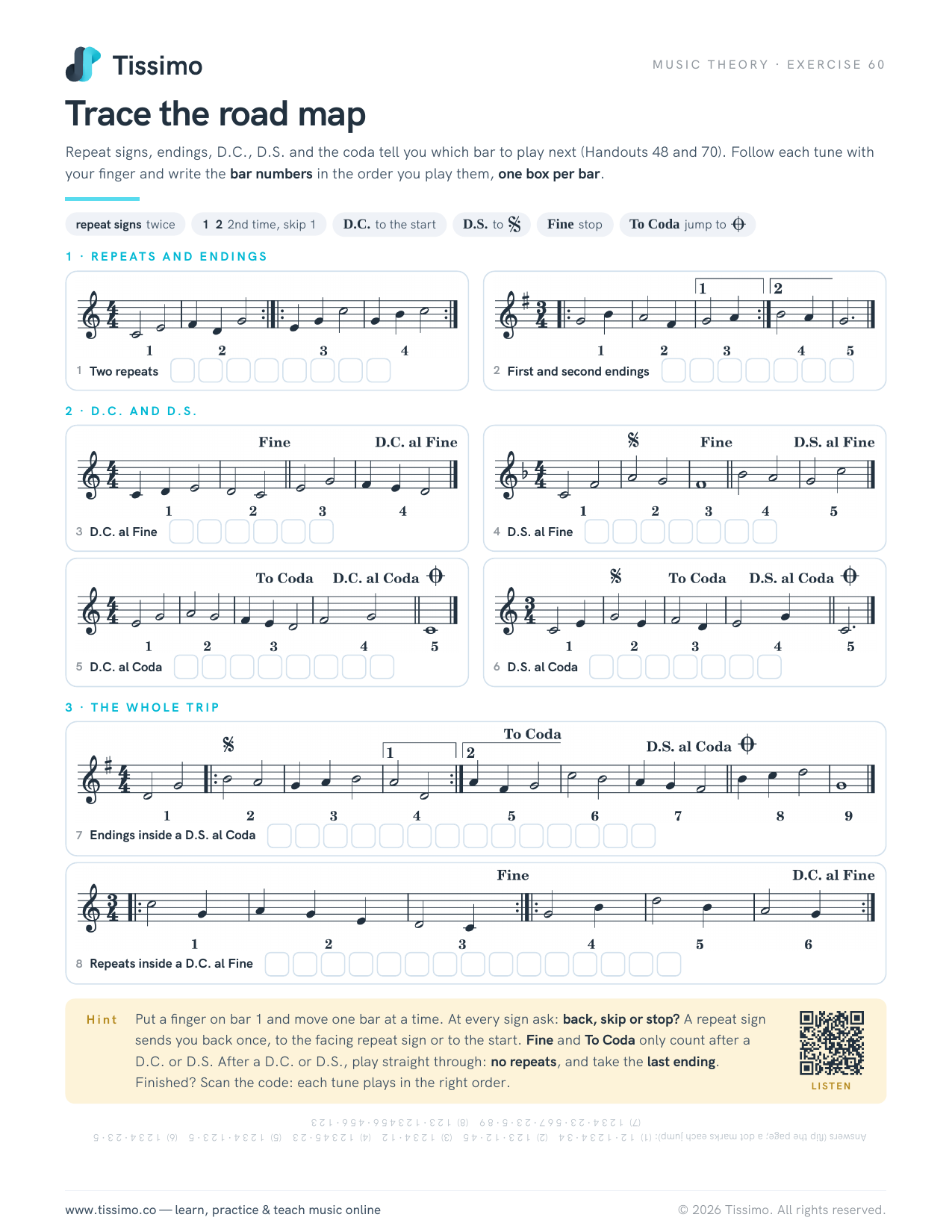 Trace the road mapRepeat signs, endings, D.C., D.S. and the coda tell you which bar to play next (Handouts 48 and 70). Follow each tune with your finger and write the bar numbers in the order you play them, one box per bar.
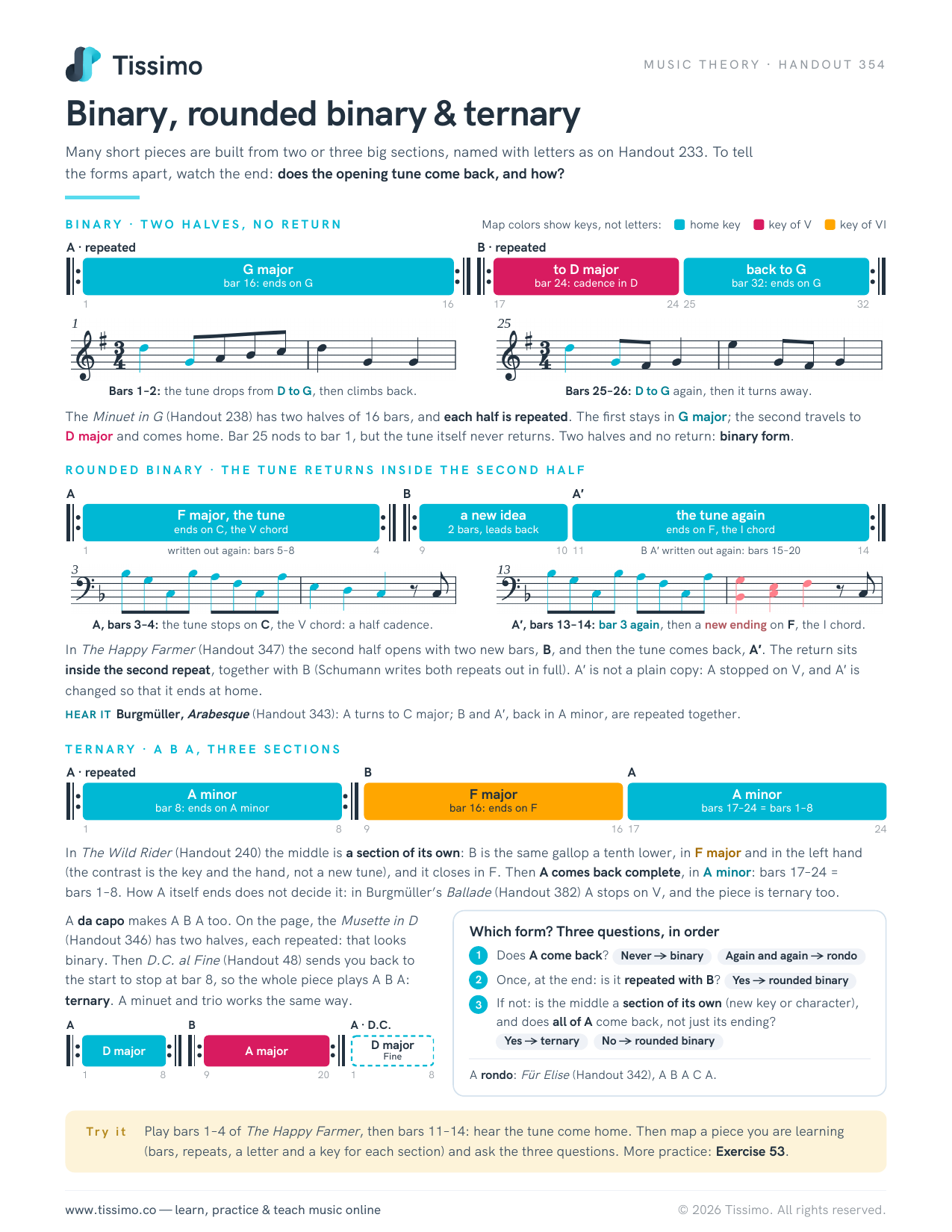 Binary, rounded binary & ternaryMany short pieces are built from two or three big sections, named with letters as on Handout 233. To tell the forms apart, watch the end: does the opening tune come back, and how?