Notation & Symbols
Clef
Pronounced KLEF
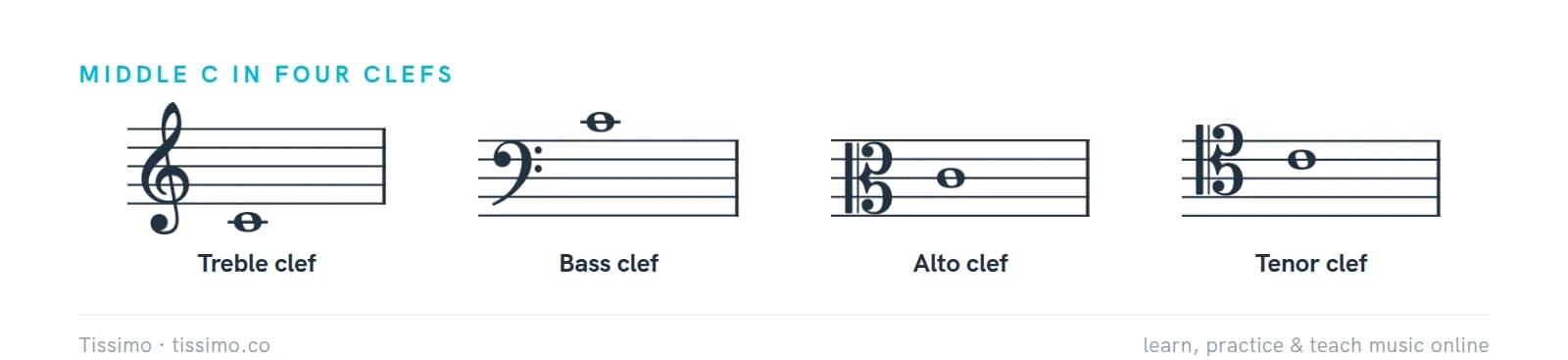
A clef is the symbol at the start of a staff that fixes the pitch of one line, and with it the name of every line and space. The common clefs are the treble, bass, alto and tenor clefs.
A clef is the first symbol on every line of music. By itself a staff is just five lines; the clef ties one of those lines to a particular note, and every other line and space follows in alphabetical order from there. Change the clef and the same spot on the staff names a different note.
Three clef shapes
Modern music uses three clef signs. Each grew out of a stylized letter, and each marks the line that carries its letter's note:
- The G clef curls around the line that is G above middle C. On the second line it is the treble clef.
- The F clef has two dots that sit either side of the line that is F below middle C. On the fourth line it is the bass clef.
- The C clef points with its center to the line that is middle C. On the third line it is the alto clef; on the fourth line, the tenor clef (see C clef).
Why so many clefs?
Each instrument and voice reads the clef that keeps most of its notes on the staff, with as few ledger lines as possible. Violin, flute and the right hand of the piano read treble clef. Cello, bassoon, tuba and the piano's left hand read bass clef. The viola reads alto clef, and cellos, bassoons and trombones switch to tenor clef for high passages.
In older music you will also meet C clefs on other lines (the soprano clef on the first line, the mezzo-soprano on the second, the baritone on the fifth) and, now and then, a G clef on the first line, the French violin clef. The method never changes: find the line the clef names, then count.
Clef changes and special clefs
A clef can change partway through a piece. The new clef is printed smaller, just before the note where it takes effect, and it stays in force until the next change. Piano music does this often, whenever one hand moves into the other's register.
A few clefs work differently:
- A treble clef with a small 8 underneath means "sounds an octave lower than written". Tenor parts in choral music often use it. Guitar music is also written in treble clef and sounds an octave lower, whether or not the 8 is printed.
- The neutral (percussion) clef, two thick vertical strokes, is used for unpitched percussion such as the drum kit.
- Guitar tablature begins with the word TAB instead of a clef.
Learn the two everyday clefs with The Staff & the Treble Clef and The Bass Clef & the Grand Staff, then try Reading alto & tenor clefs.
Common questions
What are the four main clefs?
Treble (a G clef on the second line), bass (an F clef on the fourth line), alto (a C clef on the third line) and tenor (a C clef on the fourth line). Treble and bass are by far the most common.
Why is it called a clef?
Clef is French for key. The clef is the key to the staff: it tells you which note each line and space stands for.
Practice it: free worksheets
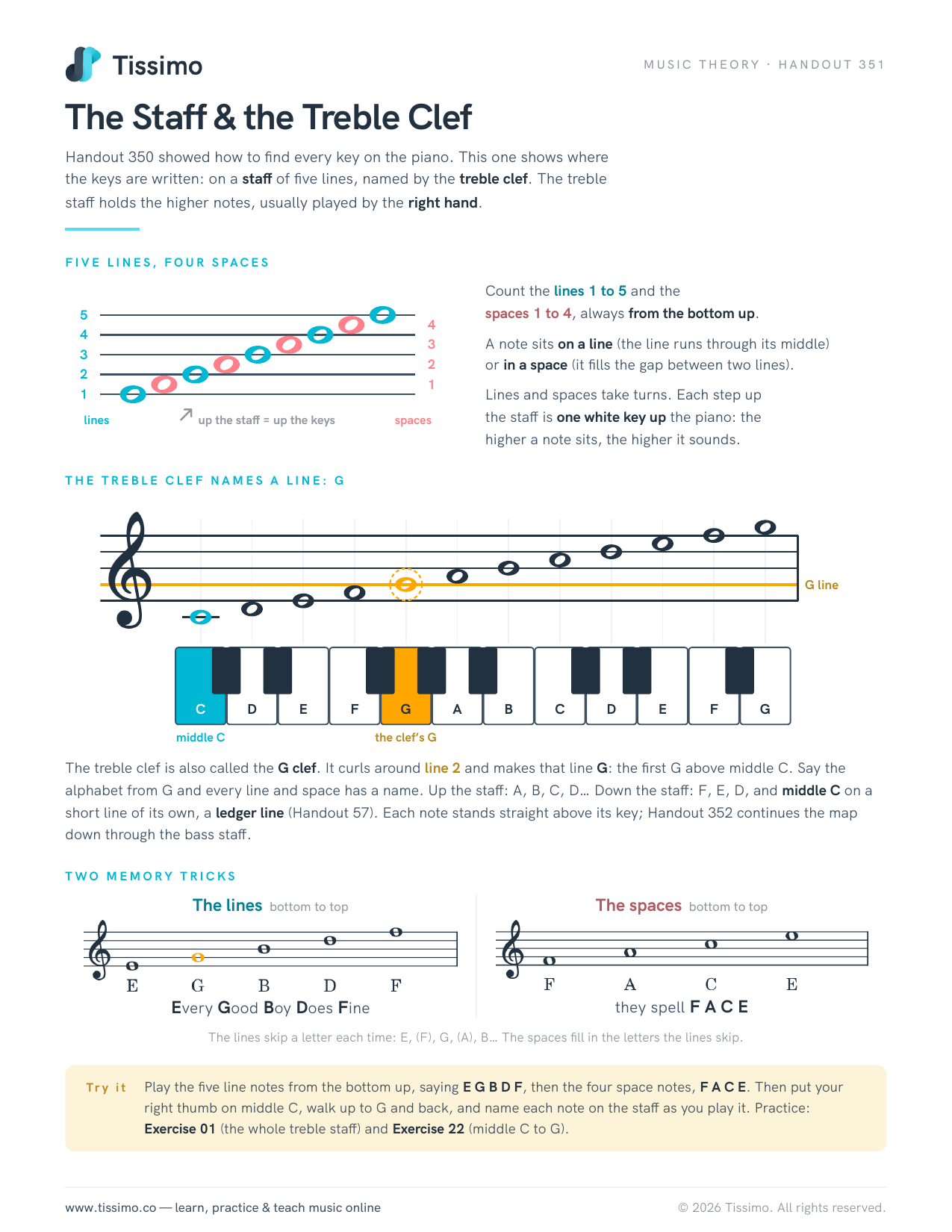 The Staff & the Treble ClefHandout 350 showed how to find every key on the piano. This one shows where the keys are written: on a staff of five lines, named by the treble clef. The treble staff holds the higher notes, usually played by the right hand.
 The Bass Clef & the Grand StaffThe bass staff holds the lower notes, usually played by the left hand. It works just like the treble staff (Handout 351), but its clef names a different line.
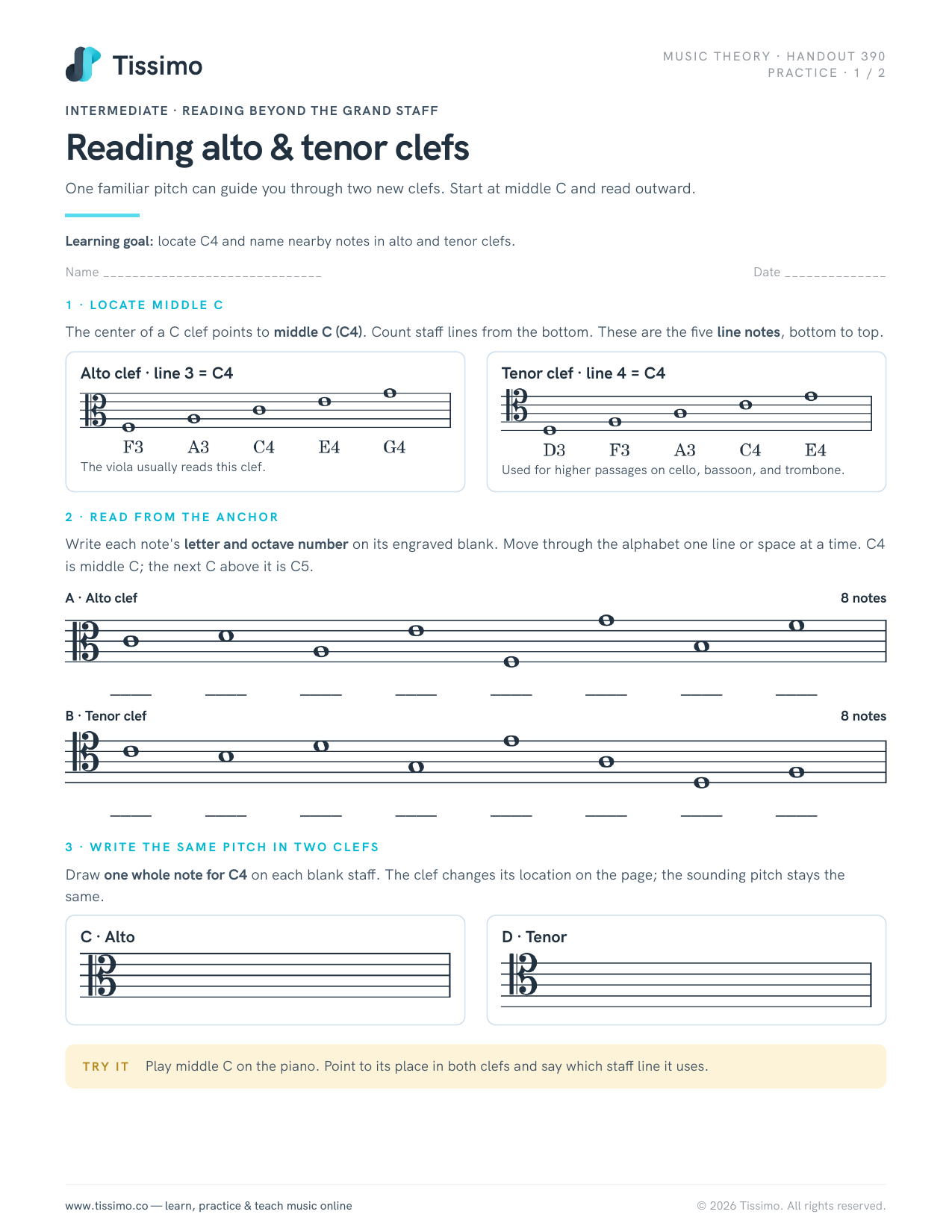 Reading alto & tenor clefsOne familiar pitch can guide you through two new clefs. Start at middle C and read outward.
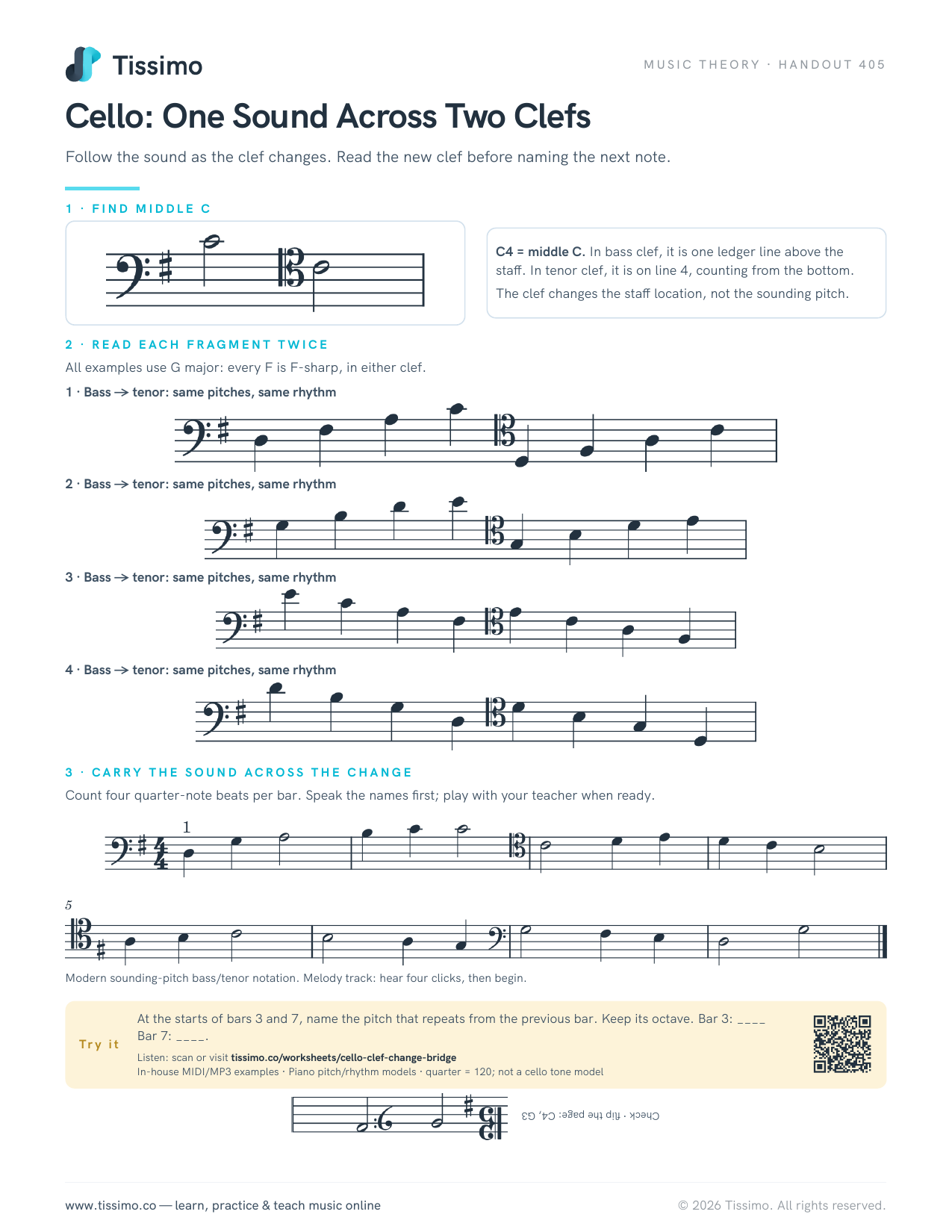 Cello: One Sound Across Two ClefsFollow the sound as the clef changes. Read the new clef before naming the next note.
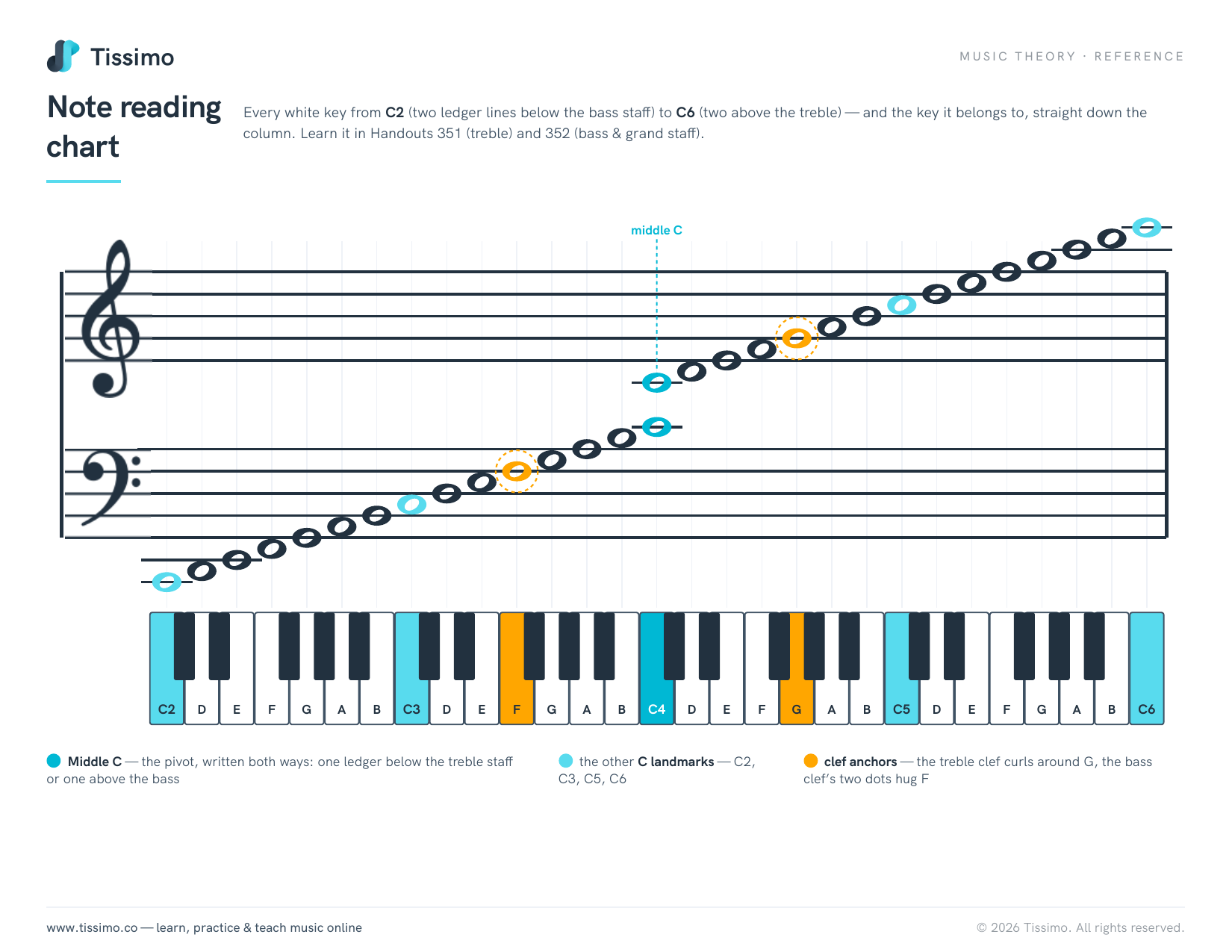 Note reading chartEvery white key from C2 (two ledger lines below the bass staff) to C6 (two above the treble) — and the key it belongs to, straight down the column. Learn it in Handouts 351 (treble) and 352 (bass & grand staff).