Instruments & Voices
Tuba
Pronounced TOO-buh
The tuba is the largest and lowest common brass instrument, with a wide conical tube, a big cup mouthpiece and three to six valves. It reads bass clef at concert pitch and anchors bands and orchestras.
The tuba is the bass of the brass family. Its tube is wide and conical, about 16 to 18 feet long on the common B♭ and C tubas, coiled into an instrument you hold upright on your lap with the bell pointing up. Its sound is deep, round and surprisingly soft-edged, and it can be gentle and lyrical as well as powerful.
How a tuba makes its sound
You buzz your lips into a large, deep cup mouthpiece. As on all brass instruments, changing the lip tension and air moves you between the notes of the harmonic series, and the valves add tubing to lower the pitch. Tubas have three to six valves, and four is common; the extra valves improve the tuning of low notes and fill in the range below the open notes. Valves may be pistons or rotary valves.
Tubas are built in different keys: B♭ and C (the large "contrabass" tubas), and E♭ and F (smaller "bass" tubas). Orchestral players often switch between a C tuba and an F tuba depending on the music.
Range
A professional tubist's range runs from about D1 up to about F4, and further at both ends in solo music. Students usually work in the middle of that, roughly from F1 to B♭3.
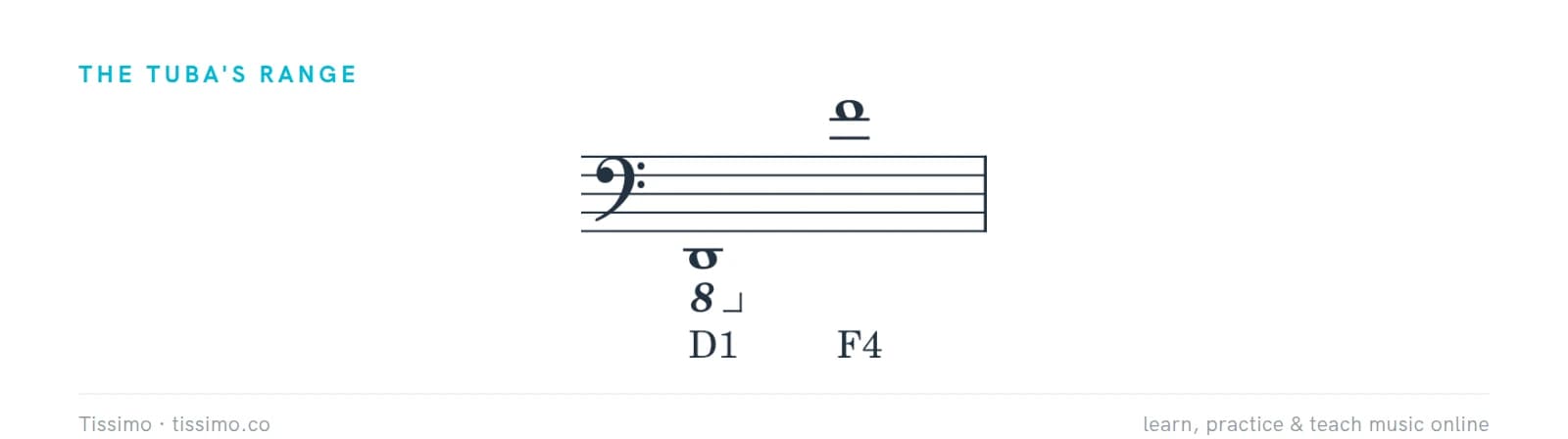
How tuba music is written
In orchestras and most bands, tuba music is written in bass clef at concert pitch, whatever key the instrument is built in. Players learn fingerings for their own instrument rather than transposing. The exception is the British-style brass band, whose E♭ and B♭ basses read treble clef parts written as transposing instruments.
Relatives
- The sousaphone is a tuba made to wrap around the player's body, with the bell high above the head, for marching bands.
- The euphonium is a smaller, tenor-range tuba with a mellow tone, common in bands.
- The baritone horn is a close cousin of the euphonium, with a narrower bore.
Its role
An orchestra usually has one tuba, which plays the bass of the brass section and often doubles the double basses. Concert and marching bands have several. The tuba also plays in brass quintets, New Orleans jazz and brass bands, polka and Mexican banda music, where it often provides the bass line.
Tips for beginners
- Breathe deeply and use a lot of relaxed air: the tuba needs volume of air more than pressure.
- Sit tall and bring the mouthpiece to you, adjusting your chair or a stand rather than slumping.
- Keep the lips loose and buzzing freely for low notes; tension makes them thin and sharp.
- Practice reading ledger lines below the bass staff, where many tuba notes live.
Common questions
Is the tuba a transposing instrument?
In orchestras and most bands, no: tuba parts are written in bass clef at concert pitch, even for a B♭ or E♭ tuba. British brass bands are the exception, with treble-clef parts that transpose.
What is the difference between a tuba and a sousaphone?
A sousaphone is a tuba shaped to wrap around the player's body for marching, with a large bell that faces forward above the head. A concert tuba is held upright on the lap with the bell pointing up.
Practice it: free worksheets
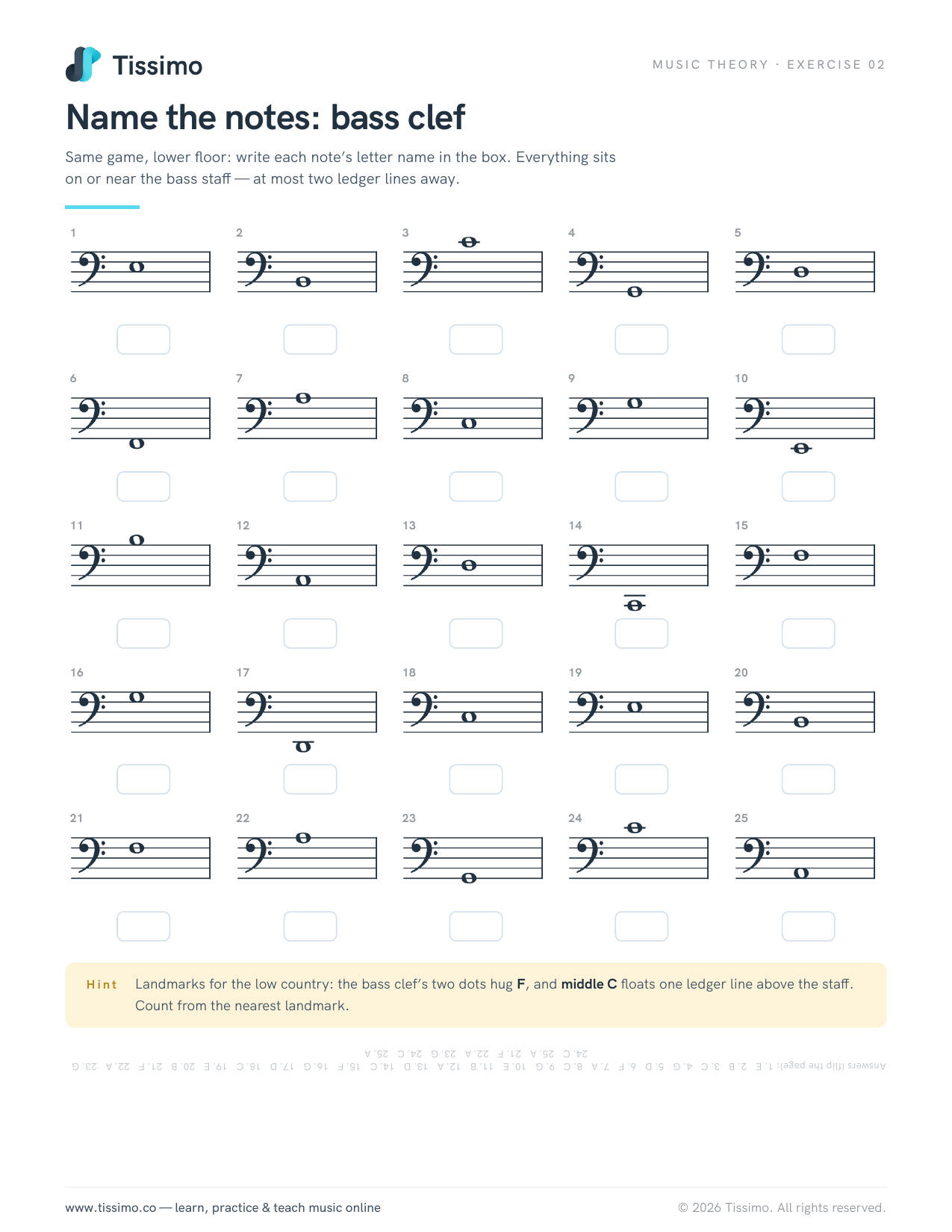 Name the notes: bass clefSame game, lower floor: write each note’s letter name in the box. Everything sits on or near the bass staff — at most two ledger lines away.
 The Bass Clef & the Grand StaffThe bass staff holds the lower notes, usually played by the left hand. It works just like the treble staff (Handout 351), but its clef names a different line.
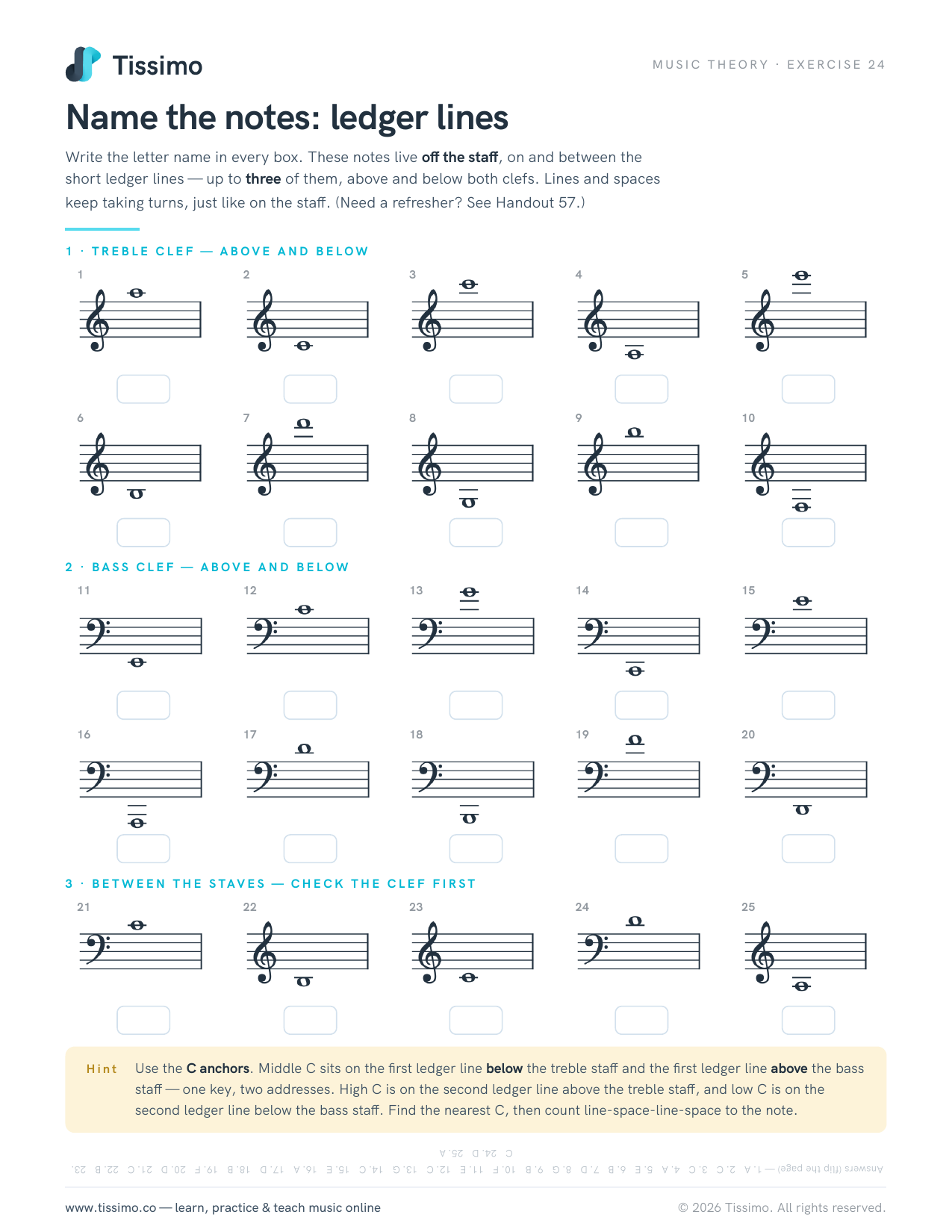 Name the notes: ledger linesWrite the letter name in every box. These notes live off the staff, on and between the short ledger lines — up to three of them, above and below both clefs. Lines and spaces keep taking turns, just like on the staff. (Need a refresher? See Handout 57.)