Instruments & Voices
Viola
Pronounced vee-OH-lah
The viola is a bowed string instrument slightly larger than the violin, tuned C–G–D–A, a fifth lower. It has a warm, darker tone, plays the inner parts of the string section and reads mainly alto clef.
The viola looks like a violin, but it is a little larger and sounds a perfect fifth lower. That lower tuning gives it a warm, dark, slightly veiled tone that many listeners describe as closer to the human voice. In the orchestra and the string quartet it plays the middle of the harmony, between the violins above and the cellos below.
How it makes its sound
The viola works exactly like the violin: you draw a rosined bow across the strings or pluck them (pizzicato), and your left-hand fingers stop the strings on a fingerboard with no frets. It is held under the chin in the same way. Because the body is bigger, the stretches between fingers are a little wider and the bow is slightly heavier.
Violas do not have one standard size. Full-size instruments are usually measured by body length, roughly 15 to 17 inches (about 38 to 43 cm), and players choose what suits their arms and hands. Children start on smaller violas, or on a violin strung with viola strings.
Tuning and range
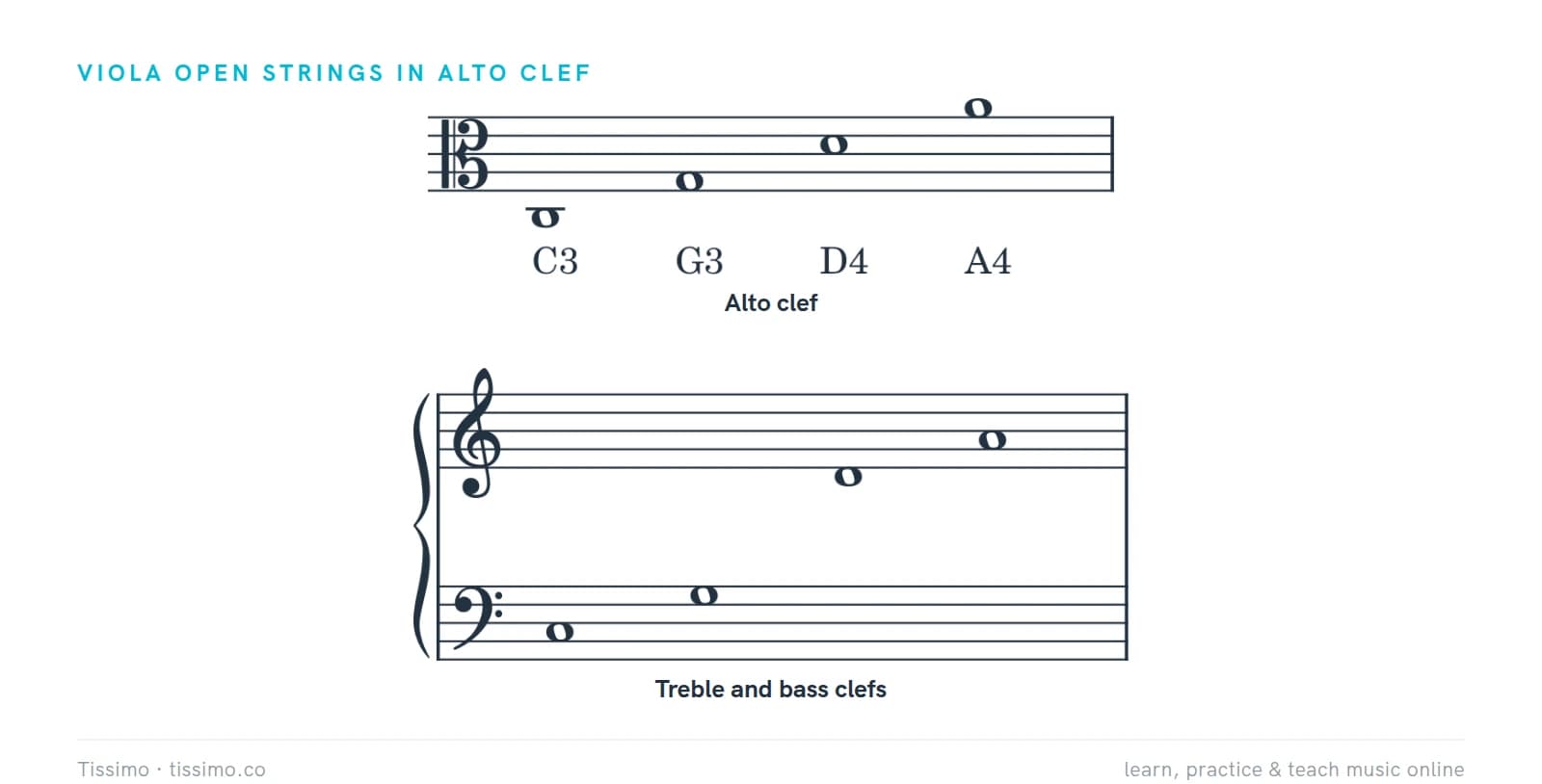
The strings are C3, G3, D4 and A4, each a perfect fifth apart. The top three are the same as the violin's lowest three; the viola swaps the violin's high E for a low C. The range runs from the open C3 up to around E6 in most music, and higher in solo writing.
How viola music is written: the alto clef
Viola music is written mainly in the alto clef, a C clef whose center marks middle C on the middle line of the staff. Most of the viola's range sits comfortably on that staff, where in treble clef it would need many ledger lines below and in bass clef many above. For high passages the music switches to treble clef. The viola is the main instrument that reads alto clef today, so violists learn it from the start.
Its role
Much of the time the viola fills in the harmony, holds inner lines and adds rhythm, and its sound gives the string section its depth. It also has a solo repertoire of sonatas, concertos and chamber music, and composers often give it melodies that need its darker color.
Tips for beginners
- Learn the alto clef as its own clef rather than translating from treble: middle C on the middle line is your anchor.
- Let the bow's weight sink into the thicker strings; the C string needs a slower, heavier stroke than the violin's E.
- Choose an instrument size you can play without straining, rather than the biggest one you can reach.
Common questions
What is the difference between a violin and a viola?
The viola is slightly larger, sounds a perfect fifth lower and has a darker tone. Its strings are C, G, D, A instead of the violin's G, D, A, E, and its music is written mainly in alto clef rather than treble clef.
Why does the viola use the alto clef?
The viola's range is centered around middle C. In alto clef, middle C is the middle line, so most viola notes fit on the staff, while treble or bass clef would need many ledger lines.
Practice it: free worksheets
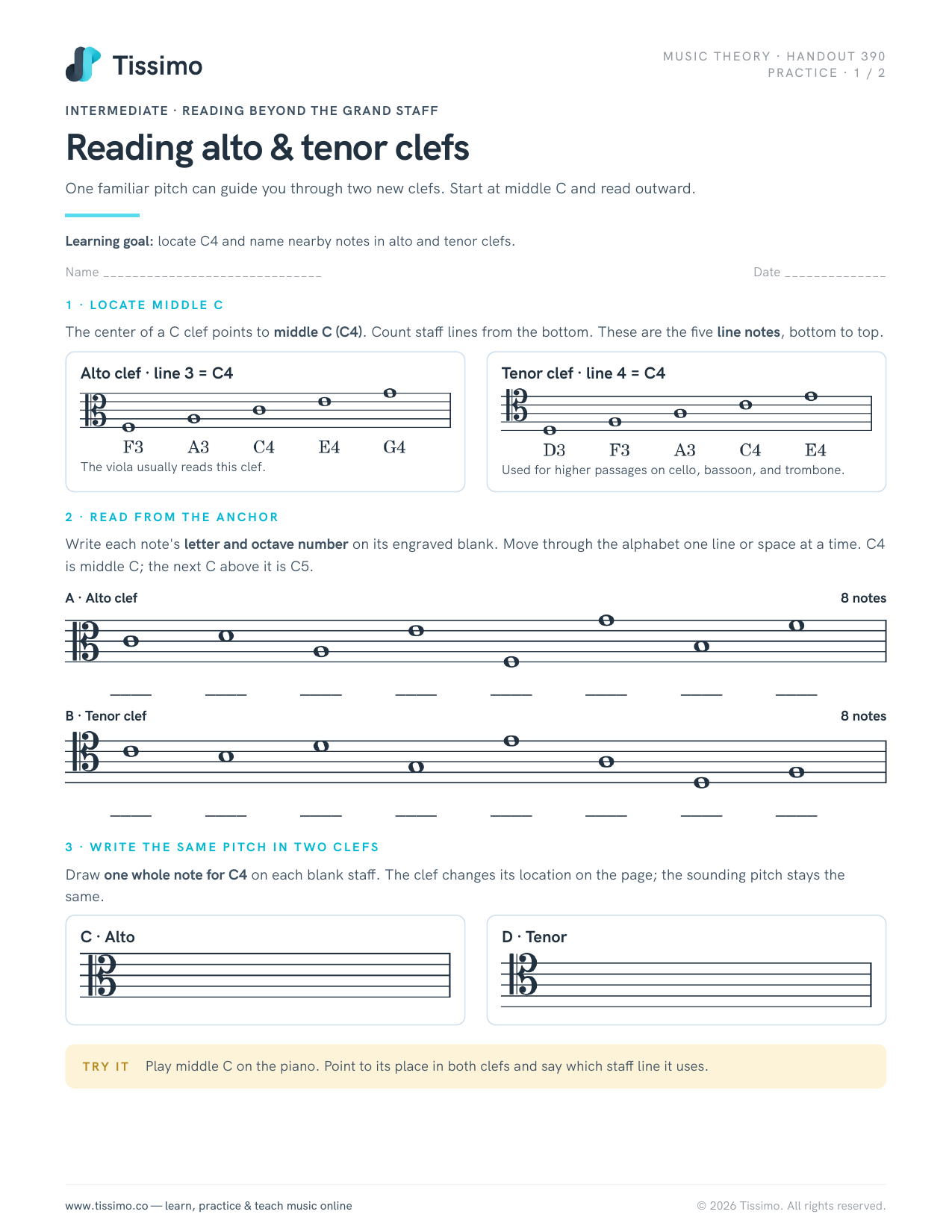 Reading alto & tenor clefsOne familiar pitch can guide you through two new clefs. Start at middle C and read outward.
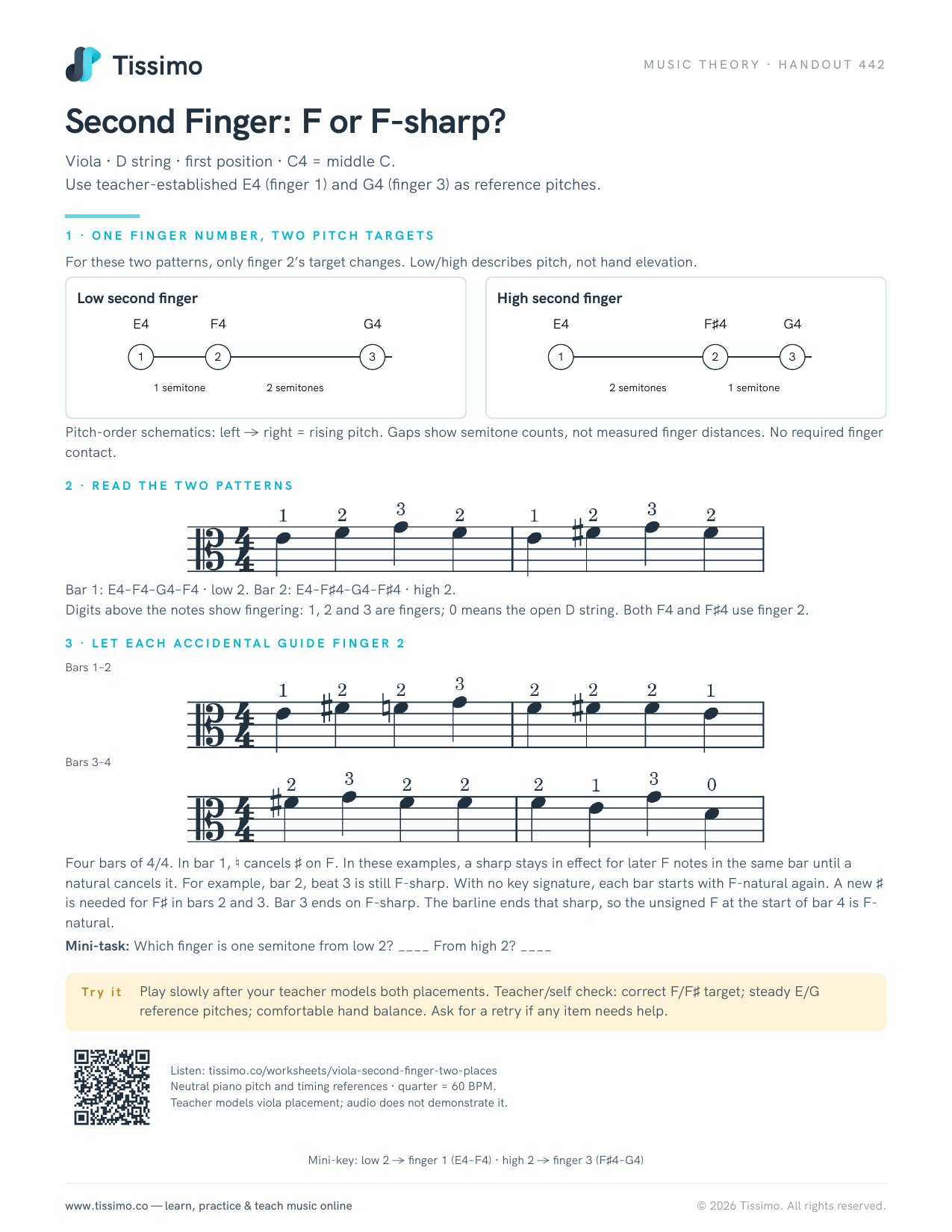 Second Finger: F or F-sharp?Viola · D string · first position · C4 = middle C. Use teacher-established E4 (finger 1) and G4 (finger 3) as reference pitches.
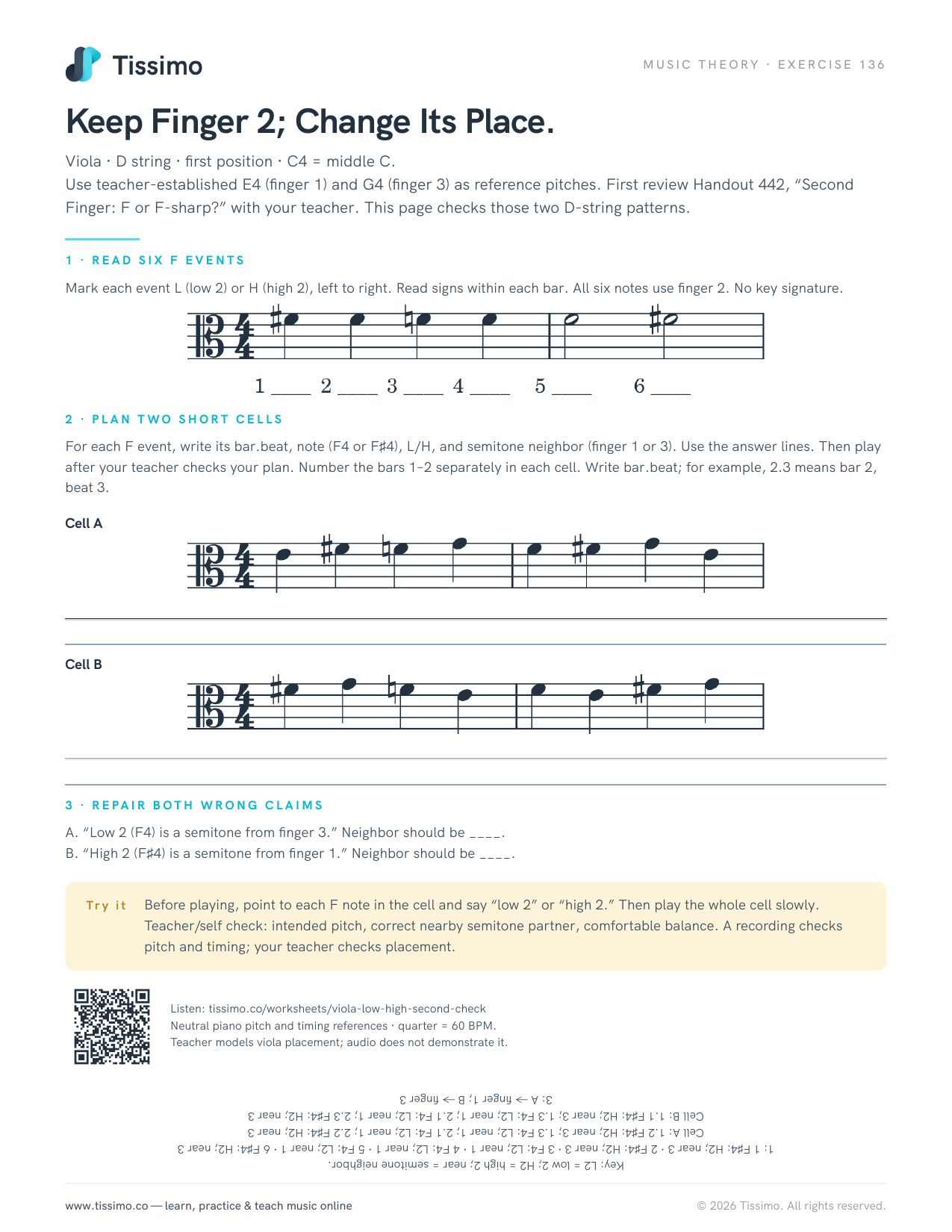 Keep Finger 2; Change Its Place.Viola · D string · first position · C4 = middle C. Use teacher-established E4 (finger 1) and G4 (finger 3) as reference pitches. First review Handout 442, “Second Finger: F or F-sharp?” with your teacher. This page checks those two D-string patterns.