Notation & Symbols
Repeat Sign
A repeat sign is a double bar line with two dots that tells you to play a passage again. An end-repeat sends you back to the matching start-repeat sign, or to the beginning if there is none.
A repeat sign is a thick and a thin bar line with two dots in the middle two spaces of the staff. The dots always face the music to be repeated:
- A start-repeat sign (thick line, thin line, then the dots) marks where the repeated passage begins.
- An end-repeat sign (the dots, then thin and thick lines) tells you to go back.
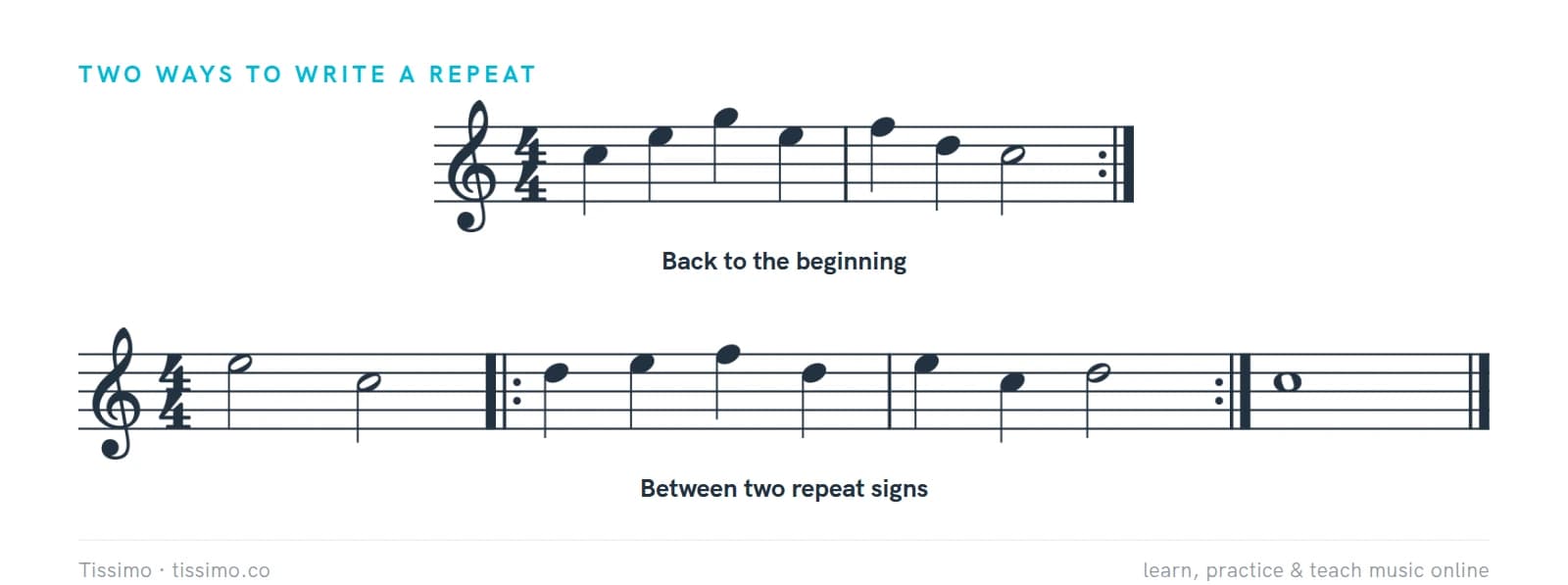
How to play a repeat
When you reach an end-repeat sign, go back to the nearest start-repeat sign before it and play from there again. If there is no start-repeat sign, go back to the beginning of the piece; composers usually leave the start-repeat out there. The second time you reach the end-repeat sign, carry on past it.
Unless the music says otherwise, the passage is played twice in total: once, then once more. Words such as "play 3 times" or "3x" ask for more.
Repeats with endings
Often the last bars of a repeated passage change the second time through. Those bars are written as first and second endings: brackets labeled 1. and 2. that tell you which bars to play each time.
Repeats on the road map
Repeat signs belong to a family of navigation marks, along with D.C., D.S., the segno, the coda and fine. By convention, when a D.C. or D.S. sends you back, you skip the repeats on the second time around, unless the score asks for them.
In longer works, repeats are part of the form. In many Classical sonata form movements, for example, the whole exposition carries a repeat sign. Performers sometimes leave long repeats out, a choice of taste and tradition rather than a rule.
Practice the route in Navigation Signs and Trace the road map.
Common questions
How many times do you play a repeat?
Twice in total: once, then once more. The score says so when it wants more, for example "play 3 times".
Where do you go back to if there is no start repeat sign?
To the beginning of the piece.
Practice it: free worksheets
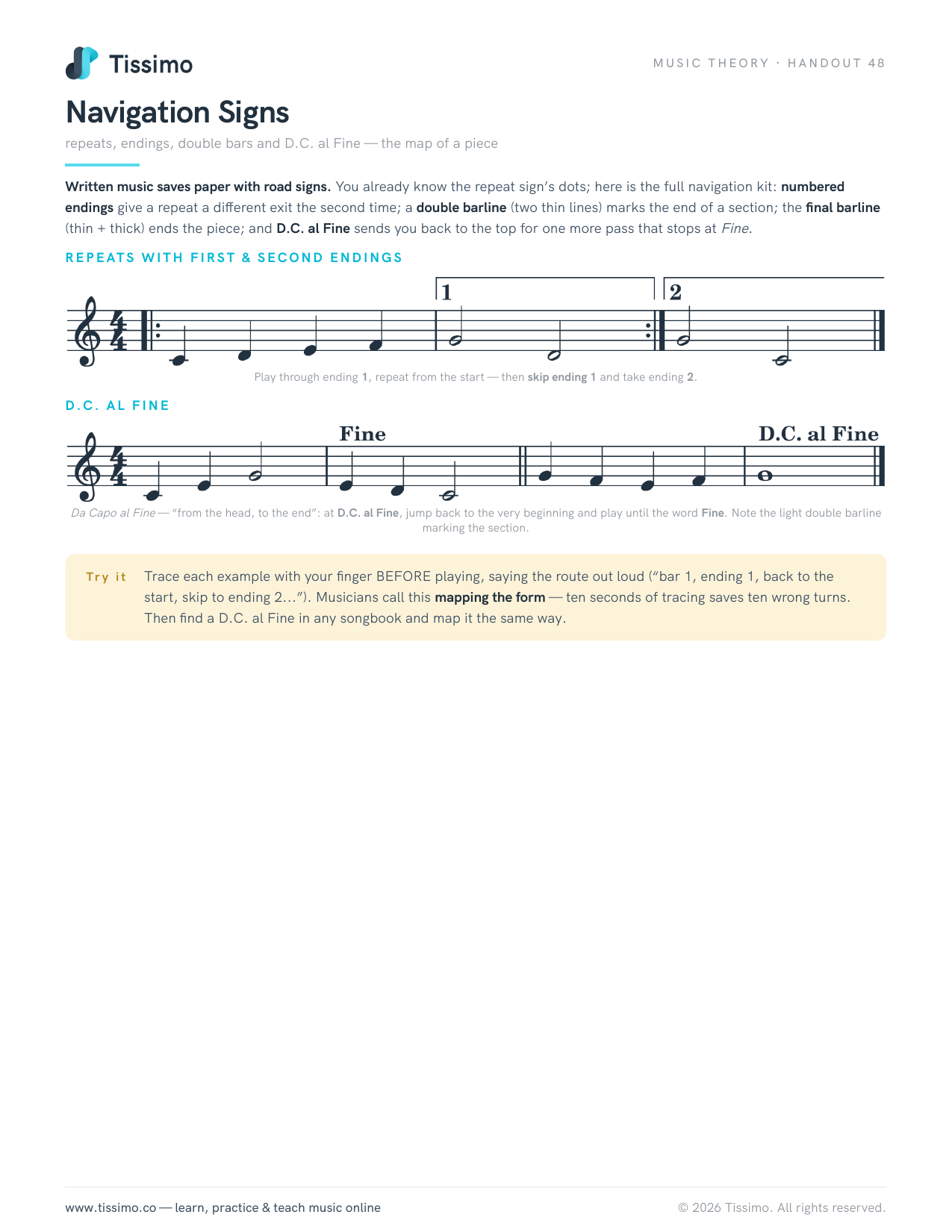 Navigation Signsrepeats, endings, double bars and D.C. al Fine — the map of a piece
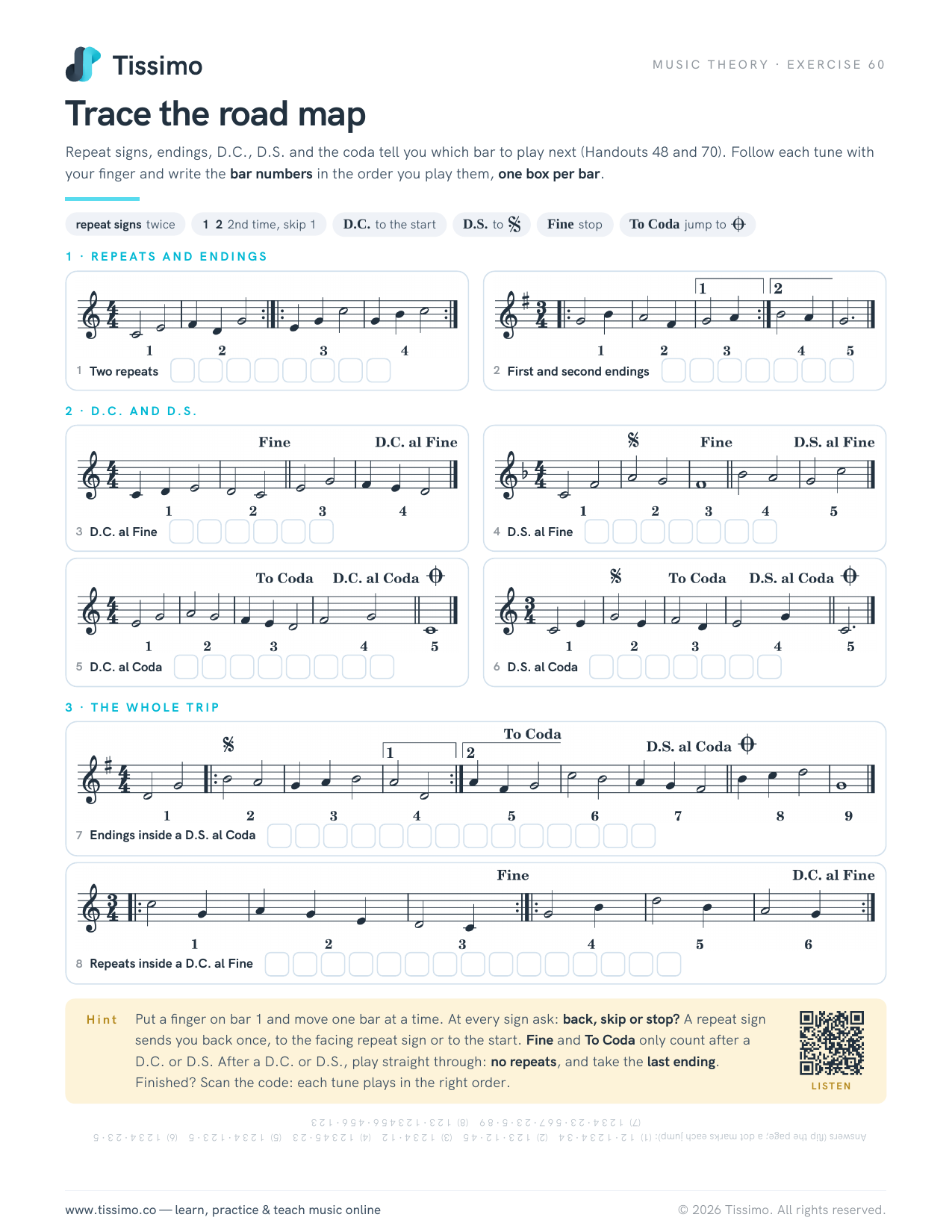 Trace the road mapRepeat signs, endings, D.C., D.S. and the coda tell you which bar to play next (Handouts 48 and 70). Follow each tune with your finger and write the bar numbers in the order you play them, one box per bar.