Styles, Genres & Eras
Film Music
Film music is music written or chosen to accompany a film, from the orchestral underscore that shapes a scene's emotion to the songs and source music heard by the characters themselves.
Film music supports the story on screen. It can set a time and place, reveal what a character is feeling, build suspense, tie scenes together and tell the audience how to react, often without them noticing. Most film music is written by a composer specifically for the film, a score, though films also use existing songs and recordings.
Key ideas
- Underscore (non-diegetic music): music only the audience hears, such as an orchestra swelling during a farewell.
- Source music (diegetic music): music that exists in the story world, such as a band playing at a party or a song on a car radio.
- Themes and motifs: recurring themes linked to characters, places or ideas, a technique that goes back to Wagner's leitmotifs in opera. A motif can change mood with the story, heroic in one scene, tragic in another.
- Cues: individual pieces of music for particular scenes. Composer and director decide where each cue starts and stops in a spotting session.
- Synchronization: music is timed precisely to picture, often using a click track.
- Mickey-Mousing: music that imitates on-screen action exactly, as in cartoons.
A short history
- Silent films were never silent: pianists, organists or orchestras played live, often improvising or using collections of mood pieces.
- With sound films from the late 1920s, studios hired composers to write full scores. Max Steiner's score for King Kong (1933) is often cited as a landmark of the early sound era.
- The Hollywood studio era drew on late Romantic orchestral style, with composers such as Steiner, Erich Wolfgang Korngold and later Bernard Herrmann (Psycho, Vertigo).
- Ennio Morricone's scores for westerns such as The Good, the Bad and the Ugly used whistling, electric guitar and unusual sounds.
- John Williams revived the grand symphonic score with Jaws, Star Wars, E.T. and the Indiana Jones films.
- Hans Zimmer and many others blended orchestra with electronics and sound design.
Film music as concert music
Many scores are performed in concert halls, and film concerts with live orchestra playing to the projected picture have become popular. Film music has also introduced generations of listeners to the sound of the orchestra.
Listening tip
Watch a short scene twice: once with the sound off, once with it on. Notice how the music changes what you feel about the same images, and listen for themes that return when a character reappears. The Motif and sequence worksheet shows how short ideas are reused.
Common questions
What is the difference between a film score and a soundtrack?
The score is the original music composed for the film. A soundtrack (or soundtrack album) can include the score, the songs used in the film, or both.
What is diegetic music?
Music that exists within the world of the story, so the characters can hear it, such as a band at a party. Non-diegetic music, the underscore, is heard only by the audience.
Practice it: free worksheets
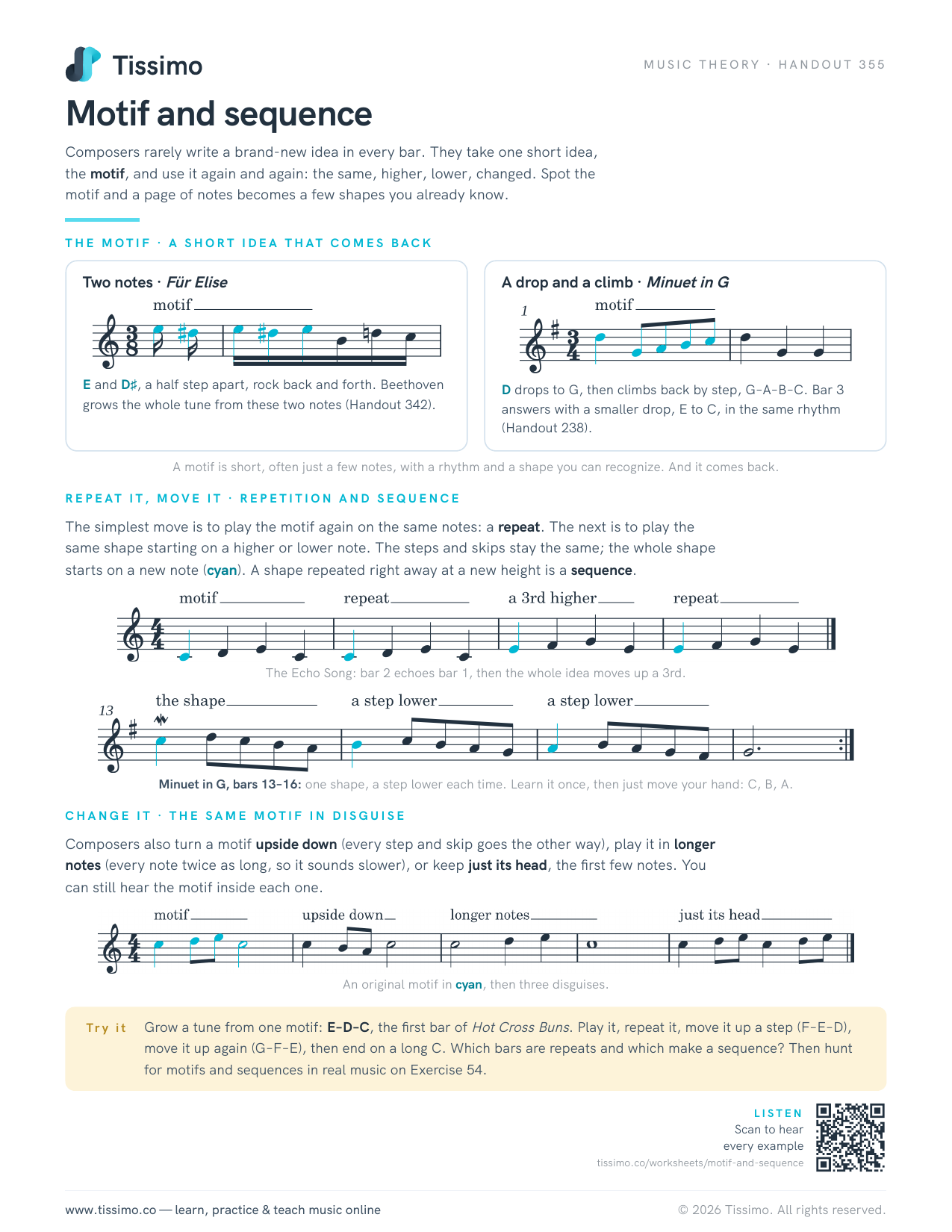 Motif and sequenceComposers rarely write a brand-new idea in every bar. They take one short idea, the motif, and use it again and again: the same, higher, lower, changed. Spot the motif and a page of notes becomes a few shapes you already know.
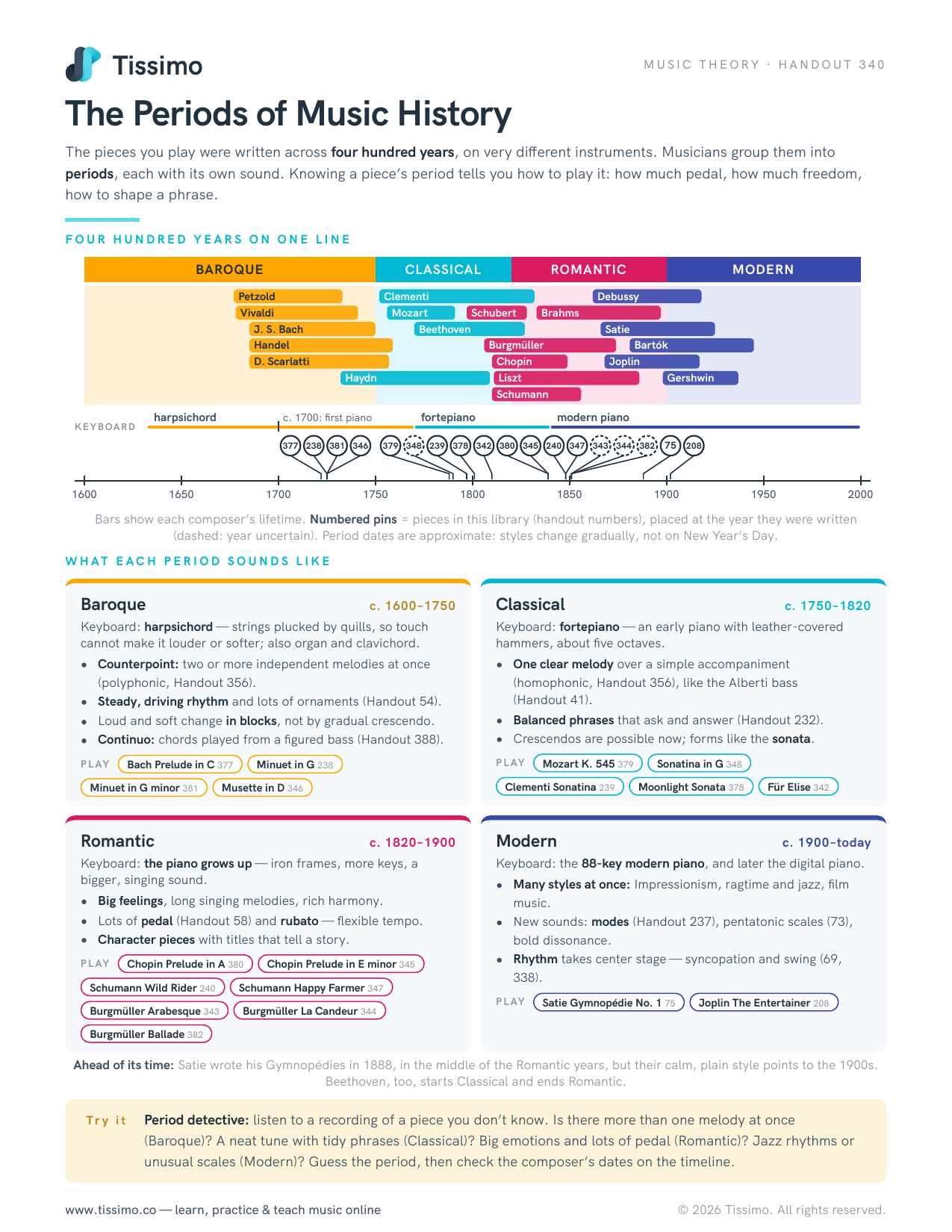 The Periods of Music HistoryThe pieces you play were written across four hundred years, on very different instruments. Musicians group them into periods, each with its own sound. Knowing a piece’s period tells you how to play it: how much pedal, how much freedom, how to shape a phrase.