Form & Structure
Opera
Pronounced OP-er-uh
Opera is a form of drama in which the story is told mostly or entirely through singing, accompanied by an orchestra and performed on stage with sets, costumes and acting.
An opera is a play set to music. Singers act the roles, an orchestra accompanies them from the pit, and the story unfolds on stage with scenery and costumes. In most operas almost every word is sung. The text is called the libretto ("little book"), written by a librettist.
The building blocks
- Overture or prelude: the orchestral opening.
- Recitative: speech-like singing that moves the plot forward through dialogue.
- Aria: a solo song in which a character expresses feelings, the moments most audiences remember.
- Ensembles: duets, trios and larger groups, often with different characters singing different words at once.
- Chorus: crowd scenes for the whole company.
- Some operas use spoken dialogue instead of recitative between the musical numbers.
A short history
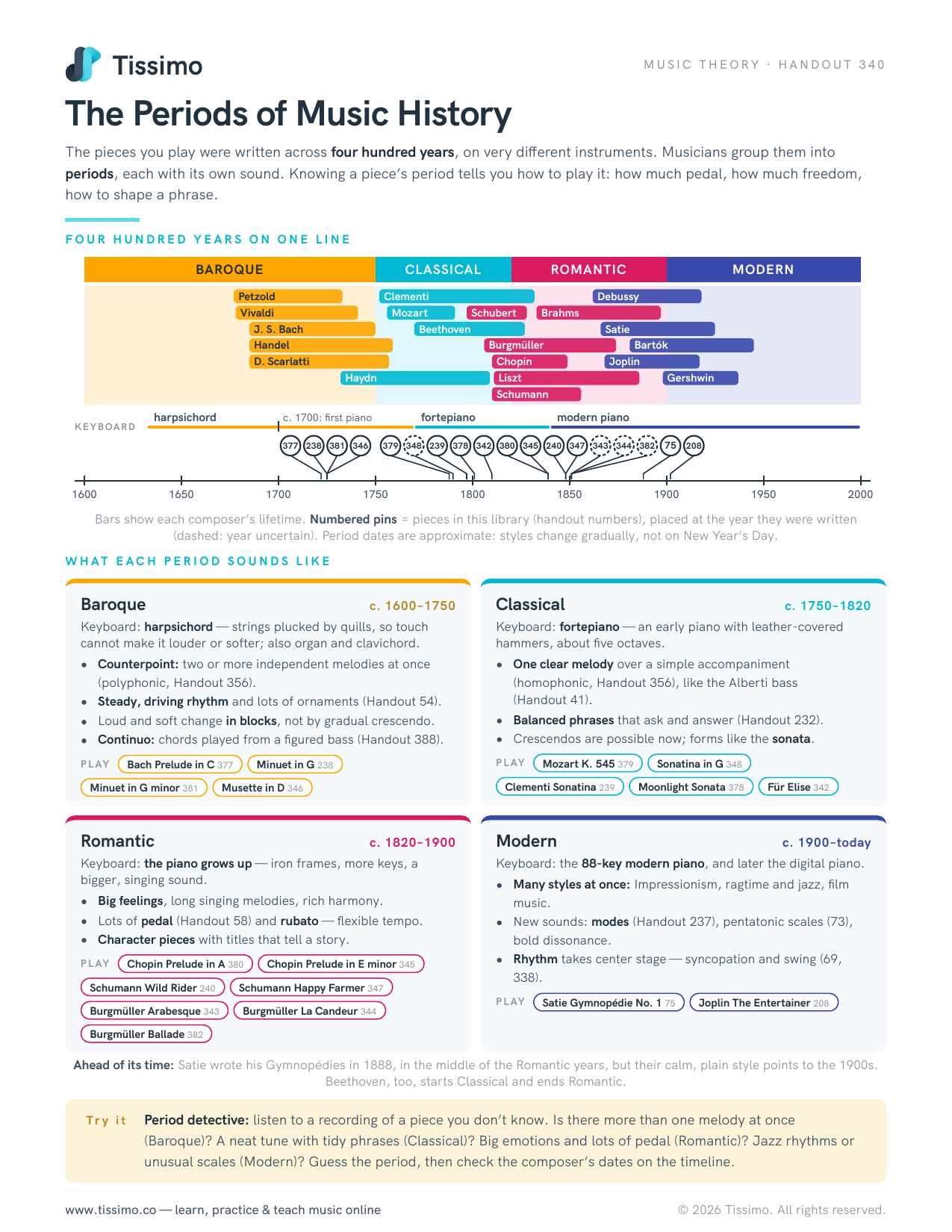
- Beginnings: opera grew out of experiments in Florence around 1600 by musicians and scholars who wanted to recreate the sung drama they believed the ancient Greeks had used. Monteverdi's L'Orfeo (1607) is the earliest opera still regularly performed.
- Baroque: opera seria (serious opera) on heroic and mythological subjects, built from recitatives and showpiece da capo arias. Handel wrote dozens in London.
- Classical: Mozart mastered opera buffa (comic opera) in The Marriage of Figaro and Don Giovanni, and the German Singspiel, with spoken dialogue, in The Magic Flute.
- 19th century: Italian bel canto opera (Rossini, Bellini, Donizetti) prized beautiful, agile singing; Verdi wrote powerful dramas such as Rigoletto, La traviata and Aida; Wagner created vast "music dramas," including the four-opera Ring cycle, tied together by recurring themes called leitmotifs; Bizet's Carmen became one of the most performed operas of all.
- Around 1900 and later: Puccini's La bohème, Tosca and Madama Butterfly; then new directions with Berg's Wozzeck, Gershwin's Porgy and Bess and Britten's Peter Grimes. Composers continue to write new operas.
Opera, operetta and musicals
Operetta is lighter, usually comic, and mixes songs with spoken dialogue; Johann Strauss II's Die Fledermaus and Gilbert and Sullivan's comic operas are classics. Musical theater grew partly out of operetta and usually uses popular song styles and more spoken dialogue. The borders are blurry, and some works are performed by both opera companies and theater companies.
Voices in opera
Roles are written for particular soprano, mezzo-soprano, tenor, baritone and bass voices. Operatic singers are trained to project over an orchestra without amplification.
Common questions
What was the first opera?
Jacopo Peri's Dafne (about 1598) is usually called the first, but its music is mostly lost. Monteverdi's L'Orfeo (1607) is the earliest opera still regularly performed.
What is the difference between an opera and a musical?
Operas are usually sung throughout by classically trained, unamplified voices. Musicals use popular song styles, more spoken dialogue and amplified voices. Operetta sits between the two.