Rhythm & Meter
Counting Rhythm
Counting rhythm means saying the beats and their parts out loud, such as 1 & 2 & or 1 e & a, while you read or play, so that every note and rest starts in exactly the right place.
Counting is the most reliable tool for reading rhythm. You speak a steady stream of numbers and syllables that marks each beat and its parts, and you place each note on the syllable where it starts. Because the counting never stops, rests and long notes get their full value, and tricky rhythms fall into place.
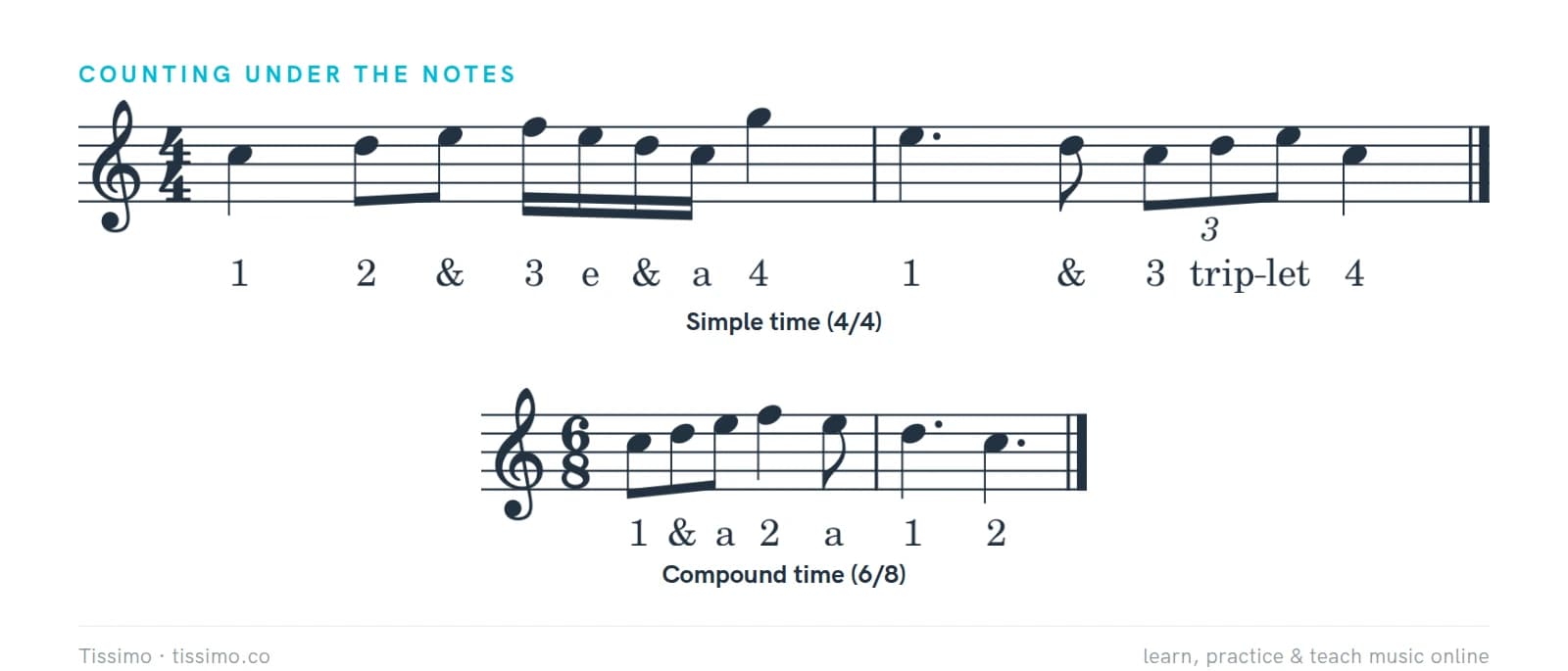
The standard counting system
In 2/4, 3/4 and 4/4:
- Beats get numbers: "1, 2, 3, 4".
- Halves of the beat (eighth notes) get "&": "1 & 2 &".
- Quarters of the beat (sixteenth notes) get "e" and "a": "1 e & a", said "one-ee-and-uh".
- Thirds of the beat (triplets) get "trip-let": "1-trip-let". Some teachers use "1 & a" or "1-la-li" instead.
In compound meters such as 6/8 there are two common habits. You can count the beats and their thirds, "1 & a 2 & a", or count every eighth note, "1 2 3 4 5 6", with the beats on 1 and 4.
How to count a rhythm
- Find the time signature and decide which note gets the beat.
- Write the count under each note, where it starts. Put a rest's count in parentheses, like (3), and give no count to a note that a tie runs into.
- Say the full count steadily, every syllable, and clap or play only on the written ones.
- Start slowly, with a metronome if you like, and keep counting through rests and held notes.
The Write the Counts worksheets practice exactly these steps: quarter and eighth notes in Write the Counts, sixteenths in Write the Counts 2, triplets and ties in Write the Counts 3, and compound time in Write the Counts 4.
Other counting systems
Many teachers use rhythm syllables instead of numbers. Kodály-based teaching uses syllables such as "ta" for a quarter note and "ti-ti" for two eighth notes. Another system, Takadimi, gives each position in the beat its own syllable, such as "ta ka di mi" for four sixteenth notes. These systems describe the sound of a rhythm rather than its place in the bar, and many musicians use them alongside counting.
Common counting mistakes
- Stopping the count during a rest.
- Cutting long notes short because nothing seems to be happening.
- Speeding up in easy passages and slowing down in hard ones.
Counting aloud at a steady tempo cures all three. See also subdivision, the skill of feeling these smaller counts inside each beat.
Common questions
What do e and a mean when counting rhythm?
They mark the sixteenth notes between the beat and its &. Each beat is counted "1 e & a": the number on the beat, "&" halfway through, and "e" and "a" a quarter and three-quarters of the way through.
Should I count out loud?
Yes, especially when you are learning a new piece. Counting aloud makes it obvious when you skip a rest or rush a long note. Once the rhythm is secure, you can count silently.
Practice it: free worksheets
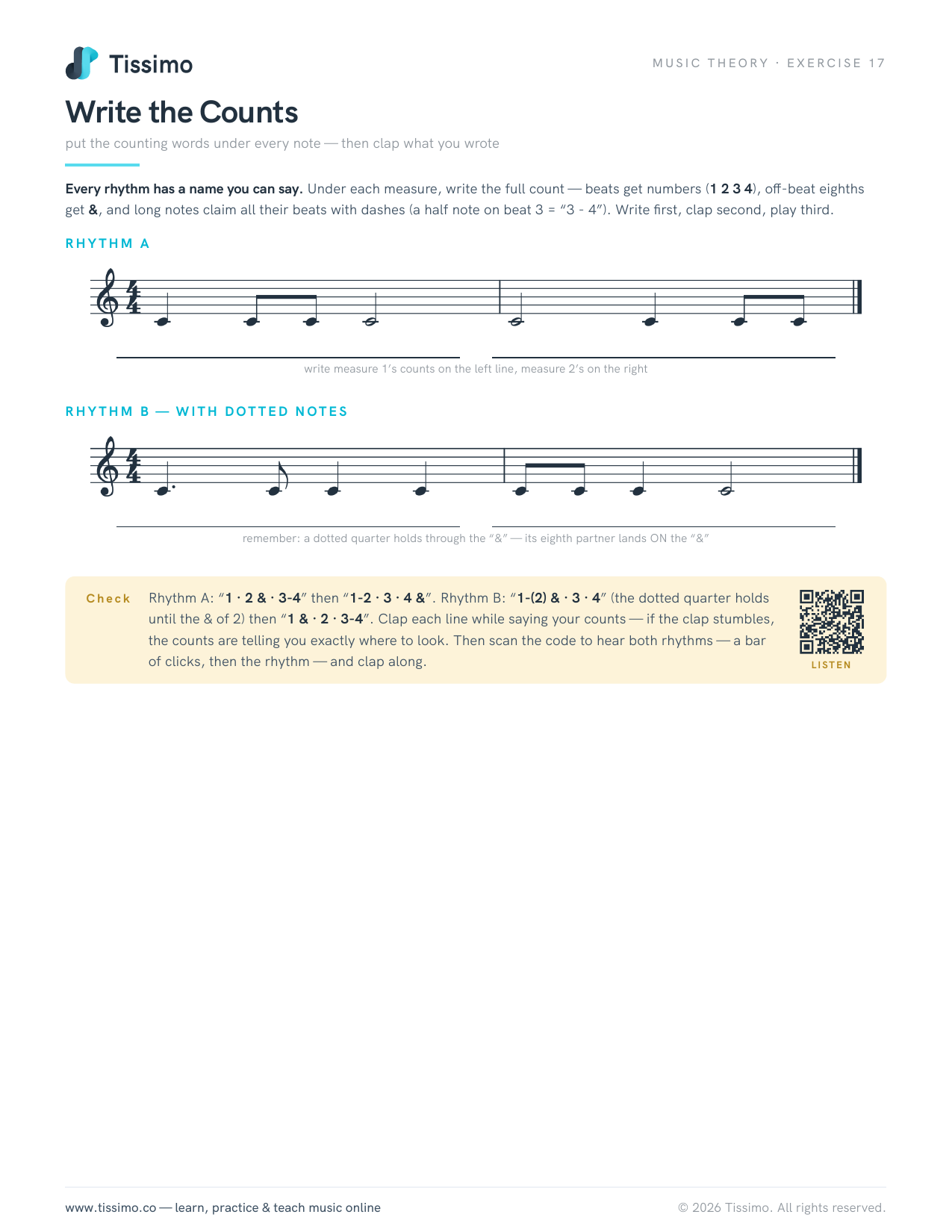 Write the Countsput the counting words under every note — then clap what you wrote
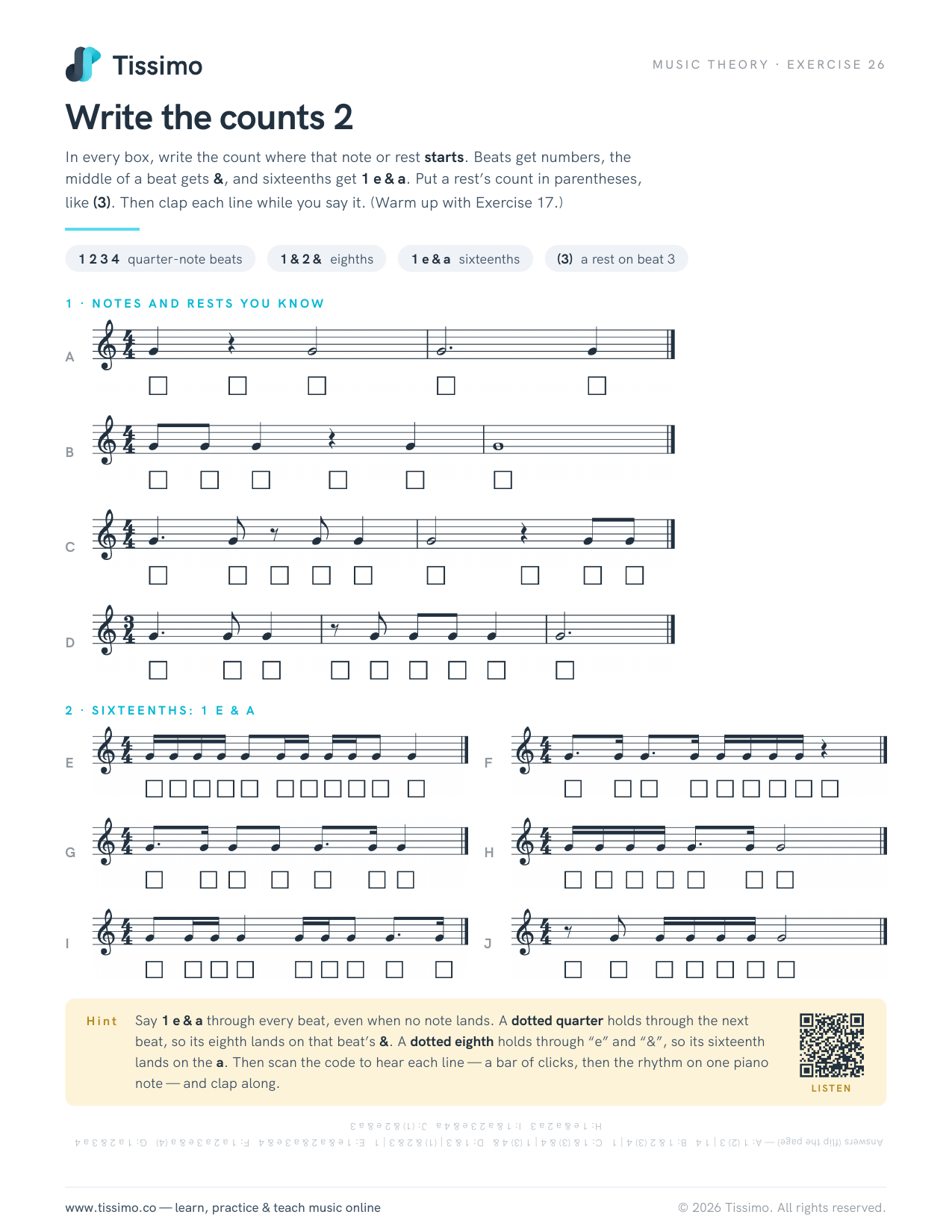 Write the counts 2In every box, write the count where that note or rest starts. Beats get numbers, the middle of a beat gets &, and sixteenths get 1 e & a. Put a rest’s count in parentheses, like (3). Then clap each line while you say it. (Warm up with Exercise 17.)
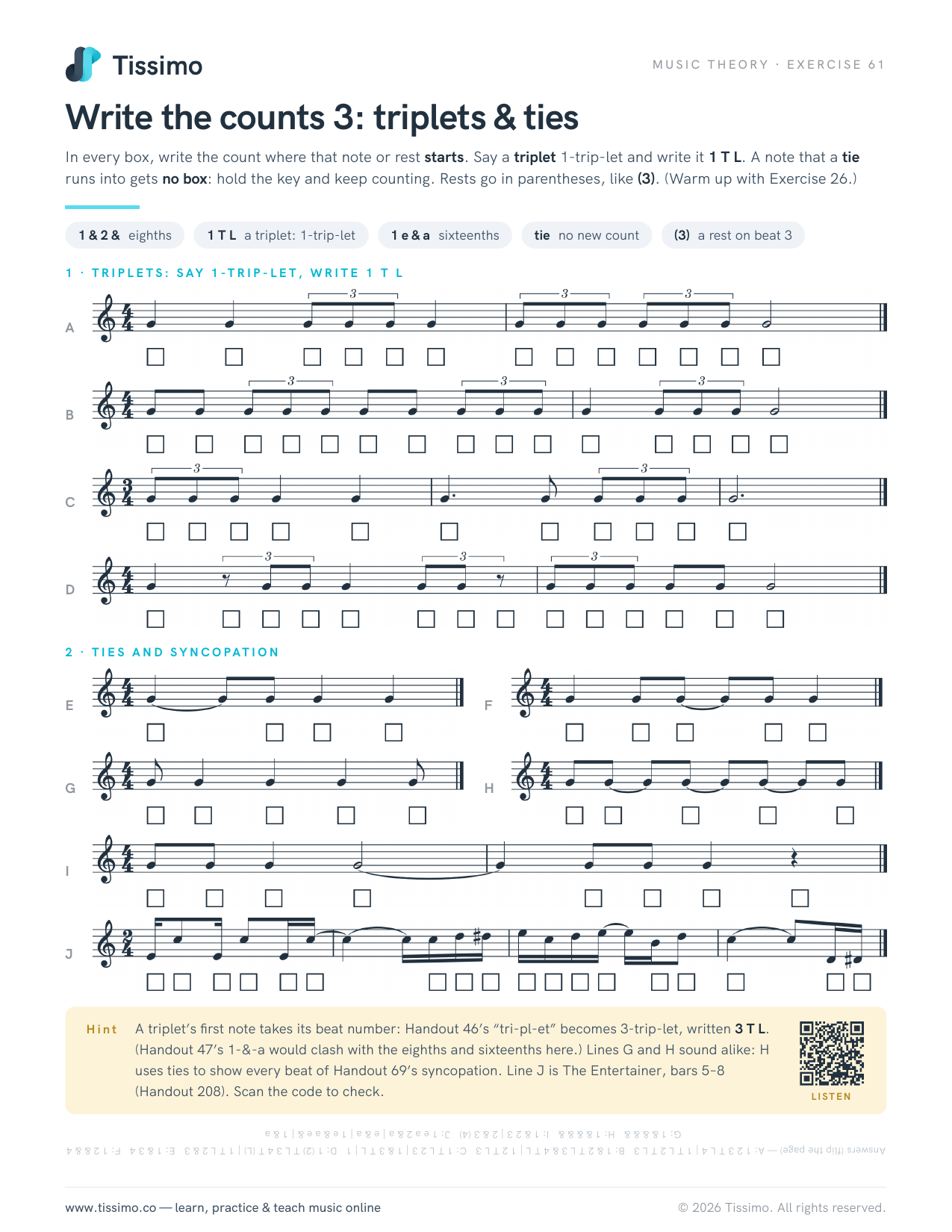 Write the counts 3: triplets & tiesIn every box, write the count where that note or rest starts. Say a triplet 1-trip-let and write it 1 T L. A note that a tie runs into gets no box: hold the key and keep counting. Rests go in parentheses, like (3). (Warm up with Exercise 26.)
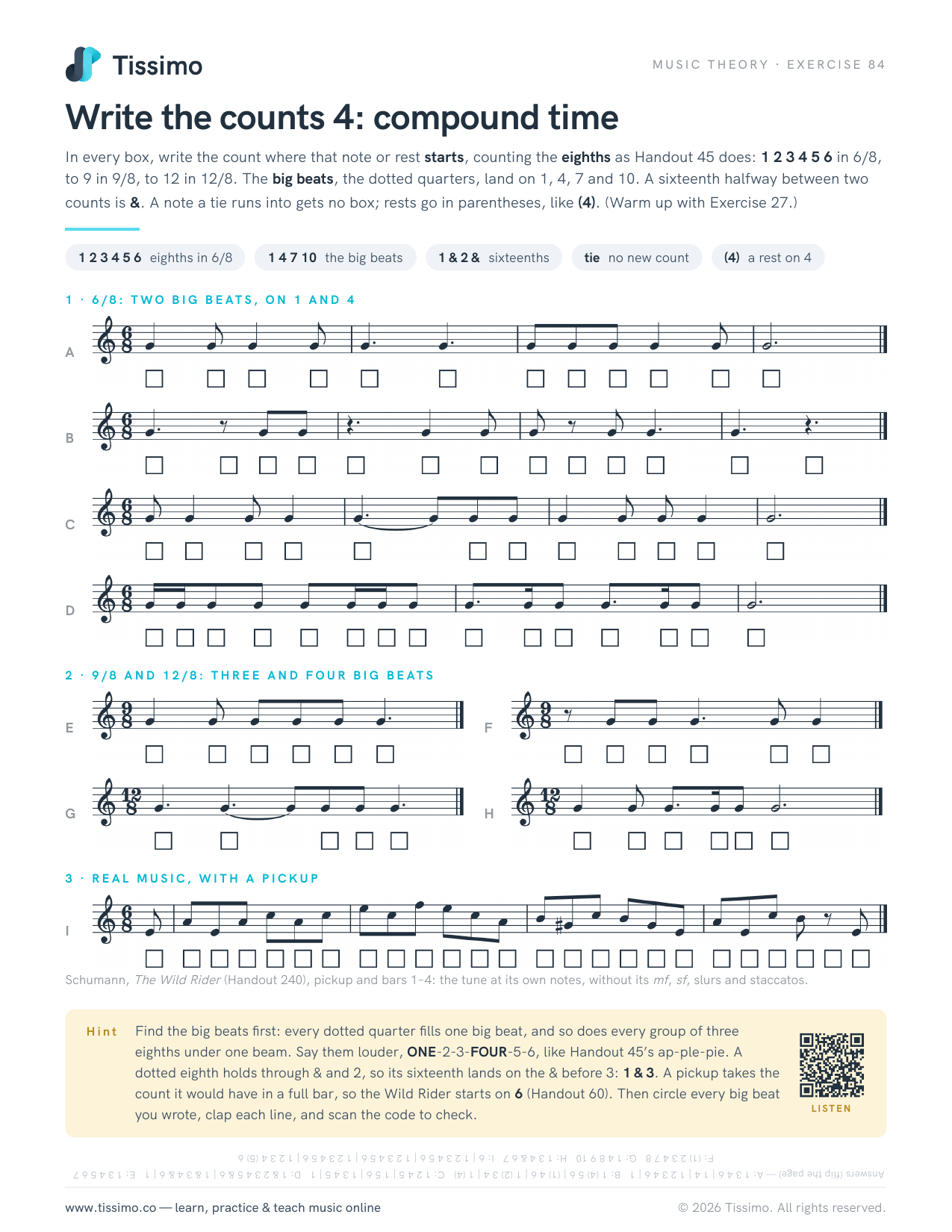 Write the counts 4: compound timeIn every box, write the count where that note or rest starts, counting the eighths as Handout 45 does: 1 2 3 4 5 6 in 6/8, to 9 in 9/8, to 12 in 12/8. The big beats, the dotted quarters, land on 1, 4, 7 and 10. A sixteenth halfway between two counts is &. A note a tie runs into gets no box; rests go in parentheses, like (4). (Warm up with Exercise 27.)
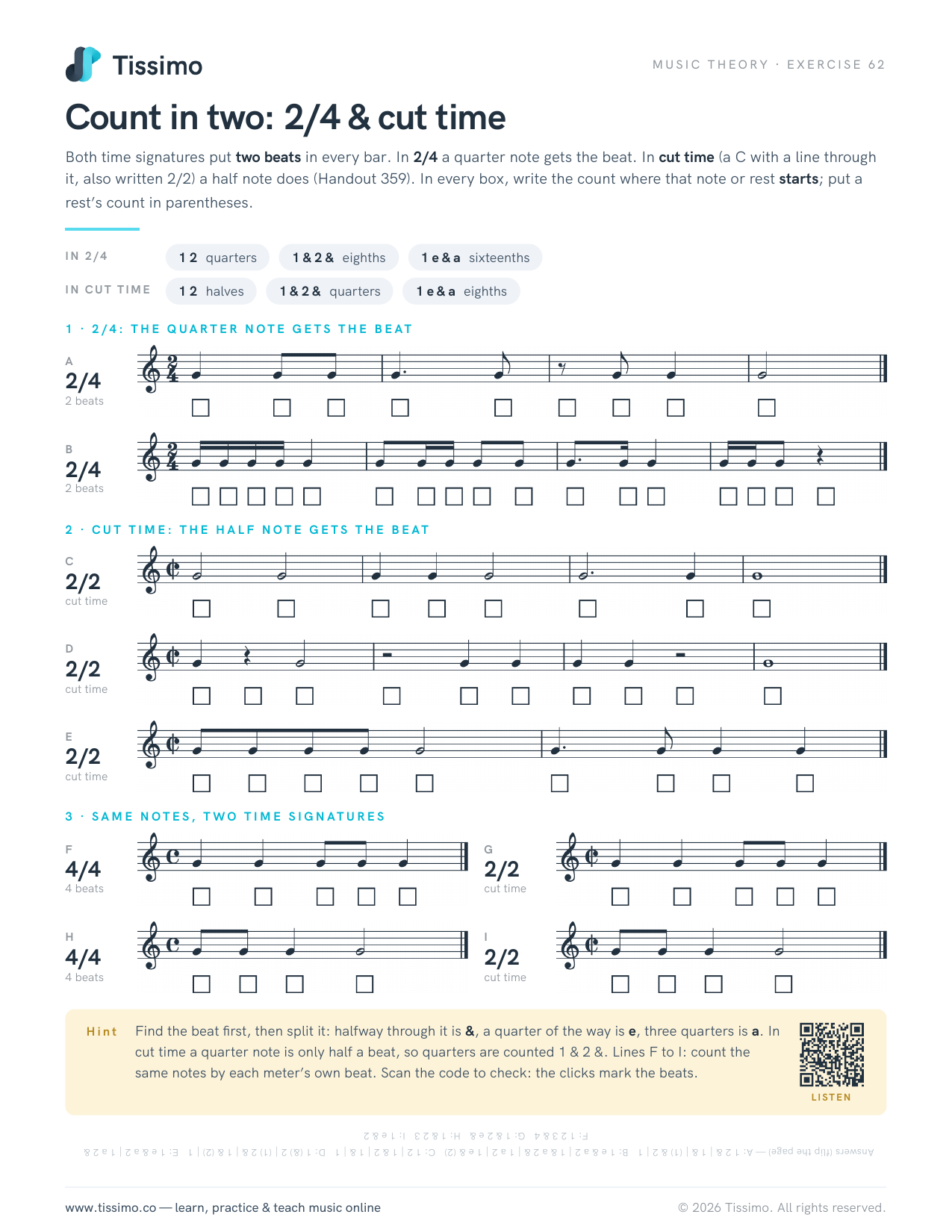 Count in two: 2/4 & cut timeBoth time signatures put two beats in every bar. In 2/4 a quarter note gets the beat. In cut time (a C with a line through it, also written 2/2) a half note does (Handout 359). In every box, write the count where that note or rest starts; put a rest’s count in parentheses.