Instruments & Voices
Saxophone
The saxophone is a single-reed woodwind with a conical brass body. Its main sizes, soprano, alto, tenor and baritone, all read treble clef with the same fingerings and transpose by different intervals.
The saxophone combines a clarinet-style mouthpiece and single reed with a wide, conical metal body. It was invented by the Belgian instrument maker Adolphe Sax in the 1840s, and it is a woodwind despite being made of brass, because its sound starts at a reed. Its voice can be smooth and mellow or loud and raw, which has made it a star of jazz, R&B, rock, pop, funk and concert band music.
How a saxophone makes its sound
The reed, held to the mouthpiece by a ligature, vibrates against the mouthpiece and sets the air in the body vibrating. Large keys with padded cups cover the tone holes. Because the body is conical, the saxophone overblows to the octave (like the oboe and flute, unlike the clarinet), and an octave key moves you into the upper register with almost the same fingerings. That makes the saxophone one of the quicker woodwinds to get started on.
The saxophone family
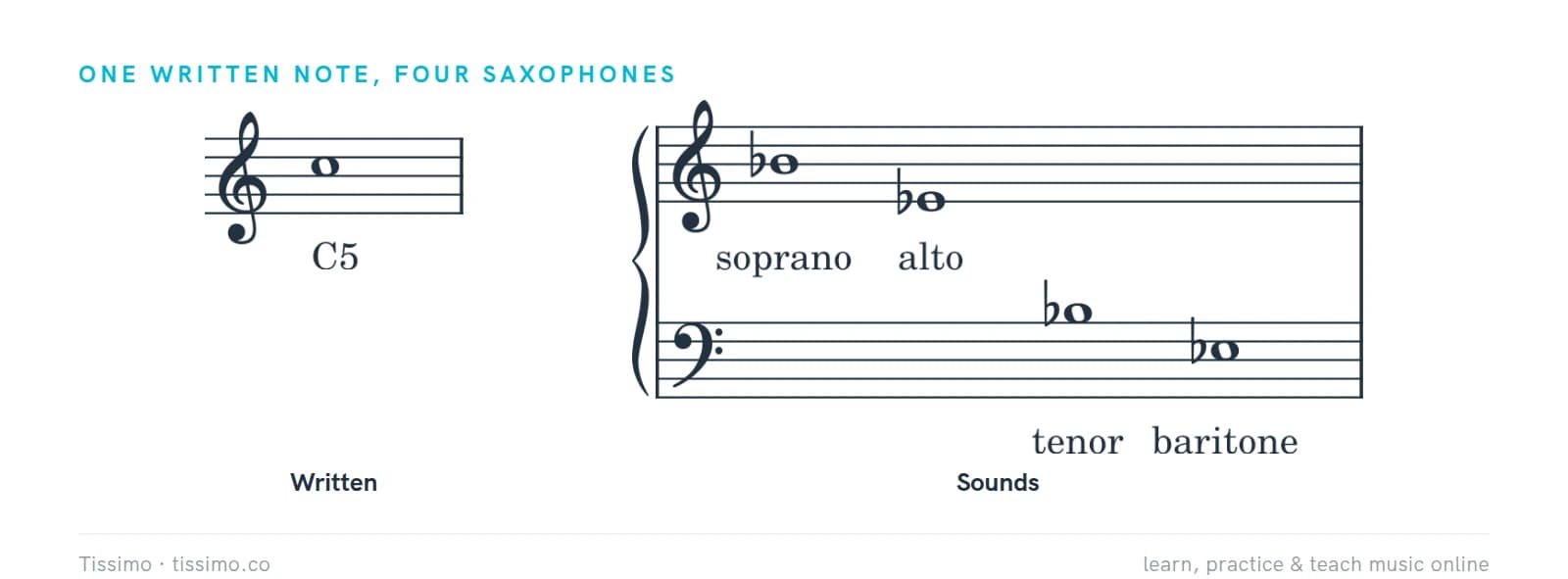
- Soprano in B♭: often straight, like a clarinet; sounds a major second lower than written.
- Alto in E♭: the usual first saxophone; sounds a major sixth lower than written.
- Tenor in B♭: the classic jazz tenor sound; sounds a major ninth lower (an octave plus a major second).
- Baritone in E♭: the big bottom of the section; sounds an octave plus a major sixth lower.
Every saxophone reads treble clef and uses the same fingerings, so a written note is played the same way on all of them. That is why they are written as transposing instruments: switching between sizes needs no new fingerings, only a different sound.
Range
Most saxophones have a basic written range of B♭3 to F6 or F♯6. Many baritone saxophones extend down to written A3, sounding C2. Advanced players extend it upward into the altissimo register with special fingerings. On the alto, the written range sounds from D♭3 to about A5; on the tenor, from A♭2 to about E5.
Its role
A big band usually has a five-piece saxophone section (two altos, two tenors and a baritone). Saxophones also lead small jazz groups, play solos and horn-section lines in pop and soul, and form saxophone quartets (soprano, alto, tenor, baritone). Concert bands use the whole family, and composers have written a growing classical repertoire for it.
Tips for beginners
- The alto is the usual starting size: it is comfortable to hold and its fingerings carry over to every other saxophone.
- Start with a softer reed (often strength 2 or 2½) and move up as your air support grows.
- Rest your top teeth on the mouthpiece and cushion the reed with your bottom lip; don't bite.
- Use a neck strap adjusted so the mouthpiece comes straight to your mouth without bending your head.
Common questions
Is the saxophone a woodwind or a brass instrument?
A woodwind. It is made of brass, but its sound comes from a vibrating reed, like a clarinet's. Brass instruments make their sound with the player's buzzing lips in a cup-shaped mouthpiece.
What key is an alto saxophone in?
E♭. A written C on the alto sounds as the E♭ a major sixth below. The tenor and soprano are in B♭ and the baritone is in E♭, an octave below the alto.
Which saxophone should a beginner start on?
Usually the alto. It is a manageable size, responds easily and uses the same fingerings as every other saxophone, so switching to tenor or baritone later is straightforward.
Practice it: free worksheets
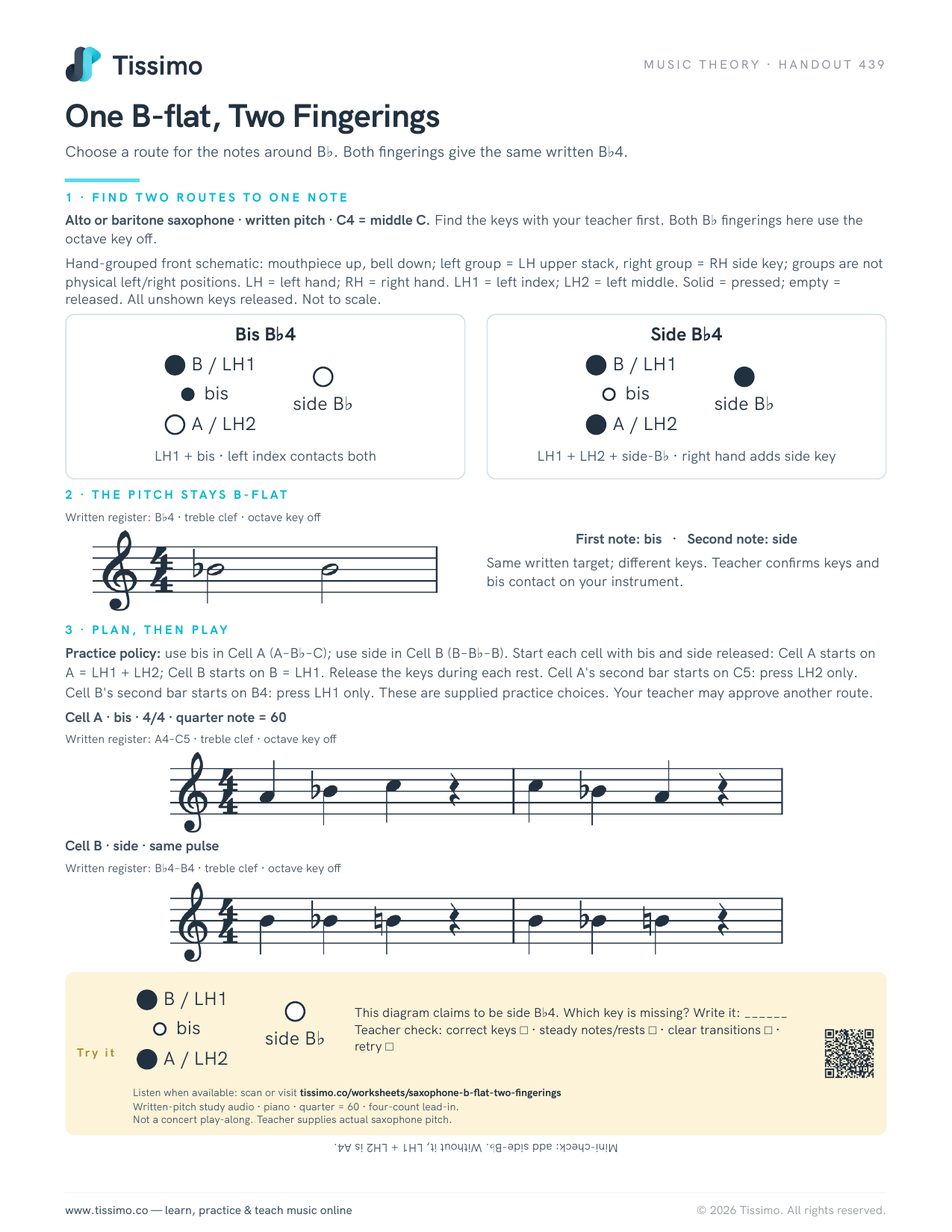 One B-flat, Two FingeringsChoose a route for the notes around B♭. Both fingerings give the same written B♭4.
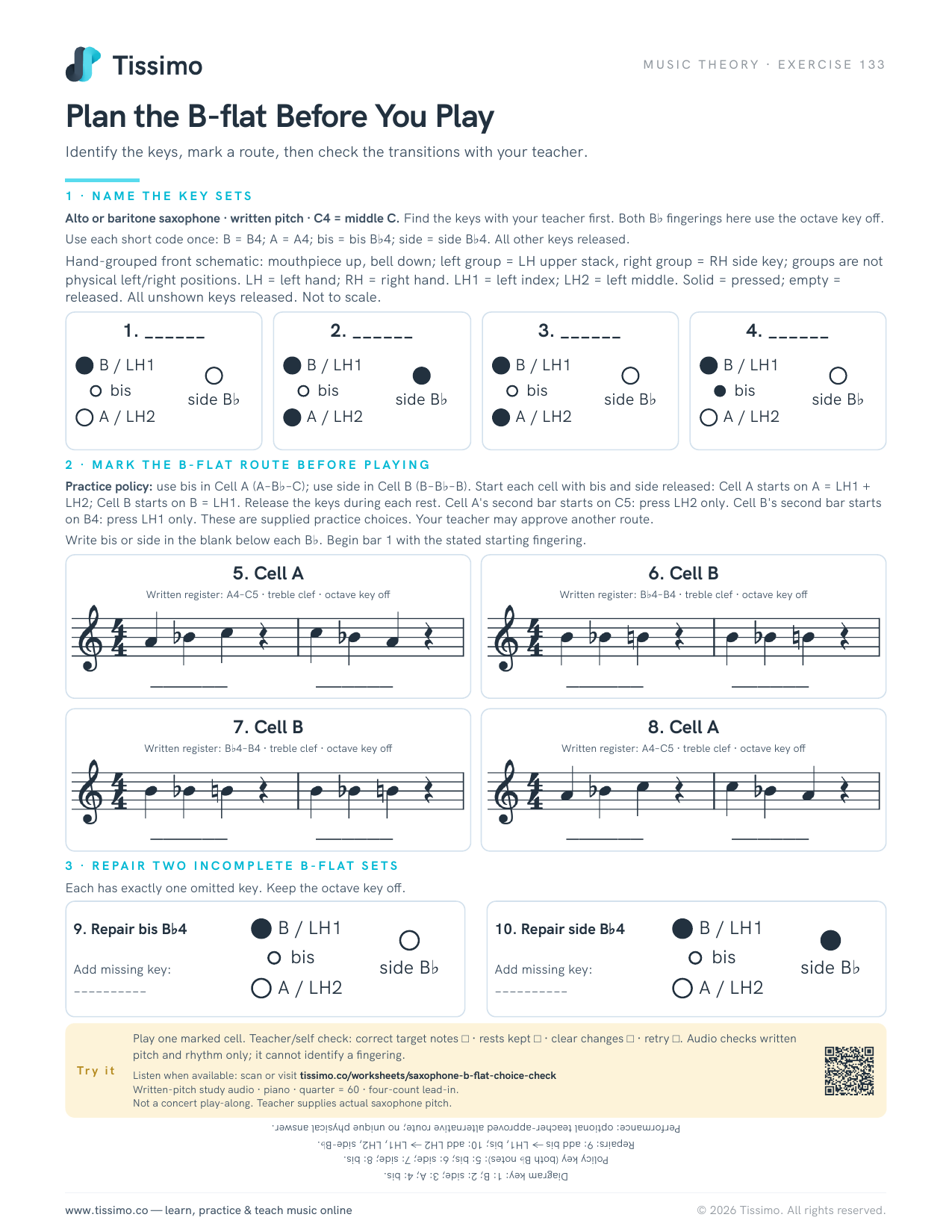 Plan the B-flat Before You PlayIdentify the keys, mark a route, then check the transitions with your teacher.
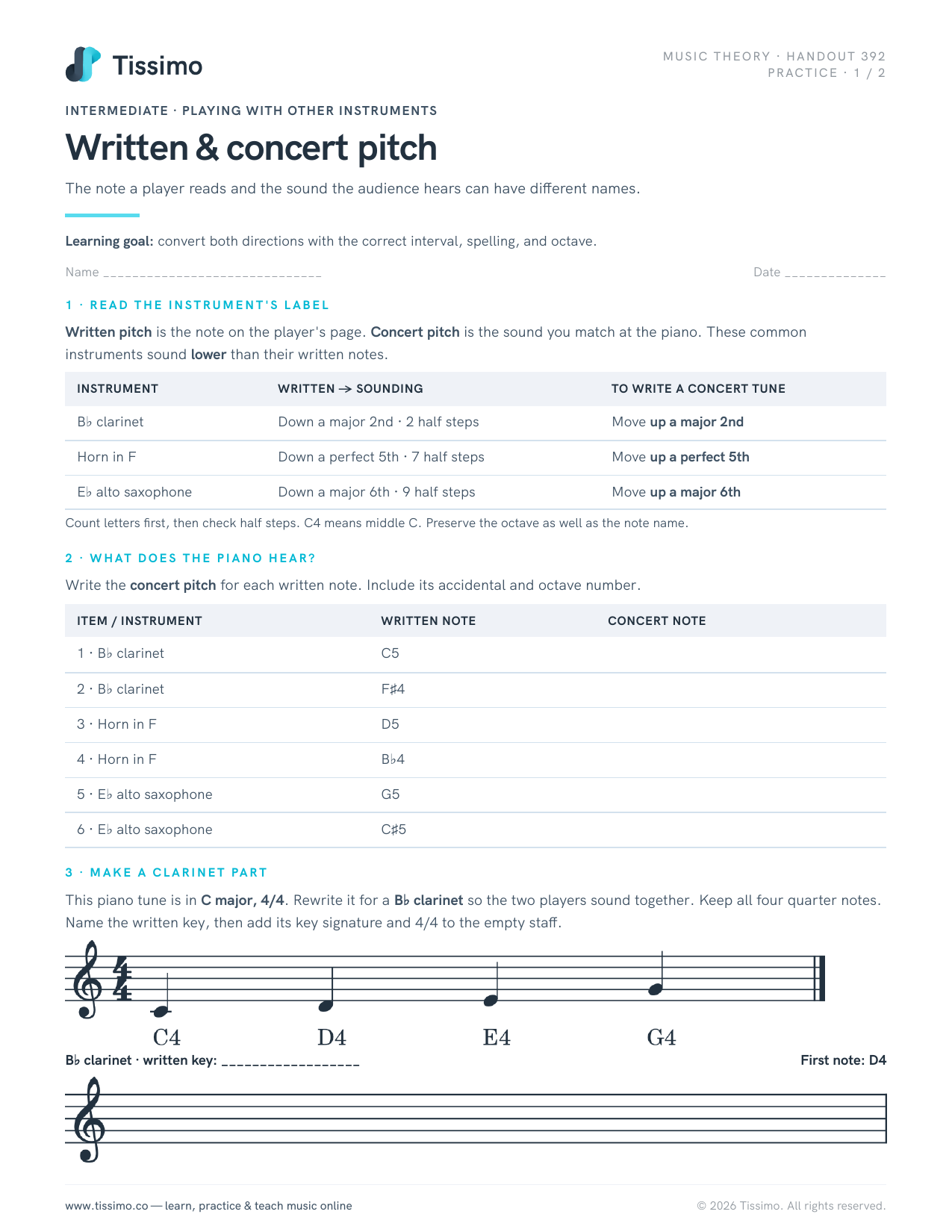 Written & concert pitchThe note a player reads and the sound the audience hears can have different names.
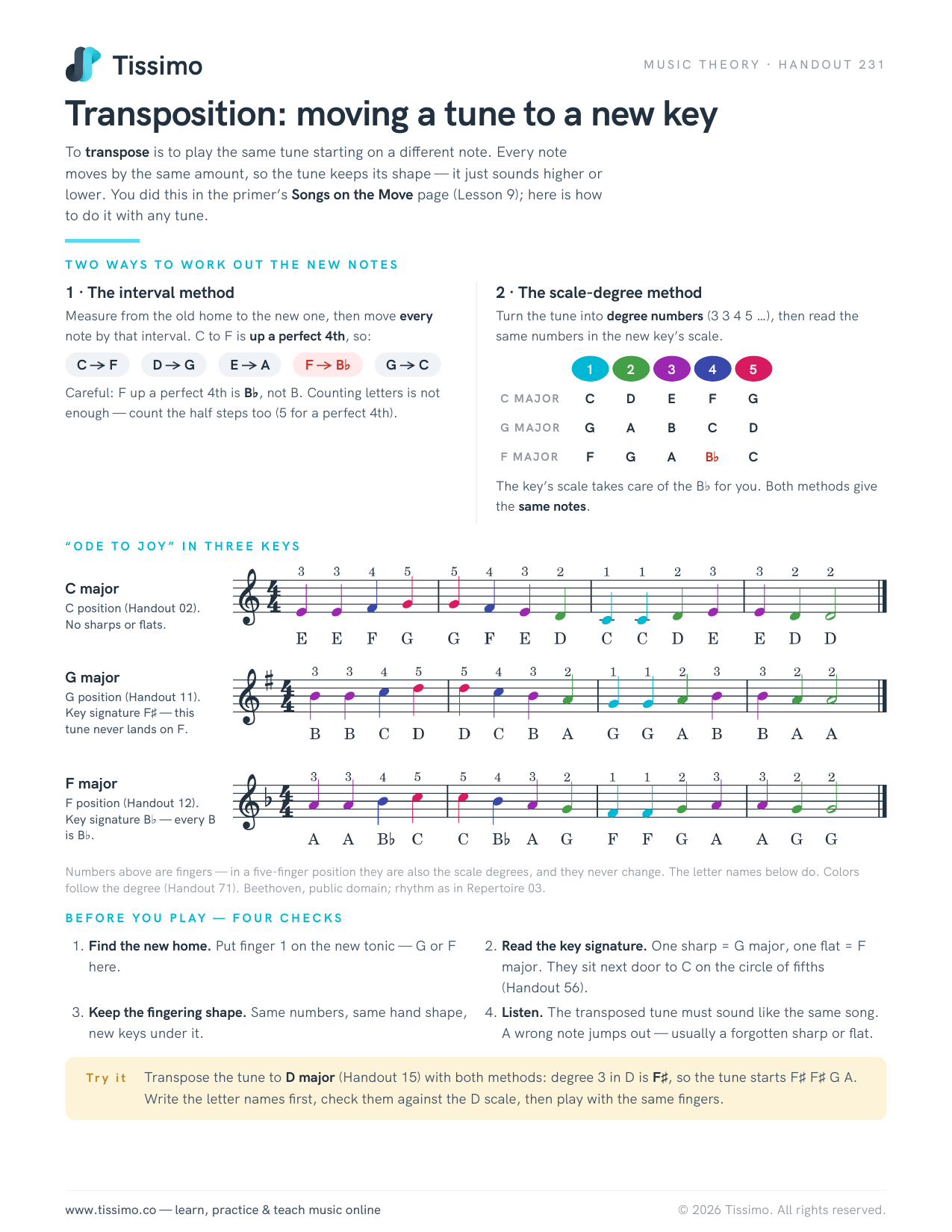 Transposition: moving a tune to a new keyTo transpose is to play the same tune starting on a different note. Every note moves by the same amount, so the tune keeps its shape — it just sounds higher or lower. Here is how to do it with any tune.
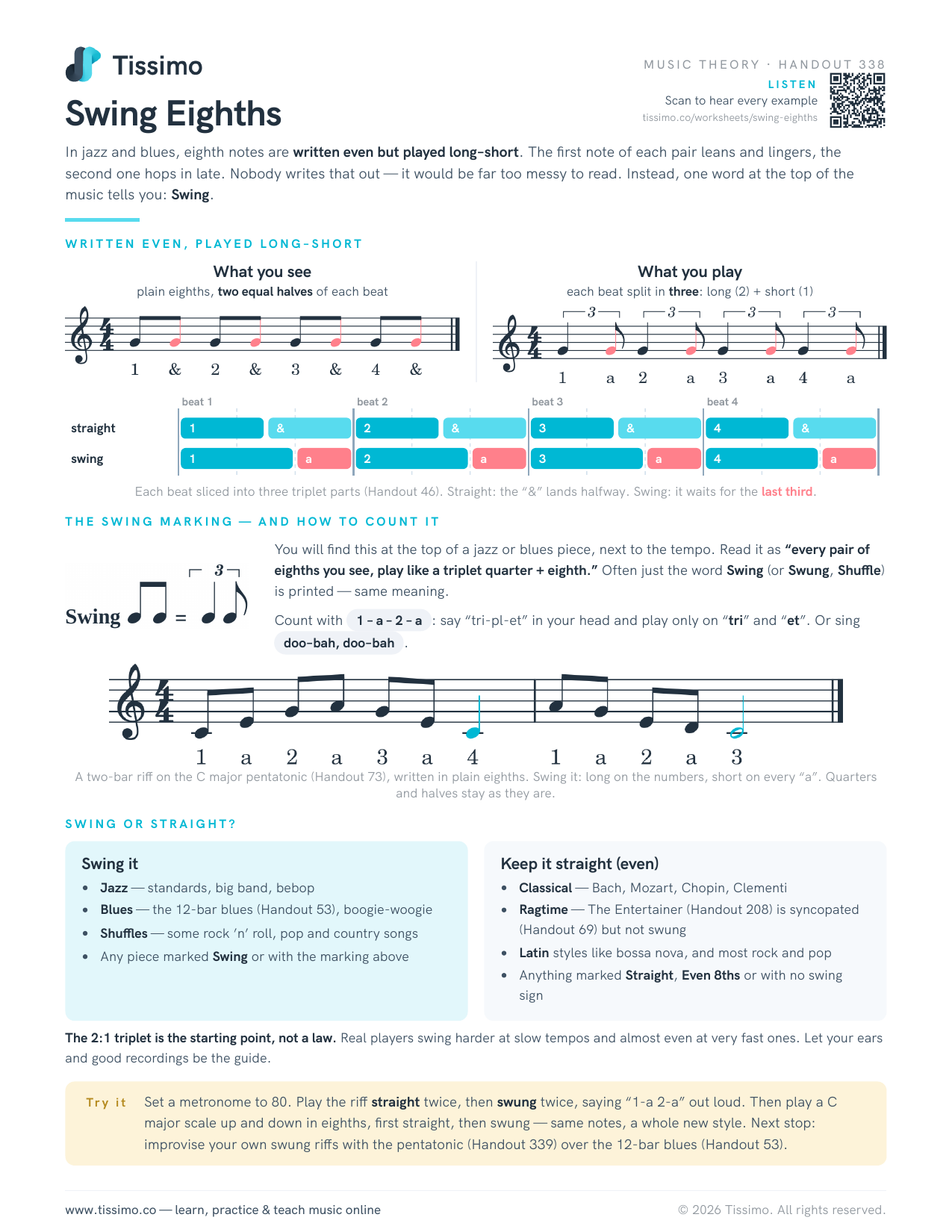 Swing EighthsIn jazz and blues, eighth notes are written even but played long–short. The first note of each pair leans and lingers, the second one hops in late. Nobody writes that out — it would be far too messy to read. Instead, one word at the top of the music tells you: Swing.