Melody, Texture & Counterpoint
Riff
A riff is a short, catchy musical figure, usually one or two bars long, repeated over and over as the backbone of a song. It is a defining feature of rock, blues, funk and jazz.
A riff is a short, catchy figure, usually one or two bars long, that repeats again and again and holds a song together. Riffs are the signature of rock, blues, funk and metal, and they have a long history in jazz. Often a riff is the first thing you hear in a song, and the part everyone wants to learn when they pick up a guitar or a bass.

What makes a riff
- It is short, so it can loop.
- Its rhythm is strong. Rests, syncopations and accents matter as much as the pitches.
- It uses few notes, very often from the minor pentatonic or blues scale, circling around the tonic. Many guitar riffs sit in E or A, where the low open strings can ring.
- It repeats, with small changes. The last time through, a riff often bends its ending to lead into the next section, as in bar 3 of the example.
Riff, ostinato, lick and hook
- An ostinato is the classical word for any persistently repeated pattern; a riff is a kind of ostinato.
- A lick is a short stock phrase used in a solo. Players collect licks as vocabulary, but a lick is not repeated as a song's backbone.
- A hook is whatever part of a song you remember most. A great riff is often the hook.
In the swing era, big bands built whole arrangements from riffs: short figures tossed between the horn sections behind a soloist.
Learning a riff
Learn the rhythm first: clap it or tap it until it feels natural, then add the notes. Practice it slowly with a metronome or a drum loop, and only speed up once it grooves. A riff that is rhythmically tight at a slow tempo sounds better than a fast, ragged one. For the scales most riffs come from, see The Pentatonic & Blues Scales.
Common questions
What is the difference between a riff and a lick?
A riff is a repeated figure that forms the backbone of a song. A lick is a short stock phrase used in a solo or fill, often only once.
What is the difference between a riff and an ostinato?
Very little: both are repeated patterns. Ostinato is the classical term; riff is the usual word in rock, blues, jazz and pop.
Practice it: free worksheets
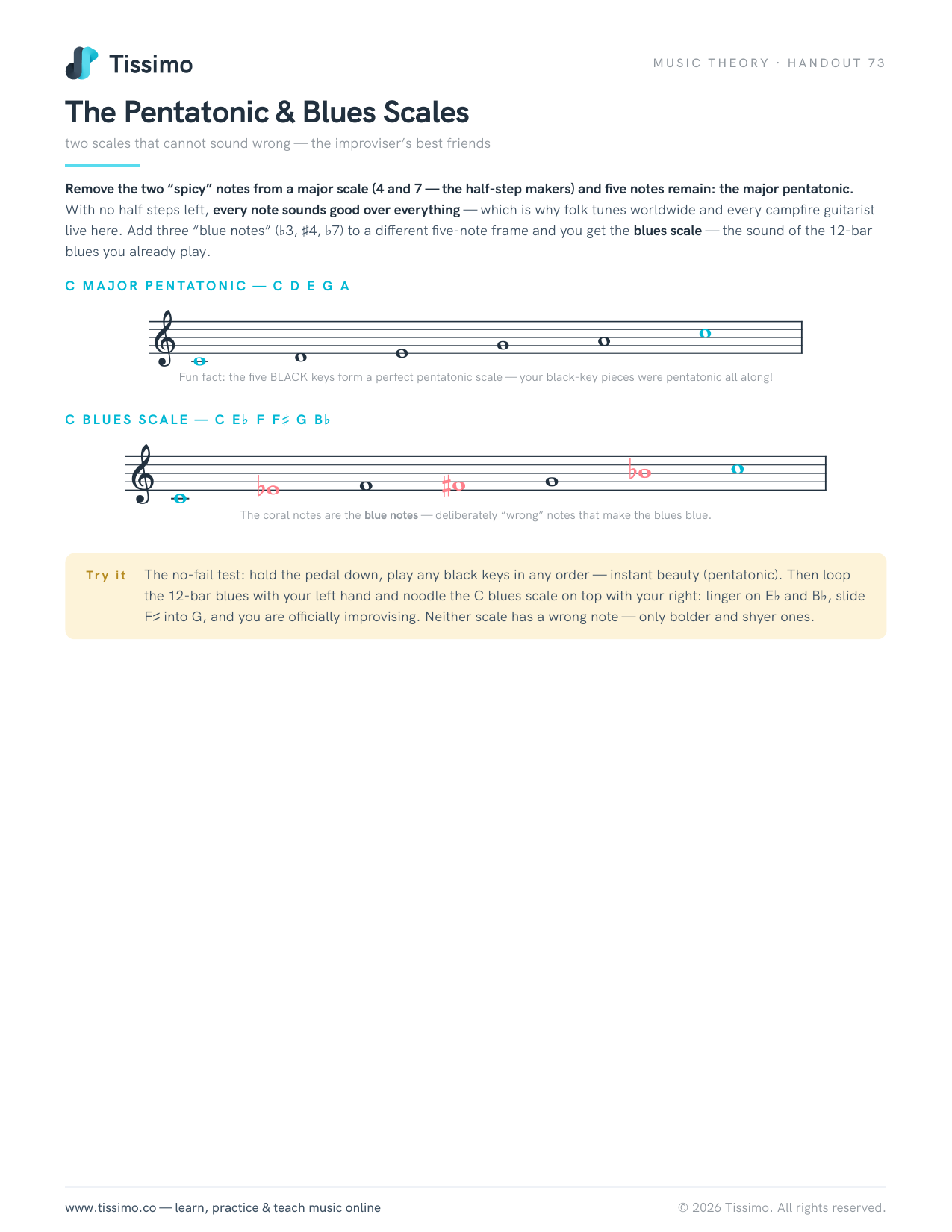 The Pentatonic & Blues Scalestwo scales that cannot sound wrong — the improviser’s best friends
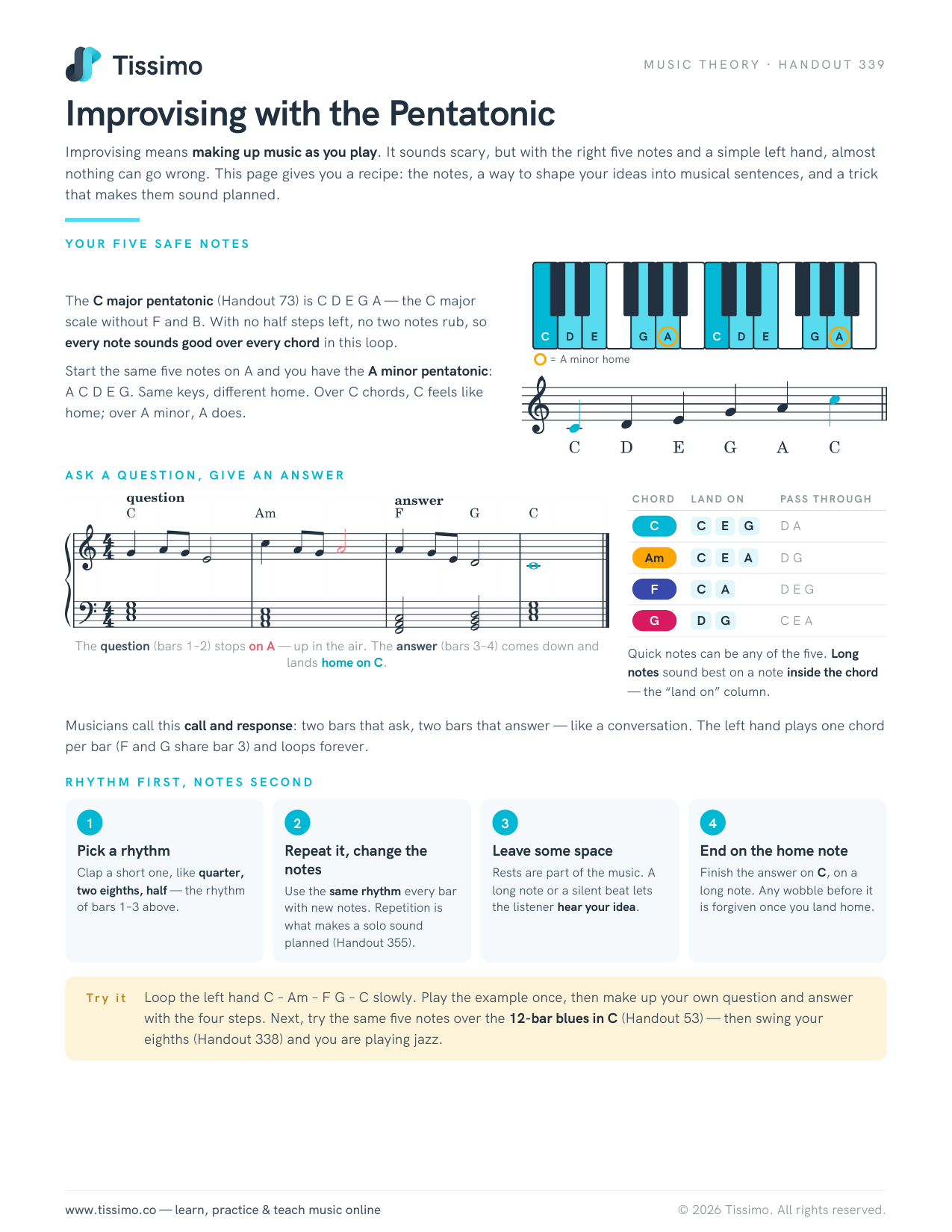 Improvising with the PentatonicImprovising means making up music as you play. It sounds scary, but with the right five notes and a simple left hand, almost nothing can go wrong. This page gives you a recipe: the notes, a way to shape your ideas into musical sentences, and a trick that makes them sound planned.
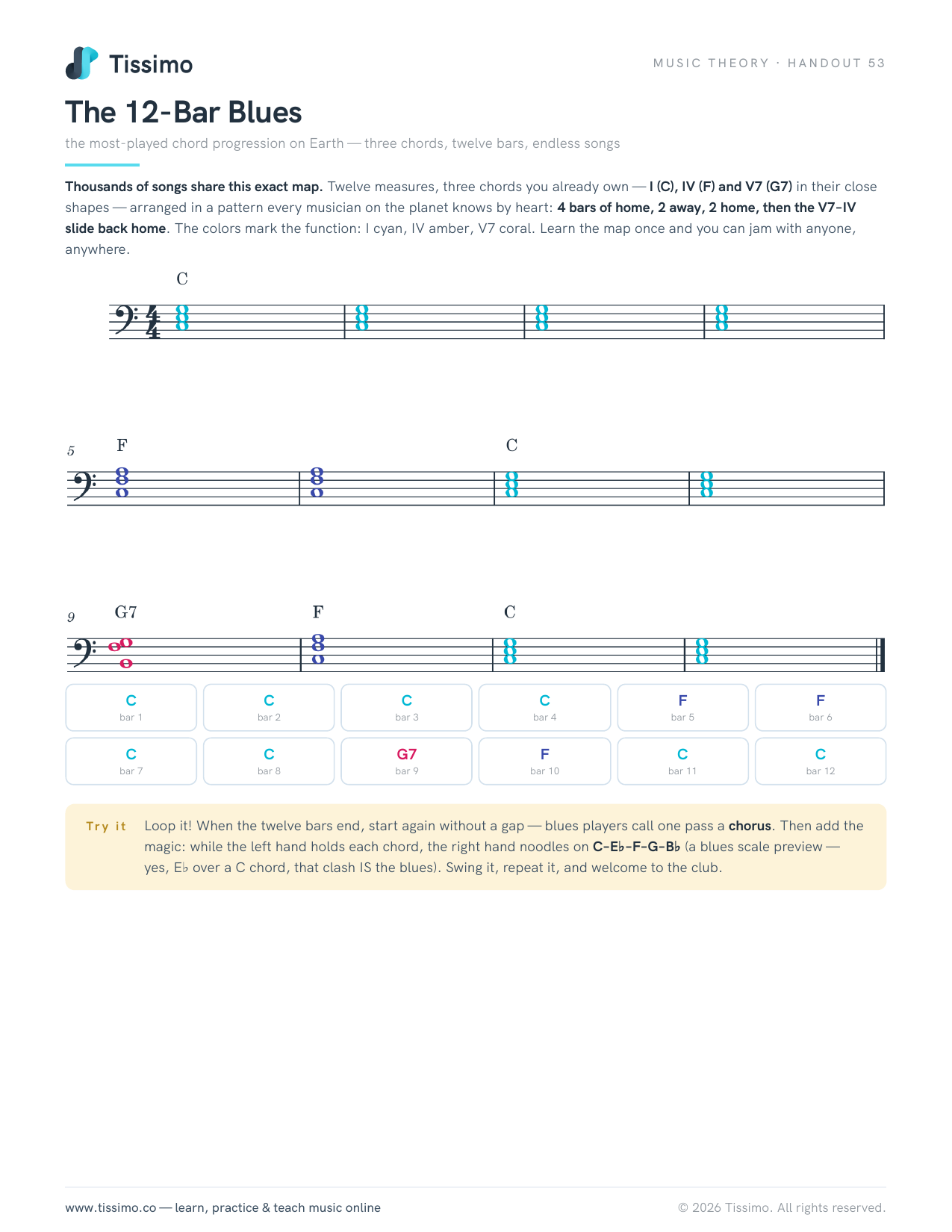 The 12-Bar Bluesone of the best-known chord progressions — three chords, twelve bars, endless songs