Scales, Keys & Modes
Mode
A mode is a type of scale defined by its pattern of whole and half steps around a home note. The seven church modes, from Ionian to Locrian, each start on a different note of the major scale.
A mode is a way of arranging the notes of a scale around a home note. In everyday theory the word usually means one of the seven church modes (also called diatonic modes). Each uses the same seven notes as a major scale but treats a different note as home, so each has its own pattern of whole and half steps and its own mood.
The white-key modes
The easiest way to meet them is on the white keys of the piano. Play from each white key up to the next key with the same letter name:
- C to C: Ionian, the major scale
- D to D: Dorian
- E to E: Phrygian
- F to F: Lydian
- G to G: Mixolydian
- A to A: Aeolian, the natural minor scale
- B to B: Locrian
All seven use the same white keys, yet they sound different, because the two half steps (E–F and B–C) fall in different places relative to the home note.
Comparing modes on one tonic
To hear what makes each mode distinctive, play them all from the same tonic. Each one turns out to be a major or minor scale with one or two notes changed: its characteristic note. The three modes with a major 3rd:
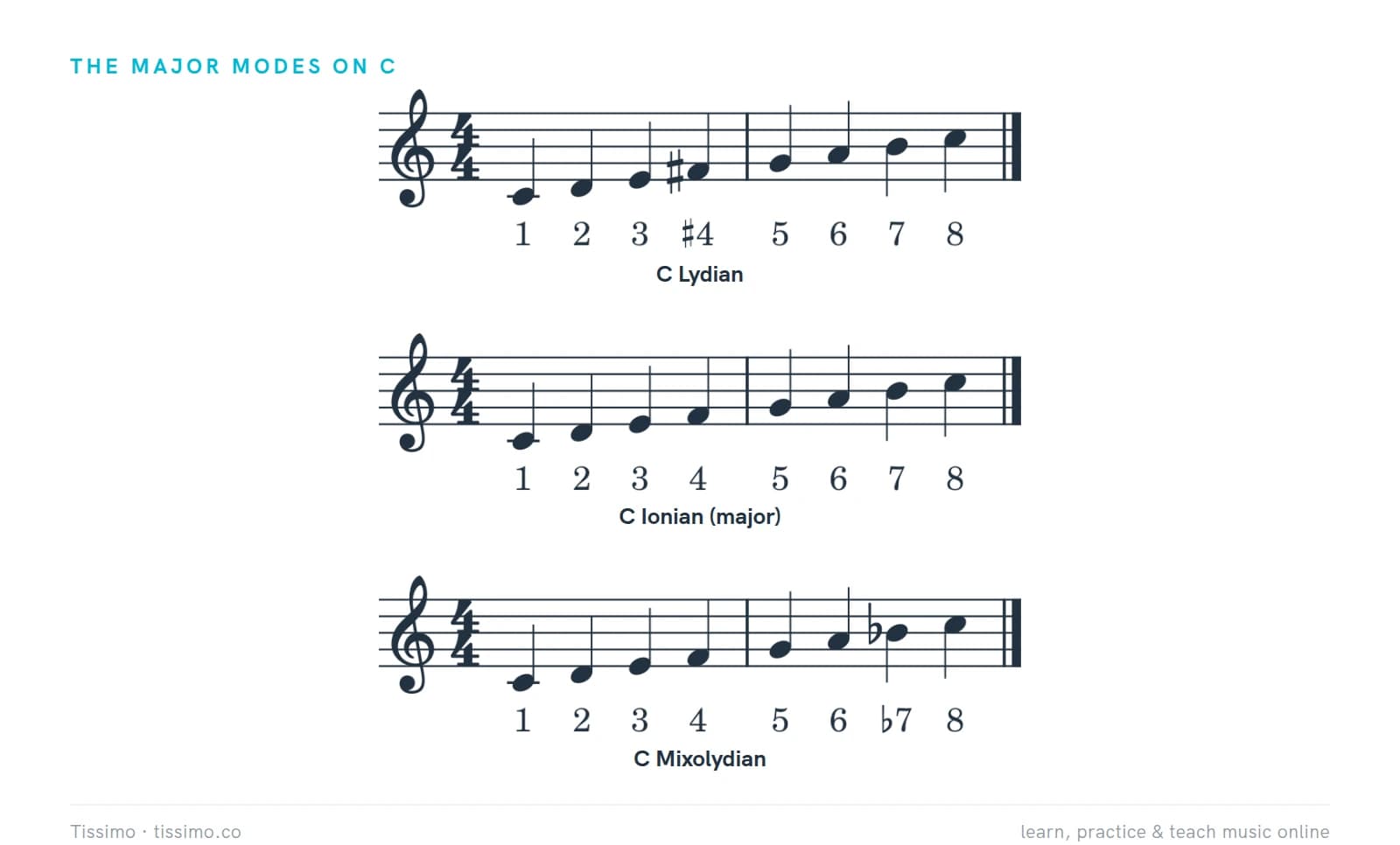
And the four with a minor 3rd:
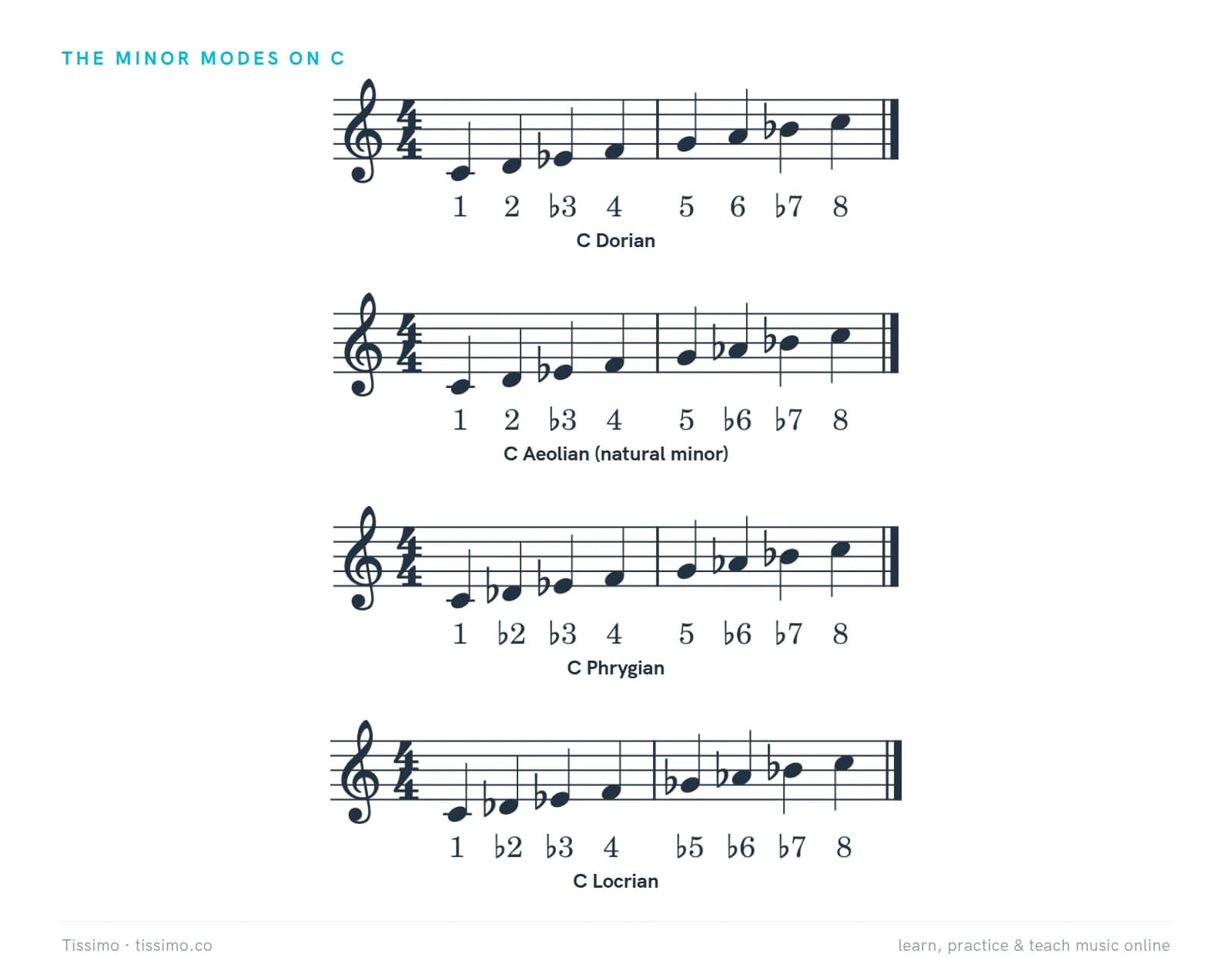
Arranged from brightest to darkest, the modes run: Lydian (major with a raised 4th), Ionian (major), Mixolydian (major with a lowered 7th), Dorian (minor with a raised 6th), Aeolian (natural minor), Phrygian (minor with a lowered 2nd) and Locrian (lowered 2nd and 5th). Each step along that list lowers exactly one note by a half step.
Where the names come from
The names are borrowed from ancient Greek, but the medieval church modes do not match what the Greeks meant by them. Medieval theorists described eight modes for chant, built on D, E, F and G. In 1547 the Swiss theorist Heinrich Glarean added modes on A and C, which he named Aeolian and Ionian. A mode on B, now called Locrian, was set aside as impractical, because its tonic has no perfect fifth above it.
Modes today
Modes faded from use as major and minor keys took over during the 1600s, then returned in the late 19th and 20th centuries: in classical music, in jazz (where players match a mode to each chord) and in folk, rock, pop and film music. When a musician says a song is "in Dorian", they mean its melody and chords center on a tonic but follow the Dorian pattern of steps.
The word also has a broader meaning. Musicians speak of the major mode and the minor mode, and other scales, such as melodic minor, have modes of their own.
The modes shows all seven on the white keys; Name the modes and Hear the Changed Degree: Modal Pairs train your eyes and ears.
Common questions
What are the seven modes in order?
Starting from C on the white keys: Ionian (C), Dorian (D), Phrygian (E), Lydian (F), Mixolydian (G), Aeolian (A) and Locrian (B). A popular memory aid is "I Don't Particularly Like Modes A Lot".
What is the difference between a mode and a scale?
A mode is a kind of scale. The word stresses which note is home: D Dorian and C major use the same seven notes, but they are different modes because they center on different tonics.
Practice it: free worksheets
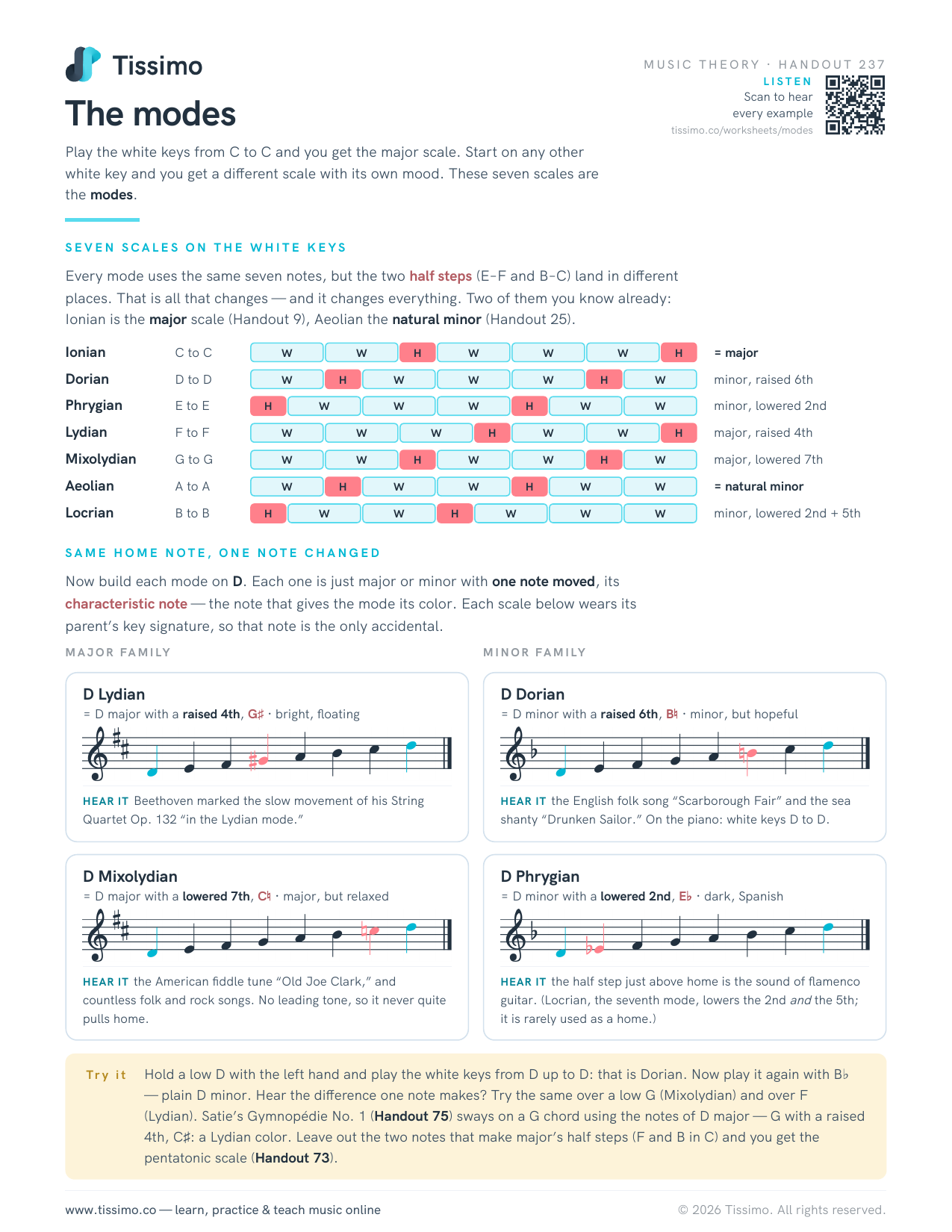 The modesPlay the white keys from C to C and you get the major scale. Start on any other white key and you get a different scale with its own mood. These seven scales are the modes.
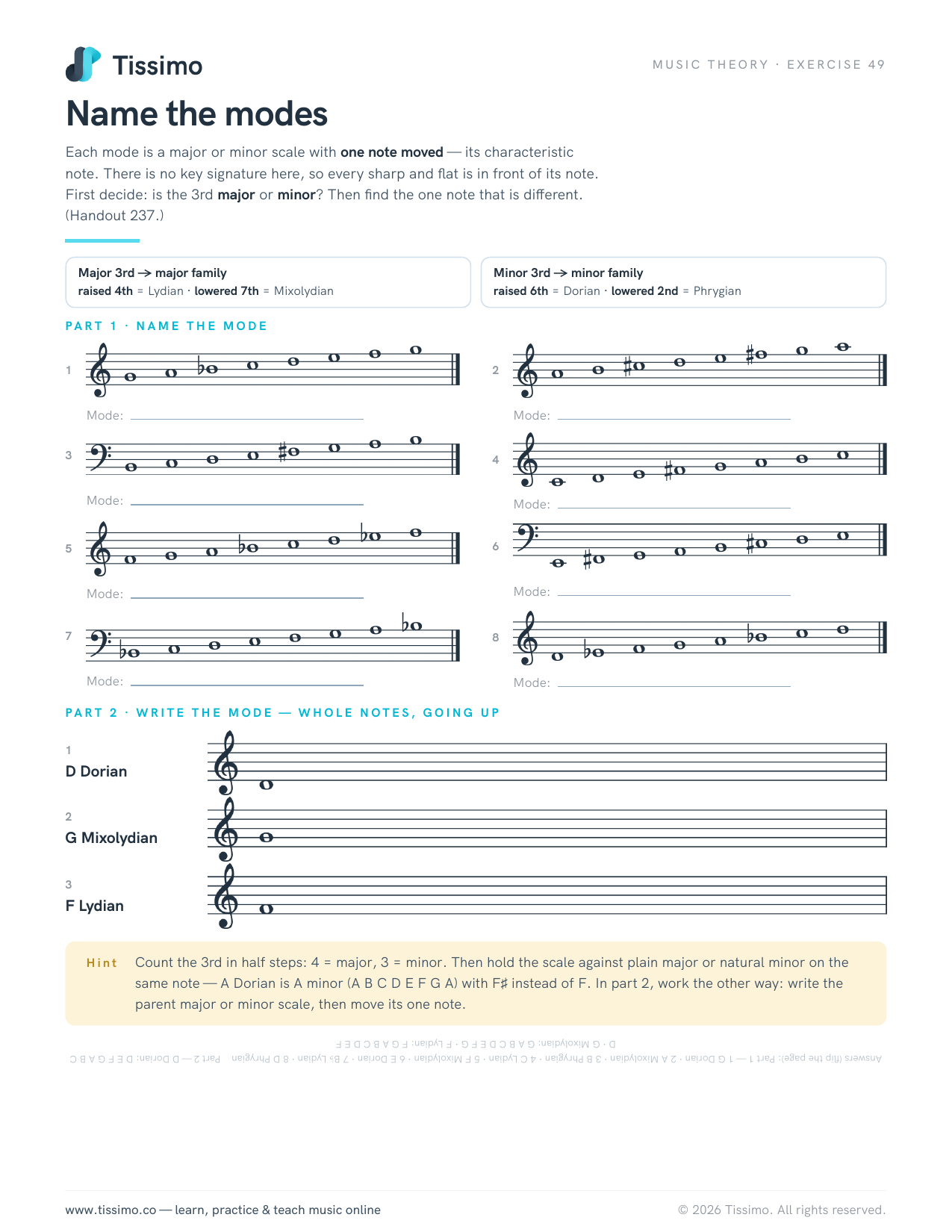 Name the modesEach mode is a major or minor scale with one note moved — its characteristic note. There is no key signature here, so every sharp and flat is in front of its note. First decide: is the 3rd major or minor? Then find the one note that is different. (Handout 237.)
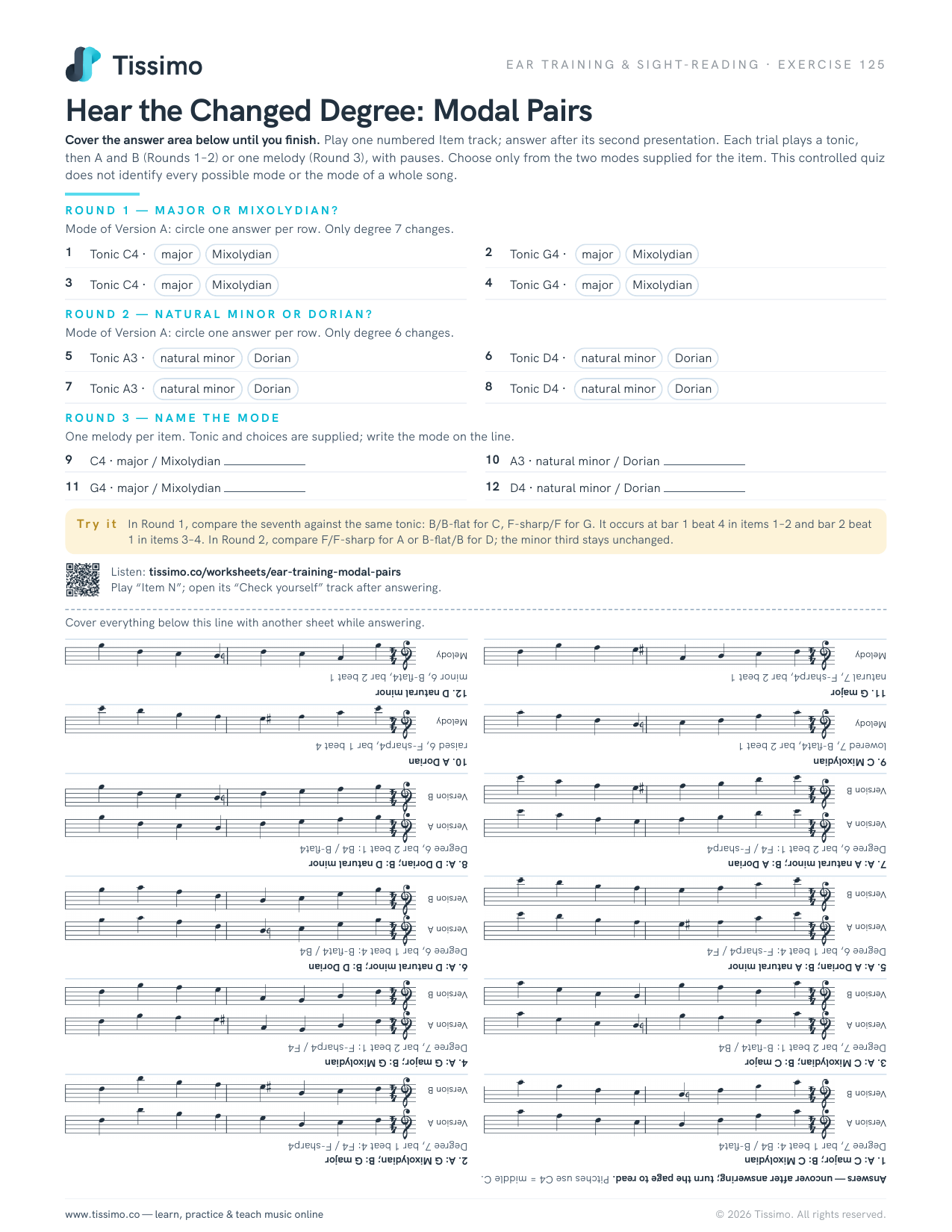 Hear the Changed Degree: Modal PairsCover the answer area below until you finish. Play one numbered Item track; answer after its second presentation. Each trial plays a tonic, then A and B (Rounds 1–2) or one melody (Round 3), with pauses. Choose only from the two modes supplied for the item. This controlled quiz does not identify every possible mode or the mode of a whole song.
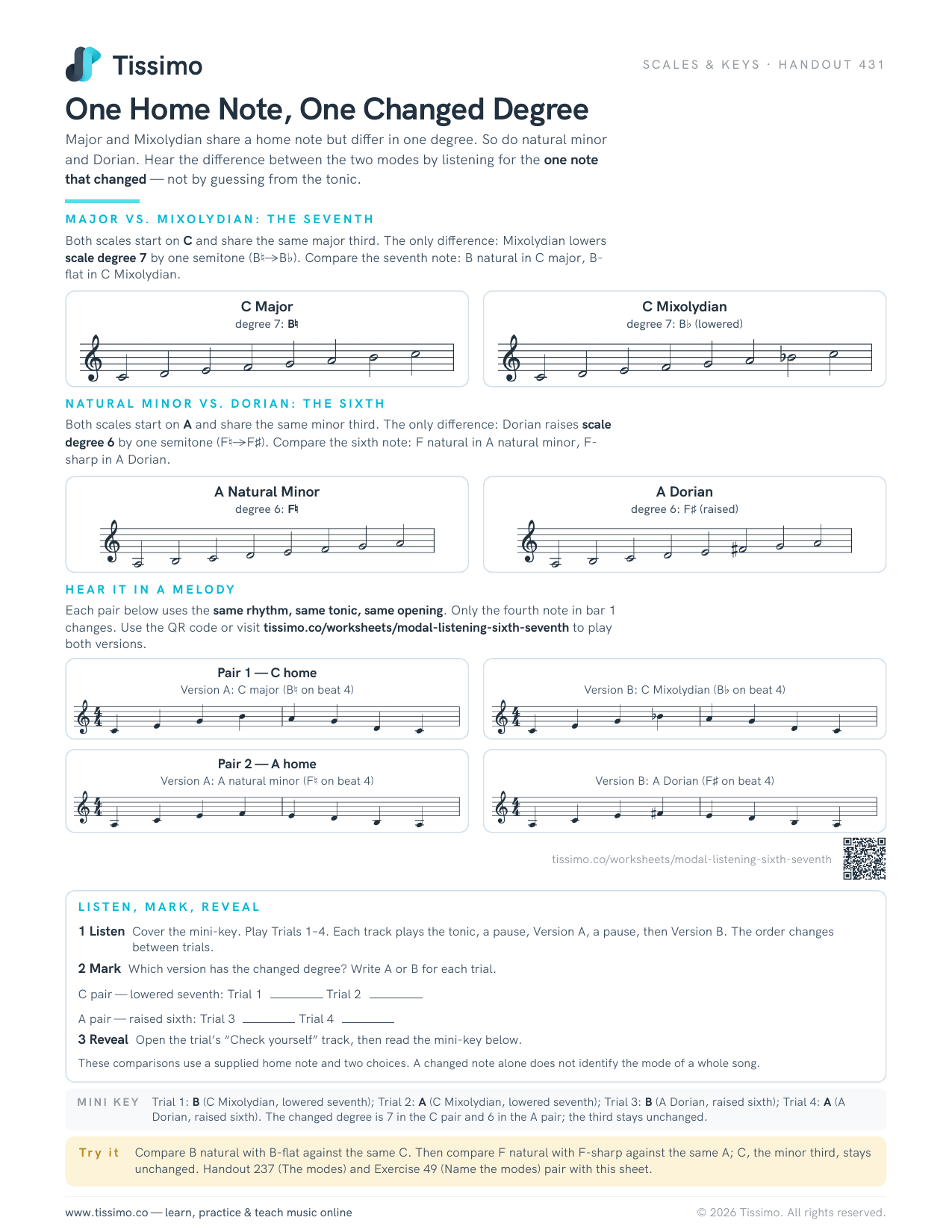 One Home Note, One Changed DegreeMajor and Mixolydian share a home note but differ in one degree. So do natural minor and Dorian. Hear the difference between the two modes by listening for the one note that changed — not by guessing from the tonic.
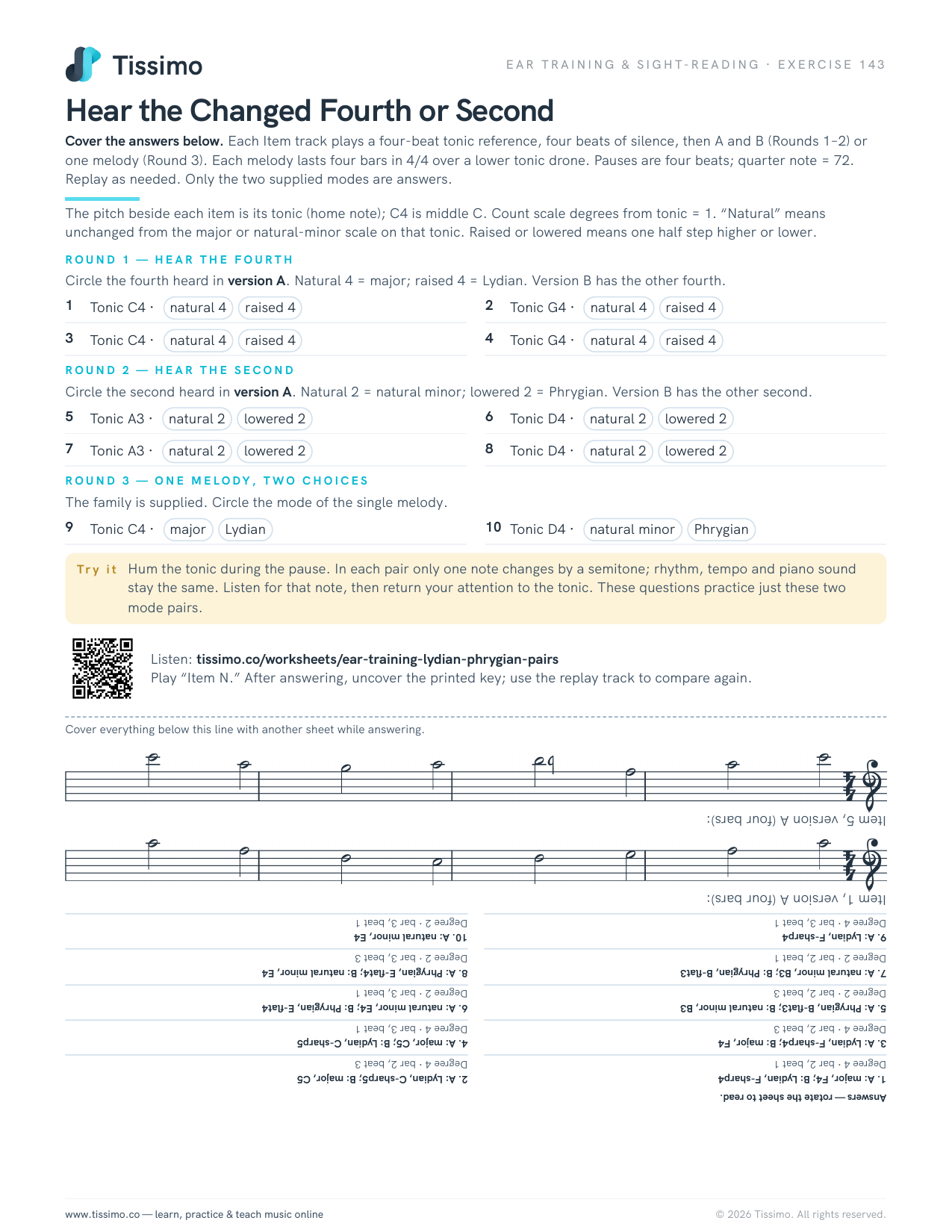 Hear the Changed Fourth or SecondCover the answers below. Each Item track plays a four-beat tonic reference, four beats of silence, then A and B (Rounds 1–2) or one melody (Round 3). Each melody lasts four bars in 4/4 over a lower tonic drone. Pauses are four beats; quarter note = 72. Replay as needed. Only the two supplied modes are answers.