Scales, Keys & Modes
Dorian Mode
Pronounced DOR-ee-un
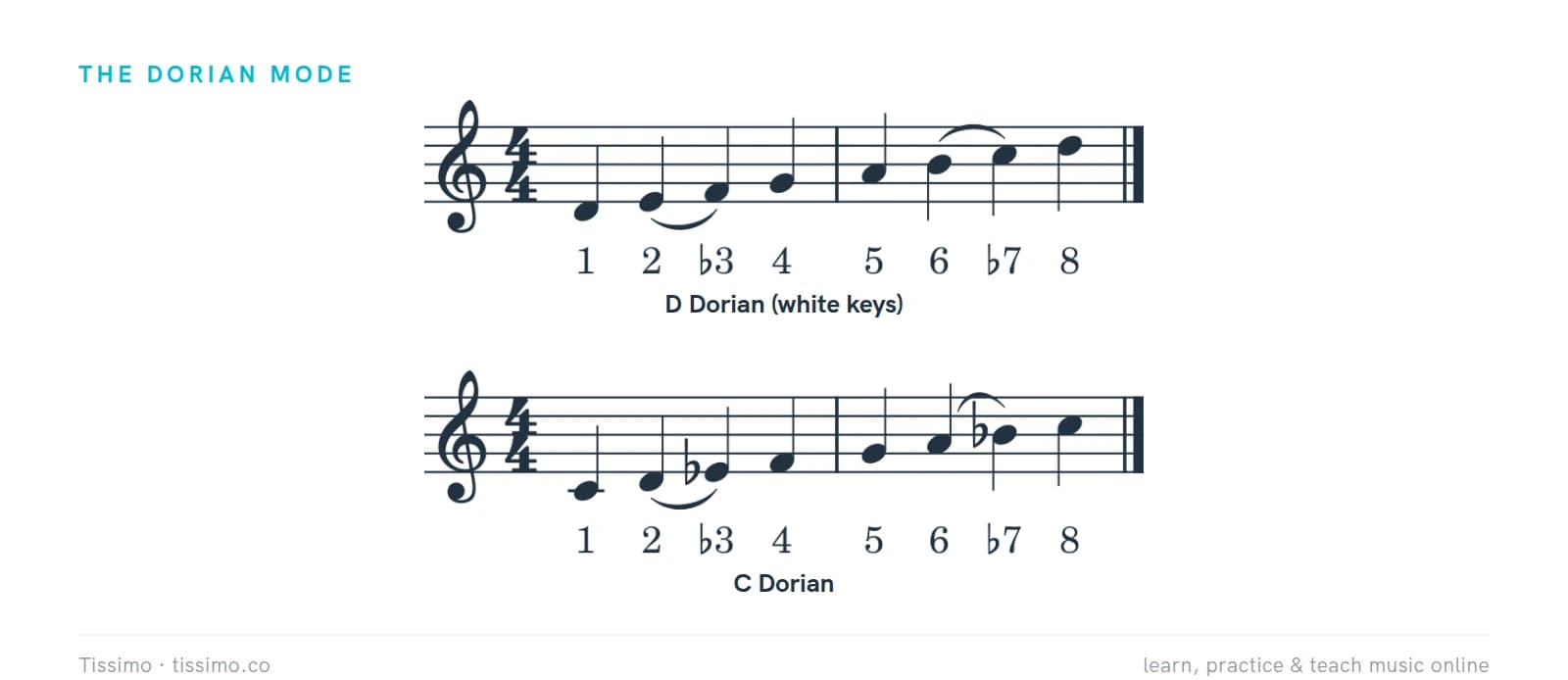
The Dorian mode is a minor-sounding scale with a raised 6th: the white keys from D to D. Its step pattern is whole, half, whole, whole, whole, half, whole.
The Dorian mode is the white keys from D to D: D E F G A B C D. It has a minor 3rd (F), so it sounds minor, but its 6th degree (B) is a half step higher than in the natural minor scale, which has B♭. That one note gives Dorian its color: darker than major, but warmer and less mournful than natural minor.
The step pattern
W – H – W – W – W – H – W
The half steps fall between degrees 2 and 3 (E–F) and between 6 and 7 (B–C). Measured against the major scale, Dorian is 1 2 ♭3 4 5 6 ♭7: natural minor with a raised 6th, or major with a lowered 3rd and 7th.
The Dorian sound in chords
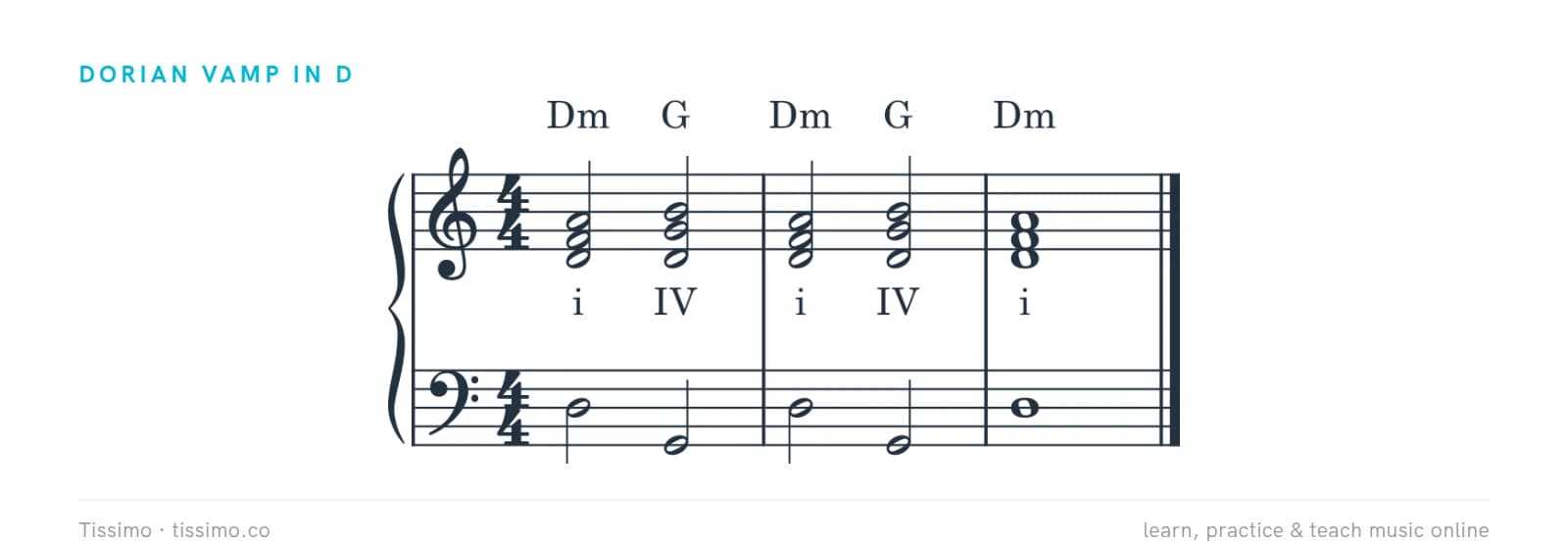
The raised 6th shows up most clearly in the chord on the 4th degree. In D natural minor that chord is G minor (G B♭ D); in D Dorian it is G major (G B D). Moving from the minor tonic chord to a major IV, Dm to G and back, is the signature Dorian sound, heard in many funk, rock and jazz grooves.
Where you hear it
Miles Davis's "So What", from the 1959 album Kind of Blue, is a famous example: its A sections sit on D Dorian, and its bridge moves up a half step to E♭ Dorian. Dorian also turns up in many folk tunes from the British Isles and in rock and pop that wants a minor mood without heaviness. In jazz, Dorian is the standard chord-scale for a minor seventh chord working as ii, such as Dm7 in C major.
Finding Dorian in any key
Dorian starts on the 2nd degree of a major scale. To find any Dorian mode, go down a whole step to its parent major key and use that key's notes: E Dorian uses the notes of D major (two sharps), G Dorian those of F major (one flat), and C Dorian those of B♭ major (two flats), C D E♭ F G A B♭ C.
The other route: take the natural minor scale on the same note and raise its 6th. Use whichever is quicker for the key in front of you. Hear the Changed Degree: Modal Pairs and One Home Note, One Changed Degree train you to hear Dorian and natural minor side by side.
Common questions
What is the difference between Dorian and natural minor?
One note: the 6th degree. Dorian's 6th is a half step higher (B in D Dorian, B♭ in D natural minor), which makes the chord on the 4th degree major instead of minor.
What key signature does D Dorian use?
None. D Dorian uses the notes of C major, so it is usually written with no sharps or flats, even though D is home.
Practice it: free worksheets
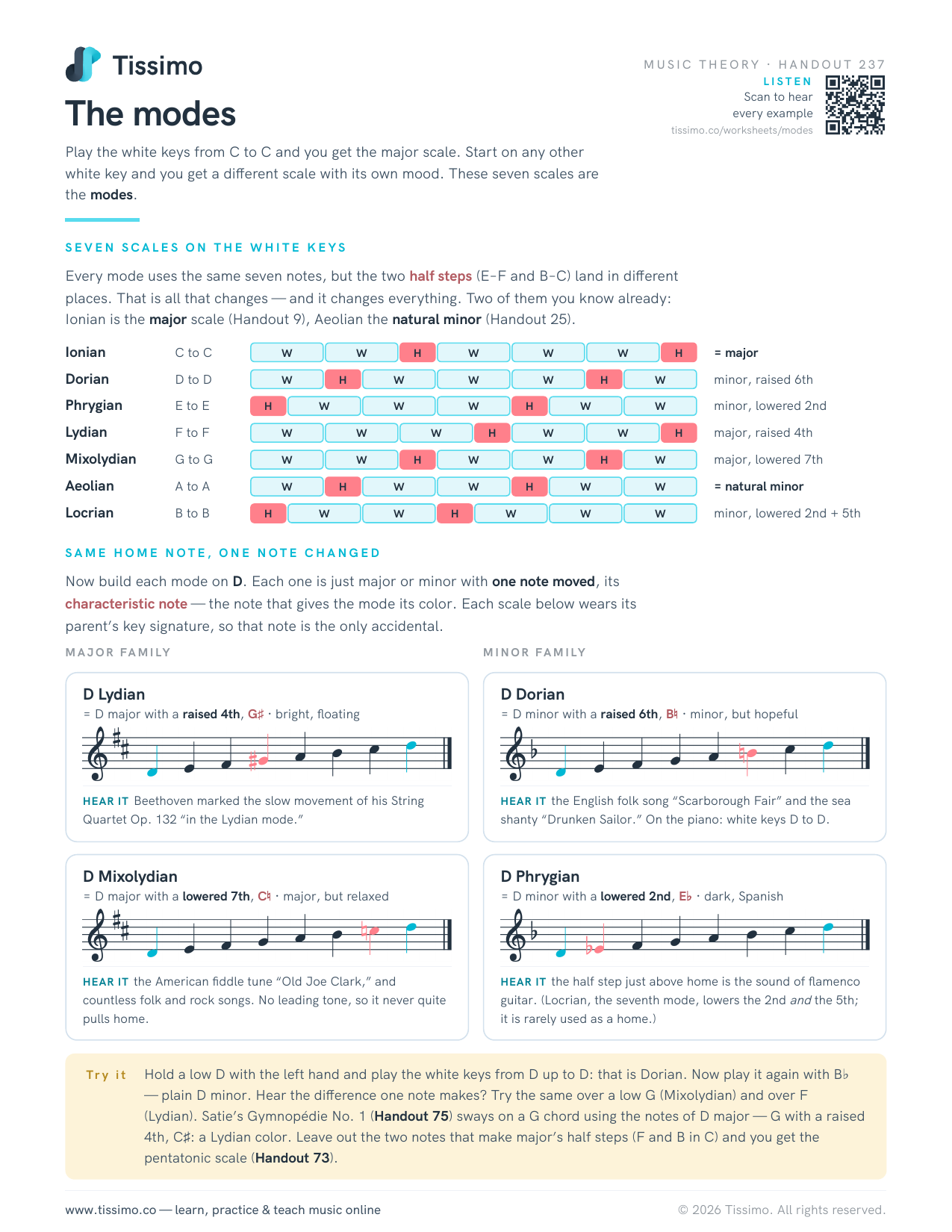 The modesPlay the white keys from C to C and you get the major scale. Start on any other white key and you get a different scale with its own mood. These seven scales are the modes.
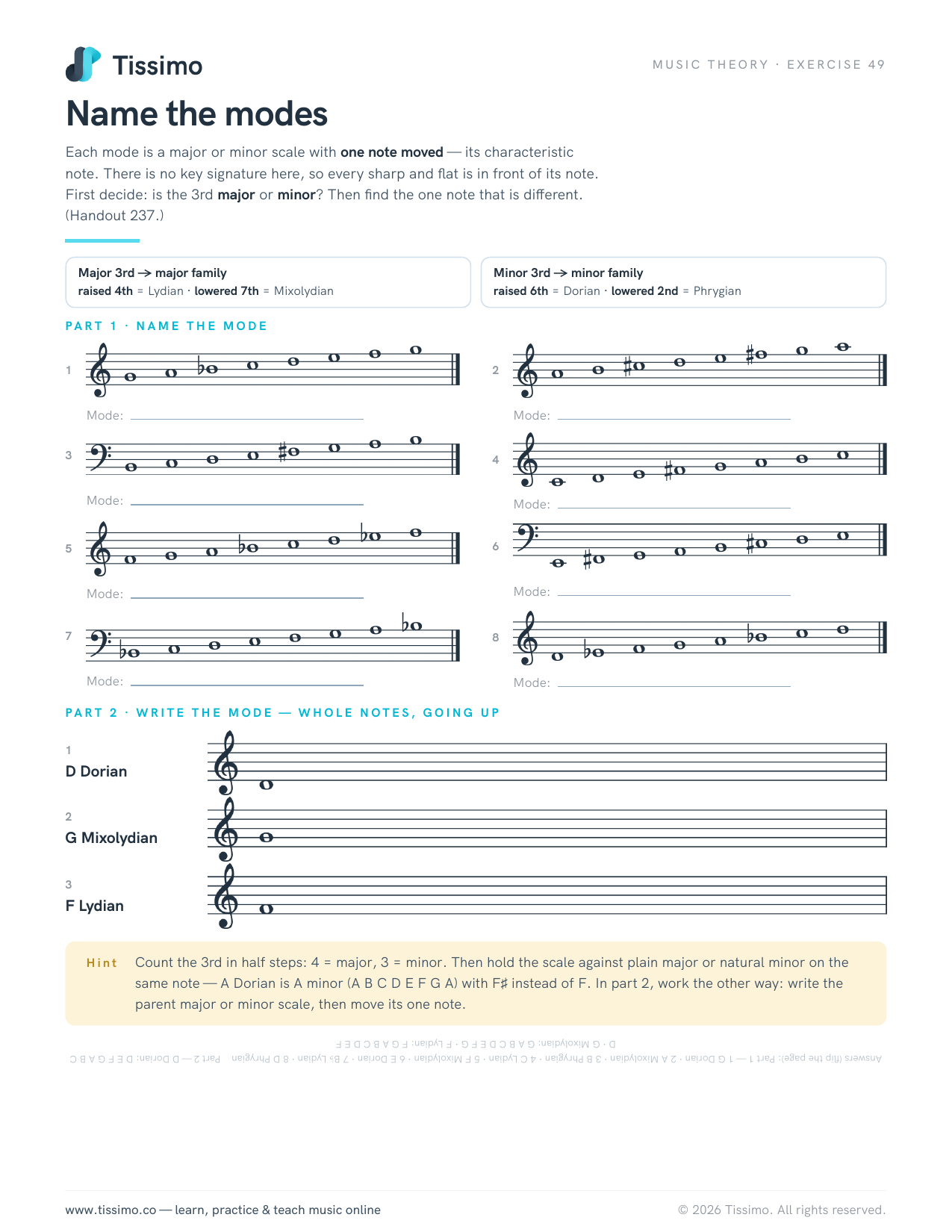 Name the modesEach mode is a major or minor scale with one note moved — its characteristic note. There is no key signature here, so every sharp and flat is in front of its note. First decide: is the 3rd major or minor? Then find the one note that is different. (Handout 237.)
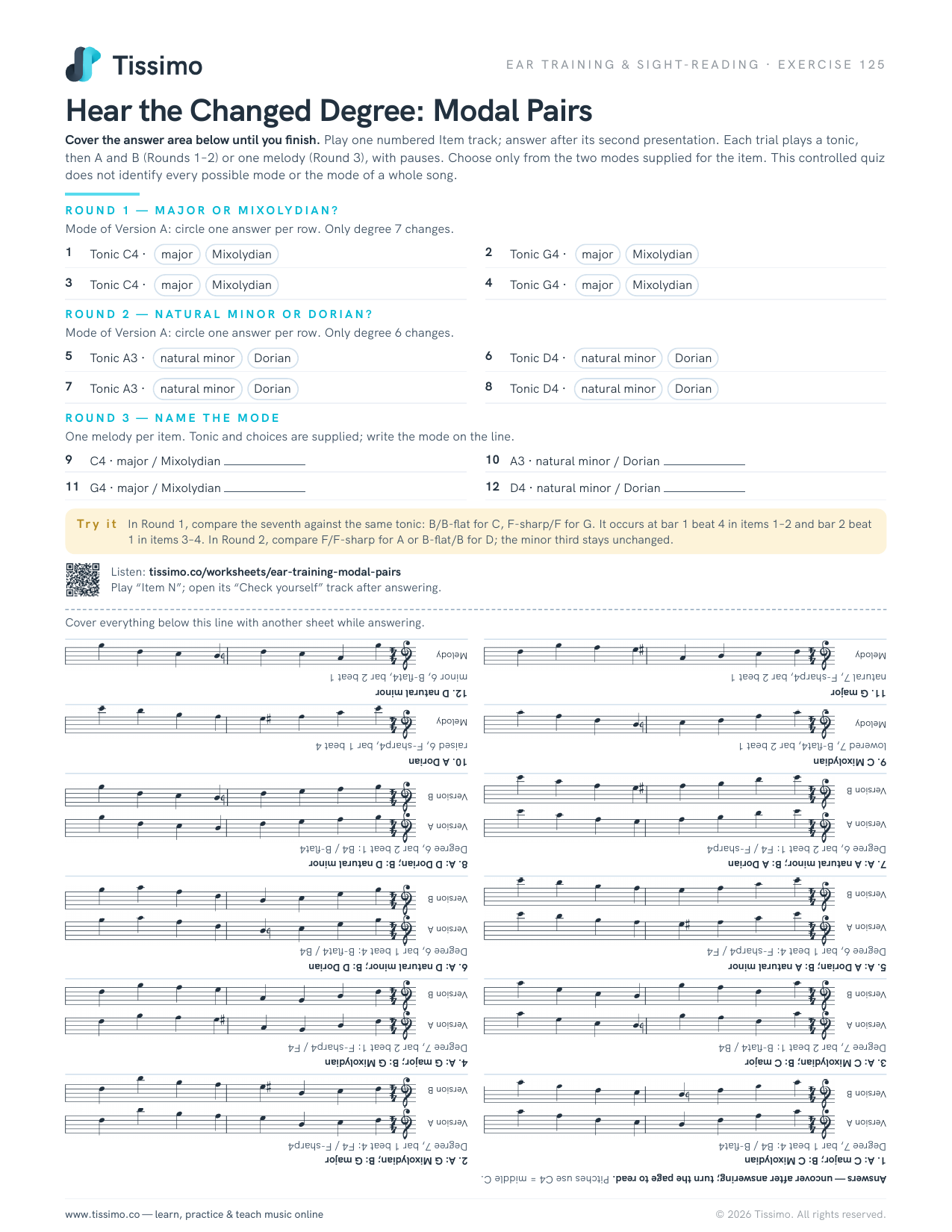 Hear the Changed Degree: Modal PairsCover the answer area below until you finish. Play one numbered Item track; answer after its second presentation. Each trial plays a tonic, then A and B (Rounds 1–2) or one melody (Round 3), with pauses. Choose only from the two modes supplied for the item. This controlled quiz does not identify every possible mode or the mode of a whole song.
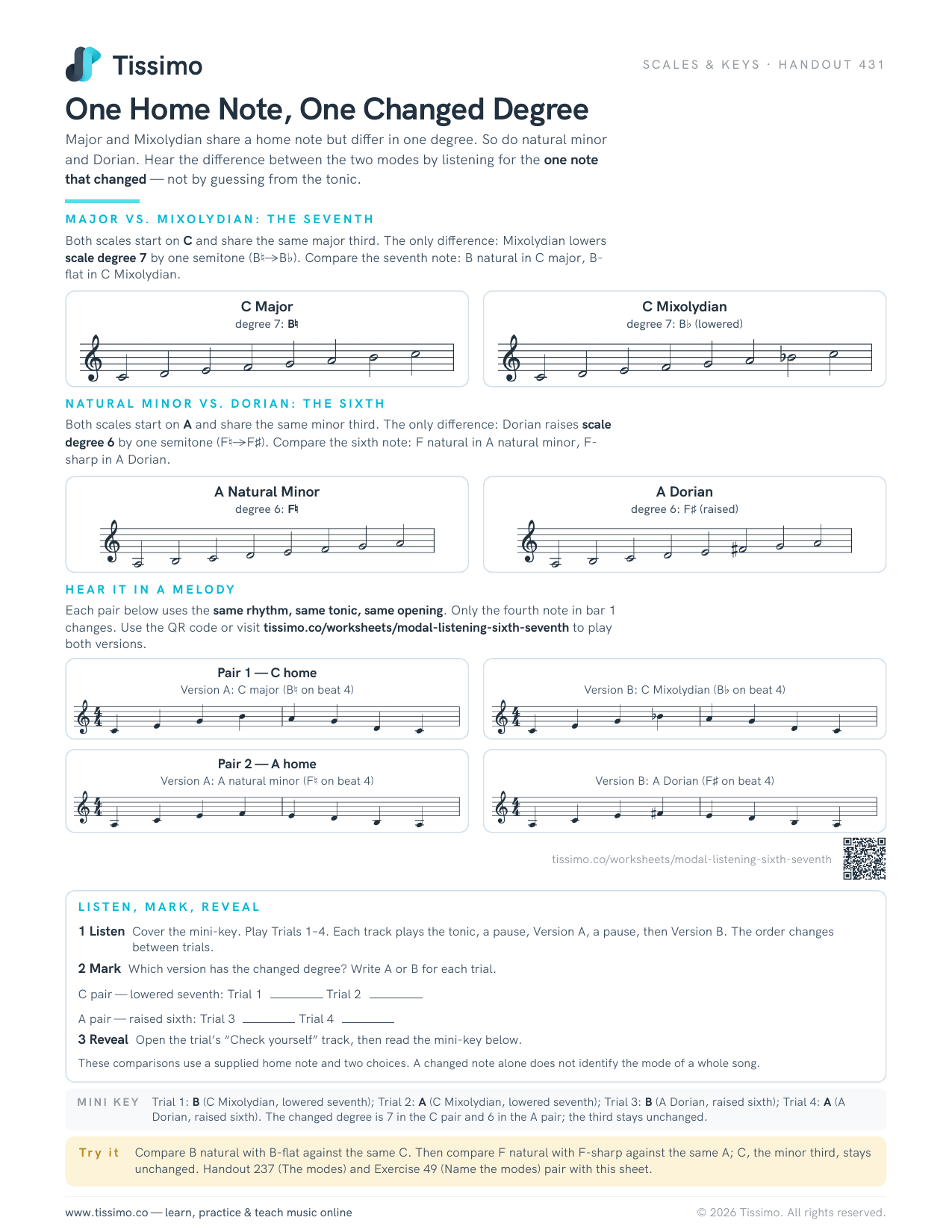 One Home Note, One Changed DegreeMajor and Mixolydian share a home note but differ in one degree. So do natural minor and Dorian. Hear the difference between the two modes by listening for the one note that changed — not by guessing from the tonic.