Scales, Keys & Modes
Locrian Mode
Pronounced LOH-kree-un
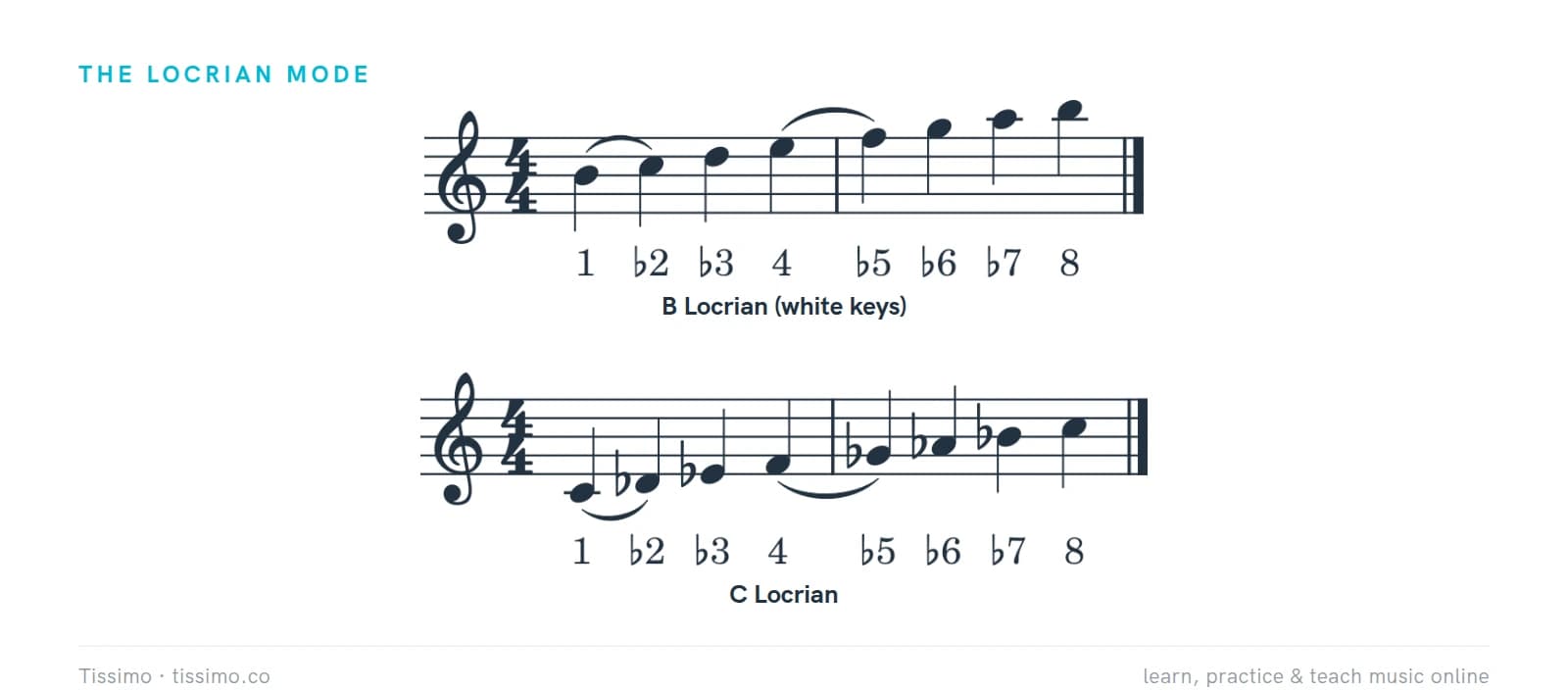
The Locrian mode is the white keys from B to B. With a lowered 2nd and a lowered 5th, its tonic chord is diminished, which makes it the least stable of the seven modes.
The Locrian mode is the white keys from B to B: B C D E F G A B. Compared with the natural minor scale on B, two notes are lower: the 2nd (C instead of C♯) and the 5th (F instead of F♯). Measured against the major scale it is 1 ♭2 ♭3 4 ♭5 ♭6 ♭7, the darkest of the seven modes.
The step pattern
H – W – W – H – W – W – W
Why Locrian is rarely home
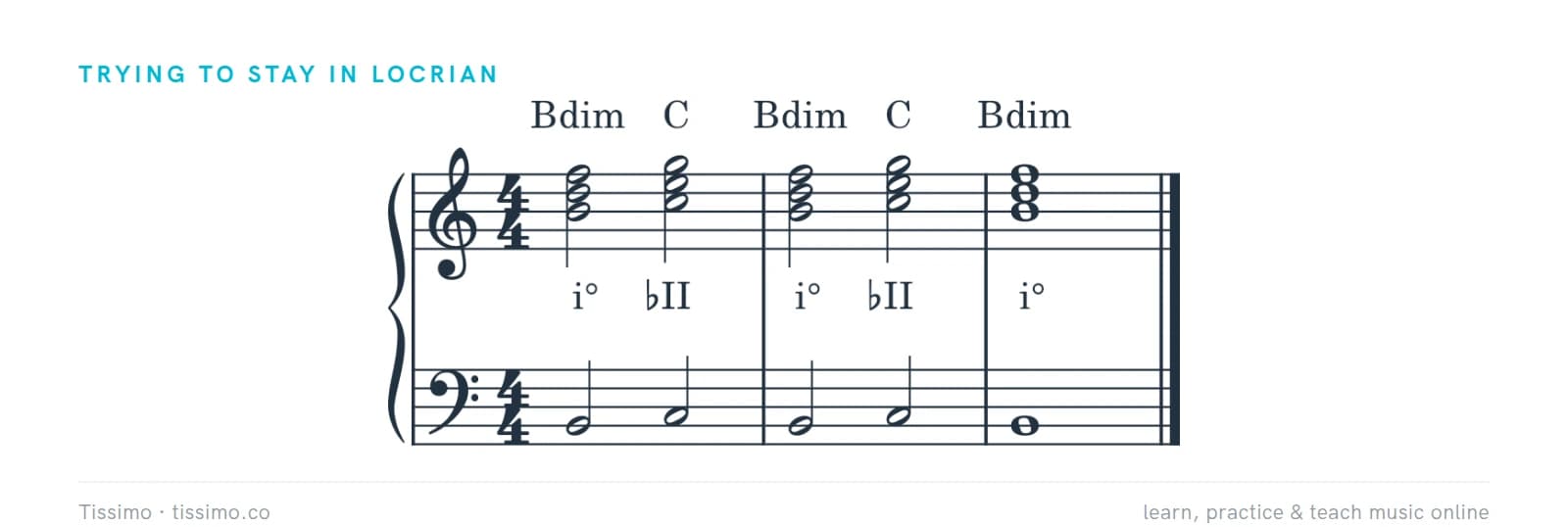
A mode needs a stable tonic chord, and that is exactly what Locrian lacks. Its 5th degree is a tritone above the tonic, not a perfect fifth, so the triad on the tonic is a diminished triad: B D F. A diminished chord sounds tense and unfinished, and it wants to move somewhere else. Add the half step from the tonic up to the ♭2 and there is nothing solid to land on. That is why composers have used Locrian far less than the other modes, and why medieval theory set a mode on B aside as impractical.
Where Locrian is used
- Jazz. Locrian is the standard chord-scale for a half-diminished seventh chord (m7♭5), such as Bø7 (B D F A) working as ii in a minor-key ii–V–i (Bø7, E7, Am). There the chord is not home, so the mode's instability is exactly right. Jazz players also use a variant with a natural 2nd, called Locrian ♮2, the 6th mode of melodic minor.
- Metal. Some heavy metal riffs lean on the ♭2 and ♭5 for an unsettling sound, although many of them move in and out of the mode rather than staying in it.
Finding Locrian in any key
Locrian starts on the 7th degree of a major scale, so its parent key is a half step higher: B Locrian uses the notes of C major, E Locrian those of F major (E F G A B♭ C D E), and C Locrian those of D♭ major, five flats: C D♭ E♭ F G♭ A♭ B♭ C.
Common questions
Why is the Locrian mode rarely used?
Its tonic chord is diminished (B D F in B Locrian), because the 5th above the tonic is a tritone instead of a perfect fifth. Without a stable home chord, it is hard to make music feel settled in Locrian.
What chord goes with the Locrian mode?
A half-diminished seventh chord (m7♭5). B Locrian contains B D F A, the notes of Bø7, which is why jazz players use Locrian over m7♭5 chords.
Practice it: free worksheets
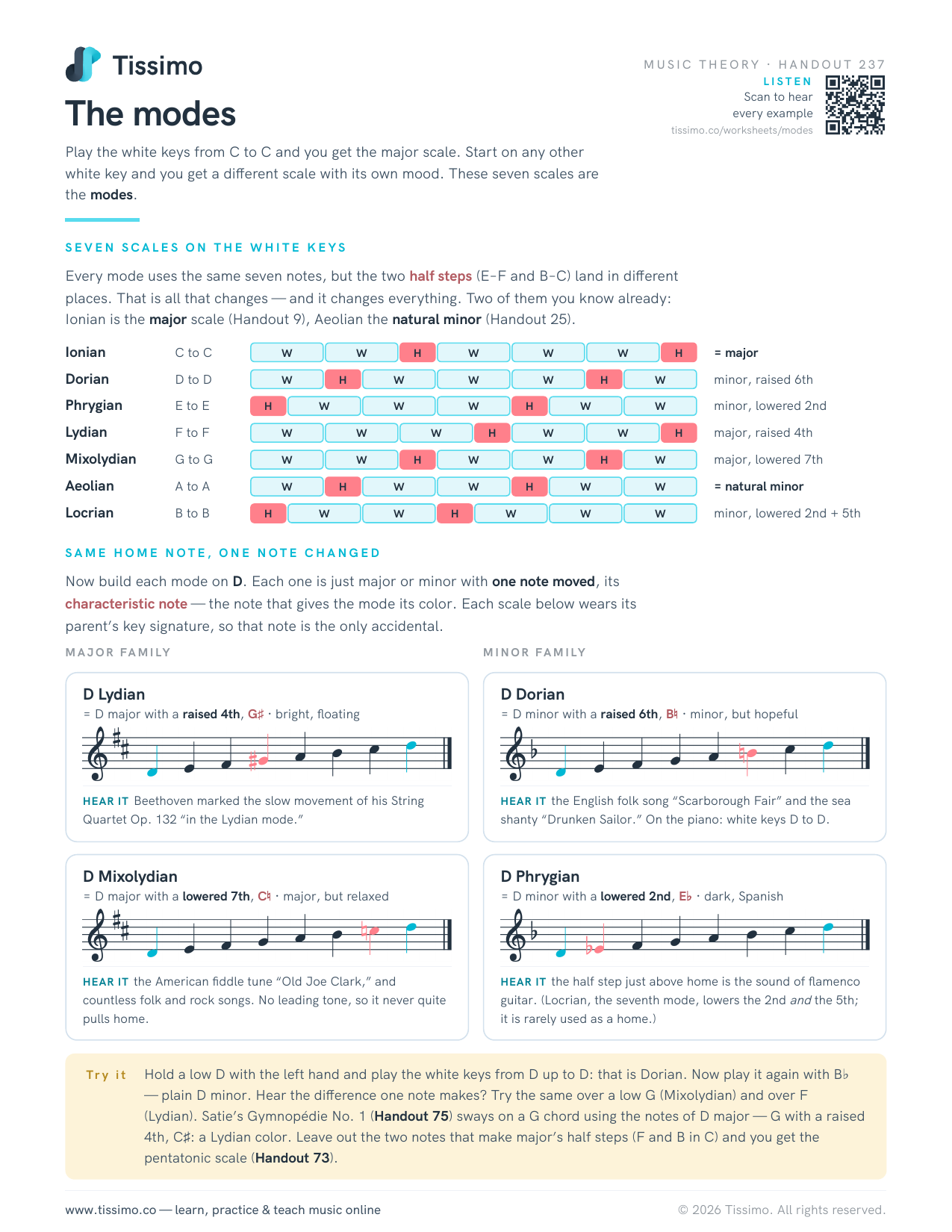 The modesPlay the white keys from C to C and you get the major scale. Start on any other white key and you get a different scale with its own mood. These seven scales are the modes.
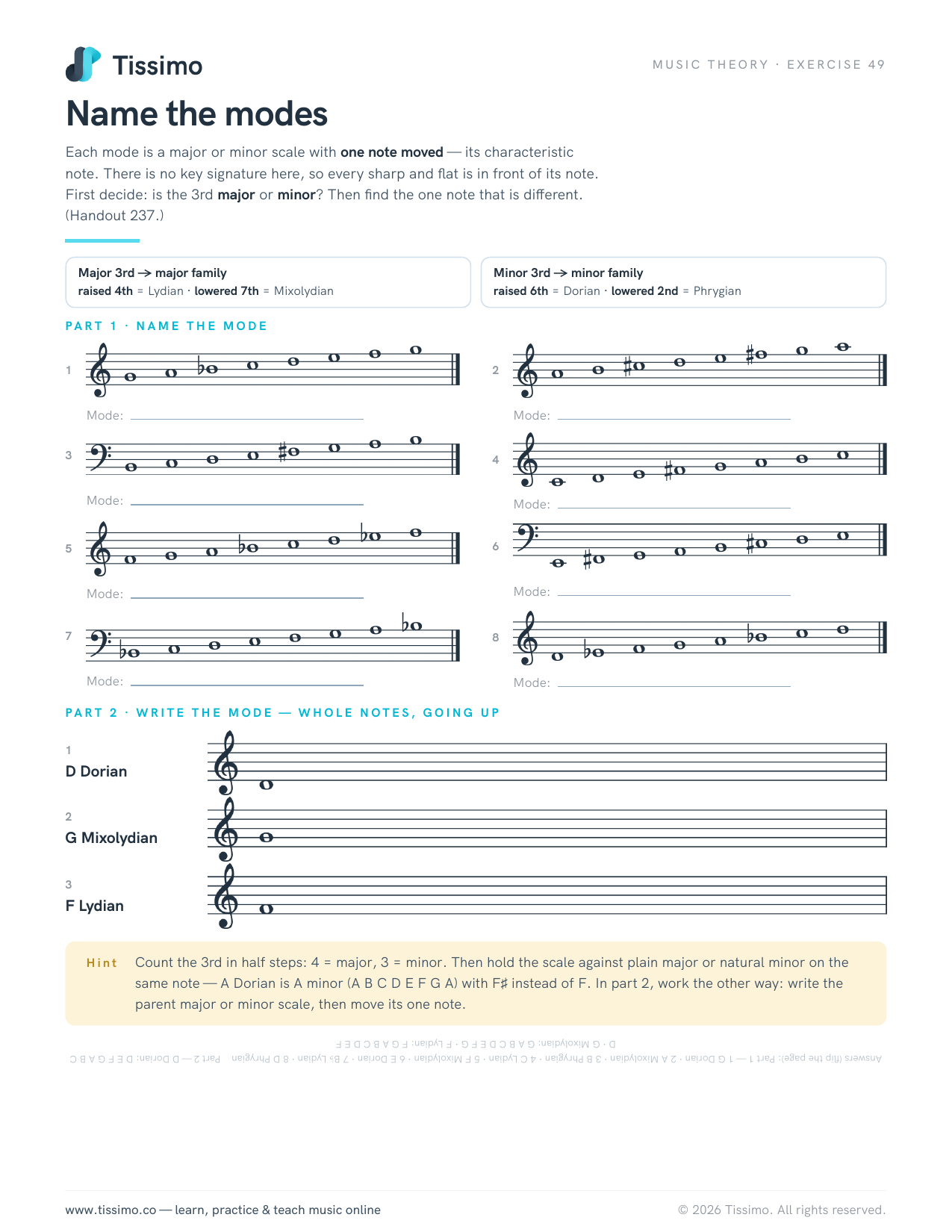 Name the modesEach mode is a major or minor scale with one note moved — its characteristic note. There is no key signature here, so every sharp and flat is in front of its note. First decide: is the 3rd major or minor? Then find the one note that is different. (Handout 237.)
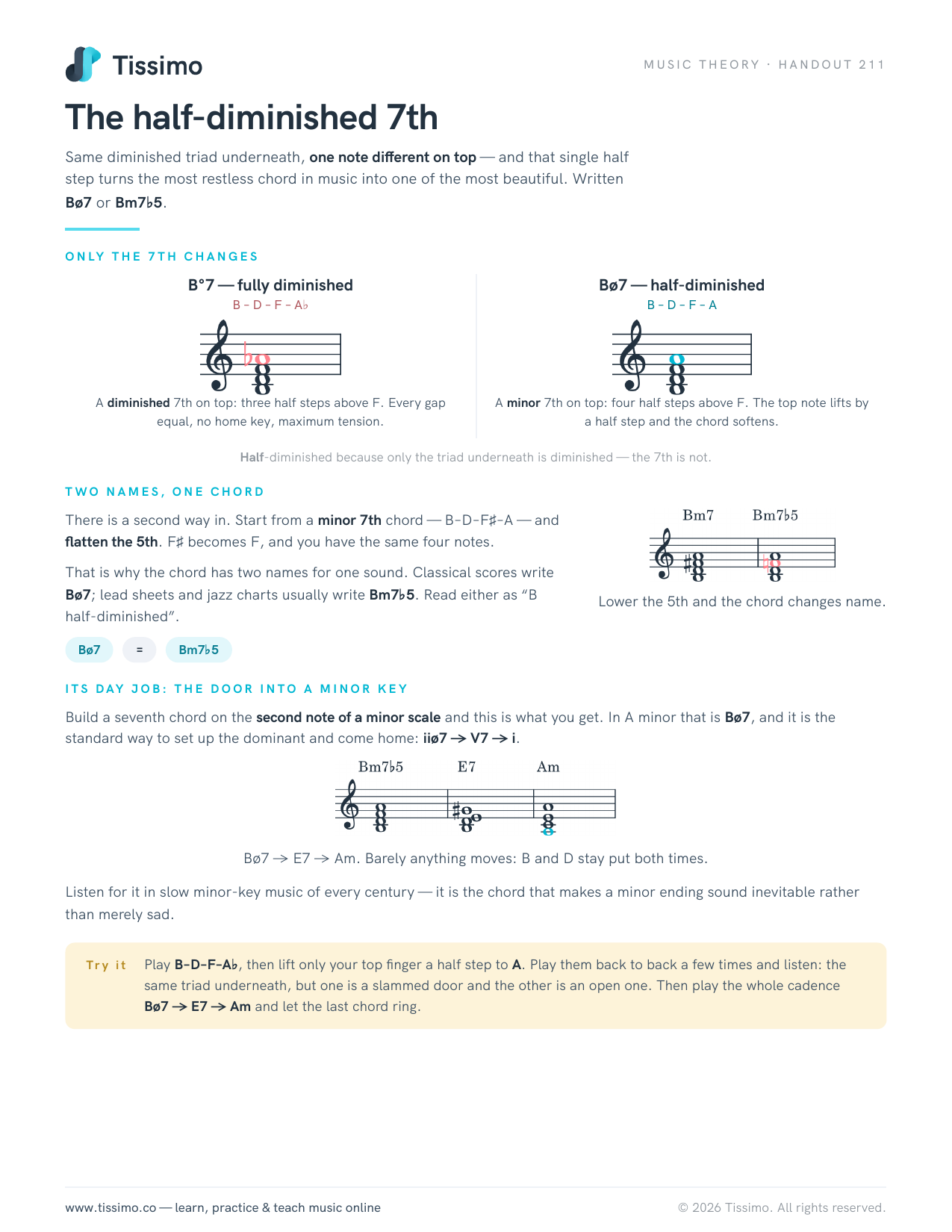 The half-diminished 7thSame diminished triad underneath, one note different on top — and that single half step turns the most restless chord in music into one of the most beautiful. Written Bø7 or Bm7♭5.