Scales, Keys & Modes
Whole-Tone Scale
The whole-tone scale is a six-note scale made entirely of whole steps, such as C D E F♯ G♯ A♯. With no half steps and no perfect fifths, it has a floating, dreamlike sound.
The whole-tone scale is built from one step size only: the whole step. Six whole steps take you from the starting note to the same note an octave higher, so the scale has six different notes. From C it runs C D E F♯ G♯ A♯, and then C again.
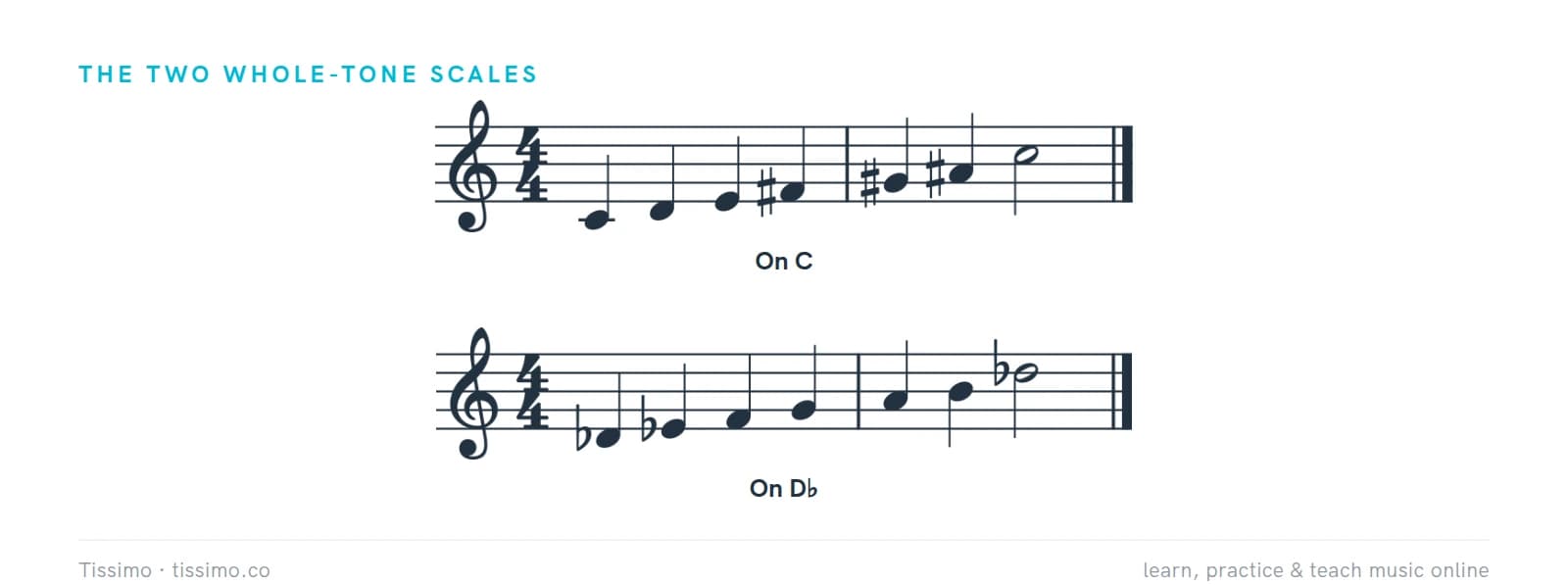
Only two whole-tone scales
Because every step is the same, the scale repeats itself after a single whole step: the whole-tone scale on D has exactly the same notes as the one on C, just starting in a different place. As a result there are only two different whole-tone scales in the whole chromatic scale:
- C D E F♯ G♯ A♯ (the same notes start on D, E, F♯, G♯ or A♯)
- D♭ E♭ F G A B (the same notes start on E♭, F, G, A or B)
Between them, the two collections use each of the twelve notes exactly once.
Why it sounds the way it does
The whole-tone scale has no half steps, so there is no leading tone pulling toward a home note, and it has no perfect fifths, the interval that anchors major and minor chords. Every note relates to its neighbors in exactly the same way, so none of them stands out as the tonic. The chords it does contain are augmented triads (C E G♯, D F♯ A♯) and dominant seventh chords with a raised or lowered 5th. The result is a hazy, suspended sound that seems to float without arriving anywhere.
Where you hear it
Claude Debussy used the whole-tone scale often, most famously in his piano prelude Voiles, which is built almost entirely on it, and Olivier Messiaen counted it as the first of his "modes of limited transposition". Film and television composers often reach for it for dream sequences, magic and moments of confusion. Jazz musicians use it over dominant seventh chords with an altered 5th (C7♯5 or C7♭5), since every note of those chords belongs to the scale.
Spelling it
Six notes and seven letter names means one letter is skipped. There is no single correct spelling: C D E F♯ G♯ A♯ and C D E F♯ G♯ B♭ are both common, and composers choose whichever reads more easily in context. Swapping A♯ for B♭ is an enharmonic equivalent change and does not alter the sound.
Try it
Play C D E F♯ G♯ A♯ C with the pedal down, then play the scale again starting on D. You will hear the same color, not a new key. Repeat the Steps, Find the Loop builds the scale from its step pattern and shows why there are only two, and Does the New Note Belong? tests you on them.
Common questions
How many whole-tone scales are there?
Two. The scale repeats its own notes after one whole step, so every whole-tone scale is a rotation of either C D E F♯ G♯ A♯ or D♭ E♭ F G A B.
Why does the whole-tone scale sound dreamy?
It has no half steps and no perfect fifths, so no note pulls toward a home note and no chord sounds like a resting point. The music seems to float instead of arriving.
Practice it: free worksheets
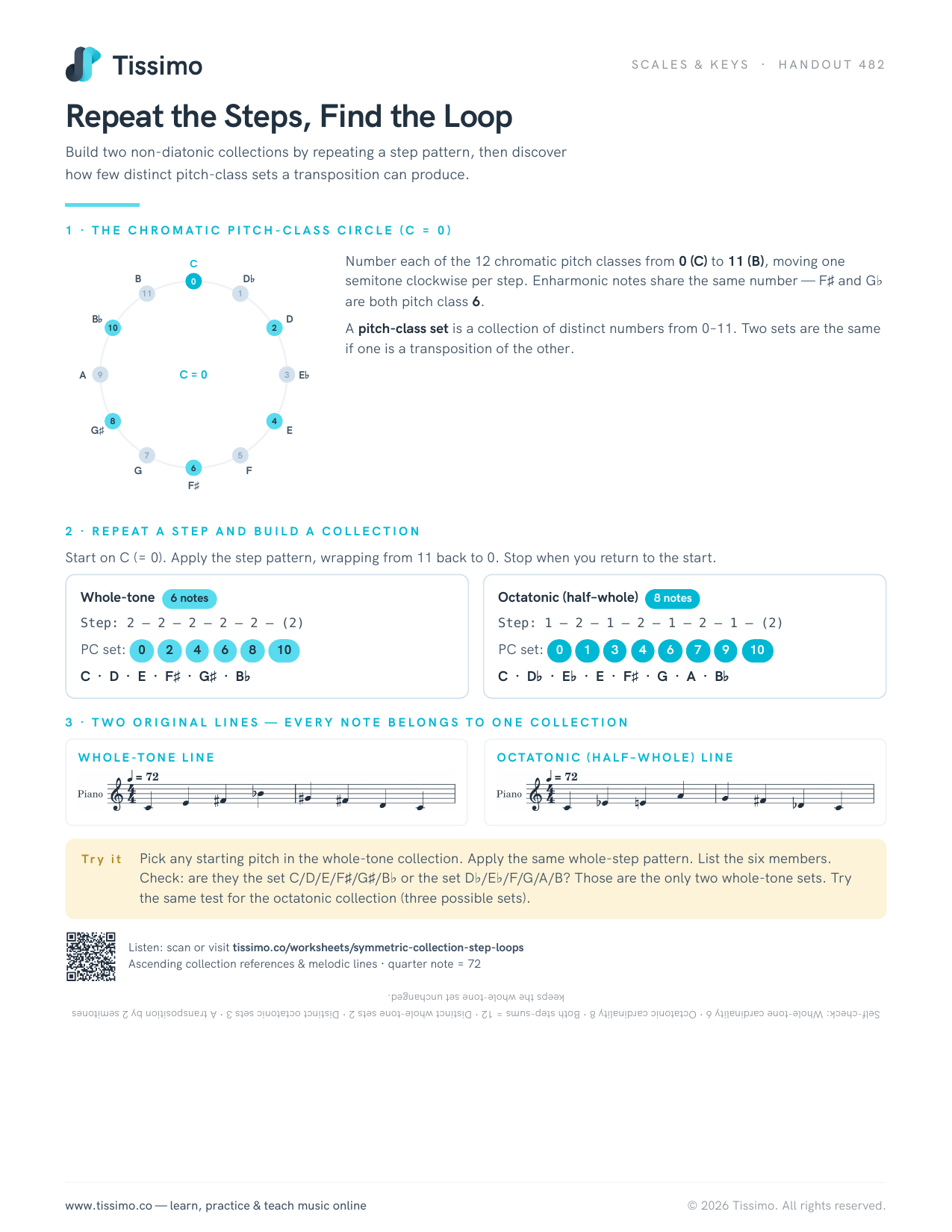 Repeat the Steps, Find the LoopBuild two non-diatonic collections by repeating a step pattern, then discover how few distinct pitch-class sets a transposition can produce.
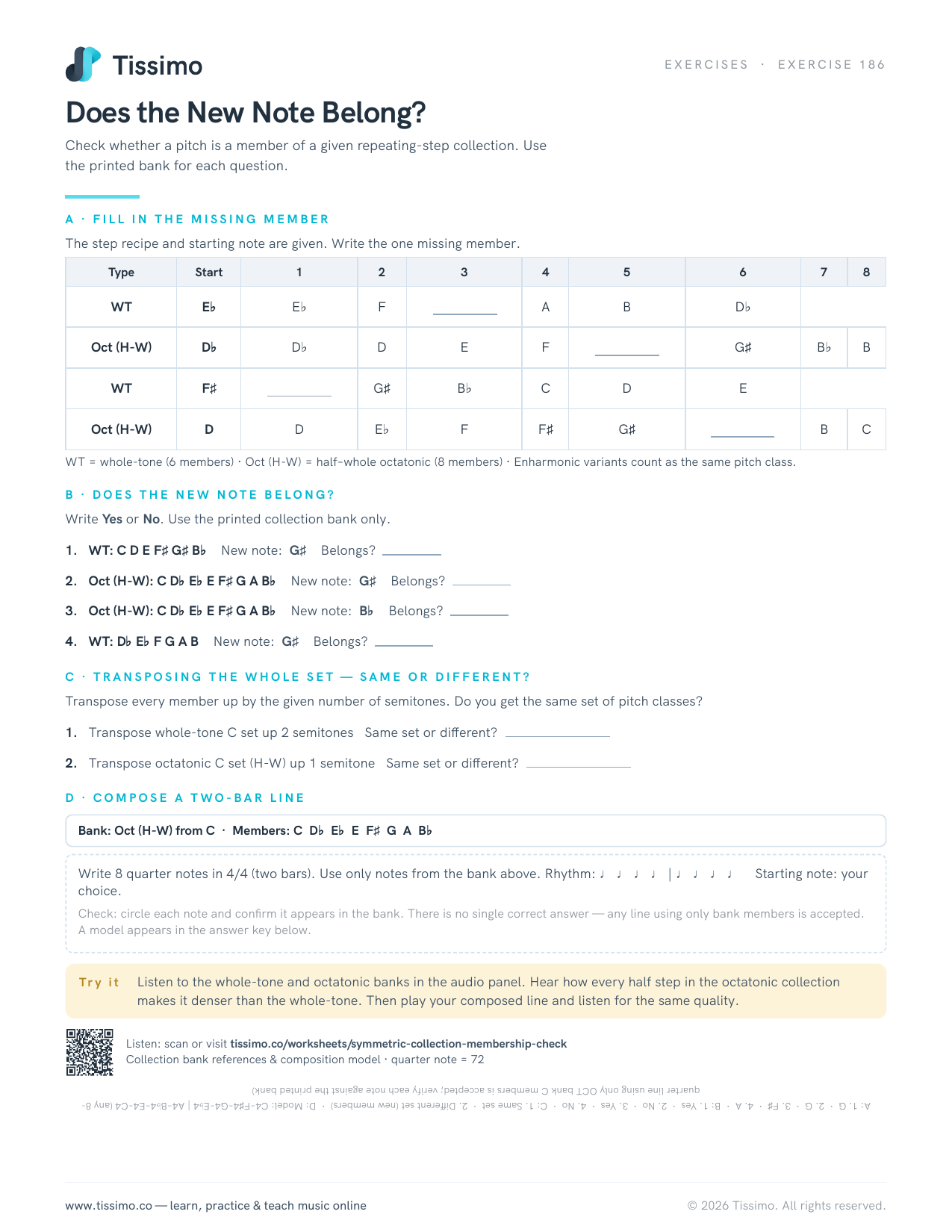 Does the New Note Belong?Check whether a pitch is a member of a given repeating-step collection. Use the printed bank for each question.