Tempo Markings
Prestissimo
Pronounced press-TEE-see-moh
Prestissimo is the fastest common tempo marking: as fast as possible while staying clear. It is the superlative of presto, usually placed above about 200 beats per minute.
Prestissimo is the superlative of presto, made with the Italian ending -issimo ("very", "most"). It asks for the fastest tempo the music can bear, usually placed above about 200 beats per minute on the charts that list it. The same ending turns piano into pianissimo and forte into fortissimo.
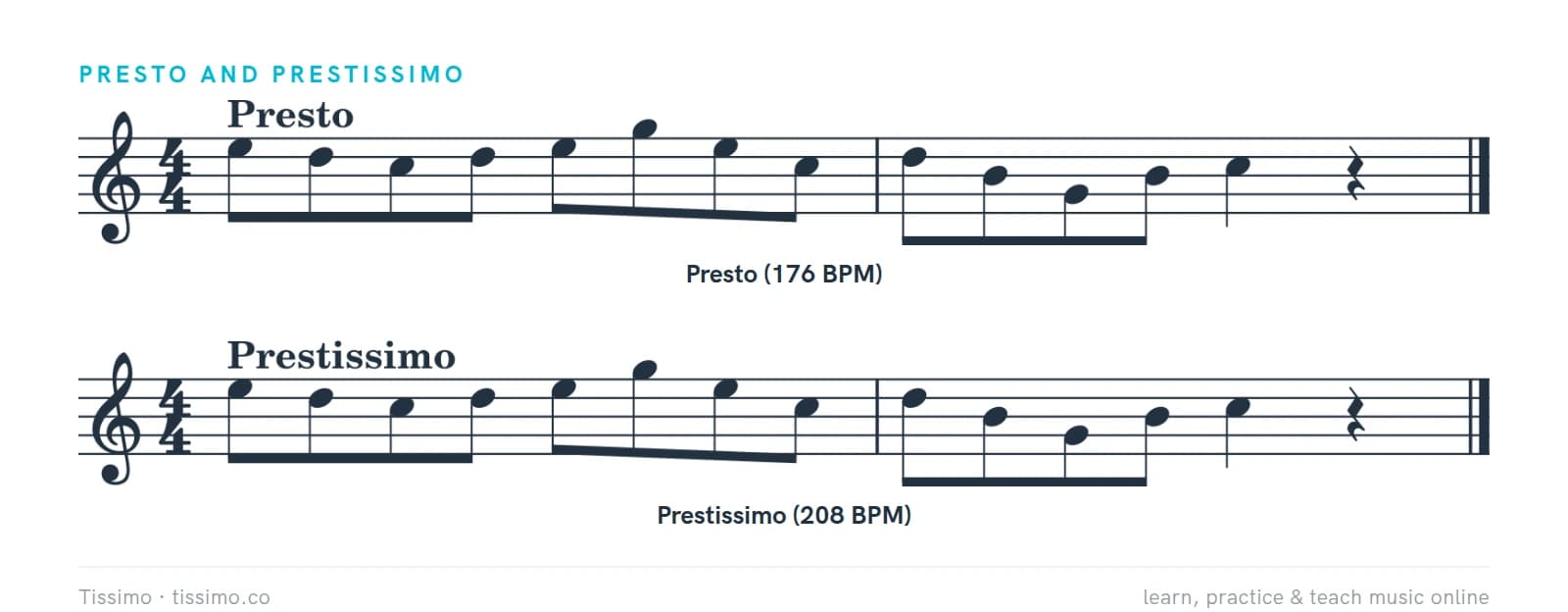
Fast, but still music
The limit of prestissimo is not how fast your fingers can move but how fast the listener can still hear the music. If the notes blur into a smear, or the phrasing disappears, the tempo has passed prestissimo and become simply too fast. That is why two fine performances of the same prestissimo can differ noticeably in speed: each player finds the fastest tempo at which their articulation stays clear.
Prestissimo in real music
The word is rarer than presto. One well-known example is the short second movement of Beethoven's Piano Sonata in E major, Op. 109, marked Prestissimo.
Practicing a prestissimo
Build it exactly like a presto, slowly and in stages, and then add one more habit: practice relaxation at speed. Play a short group of notes as fast as you can, stop, let the arm and hand go completely loose, and then play the next group. Speed that comes from tension does not last; speed that comes from small, relaxed movements does.
Prestissimo lies beyond the top of the speedometer in Tempo & the Metronome, which ends with Presto at 208, the top of a traditional metronome.
Common questions
What is the fastest tempo marking?
Prestissimo is the fastest of the common Italian tempo words. Composers sometimes add more, such as "as fast as possible", but prestissimo already means that.